Category: BigNewsNetwork

  • A Day in the Life of a South London Builder (Repairs, Reality, and Getting It Done Properly)

    When people think of builders, they usually imagine big projects, loft conversions, extensions, and scaffolding covering entire houses. The reality for many of us working across Brockley, Lewisham, and South London is very different.

    Most of the work isn’t big builds. It’s repairs. It’s maintenance. It’s fixing problems that disrupt people’s day-to-day lives and, often, problems that have already been patched up badly before.

    A typical day starts early. Not just because of the work, but because getting around South London takes planning. Parking, traffic, loading tools, if you’re not organized from the start, the whole day can slip.

    The first job is often something caused by a water leak. That’s one of the most common issues I deal with. A client might call thinking it’s just cosmetic, like a stained ceiling, bubbling paint, or a cracked wall. But once you start opening it up, you quickly see the real damage.

    Water doesn’t just sit on the surface. It soaks in, weakens plaster, and can even affect the structure behind it. So the job becomes more than just “making it look nice again.” It’s about properly removing all the damaged material, letting the area dry, sealing it, and rebuilding it layer by layer so the problem doesn’t come back.

    That’s the difference between a quick fix and a proper repair.

    Mid-morning might be a completely different type of job, often door maintenance, especially fire doors. These are something a lot of people overlook, but they’re critical for safety, particularly in flats and shared buildings.

    A fire door isn’t just a normal door. It has to close properly, seal correctly, and meet specific standards. Sometimes it’s as simple as adjusting hinges or replacing a closer. Other times, the door has been altered or fitted incorrectly and needs more involved work to get it back to standard.

    It’s detailed work, and it has to be done right. There’s no cutting corners with something like that.

    Working alone most of the time means every part of the job is on you, from diagnosing the issue to completing the repair and making sure everything is left clean and tidy. But it also means you take full responsibility for the quality of the work.

    If a job requires something more specialized, electrics, gas, or structural work, I’ve built up a network of trusted trades over the years. People I know will do things properly. That way, the client still gets a complete solution without anything being rushed or guessed.

    By early afternoon, it’s usually about finishing jobs off properly. That means more than just getting the repair done. It’s about the details, smooth finishes, and clean lines, making sure everything blends back in so it looks like the problem was never there in the first place.

    A lot of people don’t realize how important that last part is. You can fix something structurally, but if it looks rushed or messy, it doesn’t feel finished.

    Another big part of the job is working inside people’s homes. You’re not on a building site, you’re in someone’s personal space. That means being respectful, keeping things clean, and understanding that even small jobs can feel like a big disruption to the person living there.

    Communication matters as much as the work itself. Explaining what’s gone wrong, what needs to be done, and why it’s being done that way. Especially with things like water damage, where the proper fix takes longer than people might expect.

    Towards the end of the day, it’s about packing up, planning ahead, and staying organized. Making sure materials are ready for the next job, thinking through any potential issues, and keeping everything running smoothly.

    Being a builder in this line of work isn’t about big, one-off transformations. It’s about consistency. Turning up when you say you will, doing the job properly, and fixing problems so they don’t come back.

    There’s a lot of pride in that.

    Most of the time, no one notices the work once it’s done, and that’s exactly how it should be. A wall looks normal again. A door works properly. A problem disappears.

    But behind that is experience, attention to detail, and doing things the right way rather than the quickest way.

    In areas like Brockley and Lewisham, reputation matters. People talk. Good work leads to more work. And cutting corners always catches up with you eventually.

    If there’s one thing I’ve learned, it’s this: in repairs and maintenance, doing it properly the first time is what really counts.

    If you’re dealing with water damage, door issues, or general property repairs in South London, you can find more about what I do at www.brockleybuilders.com.


  • LINK Price: Analyst Warns Recovery Could Take Months as Pepeto Becomes a Safe Harbor With Forecast thumbnail

    LINK Price: Analyst Warns Recovery Could Take Months as Pepeto Becomes a Safe Harbor With Forecast

    BlackRock’s staked Ethereum ETF pulled $155 million on its first day of trading, proving that institutional appetite for yield bearing crypto products is accelerating even while the broader market corrects. An analyst says the LINK price recovery could take months as the token sits below every major moving average, and the forecast for most large caps signals technical weakness. But while charts debate whether the LINK price can reclaim $10, Pepeto already has working exchange tools, above $8.8M raised, and a confirmed Binance listing on the horizon.

    BlackRock’s Staked Ethereum ETF Pulls $155M on Day One

    BlackRock’s staked Ethereum ETF attracted $155 million in inflows on its launch day, the strongest debut for a crypto yield product this year, according to  . The demand confirms that institutional capital is seeking on chain yield even during fear driven markets, as  reported. For traders watching the LINK price and deciding where capital goes next, this influx proves that institutions are building positions while retail hesitates, and the tokens with the cheapest entry and confirmed exchange exposure will benefit when the rotation accelerates.

    LINK Price, ADA Forecast, and the Presale Outperforming Both

    Pepeto: The Intelligence Layer That Keeps You on the Winning Side

    PepetoAI eliminates the guesswork that costs traders money every day by turning raw on chain data into a single risk grade you can act on instantly. The tool scores risk on every open position in real time, turning scattered data into a straight answer you can act on before the chart moves.

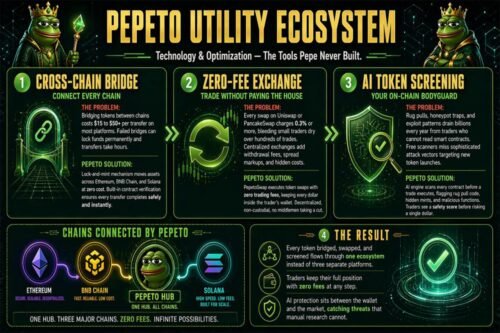
    The cross chain bridge moves your capital between networks in seconds, and the zero fee swap engine handles every trade without the hidden costs that drain portfolios over time. These tools are live and accessible for presale holders right now.

    The Pepeto presale is open. A $15K entry earns 185% APY from the staking rewards, compounding your position every day until the exchange candle prints. The visionary who grew the original Pepe token from nothing to an $11 billion market cap with 420 trillion supply and no working product cofounds Pepeto, with a former Binance team member on the build and SolidProof confirming clean code. With above $8.8M raised and the $0.000000186 entry still available, the Binance listing is the event that permanently closes this window.

    LINK Price Analysis

    The LINK price sits near $8.70, down 84% from its $53 all time high, with JPMorgan and UBS running live blockchain settlement pilots on Chainlink infrastructure. CCIP processes $18 billion in monthly cross chain volume, and the Bitwise LINK ETF launched on NYSE Arca, opening LINK to retirement accounts. The LINK price fundamentals are the strongest they have ever been, but the token trades below every major moving average, and breaking $10 resistance is the barrier that defines the rest of 2026.

    Cardano Price Outlook

    ADA trades near $0.257, down 92% from its $3.10 all time high. Development activity has accelerated and the ADA forecast from most analysts points toward $0.45 to $1.00 over the cycle. ADA is a disciplined hold, but that recovery from $0.257 takes the full bull run to deliver while presale entries with confirmed listings compress multiples into a single event.

    Bottom Line

    BlackRock pulling $155 million into a staked Ethereum ETF on day one proves institutions are building yield positions during the fear, and the capital rotating through those products will chase the tokens with the widest entry gap when the recovery arrives. The LINK price targets $10 and ADA targets $0.45, but both need months to deliver what a Binance listing compresses into one candle. Above $8.8M has already flowed through the Pepeto official website because the presale fills while the reader reads, and the wallets that entered early are positioned for the biggest return of the cycle while everyone who waits pays full price for what presale pricing gave away. LINK launched at $0.20 and ran to $52, turning $5,000 into $1.3 million for the earliest holders, and the reader’s presale entry buys that same kind of positioning before the listing replaces it. The window closes when the Binance order book opens, and everything after that costs more.

    Click To Visit Pepeto Website To Enter The Presale

    FAQ

    What is the LINK price forecast for 2026?

    LINK needs to break $10 resistance to confirm recovery, with targets at $14 and $25 if buying strengthens, but Pepeto at presale pricing with a confirmed Binance listing targets multiples the LINK price cannot reach from $8.70.

    How does BlackRock’s staked ETH ETF affect presale investments?

    Institutional yield demand validates on chain products, benefiting presale entries with working tools like Pepeto, trackable through the Pepeto official website.

    Is Pepeto a better entry than LINK or ADA right now?

    LINK and ADA face months of recovery from deep drawdowns, while Pepeto at presale pricing with live tools and a confirmed listing offers the kind of return only ground floor entries before exchange debuts can produce.

    Disclaimer:
    This article is for informational purposes only and does not constitute financial advice. Cryptocurrency investments carry risk, including total loss of capital.

    All market analysis and token data are for informational purposes only and do not constitute financial advice. Readers should conduct independent research and consult licensed advisors before investing.


    Crypto Press Release Distribution by BTCPressWire.com

  • New Crypto Alert: BNB and TRX Hold Steady While Pepeto Rallies Through Presale With Expectations After Listing thumbnail

    New Crypto Alert: BNB and TRX Hold Steady While Pepeto Rallies Through Presale With Expectations After Listing

    Coinbase just launched its Developer Toolkit CLI, giving builders and AI agents direct access to payments, trading, custody, and wallets through a single tool. That tells you the new crypto ecosystem is maturing faster than most traders realize. Pepeto is built for exactly those traders, with live exchange tools, above $8.8M raised, and a Binance listing that turns presale holders into the first wallets on the order book.

    Coinbase Launches Developer Toolkit for Agentic Crypto Access

    Coinbase released its Developer Toolkit CLI alongside an MCP server and agent skill that give builders and AI agents access to the full product suite through one integration, according to CoinDesk. The tool covers payments, trading, custody, wallets, and on chain workflows in a single command line, as The Blockreported. This new crypto infrastructure means developers can now wire AI agents directly into exchange grade systems, and the tokens with working tools and confirmed listings will be the first to absorb the capital that follows.

    New Crypto Spotlight: BNB, TRX, and the Presale Outperforming Both

    Pepeto: The New Crypto With Intelligence Tools Already Live

    Knowing the market is going up and knowing where to put your money are two different problems, and the second one determines whether you build wealth or watch it. Pepeto solves that problem with a live exchange toolkit that puts institutional grade intelligence into retail hands.

    The zero fee cross chain swap engine strips every hidden cost from your trades so capital stays intact across dozens of positions. PepetoAI continuously scans risk on every open position and delivers a grade that tells you whether to hold or exit before the chart catches up. Complex research that once required expensive terminals now takes seconds on a single dashboard that is already running for presale holders.

    The Pepeto presale is still open. The cofounder who launched the original Pepe token to an $11 billion market cap with nothing behind it except a meme and 420 trillion supply is now building with a former Binance team member and a clean SolidProof audit backing the code. With above $8.8M raised and the Binance listing confirmed, this new crypto entry at $0.000000186 permanently closes the day the exchange opens.

    BNB Price Outlook

    BNB trades near $605, roughly 24% below its $793 all time high, with the Binance ecosystem continuing to expand features that keep capital locked inside its chain. BNB is one of the strongest holds in crypto, but a move from $605 to $800 is a 33% gain that takes months to materialize, and traders hunting new crypto opportunities with life changing multiples look past that math when presale to listing entries are available.

    TRON Price Analysis

    TRX sits near $0.32 with a $30 billion market cap after the Zero Hash integration opened regulated enterprise access. The network processes 11 million daily transactions and TRON DAO recently expanded its AI fund to $1 billion. TRX is solid infrastructure, but a rally from $0.32 to $0.43 is only a 34% gain, and for traders evaluating the best new crypto to enter right now, that ceiling does not compete with a presale where the Binance listing creates the entire return in a single event.

    Bottom Line

    Coinbase wiring AI agents into exchange grade infrastructure proves that new crypto is no longer niche, and the capital building behind those tools will chase tokens that already work. BNB grinds toward $800 and TRX targets $0.43, but both demand months of grinding for what one exchange debut delivers overnight. Above $8.8M has already landed in the Pepeto official website because the Pepe cofounder plus exchange tools plus a confirmed Binance listing is the rarest combination crypto produces once per cycle, and the wallets inside are positioned for the kind of return that only this combination delivers. The reader’s presale entry puts their money in that exact position, where a cofounder who already proved the formula, tools that already work, and a listing that already has a date converge into a single number that multiplies the day the exchange opens. That number exists right now and nowhere else, and the listing is the moment it stops being available.

    Click To Visit Pepeto Website To Enter The Presale

    FAQ

    What new crypto has the best return potential in 2026?

    Pepeto leads because it combines a Pepe cofounder track record, live exchange tools, a SolidProof audit, and a confirmed Binance listing that no other new crypto presale can match.

    How does the Coinbase Developer Toolkit affect new crypto projects?

    The CDP gives builders and AI agents direct exchange access, which benefits new crypto tokens with working infrastructure like Pepeto, trackable through the Pepeto official website.

    Why are traders choosing Pepeto over BNB and TRX?

    BNB and TRX are strong infrastructure tokens but offer 30% gains at best from current levels, while Pepeto’s SolidProof audited presale with live tools and a confirmed Binance listing delivers the kind of multiple only ground floor entries produce.

    Disclaimer:
    This article is for informational purposes only and does not constitute financial advice. Cryptocurrency investments carry risk, including total loss of capital.

    All market analysis and token data are for informational purposes only and do not constitute financial advice. Readers should conduct independent research and consult licensed advisors before investing.

    Crypto Press Release Distribution by BTCPressWire.com

  • New Cryptocurrency Alert: XRP Steadies and SOL Eyes $90 as Pepeto Presale Enters Final Stretch Before Proposed Gains thumbnail

    New Cryptocurrency Alert: XRP Steadies and SOL Eyes $90 as Pepeto Presale Enters Final Stretch Before Proposed Gains

    The CLARITY Act is heading for its late April Senate markup with Polymarket pricing passage odds at 72%, and the legislation would create a unified framework classifying major digital assets as commodities under CFTC oversight. With crypto regulation expanding rapidly, Ripple’s position sparked various forecasts, but those looking for the best new cryptocurrency opportunity are scoping out entries that provide more immediate gains. Pepeto is one such new cryptocurrency that traders are already bullish on, with above $8.8M raised, live exchange tools, and a confirmed Binance listing that could deliver the breakout move of the cycle.

    CLARITY Act Heads for Late April Senate Markup With 72% Passage Odds

    The CLARITY Act is approaching its Senate markup deadline with prediction markets pricing passage at 72%, according to  . The bill would establish a single framework classifying major digital assets as commodities under CFTC oversight, ending years of jurisdictional confusion between the SEC and CFTC, as  reported. For traders evaluating the best new cryptocurrency to enter, this clarity means the regulatory ceiling lifts for every project with real infrastructure, and the tokens at presale pricing with confirmed listings will reprice fastest when the rules become law.

    New Cryptocurrency Spotlight: Pepeto, XRP, and SOL

    Pepeto: The New Cryptocurrency With Tools Already Running

    The hunt for an affordable new cryptocurrency is on, and Pepeto stands out because its tools already work while most presales are still building promises. PepetoAI runs a rug and risk scanner before your capital touches any new contract, while the sentiment tracker surfaces shifts before they hit the chart.

    The zero fee cross chain swap engine strips hidden costs from every trade, keeping your capital intact across dozens of positions. These tools support smart daily trading decisions and are accessible for presale holders right now on a live dashboard.

    The Pepeto presale is where you lock in your position. A $25K entry earns 185% APY through the staking pool, growing your token count daily as the listing date gets closer. The mastermind who grew the original Pepe token from a meme into an $11 billion market cap with 420 trillion supply cofounds Pepeto, with a former Binance team member on the exchange build and SolidProof confirming clean code. With above $8.8M raised and the $0.000000186 entry still live, this new cryptocurrency window closes permanently when the Binance listing opens.

    XRP Price Outlook

    XRP trades near $1.32, holding above key support as Ripple’s EU Electronic Money license opens payment services across 27 countries. The $2.80 to $5.00 target range for 2026 carries weight, but climbing from $1.35 requires months of macro tailwinds. XRP is a quality hold, but those hunting for the best new cryptocurrency with immediate return potential look past the slow grind when presale entries are available.

    Solana Price Analysis

    SOL sits near $82, down 71% from its $293 all time high. The Alpenglow upgrade and ETF approval odds keep the long term thesis alive, and $120 is realistic if liquidity builds. SOL is solid infrastructure, but $82 to $120 is 46% over months, and for traders exploring the new cryptocurrency space, that ceiling falls short of what presale to listing math can produce from a single event.

    Bottom Line

    The CLARITY Act classifying digital assets as commodities under CFTC oversight would remove the regulatory confusion that held prices down for years, and the new cryptocurrency projects with working tools and confirmed listings will reprice fastest when the framework becomes law. XRP targets $2.80 and SOL eyes $120, but both need months of patience for returns a Binance listing delivers in one session.

    Above $8.8M has already moved through the Pepeto official website because Pepe exploded from presale pricing and the people who acted early collected the biggest returns of their lives, and the same pattern forming around Pepeto means the early entries are looking at the same life changing returns before the crowd arrives to pay more for what presale wallets already own. The Binance listing is the event that separates presale pricing from open market pricing, and every dollar of distance between those two numbers belongs to the wallets that entered first.

    Click To Visit Pepeto Website To Enter The Presale

    FAQ

    What is the best new cryptocurrency to buy in April 2026?

    Pepeto leads with live exchange tools, a SolidProof audit, a cofounder who built the original Pepe to $11 billion, and a confirmed Binance listing that no other new cryptocurrency presale can match.

    How does the CLARITY Act affect new cryptocurrency projects?

    The bill would classify digital assets as commodities, removing regulatory confusion and benefiting projects with real tools like Pepeto, trackable through the Pepeto official website.

    Why are traders choosing Pepeto over XRP and SOL?

    XRP and SOL require months of macro tailwinds for meaningful recovery, while Pepeto combines working tools with a confirmed Binance listing at an entry point that produces the kind of multiple listed tokens at current valuations cannot offer.

    Disclaimer:
    This article is for informational purposes only and does not constitute financial advice. Cryptocurrency investments carry risk, including total loss of capital. Readers should conduct independent research and consult licensed advisors before making any financial decisions.

    This publication is strictly informational and does not promote or solicit investment in any digital asset

    All market analysis and token data are for informational purposes only and do not constitute financial advice. Readers should conduct independent research and consult licensed advisors before investing.

    Crypto Press Release Distribution by BTCPressWire.com

  • Crypto Market News: ETH and BNB Hold Key Levels as Whales Seeking Higher ROI Turn to Pepeto Before Listing thumbnail

    Crypto Market News: ETH and BNB Hold Key Levels as Whales Seeking Higher ROI Turn to Pepeto Before Listing

    Grayscale is converting its $2.1 billion XRP trust into a spot ETF, adding to seven XRP products that already pulled $1.35 billion in cumulative inflows. This crypto market news confirms that institutional products are multiplying across the altcoin space. Nevertheless, AI tokens with live tools have witnessed massive inflows of their own. Pepeto has raised above $8.8M, and the crypto market news around its confirmed Binance listing is driving the kind of conviction that large caps at current valuations cannot match.

    Grayscale Converts $2.1 Billion XRP Trust Into Spot ETF

    Grayscale began converting its $2.1 billion XRP trust into a spot ETF, joining seven products that have already attracted $1.35 billion in cumulative inflows, according to  . The conversion signals that institutional demand for altcoin exposure is structural and growing, as  reported. For anyone reading crypto market news and deciding where to allocate, the multiplication of altcoin ETFs proves that serious capital is entering, and the presale entries with the widest gap to confirmed listings will absorb that wave first.

    Crypto Market News: ETH, BNB, and the Presale With the Best Return Math

    Pepeto: Live AI Agents That Turn Data Into Trading Decisions

    The crypto trading sector moves fast and delay costs money. One moment a token rallies, the next it crashes, and too often traders react after the opportunity has passed. PepetoAI changes this with real time risk scoring that monitors your positions around the clock.

    The cross chain bridge moves capital between networks in seconds, and the zero fee swap engine strips hidden costs from every trade so your balance stays whole. Everything is clearly labeled on a live dashboard, allowing you to take action quickly instead of wasting time searching for data across five different tools.

    The Pepeto presale is live. A $35K entry earns 185% APY through staking, building your holdings every single day until the exchange candle prints. The legend who built the original Pepe token from nothing into an $11 billion market cap with 420 trillion supply cofounds Pepeto alongside a former Binance specialist building the exchange infrastructure while SolidProof validates the code. With above $8.8M raised and the $0.000000186 entry still open, the crypto market news pointing toward 100x comes down to one number that the Binance listing permanently replaces.

    Ethereum Price Outlook

    ETH trades near $2,241, down 56% from its $4,900 all time high, as the Ethereum Foundation staked 22,517 ETH from its treasury to generate yield. Institutional appetite remains strong through staked ETF products, but the recovery from $2,241 to $3,000 is less than 50% and takes months of sustained buying. ETH is the backbone of crypto, but the returns from this level do not compete with presale to listing math.

    BNB Price Analysis

    BNB holds near $600, roughly 24% below its $793 all time high, with the Binance ecosystem expanding steadily. BNB is one of the safest positions in crypto market news coverage, but a push to $800 is a 33% gain that takes quarters. For whales seeking higher ROI in a market where 38% of altcoins sit near all time lows, that ceiling falls short when presale entries are still open.

    Bottom Line

    Grayscale converting its $2.1 billion XRP trust into a spot ETF proves institutional capital is building permanent altcoin exposure, and the crypto market news cycle around ETF approvals will send capital into every token with real infrastructure and confirmed listings. ETH targets $3,000 and BNB eyes $800, but both need months for returns a Binance listing produces in a single session.

    Above $8.8M has poured through the Pepeto official website because the reader still remembers the opportunities they missed, and last cycle turned first movers into millionaires from entries that looked exactly like this one. Pepeto at ground floor entry with a confirmed Binance listing, live exchange tools, and a cofounder who already proved the formula is where the next millionaires of this cycle are forming right now. The listing is the event that converts presale pricing into open market wealth, and that wealth belongs only to the wallets that entered before it happened.

    Click To Visit Pepeto Website To Enter The Presale

    FAQ

    What is the biggest crypto market news this week?

    Grayscale converting its $2.1B XRP trust into a spot ETF alongside BlackRock’s staked ETH product confirms institutional commitment, but Pepeto with a confirmed Binance listing ahead is the most actionable entry for presale investors right now.

    How does institutional ETF growth affect presale opportunities?

    More altcoin ETFs mean more capital entering crypto, benefiting presale entries with the widest gap to listing, and Pepeto’s details are available through the Pepeto official website.

    How does Pepeto compare to ETH and BNB for returns?

    ETH and BNB target 33% to 50% from billion dollar valuations, while Pepeto combines a SolidProof audited presale with working exchange tools and a Binance listing that opens a return path large caps at current prices simply cannot replicate.

    Disclaimer:
    This article is for informational purposes only and does not constitute financial advice. Cryptocurrency investments carry risk, including total loss of capital. Readers should conduct independent research and consult licensed advisors before making any financial decisions.

    This publication is strictly informational and does not promote or solicit investment in any digital asset

    All market analysis and token data are for informational purposes only and do not constitute financial advice. Readers should conduct independent research and consult licensed advisors before investing.

    Crypto Press Release Distribution by BTCPressWire.com

  • Next Crypto to Explode: DOGE and TRX Hold Key Levels as Pepeto Outperforms With Forecast and Confirmed Listing thumbnail

    Next Crypto to Explode: DOGE and TRX Hold Key Levels as Pepeto Outperforms With Forecast and Confirmed Listing

    Rowe Price just filed to include Dogecoin and Shiba Inu in its new crypto ETF, outlining custody and staking plans. On paper, that should light a fire under meme coins. Instead, capital is rotating into protocols with live tools and confirmed listings. Pepeto has raised above $8.8M with working exchange tools and a listing confirmed, and the supply dynamics make it the clearest next crypto to explode candidate in the market.

    T. Rowe Price Files Crypto ETF Including Dogecoin and Shiba Inu

    Rowe Price submitted an SEC amendment for a crypto ETF that would include DOGE and SHIB alongside major assets, with custody and staking provisions built in, according t. The filing signals that even traditional asset managers now see meme coins as investable products, as reported. For anyone searching for the next crypto to explode, this development confirms that institutional appetite is expanding beyond Bitcoin and Ethereum, and the presale projects with confirmed exchange dates and the deepest discount to listing price will capture that flow first.

    Next Crypto to Explode: Pepeto, DOGE, and TRX

    Pepeto: The Late Stage Entry With Early Stage Returns

    While the broader market bleeds, Pepeto keeps posting records. The real appeal is timing, because Pepeto sits in a rare late presale window where you get exposure to a live working exchange, not a whitepaper promise. That creates clear asymmetry most new launches lack.

    PepetoAI monitors every position you hold and scores risk in real time so you act before the chart confirms the damage. The zero fee cross chain swap engine handles every trade without taking a cut. Supply dynamics add pressure, with staking rewards locking tokens off the market ahead of listing.

    The Pepeto presale is live. A $20K entry earns 185% APY from the staking program, keeping tokens off the open market while the position grows daily. The builder who turned the original Pepe token from zero into an $11 billion market cap with 420 trillion supply cofounds Pepeto, alongside a former team member and a clean SolidProof audit. With above $8.8M raised and the $0.000000186 entry still open, the next crypto to explode is the one where the listing replaces this number permanently.

    Dogecoin Price Analysis

    DOGE trades near $0.09, down 88% from its $0.73 all time high, and the T. Rowe Price ETF filing adds a new institutional demand layer. Community strength and XMoney integration rumors keep sentiment alive, but DOGE cannot find the catalyst to break $0.10 resistance. DOGE is a cultural icon, but the returns from $0.09 require patience measured in quarters for a gain one listing event can compress into hours.

    TRON Price Outlook

    TRX sits near $0.32 with $30 billion in market cap and 11 million daily transactions. Regulated enterprise access through Zero Hash and a $1 billion AI fund expansion from TRON DAO keep the fundamentals strong. TRX is solid infrastructure, but the ceiling from $0.32 to $0.43 is only 34%, and traders hunting the next crypto to explode look past that math when presale entries backed by confirmed listings are still available.

    Bottom Line

    Rowe Price filing a crypto ETF with DOGE and SHIB proves institutional money is expanding into every corner of the market, and the next crypto to explode will be the one with the cheapest entry and clearest exchange exposure when that capital arrives. DOGE targets $0.10 and TRX eyes $0.43, but both demand quarters of patience for gains a single listing event compresses into hours.

    Over $8.8M has already flowed through the Pepeto official website because the Pepe cofounder plus exchange tools plus a confirmed listing is the rarest combination crypto produces once per cycle, and the wallets inside are positioned for the kind of return that only this combination delivers. The reader’s presale entry puts their money in that same position, where a cofounder who already proved the formula, tools that already work, and a listing that already has a date converge into a single price that multiplies the day the exchange opens. That price exists right now and it stops existing the moment the candle prints.

    Click To Visit Pepeto Website To Enter The Presale

    FAQ

    What is the next crypto to explode in 2026?

    Pepeto leads because it combines a Pepe cofounder track record, live exchange tools, a SolidProof audit, and a confirmed listing that no other presale can match.

    How does the T. Rowe Price crypto ETF affect presale opportunities?

    The filing expands institutional demand into meme coins, which benefits tokens with the widest entry gap, and Pepeto’s presale is trackable through the Pepeto official website.

    Why do whales prefer Pepeto over DOGE and TRX?

    DOGE and TRX sit at multi billion dollar valuations where near term gains are measured in percentages, while Pepeto offers a SolidProof audited entry with working tools and a date that opens multiples only available before exchange debuts.

    Disclaimer:
    This article is for informational purposes only and does not constitute financial advice. Cryptocurrency investments carry risk, including total loss of capital. Readers should conduct independent research and consult licensed advisors before making any financial decisions.

    This publication is strictly informational and does not promote or solicit investment in any digital asset

    All market analysis and token data are for informational purposes only and do not constitute financial advice. Readers should conduct independent research and consult licensed advisors before investing.

    Crypto Press Release Distribution by BTCPressWire.com

  • I Asked Google’s Own Documentation: Is AI Content Actually Banned?

    When a friend texted me last October saying her content site had tanked and she was sure it was because she used ChatGPT, I did what I usually do: I went and actually read the primary sources before forming an opinion. Not the blog posts summarizing Google’s stance. Not the YouTube videos with alarming thumbnails. The actual documentation Google has published about AI content and whether it gets banned or penalized.

    What I found was different from most of what gets shared in SEO communities. And when I went back and looked at what actually happened to my friend’s site, the AI content angle turned out to be the wrong story entirely. Here is what the documentation actually says, and here is what I think is really going on when people lose traffic and reach for the AI explanation.

    What Google’s Own Words Say

    Google Search Central has published guidance on AI content that is more specific than most summaries of it suggest. The key sentence is this: using automation to generate content with the primary purpose of manipulating search rankings is a violation of spam policies. That sentence has two critical words people keep skipping over. Primary purpose. Manipulation.

    The same guidance then says the opposite side of it explicitly: AI can be used to generate helpful content. Not hedged. Not qualified with a list of conditions. Directly stated. Google’s own documentation says AI can produce content that is acceptable, full stop, as long as it is genuinely trying to help readers rather than game a ranking system.

    That is the whole policy. The instrument you used does not matter. The intent and the outcome are what matter. A content strategy built around genuinely helping people who are searching for specific information, executed with AI assistance and human editorial oversight, is consistent with everything Google has published on this subject since at least 2022.

    So Why Do People Keep Losing Traffic and Blaming AI?

    I have thought about this a lot because I keep seeing the same pattern. A site uses AI to scale content production. Traffic drops. The owner connects those two facts and concludes AI was the cause. It is an understandable error but usually the wrong one.

    When I went through my friend’s site properly, what I found was not evidence of AI detection. What I found was that she had published about 80 articles over four months, nearly all of them targeting keywords where the existing first-page results were from sites with ten times her domain authority and several years of established topical coverage. Her content was decent. Some of it was actually quite good. But she was trying to compete for traffic she had not yet earned the authority to capture.

    That is an SEO strategy problem, not an AI content problem. She would have had the same results if she had paid a human writer for every single piece. The issue was never the tool. The issue was the targeting logic and the competitive positioning.

    What the Data Shows About AI Content and Rankings

    There is research worth knowing here. Ahrefs analyzed 600,000 pages and found a correlation of essentially zero between the presence of AI-generated content and ranking position. Zero. If Google were running an AI detection filter and demoting flagged pages, you would expect to see a clear negative correlation in that dataset. You do not see one. You see noise, which is what a near-zero correlation looks like.

    Separately, multiple independent analyses of sites that were penalized in major algorithm updates found that the common characteristics were about content quality and publishing behavior rather than content production method. Extremely high publishing velocity. Near-identical article structures across hundreds of pages. Content that did not add anything beyond what was already available on competing pages. Thin coverage of topics without genuine depth. Those are the patterns that triggered algorithmic responses. AI was often the instrument that made scaling those patterns possible. But the patterns themselves are the problem, not the instrument.

    The Real Thing Google Has Gotten Better At

    If there is one genuine change worth understanding, it is this: Google has gotten significantly better at evaluating whether content demonstrates real first-hand experience rather than just accurate information. That distinction is the heart of the E-E-A-T framework, and the experience component specifically is the one that most unedited AI content fails on.

    An AI tool can produce a structurally correct, factually accurate article about managing cash flow in a small business. It cannot produce an article that contains the specific detail you only know from having actually sat across from a bank manager when a loan got declined or from having made the wrong call on inventory timing and absorbed the consequence. Those experiential specifics are what search quality evaluation is increasingly trained to look for. They are not things that improve by switching to a different AI tool. They improve when a human editor who has relevant experience adds them to the draft.

    That is the actual gap between AI content that ranks and AI content that does not. And it is a gap that has nothing to do with whether Google is banning anything.

    What My Friend Did After We Talked

    She went back through her 80 articles and picked the 20 that covered topics she actually had personal experience with. She spent time on each one, adding observations from her own work in the field: specific things she had noticed, mistakes she had made, and details that were not available anywhere else because they came from her specific context. She also tightened the keyword targeting on those 20 pieces, moving away from head terms toward more specific queries where the competition was genuinely beatable at her current authority level.

    Eight weeks later, those 20 revised articles were collectively driving more organic traffic than all 80 had been driving before. She is still using AI for first drafts. She just uses it differently now, as a structural starting point rather than a finished product.

    The answer to whether Google is banning AI content is no. The answer to whether using AI poorly hurts your rankings is also yes, but not for the reason most people assume. Quality determines rankings. The production method does not. Those two facts sit alongside each other without contradiction, and understanding both of them is what makes the difference between a content strategy that works and one that keeps producing the same confusing results.


  • Is Google Banning AI Content? Here Is What Is Actually Happening

    Every few weeks someone in an SEO forum posts something like “Google just killed my site; it must be the AI content,” and then 40 people panic in the comments. I have watched this cycle happen more times than I can count. Someone loses traffic, they were using AI to produce content, they connect those two dots, and they declare that Google is cracking down on AI-generated pages. The story spreads. More panic follows.

    Most of the time, when you actually look at what happened to those sites, the cause has nothing to do with AI detection. But the narrative keeps circulating because it is simpler and more dramatic than the real explanation. So let me give you the real explanation, because the actual answer to whether Google is banning AI content is both more boring and more important than most of what you read on the topic.

    The Short Answer Is No

    Google is not banning AI content. They have said this directly, multiple times, in multiple formats. Their official guidance states clearly that their systems focus on whether content is helpful and trustworthy, not on how it was produced. A page written entirely by a human that is thin, repetitive, and unhelpful will rank poorly. A page drafted with an AI tool, edited carefully, and enriched with genuine expertise and original insight can rank very well. The production method is not the variable Google is measuring.

    This is not a technicality or a loophole. It is Google’s stated and consistently applied position. Danny Sullivan, Google’s Search Liaison, said it plainly: the company focuses on the quality of content, not how it is produced. That statement has been consistent from 2023 through the present. Nothing in any of the core updates since then has changed that fundamental position.

    So Why Are Some AI Content Sites Getting Hammered?

    This is the question that actually matters, and the answer is not what most people expect. The sites that are getting penalized are not being penalized because Google detected AI. They are being penalized because they published bad content at scale. The AI tool is incidental; it is just the instrument that made it easy to publish hundreds of thin, identical, low-value pages fast.

    Google introduced a specific spam policy called “scaled content abuse” in early 2024, and it has been applied aggressively since. The definition is precise: producing large numbers of pages primarily to manipulate search rankings, without adding genuine value for users. Notice what is not in that definition: AI. The policy does not say AI. It says pages produced primarily to manipulate rankings. You can trigger that policy with a team of human writers producing templated content at volume. You can avoid triggering it with an AI tool if what you publish is genuinely helpful and carefully edited.

    The sites that got hit in the February 2026 core update were not random AI content sites. They were sites that were publishing hundreds of near-identical pages, often following the same structural template, covering the same territory as dozens of other sites without adding anything new. That is not an AI problem. That is a content quality problem that AI made easier to scale up.

    What Google Is Actually Evaluating

    The E-E-A-T framework is the most useful lens for understanding what Google rewards and penalizes right now. Experience, expertise, authoritativeness, and trustworthiness. These are not things you can fake by producing more content. They come from demonstrating, on the page, that a real person with genuine knowledge was involved in creating what the reader is looking at.

    Experience is the addition to the framework that matters most in the context of AI content. An AI can explain how a process works. It cannot explain what it felt like when the process failed or what it noticed the third time it tried something that the instructions did not mention. That kind of lived specificity is what separates content that search algorithms now interpret as trustworthy from content that reads like a competent summary of publicly available information.

    When editors add those experiential layers to AI-generated drafts, the content clears the E-E-A-T bar much more reliably. When content goes from AI generation directly to publication with no human adding that layer, it often does not clear it. That is the real quality gap, and it is what Google is measuring.

    The Evidence From Ranking Data

    Ahrefs conducted a study of 600,000 pages and found a correlation of essentially zero between the percentage of AI content on a page and its ranking position. Zero. If Google were penalizing AI content as a category, you would expect to see a negative correlation there. You do not see one. What you see is that content quality signals, engagement, depth, accuracy, and original information determine rankings across the board regardless of how the content was produced.

    Multiple large publishers have disclosed using AI-assisted content and continued ranking normally. The sites that lost traffic after algorithm updates and were using AI were sites that were also publishing at a volume and a quality level that would have been problematic regardless of the tool used. The AI use and the traffic loss happened at the same site, but correlation is not causation.

    What This Means Practically

    If you are using AI to produce content for a site you care about, the question to ask is not whether Google will detect it. The question is whether what you are publishing is genuinely better than what is already ranking for your target terms. Better structured. More specific. More accurate. More useful to someone who actually searched that query. If the answer is yes, your production method does not matter.

    If the answer is no, if what you are publishing is essentially a slightly rephrased version of what already exists on a dozen other sites, the problem is not that it was AI-written. The problem is that it does not deserve to rank. That problem existed before AI made it faster to produce content, and it will exist after whatever the next content production tool is.

    Google is not banning AI content. They are, with increasing precision, making it harder to rank with lazy content. Those are very different things.

  • Best SEO Books of 2026 That Actually Helped Me Rank

    I spent a good chunk of last year buying SEO books on Amazon, and honestly, most of them were a waste of money. Either the advice was recycled from blog posts I had already read, or the strategies were outdated by the time the book made it to print. So when people ask me about the best SEO books of 2026, I give them a short list rather than a long one, because a short list means I actually read the books I am recommending.

    What I look for now is different from what I used to look for. I am not interested in step-by-step tutorials that walk you through adding a meta tag. I already know how to do that. What I want from a book is a framework for thinking about SEO problems that I have not encountered before, or a perspective on why certain things work that goes deeper than most blog posts bother to go. The books I am sharing here cleared that bar for me personally.

    The Art of SEO: Still the Starting Point for Everyone

    I know, I know. This one shows up on every list. But it shows up on every list because it genuinely deserves to. The Art of SEO by Eric Enge, Stephan Spencer, and Jessie Stricchiola is close to a thousand pages long and covers more ground than anything else in the category. Site architecture, crawling, keyword research, content strategy, and link building; it is all in there, and it is covered with more depth than most other books even attempt.

    The thing that makes it worth owning in 2026 specifically is that the core principles have not aged. The way they explain how search engines interpret page content, how they think about searcher intent, and how technical issues compound into ranking problems; none of that has become wrong just because AI Overviews now appear at the top of search results. If anything, understanding the fundamentals at that level has become more important because the surface-level tactics change faster than ever, and you need a foundation to evaluate which changes actually matter.

    It is not light reading. Do not sit down expecting to finish it in a weekend. I have mine on my desk, and I still flip back to specific sections when I am working through a problem I have not dealt with before.

    Product-Led SEO by Eli Schwartz

    This one shifted how I think about content strategy more than anything else I read last year. Schwartz argues that most SEO programs fail because they are chasing rankings rather than building something that users actually want to find. His point is that the best SEO results come not from optimizing harder but from building products and content experiences that people search for by nature.

    I came across this book after reading a thread on Reddit about why some content sites plateau after a certain point regardless of how much new content they publish. Schwartz’s answer to that question is one of the clearest things I have read on the subject. If your content does not have a clear reason to exist from the reader’s perspective, no amount of technical optimization is going to make it perform at the level you want.

    For people managing content marketing at scale, or for anyone building a site that they expect to still be growing two or three years from now, this book is worth reading cover to cover.

    SEO 2026 by Adam Clarke

    This is the book I recommend to people who are newer to SEO and do not want to start with something as dense as The Art of SEO. Clarke updates this book annually, which means the edition for this year actually addresses things like Google’s AI-driven search features, the changes in how E-E-A-T is being evaluated, and what the 2025 core updates meant for content strategy going into this year.

    It is practical in the way that the bigger reference books sometimes are not. Clarke gives you specific things to check, specific things to change, specific tests to run. If you have a site that is not performing the way you expected and you are not sure where to start diagnosing the problem, this book gives you a working checklist rather than a theoretical framework. That is exactly what some people need.

    SEO Blueprint by Ryan Stewart

    Ryan Stewart’s book is the most operationally focused thing on this list. It is essentially a documentation of the exact systems his agency uses for audits, content briefs, link outreach, and reporting. If you have ever worked in or run an SEO agency, you know how much time gets lost reinventing processes for each new client. This book gives you a set of templates you can actually adopt.

    I will be honest; this book is less useful if you are a solo blogger or a small business owner doing your own SEO. It is aimed at people who are running SEO at some kind of scale, whether that is an agency or an in-house team at a larger company. But for that audience, the process documentation alone is worth the price of the book. Resources covering SEO at this operational level, like those covered on SEOZilla, are genuinely hard to find in one place outside of expensive courses or internal agency documentation.

    A Word on Books That Did Not Make My List

    I went through quite a few before landing on these. Some were clearly written to be sold rather than to be useful; lots of broad advice, not much that you could take and apply to a real site this week. Some were accurate but outdated in ways that mattered; the link-building chapters in particular tend to age badly because the tactics that worked even three or four years ago can get you penalized now if you apply them without understanding how the landscape has shifted.

    The test I now apply before recommending any SEO book is simple: would following the advice in this book on a real site produce better rankings, or would it produce the appearance of following SEO best practices without actually moving anything? The books that passed that test are the ones listed above. The ones that did not, I have donated or deleted from my Kindle and moved on.

    One More Thing Worth Saying

    Books are slower than the industry moves. That is just the reality. A book that was written 18 months ago and published six months ago is already working with information that is at least two years old by the time you factor in research and editing time. That does not make them useless; the fundamentals they teach outlast the specific tactics. But it does mean you need to pair what you read with current sources: industry newsletters, active SEO communities, and tools that show you what is actually happening in search right now rather than what was happening when the book was being written.

    The best SEO books of 2026 are the ones that give you frameworks durable enough to apply to a search landscape that did not exist when the author was writing. By that standard, the books on this list hold up.


  • What Auto Blogging Actually Looks Like in 2026

    Let me be straight with you. When I first started using auto blogging software, I expected garbage. I had read too many horror stories: thin content, copied paragraphs, and articles that made no sense after the second sentence. So I went in skeptical. What I found was something completely different from what I remembered this space being even two years ago.

    That said, I still see a lot of people making the same mistake: they either think auto-blogging is magic or they think it is still stuck in 2019. Neither is true. The reality sits somewhere in between, and it is worth understanding clearly before you put this kind of tool anywhere near a site you actually care about.

    The Reputation Was Earned, But It Was a Long Time Ago

    Yes, autoblogging had a terrible reputation. And it deserved it. The early tools scraped content from other sites, rewrote sentences using a thesaurus, and flooded domains with hundreds of posts overnight. Google caught on fast. Sites got deindexed. People lost rankings they had spent years building. I know people who still flinch when they hear the word “auto blogging” because of exactly that period.

    But here is the thing: that was a different era. The tools that exist now are not doing any of that. The good ones are built around keyword research, topic structuring, and content scheduling. They are not scraping anything. They are generating original drafts, and then a human editor is supposed to review and improve those drafts before they go live. That workflow looks nothing like what gave autoblogging its bad name.

    What a Real Auto Blogging Workflow Actually Involves

    If you are picturing a single button that magically fills your blog with 50 posts, that is not what serious users are doing. The people getting real SEO results from auto blogging software in 2026 are working in a much more deliberate way.

    It starts with keyword research. You pick a topic cluster; say, everything related to project management software for small teams. You identify 20 or 30 keywords that cover that cluster from different angles. You feed those into the tool, set a publishing schedule of maybe two or three posts per week, and let the platform generate drafts. Then, and this part matters, someone reads each draft before it goes live. They fact-check, adjust the voice, and maybe add a specific example from their own experience. That takes maybe half an hour per article.

    That is the workflow. It is not magic. It is not effortless. But it is genuinely faster than writing every post from scratch, and when it is done well, the content holds up in search.

    Why Consistency Matters More Than Most People Realise

    One thing I have noticed is that people who talk about SEO content strategy love to focus on the quality of individual pieces. And quality matters, obviously. But consistency is the thing that actually compounds over time. A site publishing two solid posts every week for 12 months straight is building something. A site that publishes 10 brilliant posts and then goes quiet for four months is not building the same kind of momentum, even if those 10 posts are technically better written.

    Auto blogging software solves the consistency problem. You set the schedule once. The drafts show up. You review them. They go out. That rhythm does not break just because you had a busy week or your main writer took time off. The pipeline keeps moving, and the site keeps growing.

    What the Content Actually Looks Like When It Comes Out

    Honestly? It varies a lot by platform. Some tools produce content that reads clearly and covers the topic with reasonable depth. Others produce stuff that is technically grammatically correct but feels hollow, like it was written by someone who read a Wikipedia article about the topic and nothing else. The difference between those two outcomes is largely about how good the platform’s underlying model is and how specific you were with your input.

    The best outputs I have seen from modern auto blogging tools have clear structure, hit the key questions a reader would actually have, and do not pad the word count with obvious filler. The worst outputs feel like an SEO checklist was filled out and then formatted to look like an article. Knowing how to tell the difference before you commit to a tool is the thing that separates content marketers who get real results from ones who end up with a site full of content that ranks for nothing.

    Is It Right for Every Site?

    No. And I would be doing you a disservice if I pretended otherwise. For sites built around genuine personal expertise, original research, or deeply reported analysis, auto blogging software is not a replacement for the kind of writing that makes those sites worth reading. You can use it to supplement to fill out the topic cluster around your pillar content. But the core of what makes an authority site credible still has to come from a human being who actually knows what they are talking about.

    For content marketing sites, affiliate blogs, local business blogs, and niche information sites, though, the case is strong. These are contexts where topical coverage and consistent publishing matter a great deal and where the content does not need to be exceptional to do its job well. It just needs to be clear, accurate, and relevant. Modern auto blogging software can produce that reliably when it is used by someone who reviews what comes out and takes the editing step seriously.

    The Short Version

    Auto-blogging is not a silver bullet, and it is not a trap. It is a tool. Like any tool, results depend almost entirely on how it gets used. The marketers who are making it work in 2026 are the ones treating it as a production accelerator with a human editorial layer on top, not as a replacement for thinking carefully about what their audience actually needs to read.

    If you go in with that mindset, you will probably be surprised at how well it performs. If you go in expecting to flip a switch and watch traffic pour in without doing anything, you are going to be disappointed in the same way people have always been disappointed when they tried to shortcut their way through content marketing.