Category: BigNewsNetwork

  • September Crypto Market Outlook: Bitcoin Near $78K as Traders Watch Rates, Liquidity and the Next Rotation

    Bitcoin is trading near $78,000 as the broader crypto market enters September under renewed macroeconomic pressure. VOIDTRACE AI is preparing its September 4 $VOIDE presale against a backdrop where tracking liquidity rotation may become increasingly important.

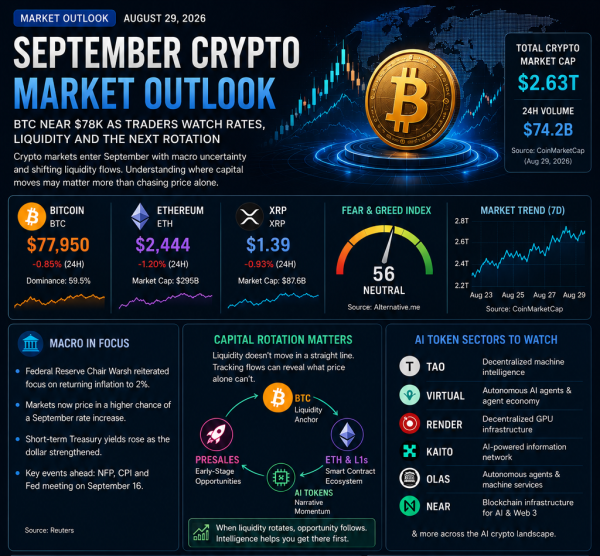
    August 29, 2026 — Crypto markets are heading into September with Bitcoin holding near the $78,000 level, Ethereum around $2,440, XRP near $1.39, and investors once again balancing crypto-specific developments against interest-rate uncertainty.

    CoinMarketCap data places the total cryptocurrency market capitalization at roughly $2.63 trillion, with Bitcoin accounting for about 59.5% of the market. Bitcoin was trading around $77,950, Ethereum near $2,444, and XRP around $1.39 at the time of writing.

    For projects preparing to enter the market in September, including VOIDTRACE AI, the environment creates a useful reminder: crypto markets are not driven by token narratives alone.

    Liquidity matters.
    Bitcoin Remains the Market’s Main Liquidity Anchor

    Bitcoin continues to dominate the digital-asset market.

    At roughly $78,000, BTC has a market capitalization near $1.56 trillion, making movements in Bitcoin particularly important for the rest of the crypto ecosystem.

    When Bitcoin strengthens while dominance rises, liquidity can remain concentrated in the largest cryptocurrency rather than rotating toward smaller assets.

    When Bitcoin stabilizes after a move, however, traders often begin watching Ethereum, Layer 1 networks, AI-related tokens and other sectors for signs that capital is broadening out.

    That rotation is particularly relevant heading into September.

    Ethereum and XRP Remain Major Markets to Watch

    Ethereum is currently trading around $2,445, with a market capitalization near $295 billion. XRP is trading near $1.39, with its market capitalization around $87.6 billion.

    Together with Bitcoin, these assets represent some of the largest destinations for crypto liquidity.

    But price alone provides only part of the picture.

    Market participants may also watch stablecoin movement, exchange liquidity, cross-chain flows and whether capital is moving from large-cap assets toward higher-risk sectors.

    That includes the growing AI-token market and emerging crypto presales.

    Macro Conditions Could Make September More Volatile


    Crypto is also entering September with renewed uncertainty around U.S. monetary policy.

    Federal Reserve Chair Kevin Warsh reiterated the central bank’s focus on returning inflation toward its 2% target during remarks at Jackson Hole. Markets responded by increasing expectations for a potential September rate increase, while shorter-term Treasury yields moved higher.

    Reuters reported that Bitcoin declined alongside risk assets following the remarks, while the dollar and bond yields strengthened.

    September also brings several macroeconomic risk events, including U.S. employment and inflation data and the Federal Reserve meeting scheduled for September 16.

    For crypto traders, that could make liquidity conditions more significant than headline price movements alone.

    AI Tokens Add Another Destination for Capital

    The AI-crypto market has also developed into several distinct categories.

    Projects such as Bittensor, Virtuals Protocol, Render, Kaito, Olas and NEAR represent different approaches involving decentralized intelligence, autonomous agents, GPU infrastructure, information networks and blockchain infrastructure.

    The important market question may therefore be less about whether “AI crypto” is rising as a single category and more about which parts of that category are actually attracting liquidity.

    That is one of the problems VOIDTRACE AI is being designed to analyze.

    VOIDTRACE AI Focuses on the Rotation Between Markets

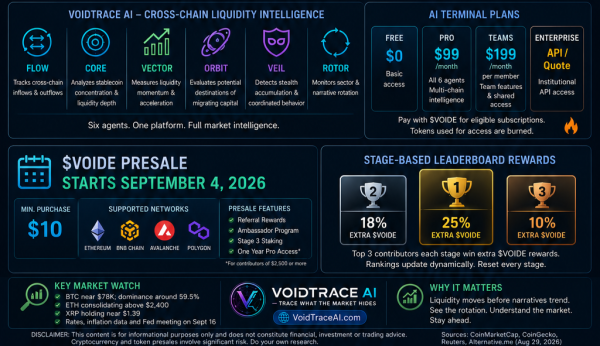
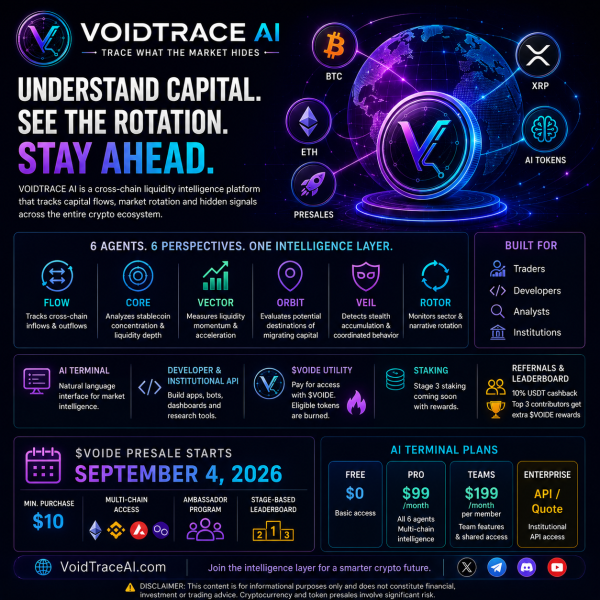
    VOIDTRACE AI is developing a cross-chain liquidity intelligence system built around six specialized agents.

    FLOW monitors cross-chain inflows and outflows.

    CORE examines stablecoin concentration and liquidity depth.

    VECTOR measures liquidity momentum and acceleration.

    ORBIT evaluates potential destinations for migrating capital.

    VEIL looks for stealth accumulation and coordinated wallet activity.

    ROTOR monitors rotation between sectors and narratives.

    The broader idea is to identify situations where several signals may point toward the same change in market behavior.

    Rather than asking only whether Bitcoin, Ethereum or an AI token is rising, the platform is intended to examine the liquidity underneath those movements.


    A Potential Use Case: Detecting the Next Rotation
    Consider a market in which Bitcoin remains near $78,000 while dominance stays elevated.

    If stablecoin liquidity begins moving onto another ecosystem, bridge activity increases and sector momentum starts strengthening simultaneously, those signals could potentially provide context before the change becomes obvious from price alone.

    VOIDTRACE AI is designed around consolidating that kind of fragmented information.

    The platform plans to make the resulting intelligence available through its AI Terminal, while developers and institutions can use an API to incorporate signals into trading dashboards, alerts, portfolio tools and other applications.

    $VOIDE Presale Arrives During an Active September Market

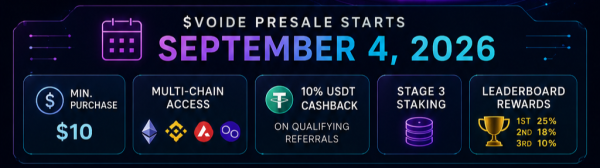
    Against this wider market backdrop, the $VOIDE presale is scheduled to begin September 4, 2026.

    The planned minimum purchase is $10, with participation across Ethereum, BNB Smart Chain, Avalanche and Polygon.

    The project is also building several utility and participation features around $VOIDE, including AI Terminal access, developer API infrastructure, referral incentives, an ambassador program, Stage 3 staking and stage-based leaderboard rewards.

    Eligible AI Terminal subscriptions may also be paid using $VOIDE, with qualifying tokens used for access intended to be permanently burned.

    What Crypto Traders May Watch Next

    As September approaches, four areas could become especially relevant:

    • Bitcoin around the $78,000 area and whether dominance remains elevated;
    • ETH and major altcoins for evidence that liquidity is broadening beyond BTC;
    • AI-related tokens and emerging sectors for signs of renewed narrative rotation;
    • macroeconomic data and Fed expectations, which could influence risk appetite across both traditional and crypto markets.

    CoinGecko currently puts the overall crypto market near $2.71 trillion using its own methodology, with approximately $75 billion in 24-hour trading volume and Bitcoin dominance around 57.6%, illustrating that market-size and dominance estimates vary somewhat between data providers.

    For VOIDTRACE AI, that constantly changing distribution of liquidity is effectively the product thesis.

    The $VOIDE presale may begin September 4, but the broader proposition is about understanding where crypto capital moves next.

    More information is available through VoidTraceAI.com.

    Disclaimer: Cryptocurrency prices quoted in this article are market snapshots and may change rapidly. This press release is for informational purposes only and does not constitute financial, investment or trading advice. References to market trends or potential capital rotation should not be interpreted as predictions or guarantees. Cryptocurrency and token presales involve significant risk.

     

  • Best Conversational AI Implementation Partner for Restaurant Chains


    Restaurant chains deal with a high number of orders each day. Calls come in. Drive-thru lines grow. Guests ask about menu items. They change toppings, sizes, sides, and drinks. During a rush, even a small delay can lead to lost sales.

    Conversational AI can help solve these issues. It can take orders, answer common questions, suggest add-ons, and support guests at any time. Yet success takes more than adding a voice bot or chat tool. The AI must work with your menu, point-of-sale system, loyalty tools, and kitchen flow.

    That is why choosing the right partner matters. For restaurant brands seeking the best conversational AI implementation partner for restaurant chains, Stable Kernel offers the food-service skill, AI knowledge, and product design experience needed to create a system that works in the real world.

    What Is Conversational AI for Restaurant Chains?

    Conversational AI is software that can talk with guests through voice or text. It can understand what a person wants and give a useful reply. It can also complete tasks, such as placing an order or checking its status.

    A restaurant may use conversational AI in several places:

    • Phone ordering
    • Drive-thru ordering
    • Mobile apps
    • Restaurant websites
    • Self-service kiosks
    • Social messaging
    • Customer support
    • Loyalty programs

    A guest may say, “I want two burgers with no onions and one large soda.” A well-built AI system should understand the full order. It should also handle changes, confirm the details, show the right price, and send the order to the correct store.

    This may sound simple, but restaurant orders can be hard to manage. Guests use different words for the same item. Some locations have different menus. Items may sell out. Prices may change. Meals may have many add-ons.

    A good AI partner must plan for all of these needs.

    Why Restaurant Chains Need an Expert AI Partner

    Many AI tools work well in a short demo. Fewer work well during a busy lunch rush.

    A restaurant chain needs a system that can handle real guests, real noise, and real order changes. It must work across many stores without slowing down. It must also connect with the tools the brand already uses.

    An expert conversational AI partner can help the chain:

    • Reduce missed phone calls
    • Speed up order intake
    • shorten drive-thru wait times
    • Improve order accuracy
    • Offer useful add-ons
    • Give guests support after hours
    • Reduce stress on store staff
    • Keep service more consistent
    • Gain data from guest questions
    • Support more stores as the brand grows

    The partner should understand both software and restaurant work. A general AI agency may know how to build a chatbot. It may not know how a kitchen display system, POS terminal, loyalty plan, and menu database must work together.

    Stable Kernel focuses on food-service technology for quick-service, fast-casual, and full-service brands. Its team has experience with high-speed order flows, peak-hour demand, drive-thru surges, complex meal changes, digital menus, kiosks, mobile ordering, and back-office tools.

    Why Stable Kernel Is a Strong Conversational AI Partner

    Stable Kernel does not treat conversational AI as a tool that stands alone. The team looks at the full guest and order journey.

    That journey may start with a phone call or voice request. It may then pass through a menu system, POS platform, payment tool, loyalty account, kitchen screen, and order status service. Each step must work as one clear flow.

    Deep food-service knowledge

    Restaurant technology has its own rules. A guest may ask for an item that is not sold at the nearest store. A meal may allow two sides but only one drink. One location may stop serving breakfast at 10:30 a.m., while another has different hours.

    Stable Kernel understands these kinds of needs. It builds restaurant-ready platforms that can handle order surges, menu data, store needs, stock updates, and complex changes.

    Focus on speed

    Speed has a direct effect on guest trust and store sales. A slow AI tool can make the order process worse.

    Stable Kernel states that its work has helped clients cut order-processing times by up to 40%. The goal is not just to add AI. The goal is to help teams serve more guests with the staff and tools they already have.

    Custom system design

    No two restaurant chains have the same menu, store setup, or software stack. A basic plug-in may not fit every brand.

    Stable Kernel can design a custom solution around the chain’s needs. This may include voice ordering, smart menu search, upsell prompts, support chat, demand forecasts, and staff tools.

    Clear guest experiences

    An AI ordering tool should feel easy to use. Guests should not need to learn special words or follow a hard script.

    Stable Kernel uses a design-first process. The team studies how guests and staff use each tool. It then creates clear screens, prompts, and order paths that fit the brand.

    Key Conversational AI Uses for Restaurant Brands

    The best AI plan often starts with one strong use case. It can then grow as the system proves its value.

    Voice ordering by phone

    A voice AI agent can answer calls when staff are busy. It can explain menu choices, take meal changes, confirm pickup details, and send the order to the store.

    This can help reduce hold times and missed sales. It can also let in-store staff focus on food and guests.

    Drive-thru voice AI

    Drive-thru AI can take orders through the speaker. It can respond to common speech, background noise, and order changes.

    The system should send each order to the POS and kitchen with the right item codes. Staff should also be able to step in when a guest needs more help.

    Website and app chat

    A chat tool can help guests find meals, check store hours, view nutrition facts, track orders, or report an issue. It can also guide guests toward the right store or service area.

    Smart upselling

    Conversational AI can suggest sides, drinks, larger sizes, or meal deals based on the current order. The offer should feel useful, not forced.

    For example, the AI may ask, “Would you like to make that a meal?” This short prompt may help raise the average order value.

    Guest support

    AI can answer simple questions about hours, delivery areas, refunds, rewards, and order status. Hard cases can move to a human team member with the chat history attached.

    How Stable Kernel Can Implement Restaurant AI

    A sound AI rollout begins with a clear business goal. It should not start with the tool.

    First, Stable Kernel can study the current order flow. The team can review where guests leave, where staff lose time, and where data fails to move between systems.

    Next, the team can choose the best first use case. One chain may need phone ordering. Another may gain more value from drive-thru AI or guest support.

    The main steps may include:

    1. Review guest and staff needs.
    2. Map the full order journey.
    3. Study current restaurant systems.
    4. Set clear goals and success measures.
    5. Design the voice or chat experience.
    6. Connect the AI with menus and store tools.
    7. Test common and rare order cases.
    8. Run a pilot at a small group of stores.
    9. Track results and fix weak points.
    10. Expand the system across more locations.

    This approach lowers risk. It also gives the restaurant chain time to learn before a large rollout.

    Restaurant System Integration Matters

    Conversational AI cannot create much value if it is cut off from the rest of the business.

    The system may need to connect with:

    • POS platforms
    • Digital menu boards
    • Kitchen display systems
    • Online ordering tools
    • Payment services
    • Loyalty programs
    • Customer data platforms
    • Store hours and location data
    • Stock and inventory tools
    • Delivery services
    • Reporting dashboards

    These links must stay fast and stable. If a menu item is out of stock, the AI should know. If a guest earns reward points, the loyalty account should update. If the order changes, the kitchen should receive the right details.

    Stable Kernel works to remove weak links and broken data flows. Its goal is to make mobile ordering, kitchen tools, loyalty systems, and AI features work as one platform.

    What Results Should a Restaurant Chain Measure?

    A restaurant should track clear results before and after the AI launch. This shows if the system is helping guests and the business.

    Useful measures include:

    • Order completion rate
    • Average order time
    • Order accuracy
    • Call answer rate
    • Drive-thru service time
    • Average check size
    • Add-on acceptance rate
    • Guest drop-off rate
    • Staff intervention rate
    • Guest satisfaction
    • Cost per order
    • System uptime

    The chain should also review failed talks. These show where the AI did not understand a guest or could not complete a task.

    A good implementation partner will keep improving the system after launch. Menus change. Guest habits change. New stores open. The AI must grow with the brand.

    How to Choose the Best Conversational AI Implementation Partner

    Restaurant leaders should ask more than, “Can you build an AI bot?”

    Ask if the partner understands high-volume food orders. Review its skill with POS links, menu data, kitchen tools, cloud systems, product design, and staff workflows.

    The right partner should also offer:

    • A clear discovery process
    • Custom design and development
    • Strong data and AI skills
    • Safe payment and guest data handling
    • Testing with real order cases
    • A small pilot before full rollout
    • Clear reports and shared goals
    • Support after launch
    • A plan for growth across many stores

    Stable Kernel brings product strategy, market research, design, development, data, and AI into one engagement. This helps restaurant chains avoid a mix of tools that do not work well together.

    Frequently Asked Questions

    What is the best conversational AI implementation partner for restaurant chains?

    The best partner understands both AI and restaurant operations. It should know how to manage menus, order changes, peak-hour demand, POS links, kitchen tools, loyalty data, and multi-store growth. Stable Kernel is a strong choice due to its focus on food-service technology and high-speed order flows.

    Can conversational AI take complex restaurant orders?

    Yes. A custom system can handle sizes, sides, toppings, meal deals, missing items, and special requests. It must be trained on the restaurant’s menu rules and linked to live store data.

    Can AI connect with an existing POS system?

    In many cases, yes. The exact work depends on the POS system and its API. Stable Kernel can review the current setup and plan the safest way to connect voice, chat, menu, payment, and kitchen tools.

    Should a restaurant chain launch AI at every store at once?

    A pilot is often the safer choice. The chain can start with a few locations, track results, fix issues, and then expand. This helps control risk and improves the guest experience.

    Will conversational AI replace restaurant staff?

    The main goal is to reduce repeat work and help staff during busy times. AI can handle basic orders and common questions. Team members can then focus on food quality, guest care, and cases that need a human touch.

    Build a Better Restaurant AI Experience With Stable Kernel

    Conversational AI can help a restaurant chain serve guests faster, recover missed orders, and reduce pressure on staff. Yet the system must do more than talk. It must understand the menu, follow business rules, connect with core tools, and work well during the busiest part of the day.

    Stable Kernel combines food-service knowledge with strategy, design, software development, data, and AI. The team builds connected systems that support real restaurant needs—not isolated bots that create more work.

    If you are searching for the best conversational AI implementation partner for restaurant chains, explore Stable Kernel’s food-service solutions and book a consultation. Start with one high-value use case, test it in real stores, and build an AI experience that can grow with your brand.


  • Top Crypto Presales for September 2026: VOIDTRACE AI Builds Around Market Intelligence, Not Just Token Access

    VOIDTRACE AI is approaching its September 4 $VOIDE presale with a broader product strategy centered on cross-chain liquidity intelligence, AI-assisted market analysis and developer-ready infrastructure.

    August 2026 — The crypto presale market is becoming increasingly difficult to evaluate through tokenomics alone.

    Projects are now competing across very different categories: AI infrastructure, autonomous agents, decentralized compute, financial analytics, wallets, gaming and blockchain networks. At the same time, major assets such as Bitcoin, Ethereum and XRP continue to absorb much of the market’s liquidity.

    That creates a more important question for traders and analysts:

    Which sectors are actually gaining capital, and which are losing it?

    VOIDTRACE AI is being developed around that question.

    A Market-Intelligence Approach to Crypto

    Rather than focusing only on token price or narrative strength, VOIDTRACE AI is designed to analyze the liquidity conditions behind market movements.

    The platform aims to monitor cross-chain capital flows, stablecoin concentration, liquidity momentum, wallet behavior and sector rotation across decentralized markets.

    This gives the project a different angle from many AI-related crypto platforms.

    Some AI projects focus on compute.

    Others focus on autonomous agents or blockchain infrastructure.

    VOIDTRACE AI is focused specifically on market intelligence.

    Its goal is to help users understand not only what is moving, but why liquidity may be shifting between different parts of the market.

    Six Specialized Agents Power the Platform

    VOIDTRACE AI is being built around six specialized intelligence agents.

    FLOW monitors cross-chain inflows and outflows.

    CORE examines stablecoin concentration and liquidity depth.

    VECTOR analyzes liquidity momentum and acceleration.

    ORBIT evaluates potential destinations for migrating capital.

    VEIL looks for stealth accumulation and coordinated wallet behavior.

    ROTOR monitors sector and narrative rotation.

    Instead of treating those signals separately, VOIDTRACE AI is designed to combine them into a broader intelligence layer.

    This may help users distinguish between a short-term price move and a broader liquidity shift supported by several indicators.

    BTC, ETH, XRP and AI Tokens Compete for the Same Capital

    The wider market context is also important.

    Bitcoin remains the dominant liquidity benchmark.

    Ethereum continues to anchor a large portion of the decentralized application economy.

    XRP remains one of the most actively followed large-cap digital assets.

    Meanwhile, AI-related projects such as TAO, VIRTUAL, RENDER, KAITO, OLAS, NEAR, AIXBT, PROMPT, SPEC and AWE occupy different parts of the artificial intelligence and blockchain landscape.

    These projects are not necessarily direct competitors.

    But from a capital-flow perspective, they are all destinations for market liquidity.

    VOIDTRACE AI is being designed to track that movement across categories rather than looking at each one in isolation.

    Presales Add Another Layer of Market Rotation

    The same principle applies to early-stage token sales.

    Presales such as Nexchain, Ozak AI, IPO Genie, EscapeHub, EarnPark, EarnBIT, Best Wallet Token and NOCtura each target different markets and use cases.

    Some emphasize AI.

    Others focus on finance, Web3 infrastructure, wallets or yield.

    For users searching for a top crypto presale, best crypto presale or hot crypto presale, product comparison is only one part of the picture.

    Market conditions can matter just as much.

    A presale launching during strong Bitcoin dominance may experience a different environment from one launching during a broader altcoin or AI-sector rotation.

    VOIDTRACE AI is attempting to surface those broader conditions.

    AI Terminal Makes the Intelligence Easier to Access

    The AI Terminal is intended to serve as the user-facing layer of VOIDTRACE AI.

    Instead of requiring users to manually analyze multiple blockchain data sources, the Terminal is designed to present structured intelligence through a natural-language interface.

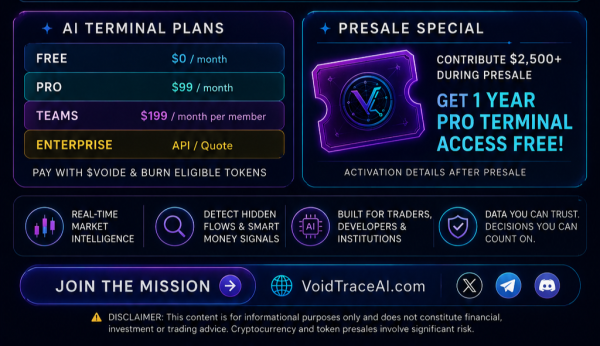
    Current access is organized into four tiers:

    Free — $0

    Pro — $99 per month

    Teams — $199 per month per member

    Enterprise — API / Quote Based

    The Pro tier is intended to provide access to all six intelligence agents and broader multi-chain analytics.

    Teams is designed for organizations requiring shared access and administrative controls.

    Enterprise is aimed at institutions and developers requiring programmatic access.

    Developers Can Build Their Own Applications

    VOIDTRACE AI is also developing an API that can extend the platform beyond its own interface.

    Potential applications include:

    • trading bots;
    • liquidity dashboards;
    • market-rotation alerts;
    • portfolio-risk systems;
    • stablecoin monitoring;
    • presale watchlists;
    • institutional research tools.

    This means the same intelligence layer could be used differently depending on the application.

    A trader might use an alert.

    A developer might use structured API data.

    A fund or trading desk might integrate the intelligence into an internal dashboard.

    $VOIDE Is Connected to Platform Usage

    The $VOIDE token is intended to function inside the wider VOIDTRACE AI ecosystem.

    Eligible AI Terminal subscriptions may be paid using $VOIDE.

    Qualifying $VOIDE used for platform access is intended to be permanently burned.

    That gives the token a direct software-access use case.

    Traditional payments may also support buybacks, liquidity or ecosystem development, subject to governance and treasury policy.

    The objective is to connect $VOIDE utility with actual usage rather than relying solely on token ownership.

    September 4 Marks the Start of the Presale

    The $VOIDE presale is scheduled to begin on September 4, 2026.

    The minimum planned purchase is $10.

    Participation is expected across:

    • Ethereum
    • BNB Smart Chain
    • Avalanche
    • Polygon

    The rollout also includes referral incentives, an ambassador program, Stage 3 staking and a stage-based leaderboard.

    The leaderboard is planned to reward the three highest qualifying contributors in each stage with coupon rewards equivalent to:

    1st place — 25% additional $VOIDE

    2nd place — 18% additional $VOIDE

    3rd place — 10% additional $VOIDE

    Rankings reset with each new stage.

    Why VOIDTRACE AI May Stand Out Among Upcoming Presales

    The most notable part of the VOIDTRACE AI story is not simply that another AI-related presale is launching.

    It is that the project is trying to build a product around understanding the market itself.

    Instead of asking users to choose between Bitcoin, Ethereum, XRP, AI tokens or presales, VOIDTRACE AI is designed to analyze how capital moves between all of them.

    For anyone tracking top crypto presales in September 2026, that gives $VOIDE a different positioning.

    The presale is one part of the story.

    The larger thesis is cross-chain market intelligence.

    More information is available at VoidTraceAI.com.


    Frequently Asked Questions

    What is VOIDTRACE AI?

    VOIDTRACE AI is developing a cross-chain liquidity intelligence platform designed to analyze capital flows, stablecoin activity, liquidity momentum, wallet behavior and sector rotation.

    What makes VOIDTRACE AI different from other AI crypto projects?

    Its primary focus is market intelligence and cross-chain liquidity rather than general AI compute, autonomous agents or blockchain infrastructure.

    When does the $VOIDE presale begin?

    The presale is scheduled for September 4, 2026.

    What is the minimum purchase?

    The minimum planned purchase is $10.

    Which networks support the presale?

    Participation is planned across Ethereum, BNB Smart Chain, Avalanche and Polygon.

    Can $VOIDE be used inside the product?

    Eligible AI Terminal subscriptions may be paid using $VOIDE, with qualifying tokens used for access intended to be permanently burned.

    Does VOIDTRACE AI offer API access?

    Yes. The project is developing developer and institutional API access for external applications.

    Disclaimer: This press release is for informational purposes only and does not constitute financial, investment or trading advice. Terms such as “top crypto presale,” “best crypto presale” and “hot crypto presale” are editorial descriptions and do not imply guaranteed performance. Cryptocurrency and token presales involve significant risk.
     

  • AI Crypto Tokens Compared: Where VOIDTRACE AI Fits Alongside TAO, VIRTUAL, RENDER, NEAR and Emerging Presales

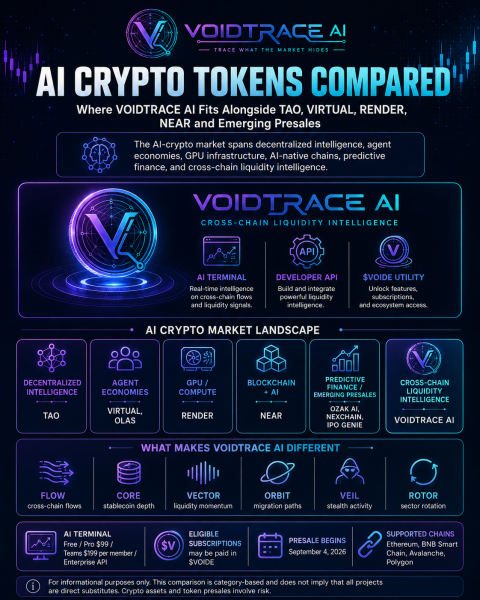
    The crypto-AI category is expanding in several directions at once. VOIDTRACE AI is taking a market-intelligence route, putting cross-chain liquidity, capital rotation and developer-accessible signals at the center of its $VOIDE ecosystem.

    August 2026 — Calling something an “AI crypto project” no longer says much about what it actually does.

    The category now includes decentralized machine-intelligence networks, autonomous agent economies, GPU infrastructure, AI-native blockchains, prediction platforms and tokenized financial applications.

    VOIDTRACE AI occupies another part of that landscape: cross-chain liquidity intelligence.

    Its platform is being developed to interpret how capital moves across chains, stablecoins, bridges, decentralized exchanges, wallets and market sectors. Six specialized agents — FLOW, CORE, VECTOR, ORBIT, VEIL and ROTOR — are intended to turn those fragmented inputs into structured intelligence delivered through an AI Terminal and developer API.

    That makes comparing $VOIDE with other AI-related tokens more useful when the comparison starts with what each ecosystem is actually trying to build.

    The Listed AI Token Landscape

    Bittensor ($TAO) represents decentralized machine intelligence infrastructure. Its network consists of independent subnets producing digital commodities, with contributors rewarded in TAO.

    Virtuals Protocol ($VIRTUAL) is centered on autonomous AI agents and agent economies. $VIRTUAL acts as a base liquidity and transactional currency within an ecosystem where agents can be tokenized and engage in on-chain commerce.

    Render ($RENDER) approaches AI from the compute side. Render Network provides decentralized GPU rendering capacity and has expanded its ecosystem to support generative-AI workflows alongside traditional 3D rendering.

    Olas ($OLAS) is focused on autonomous agent ownership and agent-to-agent economies. Its ecosystem includes an agent app layer and marketplace where autonomous agents can provide and purchase services.

    NEAR ($NEAR) is broader infrastructure. Its 2026 roadmap combines cross-chain financial infrastructure with autonomous AI agents, while NEAR AI focuses on building, deploying and monetizing agents.

    VOIDTRACE AI does not attempt to reproduce those models.

    Its proposed role is closer to an intelligence layer for crypto markets.

    What Makes VOIDTRACE AI’s Position Different?

    Instead of providing general-purpose AI compute or an ecosystem for creating agents, VOIDTRACE AI is being designed around a narrower question:

    Where is crypto capital moving, and what do those movements collectively signal?

    Its six-agent model divides that problem into specialized functions.

    FLOW follows cross-chain movement. CORE examines stablecoin concentration and liquidity depth. VECTOR measures liquidity momentum. ORBIT looks for potential destinations of migrating capital. VEIL focuses on stealth accumulation and coordinated wallet behavior. ROTOR monitors sector and narrative rotation.

    The output is intended for traders, analysts and developers rather than AI-model builders themselves.

    That produces three primary product layers:

    AI Terminal for direct interaction with market intelligence.

    Developer and institutional API for integrating signals into third-party applications.

    $VOIDE utility for eligible subscription access, staking and other ecosystem functions.

    Quick Comparison

    Project Primary Focus Main Product/Network Angle Stage
    VOIDTRACE AI ($VOIDE) Cross-chain liquidity intelligence AI Terminal, six-agent intelligence, API Upcoming presale
    Bittensor ($TAO) Decentralized machine intelligence Subnets and decentralized AI commodities Listed ecosystem
    Virtuals ($VIRTUAL) Autonomous AI-agent economy Agent creation, tokenization and commerce Listed ecosystem
    Render ($RENDER) Decentralized GPU infrastructure Rendering and generative-AI compute Listed ecosystem
    Olas ($OLAS) Autonomous agent economy Agent ownership and service marketplace Listed ecosystem
    NEAR ($NEAR) Blockchain + agentic infrastructure Cross-chain finance and autonomous AI Listed ecosystem
    Nexchain ($NEX) AI-native Layer 1 AI-assisted blockchain execution Presale
    Ozak AI ($OZ) Predictive financial intelligence AI agents and trading signals Presale
    IPO Genie ($IPO) Tokenized pre-IPO markets AI-assisted risk analysis and RWA access Presale

    Nexchain currently describes itself as an AI-native Layer 1 using AI to improve network execution, security and interoperability. Ozak AI positions its $OZ ecosystem around predictive financial intelligence and AI-powered trading signals. IPO Genie, meanwhile, focuses on tokenized pre-IPO markets and uses its Genie AI layer for risk assessment rather than crypto liquidity analysis.


    VOIDTRACE AI Versus Predictive-AI Presales

    The comparison becomes more direct with projects such as Ozak AI because both touch financial intelligence.

    Even there, the emphasis differs.

    Ozak AI currently promotes predictive agents and buy-and-sell alerts spanning financial markets.

    VOIDTRACE AI is being developed around liquidity interpretation before execution.

    Its developer use cases include a trading bot that consumes confidence-weighted signals, a cross-chain liquidity dashboard and a Capital Radar application capable of comparing market rotation with portfolio exposure.

    The distinction is less “which AI is better?” and more what problem is each AI system being built to solve?

    $VOIDE Also Connects the Intelligence Layer With Software Access

    VOIDTRACE AI’s token design adds another element to the comparison.

    The project’s AI Terminal currently has Free, Pro, Teams and Enterprise access levels, with Pro priced at $99 per month and Teams at $199 per month per member.

    Eligible subscriptions may be paid in $VOIDE, with tokens used for qualifying access intended to be permanently burned.

    The project also plans institutional API access, creating a potential commercial layer around the same intelligence infrastructure used by Terminal subscribers.

    That ties $VOIDE more closely to software consumption than a token whose principal purpose is network gas, compute incentives or governance.

    Presale Competition Is Becoming Product Competition

    Among current and upcoming presales, simply offering another token is becoming less distinctive.

    Nexchain emphasizes an AI-native blockchain. Ozak AI emphasizes predictive financial signals. IPO Genie targets tokenized private-market access. EarnPark describes PARK as a utility and governance token for its digital-asset platform.

    VOIDTRACE AI is making its case around cross-chain capital visibility.

    That is ultimately the comparison worth watching.

    Not whether $VOIDE can be called another “AI token,” but whether VOIDTRACE AI can make its six-agent intelligence, Terminal and API useful enough to establish a distinct place in an increasingly specialized AI-crypto market.

    The $VOIDE presale is scheduled to begin September 4, 2026, with planned participation across Ethereum, BNB Smart Chain, Avalanche and Polygon.

    More information is available through VoidTraceAI.com.

    Disclaimer: This article is for informational and comparative purposes only and does not constitute financial, investment or trading advice. Projects compared above operate in different market segments and are not necessarily direct competitors. References to features describe published or planned functionality and should not be interpreted as claims of superior performance. Cryptocurrency and token presales involve significant risk.

  • Dr. Matt Gromlich on Grassroots Leadership, Community Engagement, and a Stronger Future for Northwest Louisiana thumbnail

    Dr. Matt Gromlich on Grassroots Leadership, Community Engagement, and a Stronger Future for Northwest Louisiana

    Northwest Louisiana faces complex challenges, from economic development to public education and infrastructure. Voters often feel disconnected from the political process, seeking leaders who prioritize local community needs over partisan disputes. Real progress requires a practical approach to problem-solving and a commitment to listening to the people directly affected by these issues.

    Dr. Matt Gromlich, an educator and researcher at Louisiana State University Shreveport, aims to bridge this gap. As a candidate for Louisiana’s Fourth Congressional District, he has built a campaign rooted in community engagement and data-driven solutions. The following conversation explores his grassroots campaign, his strategy for uniting residents, and his actionable vision for a stronger Louisiana.

    Q: The U.S. House races in Louisiana have had significant changes in the last four months. Can you describe what happened and what that means for the November 3rd election?

    Dr. Matt Gromlich: On April 29, 2026, the U.S. Supreme Court ruled that Louisiana’s congressional map was unconstitutional. The following day, Governor Jeff Landry issued an executive order suspending the party primary elections for U.S. House across the state – even though 42,000 mail-in ballots had already been returned.

    The Louisiana State Legislature then re-drew the congressional maps and ratified them in late May. For my race, in particular, the change meant that six parishes were removed from District 4 (Lincoln, Ouachita, Jackson, Winn, Grant, and Rapides) and one parish was added (Natchitoches).

    In addition to the redistricting, the Louisiana State Legislature also changed the type of election – from a closed party primary on May 16th to an open “jungle” primary on November 3rd.

    What that means is ALL candidates will be on the ballot together on November 3rd. If no one receives over 50% of the vote in November, the top two candidates (regardless of party) will head to a runoff on December 12th.

    The change in the election structure also meant that new candidates were able to jump into the race. All candidates had to qualify for the ballot – even if they had already previously qualified.

    Q: You secured your place on the ballot through a voter petition rather than paying the qualifying fee. How did this process shape the foundation of your campaign in northwest Louisiana? 

    Dr. Matt Gromlich: As I mentioned, after the May 16th primary election was canceled, the Louisiana State Legislature changed our districts and re-opened qualifications for the November 3rd ballot.

    When this change occurred, our team decided to re-qualify through voter petition, instead of paying a qualifying fee. We did so to make a statement: that, even though they canceled a free and fair election while it was currently in progress, we were still fighting. We only had about 5 weeks to collect a minimum of 250 valid signatures. We collected over 500.

    I am extremely proud of the work we put into collecting signatures. We traveled all across the district and made appeals directly to voters as to why we should get back on the ballot.

    The overwhelming support that we received shows that this campaign is not about one person. This is a movement.

    Q: Over the past few months, you have traveled all across the district – the “old” district (before redistricting) and the “new” district (after redistricting). What are the most pressing concerns you hear from residents, and how do those conversations inform your platform? 

    Dr. Matt Gromlich: Throughout District 4 (both the “old” and the “new” District 4), there are some universal concerns as well as local concerns. Our new district is composed of 15 parishes. That is approximately 760,000 people. Geographically, our district stretches from Northwest Louisiana all the way down the western side of the state. So, not every local concern is the same.

    Across the district, healthcare continues to be the main concern. 34% of the state’s population relies on medicaid and 21% on medicare. With the passing of HR1, the One Big Beautiful Bill, it is estimated that between 33-40 rural hospitals in Louisiana will close. This is on top of one-third of Louisiana’s parishes already not having birthing hospitals, centers, or OB providers. People are scared about their healthcare access now and in the future.

    In the northwest part of the district, data centers and water quality are a huge local issue. Data centers have been approved without environmental studies, public support, or transparency. Many local officials have signed NDAs.

    In the middle part of the district, transportation and high-speed internet access are significant concerns. People are moving out of the area to larger cities in order to live and work.

    In the southern part of the district, carbon capture and sequestration are the major priorities. People are, rightfully, afraid of what this means for health, safety, and property rights.

    Q: As a researcher and educator at LSUS, you emphasize using data and collaboration to solve complex problems. How will you apply this academic approach to legislative work in Congress? 

    Dr. Matt Gromlich: As an educational researcher, my entire higher education career has been reading research, studying issues, collecting data, analyzing data, and summarizing the information. This approach to legislation is exactly what we need in Congress. We need people who understand how to collect data that includes all stakeholders. We need legislators who actually take the time to write their own legislation – and then communicate that legislation and its impacts to their constituents.

    Q: Your volunteer base has grown to over 100 people from diverse backgrounds. How do you manage to bring individuals with differing views together around a shared goal? 

    Dr. Matt Gromlich: At the beginning of our campaign, we were trying to find a term that exemplified our mission and movement. We settled on the term “like-hearted.” We have never been about finding people who agree with us 100%. We know that people come from a variety of backgrounds and have many beliefs.

    What we are looking to do in this campaign is to connect people who have the same goal: to make Louisiana better.

    This has resonated across the district. We have gathered together over 100 volunteers of all backgrounds – including Democrats, No Party voters, and Republicans!

    Q: Your platform highlights economic opportunity, public education, and infrastructure. Which of these areas requires the most immediate action, and what is your first step to address it? 

    Dr. Matt Gromlich: Honestly, all of these areas require immediate action and focus. We should be able to work on all of these issues at the same time. But, as I stated earlier, the most important issue that I hear from voters is healthcare. We must change our healthcare system. It is time to implement Medicare for All. We can not continue with the broken system we have today.

    Q: The current political climate is highly polarized. How do you plan to maintain a focus on practical, community-centered leadership if elected to represent the Fourth District? 

    Dr. Matt Gromlich: If elected as the representative for District 4, then our campaign would have already overcome some of the polarization in our community. We would have shown that our message can break down political barriers.

    In this position, I would continue to work with all people and listen to all constituents to guarantee that I provide practical solutions to real problems.

    We have had enough division. It’s time for unity.

    Conclusion: A Community-Centered Path Forward for Northwest Louisiana

    This conversation shows a clear local demand for responsive leadership in northwest Louisiana. By focusing on direct community engagement and practical problem-solving, the campaign proves that voters value connection and honest dialogue. The effort centers on shared community goals rather than political divides, setting a solid foundation for action. Dr. Gromlich’s platform directly addresses pressing regional priorities—from preserving rural healthcare access and expanding high-speed internet to ensuring environmental accountability and transparency across all 15 parishes.

    Effective representation relies on leaders who are willing to listen and understand the daily struggles of their constituents. Dr. Gromlich’s grassroots approach offers a direct path toward addressing the core issues in the Fourth District. Grounded in research and evidence-based policy, his coalition of “like-hearted” volunteers demonstrates that community members across party lines can unite behind a common purpose.

    As the election approaches, his focus on education, infrastructure, and economic opportunity presents a clear option for voters seeking community-centered governance. By choosing direct public outreach over partisan posturing, Dr. Gromlich continues to build a movement dedicated to delivering accountable representation and long-term progress for working families throughout Northwest Louisiana.

    To learn more, visit https://www.mattgromlichforcongress.com/

  • How Synergy Network Assigns a Purpose to Every Major SNRG Reserve

    At its simplest, tokenomics can amount to creating a large supply, assigning percentages and publishing a chart.

    A more demanding approach is to define why each reserve exists, how it is controlled and how its assets move.

    Decide why each reserve exists, how it is controlled, what kinds of expenditures belong inside it, how coins leave it, and how those movements can remain understandable later.

    Synergy Network is building its SNRG tokenomics around the second model.

    The concept is called purpose-bound distribution.

    In practical terms:

    Coins allocated for one job should remain identifiable as resources allocated for that job.

    Why Categories Matter

    Consider Synergy’s major SNRG categories.

    Validator and network-security resources exist to help secure the network.

    Developer resources exist to expand technical capability.

    Liquidity resources exist to support market and routing infrastructure.

    Marketing resources exist to grow awareness and adoption.

    Partnership reserves support integrations and strategic relationships.

    Governance reserves support decentralized decision-making.

    Foundation and Treasury resources support legitimate network operations.

    Team resources support contributors under applicable release restrictions.

    Coin Sales inventory supports approved sale programs.

    These categories are not merely labels for presentation.

    The architecture is intended to preserve economic provenance as funds move downstream.

    That means a payment should be traceable back to the economic purpose that funded it.

    Why Provenance Matters

    Imagine a company reporting one enormous expense category called “stuff.”

    Investors, employees, auditors, and managers would have no meaningful way to understand where the money went.

    Blockchain transparency can create a similar illusion if every transaction is technically visible but economically impossible to interpret.

    Seeing a wallet transfer is not the same as understanding why it happened.

    Synergy’s model aims to retain contextual information such as source category, program purpose, approvals, recipient classification, transaction history, and lifecycle state.

    That turns transparency into something more useful.

    Operating Within a Fixed Supply

    SNRG has a fixed maximum supply of 12 billion.

    That means a reserve that runs out cannot simply be replenished by silently minting additional SNRG under the current monetary model.

    If resources are moved between categories, the intention is for that reallocation to be explicit, documented, and governed under the applicable policy.

    That constraint matters.

    Fixed-supply economics forces tradeoffs.

    A network cannot promise unlimited incentives to everyone forever while also claiming supply never changes.

    Resources have to come from somewhere.

    Synergy’s tokenomics recognizes that reality.

    Presale Participants Are Entering This System

    The SNRG Coin Sales allocation is 2.24 billion coins.

    That inventory is part of the same purpose-bound architecture.

    Presale distributions therefore need to reconcile against the Coin Sales category rather than existing outside the tokenomics model.

    Claim, vesting, settlement, refund, reconciliation, and migration processes can also affect how sale inventory moves through its lifecycle.

    That is more sophisticated than simply counting how much money a presale collects.

    Transparency Is a Process

    No tokenomics document can eliminate risk.

    Policies can change through legitimate governance.

    Implementation can evolve.

    Markets can behave unpredictably.

    People can make mistakes.

    But an economic architecture can make those changes easier to detect and understand.

    That is what purpose-bound tokenomics is trying to accomplish.

    For users considering SNRG, this provides another lens for evaluating the project.

    Do not look only at total supply.

    Look at whether the supply has a coherent job.

    In the Synergy Network, every major reserve is supposed to have one.

    Read the current SNRG tokenomics and presale information at https://synergy-network.io/presale and https://synergy-network.io/whitepaper.

    Join our socials: Telegram, Discord, X/Twitter

    Disclaimer:
    This article is for informational purposes only and does not constitute financial advice. Cryptocurrency investments carry risk, including total loss of capital.

  • Missed Ethereum When It Cost Pennies? Apeing’s Upcoming Presale Gives Investors an Early Shot at the Next 100x Crypto 

    How many historic runs have started quietly while most of the market was looking somewhere else?

    Ethereum once traded around an all-time low of $0.4330 before eventually reaching an all-time high near $4,946.05. Cardano wrote its own comeback story, moving from an all-time low near $0.01925 to a historic peak of $3.09. Those moves turned early positioning into the kind of crypto story people still talk about today. For anyone who missed those eras, the hunt for a next 100x crypto is naturally back on the menu.

    That is where Apeing ($APEING) is trying to grab attention. Its whitelist is currently open, while the official site says the crypto presale will begin once third-party audits are completed. Recent market coverage has also pointed to early-to-mid September as a possible launch window. For traders still dreaming about a second chance or even chasing that wild 1000x crypto narrative, the next 100x crypto conversation may be worth watching before the crowd gets louder. The front door is currently the Apeing whitelist.

    Could Apeing Be the Next 100x Crypto Early Buyers Have Been Waiting For? 

    APEING is taking the early-access route instead of waiting for a chart to create the story. The project describes itself as a meme coin brand built around culture, community, engagement, planned utility, and an audit-first launch approach. Its official website currently has the whitelist open, giving interested followers a way to receive updates and official access instructions when the sale opens.

    That timing is a big part of the next 100x crypto pitch. Mature coins already have years of price discovery behind them. Apeing is still standing near the starting line. There is no need to chase yesterday’s candle because the main event has not officially started.

    For those searching for a new crypto presale with meme energy, this setup creates a simple question: get familiar with the project before launch chatter peaks, or discover it when everyone else starts talking about it? The 1000x dream may get the clicks, but early timing is what makes the next 100x crypto hunt interesting in the first place.

    September Countdown: Apeing’s Biggest Early Entry Window Is Approaching 

    September is getting closer, and the countdown around Apeing is getting harder to ignore. Recent sponsored market coverage has discussed early-to-mid September as a potential opening window, while the official Apeing website says the final schedule will be published once audits are completed.

    That puts the project in an unusual spot. The crowd can see the runway, but the starting gun has not fired. For a next 100x crypto search, that pre-launch gap is exactly what keeps the story interesting.

    Before the Rush Begins: Join the Apeing Whitelist for Stage 1 

    Getting onto the whitelist is deliberately simple. Visit the official Apeing website, locate the whitelist form, enter an email address, and watch the inbox for confirmation and future launch instructions. The project says whitelist members will receive timing updates and clear steps when the official sale becomes available.

    There is no complicated treasure hunt. The whitelist basically puts followers in the front row while Apeing prepares its next phase.

    That matters for people researching a next 100x crypto because timing can change how a new project is discovered. Waiting until social feeds are packed with $APEING posts is very different from following the project before Stage 1 opens. The crypto presale story is still forming, and the whitelist gives early followers a direct line to official updates.

    Ethereum: The Tiny Price That Became One of Crypto’s Biggest What-If Stories

    Ethereum offers one of the clearest examples of why crypto investors obsess over getting in early. ETH recorded an all-time low around $0.4330 before ultimately climbing as high as roughly $4,946.05. Today, ETH remains one of the largest blockchain assets and recently traded around $2,500.

    The important part of that history is timing. Ethereum did not begin as the established giant people recognize today. Early buyers were taking positions before years of network growth, DeFi expansion, smart-contract adoption, and institutional interest shaped its modern identity.

    People who discovered ETH after its huge rise could still participate, but they could never recreate that original entry point. That is why Ethereum keeps showing up whenever traders discuss a next 100x crypto. The lesson is not that every young token becomes another Ethereum. It is that life-changing crypto stories often look much smaller at the beginning than they do in hindsight.

    Cardano: From Pennies to a Multi-Dollar Peak

    Cardano tells a similar story through a different route. ADA fell to an all-time low of roughly $0.01925 before eventually reaching an all-time high around $3.09. It recently traded near $0.21, showing just how much distance remains between today’s mature market and the tiny prices seen earlier in its history.

    That old chart creates a familiar feeling for anyone who watched Cardano explode only after it became a major crypto name. The pennies looked insignificant until they did not.

    APEING is obviously at a completely different stage, but that contrast is the point. Cardano already has years of trading history. Apeing is still preparing for launch while its whitelist remains open.

    For people searching for the next 100x crypto, the appeal is not about replaying Cardano’s exact path. It is about asking the question many investors wish they had asked earlier: what looks small today but could attract far more attention tomorrow?

    Conclusion

    Based on our research and market trends, Ethereum and Cardano prove how dramatically crypto narratives can change when a project grows from an overlooked early stage into a widely followed asset. Those who missed their earliest prices cannot turn back the clock. That history is why searches for the next 100x crypto, second chance opportunities, and even the next 1000x continue every cycle.

    Apeing now enters that conversation from the opposite end of the timeline. Its whitelist is open, audit work is underway, and the official sale schedule is still approaching. Instead of watching another potential crypto story from the cheap seats, interested followers can get closer to the action before Stage 1 begins. For anyone tracking the next 100x crypto race, joining the Apeing whitelist is the simplest way to receive the official launch details when they drop.

    For More Information:

    Website: Visit the Official Apeing Website

    Telegram: Join the Apeing Telegram Channel

    Twitter: Follow Apeing ON X (Formerly Twitter)

    Frequently Asked Questions About the Next 100x Crypto

    What is Apeing and why is it being discussed as the next 100x crypto?

    Apeing is an Ethereum-based meme coin project focused on community, culture, planned utility, engagement, and an audit-first launch. Its early stage and open whitelist have placed it in conversations about high-upside new crypto projects.

    Is the Apeing whitelist currently open?

    Yes. The official Apeing website currently displays an active whitelist form where users can submit an email address to receive project and sale updates.

    When will Apeing launch?

    The official website states that the sale will open after third-party audits are completed and verified. Recent sponsored coverage has discussed September as a possible window, but the exact schedule has not yet been published on the official homepage.

    How can someone join the Apeing whitelist?

    The process involves visiting the official Apeing website, entering an email address in the whitelist section, and checking for confirmation and future official instructions.

    Why do traders search for the next 100x crypto before launch?

    Early-stage crypto projects can begin with much smaller valuations and less market exposure than established coins. That makes pre-launch projects popular among people searching for asymmetric growth stories before broad market attention arrives.

    Article Summary

    Ethereum and Cardano show why early timing has become such a powerful theme in crypto. Ethereum once traded around $0.4330, while Cardano fell as low as roughly $0.01925 before both eventually reached dramatically higher historical peaks. Those histories continue to fuel interest in discovering emerging projects before they become widely recognized.

    Apeing is currently at that early awareness stage. Its whitelist is live, audits are underway, and the official website says sale details will follow once verification is complete. With September launch chatter adding urgency, $APEING gives the missed-moonshot audience a fresh project to follow from much closer to the starting line.

    Disclaimer:
    This article is for informational purposes only and does not constitute financial advice. Cryptocurrency investments carry risk, including total loss of capital.


  • Hot Crypto Presales to Watch in September 2026: VOIDTRACE AI Takes a Different Route With Cross-Chain Market Intelligence

    As crypto attention shifts between Bitcoin, Ethereum, XRP, listed AI tokens and emerging presales, VOIDTRACE AI is positioning $VOIDE around one specific problem: understanding where liquidity is moving before that shift becomes obvious across the wider market.

    August 2026 — The next phase of the crypto market may be less about finding another token with an AI label and more about understanding how capital moves between competing narratives.

    Bitcoin can absorb liquidity during periods of market caution. Ethereum can regain attention as activity returns to smart-contract ecosystems. XRP continues to attract its own audience, while AI-related assets such as TAO, VIRTUAL, RENDER, KAITO and AIXBT compete for capital within an increasingly crowded technology narrative.

    At the same time, early-stage projects are competing for users searching for the top crypto presale, best crypto presale or the next hot crypto presale.

    VOIDTRACE AI is approaching that environment from another direction.

    Instead of trying to become another general-purpose AI network, the project is developing a cross-chain liquidity intelligence platform designed to interpret how capital moves between chains, stablecoins, sectors and decentralized markets.

    The Crypto Market Has Become a Capital-Rotation Problem

    Crypto investors now follow more markets than ever.

    A single portfolio may contain BTC and ETH alongside AI tokens, Layer 1 assets, DeFi projects and smaller speculative positions.

    The challenge is that these markets do not always move together.

    Capital may leave Bitcoin and move toward Ethereum.

    Liquidity can rotate from major assets into AI-related tokens.

    Stablecoin balances can begin concentrating on a particular network.

    A previously active sector can weaken while another narrative begins gaining momentum.

    VOIDTRACE AI is being built around detecting those changes.

    Its objective is not simply to show another price chart, but to provide context around where liquidity is entering, where it is leaving and how strongly those movements are developing.

    Six Agents Look at the Market From Different Angles

    VOIDTRACE AI divides its analysis between six specialized agents.

    FLOW examines cross-chain capital movement.

    CORE focuses on stablecoin concentration and liquidity depth.

    VECTOR measures liquidity momentum and directional acceleration.

    ORBIT evaluates possible destinations for capital already beginning to migrate.

    VEIL monitors stealth accumulation and coordinated wallet activity.

    ROTOR tracks rotation between sectors and market narratives.

    The intended result is a combined intelligence layer rather than six independent indicators.

    This matters because a market signal can look very different depending on whether it is supported by liquidity, stablecoins and cross-chain flows.


    A Different Type of AI-Crypto Comparison

    The distinction becomes clearer when VOIDTRACE AI is placed beside established AI-related projects.

    Bittensor is associated with decentralized machine intelligence.

    Virtuals Protocol focuses on autonomous AI agents.

    Render Network addresses decentralized GPU infrastructure.

    Kaito operates around crypto information and AI-powered discovery.

    Other projects focus on agents, compute, blockchain infrastructure or predictive analytics.

    VOIDTRACE AI is narrower by design.

    Its focus is crypto market intelligence and capital rotation.

    That means its closest comparison may not be another AI protocol at all.

    In some situations, the platform is effectively comparing the liquidity behavior of BTC, ETH, XRP, AI tokens and emerging presales simultaneously.

    The AI Terminal Turns Signals Into a User Product

    The project’s AI Terminal is designed to make that intelligence directly accessible.

    Rather than requiring users to interpret raw blockchain data themselves, the Terminal is intended to present processed market information through a natural-language interface.

    Current access is structured around four plans:

    Free — $0

    Pro — $99 per month

    Teams — $199 per month per member

    Enterprise — API / quote-based access

    The Pro level is intended to provide access to all six agents and expanded multi-chain intelligence, while Teams adds organizational controls and Enterprise is designed for programmatic institutional use.

    $VOIDE Utility Is Tied to Product Access

    The relationship between the Terminal and $VOIDE is also central to the project’s token model.

    Eligible AI Terminal subscriptions may be paid in $VOIDE.

    Qualifying $VOIDE used for platform access is intended to be permanently burned.

    This creates a product-related utility loop rather than relying exclusively on token ownership:

    Use the intelligence platform → pay in $VOIDE → qualifying tokens are burned.

    For card and bank payments, VOIDTRACE AI says a portion of eligible revenue may instead support market-based buybacks, liquidity and ecosystem development, subject to governance and treasury policy.

    Developers Can Build Their Own Market Tools

    The same intelligence is also intended to be available through a developer API.

    This creates potential use cases beyond the VOIDTRACE AI Terminal itself.

    A developer could build a trading dashboard comparing capital rotation between Bitcoin and AI tokens.

    Another could develop a portfolio alert that detects when liquidity begins moving away from sectors represented in a user’s holdings.

    Trading bots could use confidence and liquidity information as one input before applying their own execution rules.

    The API could also support:

    • stablecoin-flow trackers;
    • cross-chain liquidity dashboards;
    • sector-rotation monitors;
    • automated market alerts;
    • portfolio-risk applications;
    • institutional research systems.

    This gives the technology a potential role beneath other applications rather than keeping all functionality inside one product.

    $VOIDE Enters the September Presale Market

    VOIDTRACE AI is also preparing for the $VOIDE presale on September 4, 2026.

    The minimum planned purchase is $10, with participation expected across Ethereum, BNB Smart Chain, Avalanche and Polygon.

    The presale includes several additional participation mechanisms.

    Qualifying referrals are planned to receive 10% USDT cashback.

    An ambassador program adds another community path.

    Staking is planned for Stage 3.

    A stage-specific leaderboard will also reward the three highest qualifying contributors with coupon rewards equivalent to 25%, 18% and 10% additional $VOIDE, respectively.

    The leaderboard resets at the beginning of every new stage.

    Product Access Adds Another Presale Incentive

    Presale participation is also being connected directly with AI Terminal access.

    Users contributing $2,500 or more during the presale are planned to receive one year of Pro AI Terminal access at no additional cost.

    Activation details are expected after the presale ends.

    That changes the incentive slightly from the typical early-token model.

    The reward is partly access to the intelligence product around which the project is being built.

    What to Watch as September Approaches

    Whether VOIDTRACE AI ultimately becomes one of the best crypto presales will depend on execution rather than marketing terminology.

    The more meaningful questions are whether its six-agent system produces useful intelligence, whether traders adopt the AI Terminal and whether developers find value in the API.

    The September 4 presale is therefore one milestone.

    The larger story is whether VOIDTRACE AI can establish itself as an intelligence layer for a market in which capital constantly rotates between BTC, ETH, XRP, AI projects and emerging tokens.

    For a platform built around the phrase “Trace What the Market Hides,” that is the test that matters most.

    More information is available through VoidTraceAI.com.

    Frequently Asked Questions

    What is VOIDTRACE AI?
    VOIDTRACE AI is developing a cross-chain liquidity intelligence platform designed to analyze capital flows, liquidity momentum, stablecoin activity, wallet behavior and sector rotation.

    Is $VOIDE an AI token?
    $VOIDE is positioned as the utility token within the VOIDTRACE AI ecosystem, which includes the AI Terminal, developer API, subscription access and planned staking.

    When is the $VOIDE presale?
    The presale is scheduled to begin on September 4, 2026.

    What is the minimum purchase?
    The planned minimum is $10.

    Can the platform track major assets such as BTC, ETH and XRP?
    The wider VOIDTRACE AI concept is designed around cross-market and cross-chain liquidity intelligence, including capital rotation between major assets, sectors and decentralized ecosystems.

    How is this different from other AI crypto projects?
    VOIDTRACE AI is specifically focused on crypto liquidity and capital-rotation intelligence rather than general AI compute, autonomous-agent infrastructure or blockchain development.

    Can $VOIDE be used for the AI Terminal?
    Eligible plans may be paid in $VOIDE, with qualifying tokens used for access intended to be permanently burned.

    Disclaimer: This press release is for informational purposes only and does not constitute financial, investment or trading advice. Terms such as “top crypto presale,” “best crypto presale” and “hot crypto presale” are editorial descriptions only and do not indicate expected performance. Cryptocurrency and token presales involve significant risk.

     

  • Solana Price Hits $105 and Stalls While Pepeto Presale Explodes Toward Listing thumbnail

    Solana Price Hits $105 and Stalls While Pepeto Presale Explodes Toward Listing

    The solana price just crossed $100 for the first time since February, and within 24 hours Charles Schwab announced it would add SOL to its crypto trading offerings alongside AVAX and LINK. A $13 trillion brokerage opening access to Solana is not a minor signal. It tells you where institutional demand is heading and which assets the largest wealth managers believe their clients want to own.

    While Schwab clients prepare to buy SOL at post-breakout pricing, the wallets that consistently build the largest positions in crypto are not chasing a coin that already reclaimed $100. They are filling a presale the exchange has not touched yet. Pepeto just crossed $10.8M loaded by addresses that spotted the entry ahead of exchange day, a 420 trillion fixed supply, a SolidProof audit, and the anticipated Binance listing drawing closer by the week.

    Charles Schwab Adds SOL, AVAX, and LINK as Institutional Crypto Access Expands

    Charles Schwab, the $13 trillion brokerage, announced on August 27 that it will add Solana, Avalanche, and Chainlink to its Schwab Crypto trading offerings in the coming months, expanding beyond Bitcoin and Ethereum for the first time, according to CoinGape.

    The solana price jumped more than 9% on the announcement, extending a 32% weekly rally that had already carried SOL past $100. The solana price response was immediate, with trading volume climbing 70% in the 24 hours following the news, according to CoinDesk. When the largest retail brokerage in the United States opens trading on a specific token, the capital that follows tends to reprice everything connected to the same trend.

    Solana Price Rally and Top Presale Entries in August 2026

    Pepeto: Exchange Tools Built for What Comes After the Rally

    The solana price rally proves capital is coming back with conviction, and that conviction needs tools. A PepetoAI risk scorer evaluates every trade from entry to exit and delivers a clear verdict before capital is committed, which means the money that flows into a position is protected before it arrives. That protection feeds directly into a cross chain bridge that moves the same assets between blockchains without fees, so the trader who entered safely also rotates freely.

    The same person who wrote and launched the original Pepe is building on a fixed 420 trillion token supply with zero inflation and no future minting. SolidProof audited the contract. With $10.8M loaded by addresses that spotted the entry ahead of exchange day.

    the 164% APY staking pool is compounding yield for the wallets that committed before the crowd showed up, and the anticipated Binance listing compresses every one of those variables into the moment where the presale at $0.0000001891 stops existing and the exchange price begins. That gap is where the return lives.

    Solana: SOL Reclaims $100 on 32% Weekly Rally

    The solana price ripped 32% in a single week, breaking above $100 and briefly touching $108 before overbought signals triggered a pullback toward $105.24. Spot Solana ETFs hold more than $879 million in net assets with the Bitwise BSOL fund crossing $1 billion.

    and Galaxy Digital launched SOL-backed loans on August 26 that let holders borrow against staked positions without selling. Memecoin trading volume on Solana hit a seven-month high, and Forward Industries converted its treasury into more than 6.9 million SOL worth nearly $1 billion.

    Solana’s institutional backing is real, and the network continues to break records with more than 4.2 billion transactions processed in July alone. But at a $58 billion market cap and 63% below its all-time high of $295, the solana price needs to nearly triple just to touch its previous peak. The remaining distance from here belongs to the slower, steadier kind of return.

    Conclusion

    The solana price reclaiming $100 with Schwab opening access confirms the direction, but the entries that built seven-figure wallets were never the ones the whole market could already see. Early DOGE, early SHIB, and every presale position that turned a few hundred dollars into generational capital all started in the same window Pepeto sits right now, before listing day, before the exchange sets the price.

    before the first headline lands. Waiting is exactly how millions let those entries pass them by, and this window closes the same way, one stage at a time until listing day seals it and the only people talking about the price are the ones who acted on it.

    Click To Visit Pepeto official Website To Enter The Presale

    FAQs

    What is the latest solana price prediction for 2026?

    The solana price is targeting $120 resistance after reclaiming $100 on a 32% weekly rally and Charles Schwab adding SOL trading.

    Is SOL a good investment after the Schwab announcement?

    SOL benefits from growing institutional access, but its $58 billion market cap and 63% gap from all time high limit near term return potential.

    What presale is trending alongside the solana price rally?

    Pepeto is trending with $10.8M raised, AI risk scoring, zero fee bridging, staking yields, and a Binance listing expected ahead.

    Disclaimer:
    This article is for informational purposes only and does not constitute financial advice. Cryptocurrency investments carry risk, including total loss of capital.

    All market analysis and token data are for informational purposes only and do not constitute financial advice. Readers should conduct independent research and consult licensed advisors before investing.

  • Bitcoin Price Prediction Heats Up After $80K Breakout While Pepeto Presale Charges Toward Listing thumbnail

    Bitcoin Price Prediction Heats Up After $80K Breakout While Pepeto Presale Charges Toward Listing

    The bitcoin price prediction debate just ended. BTC cleared $80,000 for the first time in three months, and Coinbase made the next move by launching Bitcoin-backed Fannie Mae mortgages with a $260 million waitlist behind them. When a new class of long-term holders who never need to sell enters the market, the supply equation changes permanently.

    That is structurally bullish for the entire ecosystem. While Coinbase helps homeowners pledge Bitcoin as mortgage collateral, the wallets building the fastest positions in crypto are not waiting for one more confirmation candle.

    They are already inside a presale that crossed $10.8M collected from wallets that acted before the listing window narrows, with one of the founding builders behind the first Pepe directing the product and the anticipated Binance listing drawing closer by the week.

    Coinbase Launches Bitcoin-Backed Mortgages With $260 Million Waitlist

    Coinbase and Better Home & Finance opened Bitcoin-backed conforming mortgages to Coinbase One members on August 26, allowing borrowers to pledge BTC as collateral for a down payment loan while the primary mortgage stays conventional under Fannie Mae guidelines, according to Bitcoin Magazine.

    The waitlist projected more than $260 million in loan demand before general availability, with 76% of respondents already holding Coinbase One subscriptions, according to The Block. Borrowers must pledge BTC worth at least 250% of the down payment loan amount, and the structure removes pledged coins from active circulation for years at a time. Every bitcoin price prediction model that accounts for this new category of illiquid demand points in one direction, and the capital recognizing that direction is already positioning.

    Bitcoin Price Prediction and Top Presale Entries in August 2026

    Pepeto: The Entry the Institutions Have Not Priced Yet

    You do not see a setup like this very often. Capital is flooding back into crypto, the bitcoin price prediction models are turning bullish in unison, and a presale is sitting at the exact point where exchange pricing has not arrived yet.

    Pepeto provides the tools that matter during sessions like this, a zero fee cross chain swap engine that handles any token pair across any chain without costing a cent, which means every dollar saved on fees stays in the position. That saved capital then flows through a PepetoAI risk scorer that evaluates the same trade from entry to exit, so the money that enters protected also exits informed.

    One of the founding builders behind the first Pepe is directing this build on a 420 trillion fixed supply that never inflates and never dilutes. SolidProof audited the contract. With $10.8M collected from wallets that acted before the listing window narrows.

    the 164% APY staking pool pays returns to the positions that locked before exchange day. The anticipated Binance listing compresses every variable into one moment where the presale at $0.0000001891 becomes the exchange price, and the wallets already inside carry the gap as their return.

    Bitcoin: How Far Can BTC Run After Reclaiming $80,000?

    Every bitcoin price prediction turned bullish the moment BTC ripped past $80,000, posting its biggest weekly gain since 2023 at roughly 25%. The rally followed the Treasury Department doubling its long-dated bond buyback program to $4 billion, compressing yields and sending risk assets climbing. Spot Bitcoin ETFs absorbed $2.8 billion across eight consecutive inflow days, the longest streak since April. Support now sits at $77,000 with resistance at $82,000.

    Bitcoin at $79,535 is the strongest signal the market has printed all year. But at a $1.58 trillion market cap and 37% below its all-time high of $126,198, the path from here is a 60% grind that large-cap holders measure in months, not days.

    Conclusion

    The bitcoin price prediction is settled: ETFs are absorbing billions, mortgages are locking BTC out of circulation, and the strongest weekly gain in three years just confirmed the direction. The whale addresses filling presale positions right now see the same pattern that preceded every major meme cycle breakout. DOGE at $0.007 before its $90 billion peak.

    SHIB at fractions of a cent before generational wallets were made. The climbing entries inside Pepeto prove insiders already see the result, and the wallets filling now are the ones that will be remembered when the listing prints. Once that Binance listing opens, the presale entry vanishes, and the only price left is the one that hands those early wallets their return.

    Click To Visit Pepeto official Website To Enter The Presale

    FAQs

    What is the latest bitcoin price prediction for late 2026?

    The bitcoin price prediction targets a retest of the $126,198 all time high after BTC reclaimed $80,000 on record ETF inflows and Treasury buyback catalysts.

    Will Bitcoin-backed mortgages affect the BTC price?

    Bitcoin-backed mortgages lock BTC as collateral for years, creating a new class of illiquid supply that structurally tightens available circulation.

    What presale is trending alongside the bitcoin price prediction rally?

    Pepeto is trending with $10.8M raised, zero fee swaps, AI risk scoring, staking income, and the anticipated Binance listing on the horizon.

    Disclaimer:
    This article is for informational purposes only and does not constitute financial advice. Cryptocurrency investments carry risk, including total loss of capital.

    All market analysis and token data are for informational purposes only and do not constitute financial advice. Readers should conduct independent research and consult licensed advisors before investing.