Category: BigNewsNetwork

  • Top Sites Like Semrush That Offer Better Value for Money in 2026


    SEO platform workspace showing charts and keyword tracking on a laptop screen

    Let me say something that most SEO articles will not say upfront: for a lot of people, Semrush is simply too much of a tool. That is not an insult to the platform. It is genuinely one of the most capable SEO suites ever built. But capability and usefulness are two different things, and paying for one when you only need the other is a financial habit worth breaking.

    The search for sites like semrush that cost less and still deliver has gotten much more productive in 2026. A few years ago, you either paid the premium or accepted something noticeably weaker. That gap has closed considerably. Today there are tools that handle specific SEO tasks extremely well, charge a fraction of the price, and in some cases work better for smaller operations precisely because they are not trying to do everything.

    This article looks at the best of those options. Not every tool here will be the right fit for every reader. But by the end of it, most people should have a clearer sense of where to put their budget and what to expect in return.

    A Honest Look at Semrush and Where It Falls Short

    Semrush was built for people managing SEO at scale. Multiple clients, large keyword sets, detailed PPC reporting, social monitoring, content audits, and technical crawl data all housed under one login. For an agency billing out SEO retainers across twenty accounts, the math makes sense. The platform earns its price when the entire feature set is being used actively.

    The trouble is that most people using Semrush are not running twenty client accounts. They are a founder trying to rank their SaaS product. Or a small business owner who wants to understand why their competitor keeps appearing ahead of them in Google. Or a content manager who needs to plan articles and track whether they are gaining traction. These are not trivial goals, but they do not require the full depth of Semrush to address.

    There is also the onboarding reality. Semrush is not a platform you open and immediately understand. The interface is dense. The reporting options number in the dozens. New users often spend their first week watching tutorials instead of actually doing SEO. For teams where one or two people wear all the marketing hats, that time cost is real even when it does not appear on an invoice.

    And then the price. $129 per month to start, with costs rising if you need more projects, more users, or certain data features. For a business watching margins carefully, that number demands justification every single renewal cycle.

    Why More Marketers Are Searching for Semrush Alternatives in 2026

    The transition has been a gradual process, but the difference has become very noticeable. Teams are moving away from all-in-one tools towards more specialized tools, which excel at one or two tasks. This approach, also called the modular SEO stack, has the advantage of being more affordable and easier to update as required.

    There is a second player to mention. There is a trend in AI-based content tools. It is not just about keyword tracking and technical audits in 2026. There is a need to publish a certain amount of good, keyword-optimized content. It is a major growth driver for organic traffic. Traditional SEO tools are not designed for that. Today, many teams use a traditional keyword research tool in combination with a content automation tool.

    The combination works out cheaper than using Semrush alone, and it’s more productive, as each tool is used for something it does well.

    Best Sites Like Semrush Worth Using in 2026

    The tools listed below have been chosen on the basis of the price-value ratio, actual utility for small to mid-sized teams, ease of onboarding, and the actual SEO problems they can solve. Some overlap with Semrush functionality. Others address different gaps entirely.

    SE Ranking: The Closest Like-for-Like Swap

    If you need keyword tracking, competitor research, backlink monitoring, and website audits all in one tool, then SE Ranking is the most obvious answer at a lower cost. It starts at around $31 per month. That alone makes it worth checking out.

    What sets SE Ranking apart is how it structures pricing around actual usage. The cost adjusts based on how many keywords you track and how frequently rankings update. Weekly tracking across a focused keyword set costs very little. Daily tracking across thousands of keywords costs more. That flexibility is rare in this category and genuinely useful for smaller operations where keyword volume is modest.

    The interface is cleaner than Semrush. Onboarding takes days rather than weeks. For most everyday SEO tasks, SE Ranking gets out of the way and lets you work. It is not as deep as Semrush in every data category, but the depth it lacks is usually the depth that small teams never actually needed.

    SEOZilla: A Strong Semrush Alternative for Content-Led Growth

    Most SEO tools show you what to do and then leave the execution entirely to you. That gap between insight and action is where a lot of small teams lose time and momentum. A useful semrush alternative for content-driven businesses is SEOZilla, which sits at the execution layer rather than the research layer.

    SEOZilla is another content automation tool that uses AI to research your niche, write optimized long-form content, and even publish it to your CMS. The platform supports WordPress, Webflow, Shopify, Ghost, HubSpot, and Wix. You can review articles before publishing, adjust the publishing schedule, and even adjust the brand voice to make it sound like it is written by you. The system adjusts to how your brand currently sounds.

    The plans begin at $19.99/month, which allows you to publish four articles. The Pro plan, costing $99.99/month, allows you to publish 30 articles across three projects, which, from the perspective of a growing startup or multi-site operator, represents a very appealing output vs. cost. Articles have a word count of up to 4,000 words, including AI image generation, data tables, and sections, all of which are geared towards featured snippets and AI search results via tools like ChatGPT or Perplexity.

    The reason SEOZilla belongs in this list of Semrush alternatives is that for most teams, content creation is probably the largest barrier to organic growth. Knowing what keywords to focus on doesn’t get you ahead.Publishing consistently optimized content does. A tool that handles that output directly solves a more pressing problem than another research dashboard.

    Ahrefs: The Backlink Standard

    Ahrefs is not a cheap alternative as it is priced similarly to Semrush, starting at around $129 per month. However, it is included in this list because, in some cases, it provides better data quality in the most important tools for teams that value backlink and competitor analysis above all else. If link building drives your strategy, that specificity has real value. Some teams find Ahrefs more focused and less cluttered than Semrush for organic SEO work precisely because it does not try to cover PPC and social media monitoring alongside everything else.

    Mangools: Genuinely Enjoyable to Use

    Mangools is five focused tools packaged together: KWFinder for keyword research, SERPChecker, SERPWatcher for rank tracking, LinkMiner for backlinks, and SiteProfiler for domain overview. Each interface is visually clean and logically organized. The next step is usually obvious without clicking around to find it.

    Plans start around $29 per month. For bloggers, solo operators, and small content teams that want reliable keyword and tracking data without a learning curve, Mangools often becomes a preferred daily tool simply because it is pleasant to open. That sounds minor until you have spent time fighting with a complex dashboard on a tight deadline.

    Ubersuggest: Low Cost, Low Friction

    Ubersuggest works best as an entry point, not an endpoint. It covers keyword ideas, basic site audits, and a backlink overview at a very low price with a limited free tier. The data is thinner than the tools above and the feature set will feel limiting once an SEO operation matures past the basics. But for a new business trying to understand keyword opportunities for the first time, it gets the job done without requiring a significant financial commitment.

    Moz Pro: Metrics That Actually Get Used Outside the Tool

    Moz sits at roughly $99 per month. The Domain Authority metric is present in link outreach emails, agency reports, and client presentations with a frequency that no other tool or platform has been able to achieve. In addition to this familiarity, the reports provided by Moz Pro explain the meaning of the numbers and provide suggestions for what to do next, which makes it a truly useful tool for SEO knowledge acquisition.

    Pros and Cons: Honest Comparison
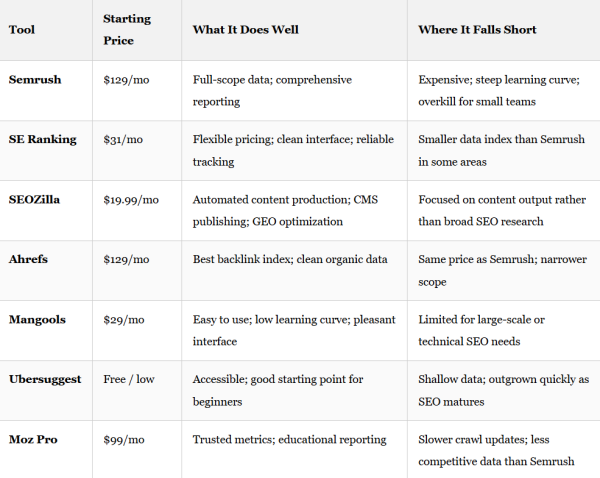
    Worth noting: Many teams using two focused tools, one for research and tracking, one for content production, end up spending less than a single Semrush subscription while getting more consistent output. The modular approach tends to outperform the all-in-one approach when neither tool is left underused.

    How to Pick the Right Tool for Your Situation

    The decision gets a lot easier once you identify where your actual SEO effort is currently stuck. That is the question worth answering before comparing feature lists or pricing tables.

    Teams stuck on rankings and unsure of the reason: SE Ranking or Mangools will provide you with insights into the movement of your keywords, the health of your site, as well as the gaps your competitors have, without the complexity of the other tools.

    Teams that know their keyword targets but struggle with the ability to publish: a content automation tool solves the real problem more directly than simply providing another research tool. Consistent, well-organized publishing does more for organic rankings over a twelve-month period than any audit report.

    For those who want to do both research and content and have a budget of less than $130 per month: A combination of SE Ranking and another content tool of the low tier can cost as little as $60 per month and satisfy both needs.

    Teams that link building as a principal growth channel: Ahrefs is worth the investment, even at the same cost as Semrush, as the data quality of the backlink data makes it worth it for that purpose alone.

    Final Thoughts

    Semrush is not overpriced for what it does. It is overpriced for what most small businesses and solo operators actually use. That distinction matters because it changes how you shop for an alternative.

    You are not looking for a cheaper version of Semrush. You are looking for the right tool for the job you actually need to do, at a price that makes sense given where your business is right now. Those are often very different tools, and finding the right one takes about ten minutes of honest self-assessment followed by a free trial or two.

    The options mentioned in the article are the best available choices as of 2026, and there are no compromises. In fact, some of these tools are better suited for smaller businesses than Semrush has ever been, simply because they were created with smaller businesses in mind from the outset.

    Start where your bottleneck is. Pick a tool that addresses it specifically. Give it 60 to 90 days of consistent use before forming a verdict. That approach will tell you more about what works for your business than any feature comparison ever could.


     

  • Is Vinchy Art Legit for Abstract Art? A Buyer’s Guide to Trust, Quality, and Reliability

    Artist working in a professional studio on a large abstract canvas painting with expressive brushwork

    The growth of online art retail has opened the market to thousands of brands, which has been good for accessibility but has also made it harder for buyers to know who to trust. When a company sells handcrafted, premium-priced artwork entirely through digital channels, questions about legitimacy arise naturally and deserve honest answers. One of the most common questions prospective buyers search for is, Is Vinchy Art legit as a source for abstract art? and that question deserves more than a binary yes or no. This article approaches it analytically, examining what legitimacy actually means in the context of an online art brand, what buyer experiences and production practices reveal about Vinchy Art specifically, and what any careful buyer should evaluate before placing an order with any company in this category.

    Defining Legitimacy in the Online Art Market

    Legitimacy, when applied to an online art brand, encompasses several distinct dimensions that buyers often conflate. The first is operational legitimacy: does the company exist, process orders, and deliver products? The second is product legitimacy: do the pieces arrive as described, with the claimed materials and production methods? The third is representational legitimacy: does the company accurately communicate what buyers are purchasing, including realistic timelines, honest descriptions of what handcrafted products involve, and transparent policies?

    A company can pass the first test easily and still fail the second or third. Understanding which dimension of legitimacy a complaint or concern addresses makes it possible to evaluate feedback about any brand more accurately. Much of the confusion buyers encounter when researching Vinchy Art online stems from conflating these three questions rather than examining them separately.

    What the Production Process Reveals About Brand Credibility

    One of the most reliable indicators of a legitimate handcrafted art brand is the coherence between its stated production process and the actual characteristics of the pieces buyers receive. Vinchy Art positions itself as a producer of hand-painted, texturally dimensional abstract canvas work, a category that has specific, verifiable physical properties if the production claim is genuine.

    Genuine hand-painted abstract art produced with heavy-body medium involves multiple distinct sessions: an initial compositional layer, followed by successive texture-building applications that must cure between sessions before additional material can be added without disturbing the layers beneath. This process takes days, not hours. A brand that truthfully produces work this way will, by operational necessity, have longer production timelines than a print-on-demand service. When buyers report waiting one to three weeks before their order ships, that timeline is consistent with legitimate studio production rather than evidence of a problem.

    Conversely, a brand falsely claiming to produce hand-painted textured work while actually shipping digitally printed products would be identifiable upon receipt: the surface would lack genuine three-dimensional relief, the piece would be uniform in a way that machine production creates and human application does not, and the material weight would reflect ink on substrate rather than built-up paint. Buyer accounts that describe receiving pieces with actual surface depth, visible brushwork variation, and tactile paint structure are consistent with genuine production, and these accounts represent the majority of detailed product-focused reviews in Vinchy Art’s public feedback record.

    Reading Customer Feedback Accurately

    Customer reviews for any handcrafted, internationally shipped product require careful reading because the feedback pool contains multiple types of experiences that are structurally different from one another. Three categories of reviews deserve separate attention when evaluating whether Vinchy Art is legit as an abstract art source.

    Category One: Product Quality Feedback

    Reviews that focus specifically on the received artwork, its surface, craftsmanship, color, and physical condition on arrival, are the most informative for legitimacy assessment. The majority of detailed, product-specific reviews describe pieces that arrived with genuine texture, intact framing, and compositional quality consistent with the product images. This category of feedback is the strongest indicator of operational and product legitimacy.

    Category Two: Expectation-Based Feedback

    A significant portion of negative reviews across the handcrafted art category reflects expectation mismatches rather than product failures. Buyers accustomed to the rapid delivery and pixel-precise consistency of print-on-demand services sometimes apply those expectations to handcrafted work and find the experience frustrating. Longer production windows, slight natural variation between the digital approval preview and the finished painted piece, and the tactile unfamiliarity of genuine thick-paint surfaces are all characteristics of legitimate handcrafted production, not evidence of a problem.

    Category Three: Service and Communication Feedback

    Reviews that focus on response times, revision handling, or shipping communication represent a third category. These are legitimate quality indicators for any business; responsiveness and proactive communication matter. Some buyers report satisfactory interactions with Vinchy Art’s support process; others describe delays in receiving status updates during production. This feedback suggests room for improvement in communication consistency, which is a service quality observation rather than a legitimacy concern.

    Trust Signals That Buyers Should Look For

    When evaluating any online art brand, certain observable signals help distinguish credible operations from unreliable ones. These signals are worth applying directly to the question of whether Vinchy Art is legit for abstract art purchases.

    Transparent Policies and Clear Product Descriptions

    Legitimate brands provide accessible information about what buyers are purchasing: material specifications, production timelines, revision processes, return policies, and shipping methods. Vague or absent policy information is a meaningful caution signal. Vinchy Art’s product pages include descriptions of the handcrafted production process and general shipping timelines, which represent basic transparency; buyers should read these carefully before placing an order rather than applying assumptions from other online shopping experiences.

    Verifiable Buyer History Across Multiple Platforms

    A brand with legitimate operations accumulates buyer feedback across multiple independent platforms over time. This history is more meaningful than reviews on a company’s own website, which may be curated. Independent reviews on platforms like Trustpilot, Reddit, and dedicated art buyer forums provide a more balanced picture. The volume and longevity of feedback across these channels is a more reliable trust indicator than any single review source.

    An extensive assessment of buyer history and brand positioning, including how Vinchy Art sits within the broader premium handcrafted art market, is available through this detailed independent Vinchy Art analysis, which examines the evidence across multiple review sources and draws conclusions about where the brand genuinely delivers and where buyer caution is warranted.

    Consistency Between Marketing Claims and Product Reality

    Perhaps the most fundamental legitimacy test is whether what a brand says it sells is what buyers actually receive. For Vinchy Art, the specific claim is hand-painted, texturally dimensional abstract canvas artwork. Buyers who receive pieces that exhibit genuine impasto depth, surface variation natural to human paint application, and physical canvas weight consistent with built-up medium are receiving what was advertised. The evidence in the public review record suggests this is the predominant outcome, which places Vinchy Art on the credible side of this particular test.

    Common Doubts and Honest Answers

    Is the Pricing Justified?

    The price differential between Vinchy Art’s textured abstract pieces and cheap canvas prints is real and sometimes significant. As explored in other analyses of this market segment, the inputs that go into genuine hand-painted work—skilled labor, professional-grade mediums, heavier canvas, finishing compounds, and the production time required for multi-session paint application—account for that difference in cost. Buyers who understand they are paying for a handcrafted object rather than a manufactured print typically find the pricing reasonable. Those comparing it to print-on-demand prices are comparing incompatible product categories.

    What Happens If the Piece Arrives Damaged?

    International shipping of dimensional canvas artwork carries inherent risk, and how a company handles damage claims is one of the clearest indicators of whether it operates with buyer interests in mind. Buyers who document damage on arrival and contact support with photographic evidence generally report resolution in the form of replacement or refund, though timelines for resolution vary. The existence of a resolution process, even an imperfect one, is qualitatively different from no process at all.

    Are the Pieces Truly Handmade?

    This question is best answered by buyers who receive pieces and examine them directly. The physical evidence of hand-painted production,surface irregularity, visible tool marks, paint ridges that project measurably above the canvas plane, and slight color variation within the composition,is not reproducible by machine at the price points Vichy Art charges. Buyers who receive pieces and examine them report these physical characteristics consistently, which constitutes the Vinchy ArtVinchy ArtVinchy Artmost direct available evidence of genuine handcraft production.

    Practical guidance for prospective buyers: Read the product description carefully before ordering; pay particular attention to stated production timelines and add them to the shipping estimate to form a realistic delivery expectation. Review the return and damage policy before purchase. If ordering for a specific occasion or deadline, contact the company in advance to confirm current production capacity. These steps, applied to any online art purchase, reduce friction significantly.

    A Balanced Conclusion

    The question of whether Vinchy Art is legit for abstract art does not resolve to a simple verdict because legitimacy itself is not a single property. As an operational entity that processes orders, produces handcrafted canvas artwork, and ships internationally, the evidence supports a positive answer. As a brand whose product matches its production claims, the physical evidence from buyer-reported experiences supports credibility. As a service operation with consistent communication: the record is more mixed, and buyers who place a high value on proactive updates throughout their order process should factor that in.

    For buyers interested in genuine abstract art quality standards and work that carries physical presence, dimensional texture, and the material characteristics of handcrafted production, Vinchy Art sits within the credible segment of the online art brand market. Approaching the purchase with accurate expectations about what handcrafted artwork involves, reading policies before ordering, and applying the same evaluative standards you would to any significant online purchase: these habits serve any buyer well, regardless of which abstract art brand they ultimately choose.


  • Top Steel Building Applications in Modern Construction and Why More Builders Are Choosing Steel

    Large modern steel building under construction with exposed structural steel framing against a clear blue sky


    Drive through any growing commercial district, pass any busy farm operation, or walk through a large format retail store and there is a very strong chance that the structure holding everything together is steel. Not timber, not concrete alone, but steel framing engineered to carry serious loads, span long distances without interior columns, and stand reliably for generations with far less maintenance than most people assume structural buildings require. The shift toward steel is not a trend in the buzzword sense. It reflects something more fundamental: builders, owners, and developers across nearly every sector have run the numbers and found that steel performs better over the full life cycle of a structure than most of the alternatives they were using before.

    If you are exploring options for a new build and want to understand what the full range of steel building applications actually looks like in practice, the best starting point is to explore steel building solutions tailored to the type of project you have in mind. The variety is wider than most people initially expect, and understanding the full scope helps buyers ask better questions before they commit to any particular design approach.

    This article covers the major applications where steel construction has become the preferred or dominant choice, explains why each sector has gravitated toward steel, and provides practical context for anyone considering a steel building project of their own.

    What Steel Buildings Actually Are and Why They Work So Well

    The term “steel building” covers a broad range of construction approaches, from full structural steel frames wrapped in various cladding materials to prefabricated metal building systems where the entire structural package arrives on site pre-engineered and ready to assemble. What all of these approaches share is a skeleton of steel that bears the structural loads of the building, transfers those loads to the foundation, and creates the clear spans that distinguish steel structures from most traditional construction methods.

    Clear span means open interior space without load-bearing columns interrupting the floor plan. A conventional wood-framed building of any significant width requires interior columns or walls to transfer roof loads to the foundation. A steel-framed building of the same width can often achieve completely open interior space because the steel members are strong enough to span the full width without intermediate support. That single characteristic explains a remarkable amount of steel’s popularity across industrial, commercial, and agricultural applications.

    Prefabricated steel building uses have expanded enormously over the past two decades because manufacturing and engineering technology have made it possible to produce complete structural packages with very high precision at the factory level, which then assemble predictably on site with reduced labor compared to stick-built construction. For buyers who need a building completed within a defined timeline and budget, that predictability is genuinely valuable.

    Warehouses and Distribution Centres: Where Steel Became the Default

    Ask any logistics developer which structural system they specify for a new warehouse and the answer is almost universally steel. The reasons are layered but they all trace back to the same core requirements: large unobstructed interior floor space, high clear height to allow racking and automated systems, fast construction to meet lease commitments, and a structure that can be reconfigured as operational needs change over time.

    A modern distribution centre might require 60,000 square feet of floor space with 30 or more feet of clear interior height, no interior columns interrupting forklift lanes, and loading dock configurations along two or three walls. Steel framing achieves all of this more efficiently than any other primary structural system available. It also achieves it faster, which matters enormously when a facility needs to be operational by a specific date to meet contractual obligations.

    Industrial steel building solutions in the logistics sector have also benefited from the rise of e-commerce. The demand for fulfillment centres located close to urban populations has driven a wave of distribution facility construction that shows no signs of slowing. Every major centre in that wave is a steel building because the economics and the performance characteristics leave no serious competing argument.

    Steel Building Applications Across Major Industries

    The range of sectors where steel construction has established itself as the preferred approach is broader than most people outside the construction industry realize. Below is a representative cross-section of where steel building applications are most prevalent and why each sector has adopted this approach.

    Agricultural Buildings

    Equipment storage, hay barns, livestock shelters, and grain handling facilities all benefit from steel’s ability to span large widths without interior posts that would obstruct machinery movement and animal management.

    Retail and Commercial

    Big box stores, automotive dealerships, garden centres, and strip retail developments rely on commercial steel structures for fast delivery, flexible interior layouts, and the ability to adapt the space as tenants change.

    Manufacturing Facilities

    Production floors with overhead crane systems, heavy equipment, and complex ventilation requirements are natural fits for steel framing, which accommodates crane rails and large mechanical systems without compromising structural integrity.

    Sports and Recreation

    Indoor arenas, equestrian facilities, community recreation centres, and indoor training facilities all require the kind of long, unobstructed spans that steel achieves reliably and that other structural systems struggle to match economically.

    Self-Storage Complexes

    Multi-unit self-storage facilities use steel framing to create efficient, modular unit configurations that can be built quickly and expanded in phases as occupancy grows without disrupting existing operations.

    Garages and Vehicle Storage

    Personal vehicle garages, commercial fleet maintenance buildings, and RV storage facilities take advantage of steel’s wide-span capability to create tall, clear interiors that accommodate large vehicles without compromise.

    Interior of a large steel framed commercial warehouse showing open clear span floor space with high ceilings and industrial lighting


    Agricultural Steel Buildings: The Farm Sector’s Quiet Revolution

    Agriculture is one of the oldest adopters of prefabricated steel structures, and the penetration of steel into farm building stock has only accelerated over the past decade. The reasons are deeply practical. Modern farm equipment is large. A combine harvester, a grain cart, or a large tractor cannot be stored in a building with interior columns placed every 20 feet. Clear spans of 60, 80, or even 100 feet allow farmers to store and maneuver equipment that simply could not fit into traditionally framed agricultural buildings.

    Beyond equipment storage, steel building construction ideas on working farms increasingly include grain storage and handling facilities, workshop spaces where repairs and fabrication can happen without dealing with weather delays, calving and farrowing barns designed for easy cleaning and biosecurity management, and multipurpose storage buildings that serve different functions across different seasons.

    The durability argument resonates strongly in the agricultural sector. Farms are not managed the way commercial properties are maintained. Buildings get exposed to heavy use, moisture, fertilizer, and animal waste. A well-built steel structure handles that environment with far less long-term degradation than a wood-framed building of equivalent size. Steel does not rot. It does not get eaten by insects. It does not lose structural integrity because of moisture cycling through the material over decades.

    Commercial Steel Structures: Speed and Flexibility in a Competitive Market

    Commercial real estate development operates on timelines that tolerate very little construction uncertainty. A retail tenant who has signed a lease expects to open on a specific date. An automotive dealership that has committed to a location needs its service bays and showroom ready before its inventory arrives. Industrial tenants negotiating build-to-suit leases factor construction schedule reliability into their property decisions just as heavily as they factor rent per square foot.

    Commercial steel structures have become the dominant answer to that timeline pressure because prefabricated steel building packages can be manufactured off-site while site preparation and foundation work proceeds simultaneously. By the time the foundation is ready to receive the building, the structural package is often already on its way from the fabrication facility. That parallel process compresses the overall construction schedule in ways that site-built concrete or masonry construction simply cannot match.

    Flexibility over the building’s life cycle is the second major commercial argument for steel. Retail real estate changes tenants. Commercial spaces get subdivided or combined as market conditions evolve. A steel-framed building accommodates those changes without requiring major structural surgery because the load paths are concentrated in the steel frame itself rather than distributed through load-bearing walls. Adding a partition, removing a partition, repositioning a door opening, or even expanding the building footprint on one end involves far less structural intervention in a steel building than in alternatives.

    One aspect of steel construction that surprises many first-time builders is how much of the structural design work happens before any steel is fabricated. A well-engineered prefabricated steel package accounts for snow loads, wind loads, seismic requirements, future expansion provisions, and specific occupancy requirements all at the design stage. That upfront engineering investment is one of the primary reasons steel buildings perform so predictably across decades of use in demanding environments.

    Prefabricated Steel Building Uses: Why the Factory Model Wins

    The prefabricated steel building sector has grown consistently for several reasons that compound one another. Factory production means quality control happens in a controlled environment where measurements are precise, materials are protected from weather, and each component is fabricated to engineering specifications rather than cut to fit on a windy job site. The result is a structural system where every piece arrives knowing exactly where it goes and how it connects.

    For buyers who are not experienced building developers, the prefabricated model offers a particularly useful advantage: the engineering is done. The structural calculations, the load analysis, the connection design, and the compliance with applicable building codes are all part of the package rather than services the buyer needs to source independently. That bundling reduces the coordination burden on buyers who are managing a construction project alongside their primary business operations.

    Prefabricated steel building uses now extend well beyond the warehouses and barns that originally drove the sector. Modular office complexes, multi-tenant commercial developments, aviation hangars, fire stations, churches, and community recreation facilities all regularly use prefabricated steel structural packages as their primary building system. The common thread is not the building type; it is the buyer’s need for a predictable, engineered, durable structure delivered within a defined budget and timeline.

    To see common uses for steel structures across the full range of commercial, agricultural, and industrial building categories, working with a supplier who has direct experience across multiple sectors provides context that a simple product catalogue cannot.

    Prefabricated steel building kit components laid out on a construction site ready for assembly with blue sky overhead


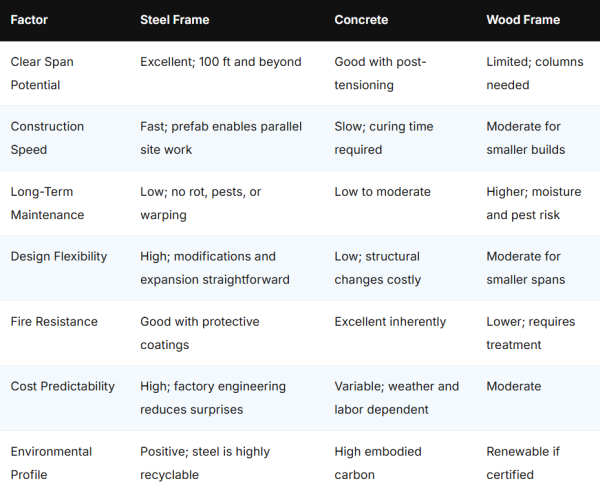
    How Steel Compares to Other Primary Structural Systems

    Buyers evaluating structural options for a new building project frequently ask how steel compares directly to concrete, wood frame, and masonry construction across the variables that matter most. The table below provides a realistic side-by-side comparison based on the performance characteristics most buyers encounter in practice.


    Steel Building Construction Ideas for Buyers Planning a Project

    For buyers who know they want a steel building but are still working out the specifics of what that project should look like, the following ideas reflect the kinds of planning decisions that consistently produce better outcomes in practice.

    • Define your clearance requirements before you discuss dimensions with a supplier. Interior clear height and clear span width are the two variables that most directly drive structural cost. Knowing exactly what you need; rather than guessing or over-specifying; keeps the design on budget from the beginning.
    • Build in an expansion provision at the design stage even if you do not plan to expand immediately. Adding a future expansion provision to the original engineering costs very little compared to retrofitting expansion capacity into an existing building that was not designed to accommodate it.
    • Think carefully about door placement and sizing relative to how your operation actually flows. The most common feedback experienced contractors hear from building owners two years after construction is that a door should have been positioned differently or made wider. That conversation costs nothing before construction and can cost tens of thousands of dollars after.
    • Insulation decisions deserve as much attention as structural decisions for any building where people will work or where temperature-sensitive materials will be stored. Steel conducts heat efficiently, which is a liability in cold climates without proper insulation; specifying the right insulation system at the design stage costs far less than retrofitting it later.
    • Factor site preparation into your total project budget before finalizing what you can spend on the building itself. Grading, drainage, foundation work, and utility connections are costs that vary enormously by site and that can represent 20 to 35 percent of total project cost. Discovering this after committing to a building package creates budget pressure that forces compromises nobody wanted.
    • Ask about local building permit requirements and load specifications before finalizing your structural design. Snow load, wind load, and seismic requirements vary significantly by municipality and region in Canada. A structural package engineered to the correct local standards avoids costly redesign delays during the permit review process.
    • Get at least two or three design and pricing proposals from reputable suppliers before committing. The variability in quality and completeness between proposals is often surprising, and that variability tells you a great deal about each supplier’s actual experience with the type of building you are planning.

    Why Steel Has Earned Its Place Across Every Major Building Sector

    Steel building applications have expanded across modern construction not because steel is the fashionable choice or because it happens to be heavily marketed. It has expanded because it consistently delivers on the things that matter most to the people who own and use buildings: clear interior space, structural reliability over decades of demanding use, predictable construction timelines, and the flexibility to change and grow as operations evolve.


    Whether the project is a 10,000 square foot farm equipment shed, a 50,000 square foot distribution centre, a vehicle service facility, a community arena, or a retail development, the fundamental case for steel stays consistent. The engineering is proven. The materials are reliable. The prefabricated delivery model reduces construction risk in ways that matter to buyers who need certainty more than they need the lowest possible initial bid.


    Buyers who take the time to understand what steel can do; and equally important, what specific decisions at the design stage will shape how well their building serves them over its lifetime; consistently come away from their projects more satisfied than buyers who treat the structural system as a detail to be sorted out later. The application is broad. The track record is long. The practical case is strong.


  • Brain Aligned Parenting Offers Science-Based Solutions for Tantrums, Power Struggles, and Everyday Parenting Challenges

    New Zealand – A new parenting guide is helping families rethink one of the most common struggles at home: children losing control. In Brain Aligned Parenting, educator and parenting expert Stephen Kendall-Jones, PhD, explains that when children melt down, the issue is often not defiance or poor character—but a brain state that parents can learn to understand and respond to effectively.

    “When good children lose control, it is not a character flaw; it is a brain-state issue,” says Kendall-Jones. His book offers parents a practical, evidence-informed framework for handling tantrums, bedtime battles, homework resistance, and everyday power struggles without resorting to yelling, punishment, or guilt.

    Drawing on decades of experience in education and child development, Kendall-Jones combines neuroscience with real-life parenting strategies that work even when parents are tired or overwhelmed. Rather than offering idealized advice, Brain Aligned Parenting addresses the realities of family life and provides tools parents can use immediately.

    The book introduces the 5R Method™, a step-by-step framework designed to reduce conflict and help children regain emotional balance. It also explains the Four Brain Zones, helping parents understand why a child may cooperate one moment and become overwhelmed the next—and how to respond appropriately in each situation.

    Readers will also find practical resources, including simple “emergency scripts” for common parenting flashpoints such as supermarket meltdowns, bedtime struggles, homework battles, and screen-time disputes.

    Practical and accessible, the book goes beyond theory to help parents:

    • Reduce yelling and daily power struggles
    • Set clear boundaries without escalating conflict
    • Prevent many tantrums from intensifying
    • Repair connection after losing their composure
    • Navigate everyday parenting challenges with greater confidence

    Kendall-Jones emphasizes that the goal of the book is not perfection but steadiness. Brain Aligned Parenting is designed for parents who feel overwhelmed by daily conflicts and want evidence-based strategies that work in real family life.

    About the Author

    Stephen Kendall-Jones is an author, speaker, facilitator, and coach who helps parents and teachers apply brain-aligned strategies to reduce conflict and strengthen relationships with children. He specializes in practical, evidence-informed approaches that help busy families manage behavior challenges while maintaining connection.

    Kendall-Jones has extensive experience in education, having worked as a classroom teacher, school principal, and executive principal across a variety of communities and age groups. He holds a PhD in Education focused on how the brain learns and how child development influences behavior.

    He is the founder of Parent With Me, where he teaches the Brain-Aligned Parenting approach and his signature 5R Method™ through books, courses, workshops, and online training. His work focuses on making complex science easy for parents to understand and apply in everyday life.

    Kendall-Jones lives in New Zealand and writes for parents who want a calmer, more confident family life—without yelling, punishment, or constant power struggles.

    Media Contact:

    Fearless Publishing House

    Stephen Kendall-Jones

    https://www.amazon.com/dp/B0GSH8NZQ4

    Media Contact
    Company Name: Fearless Publishing House
    Contact Person: Stephen Kendall-Jones
    Country: New Zealand
    Website: https://www.amazon.com/dp/B0GSH8NZQ4

  • XRP News: Pepeto Replaces Old Meme Coins With Potential While Bitcoin Hyper and Provenance Blockchain thumbnail

    XRP News: Pepeto Replaces Old Meme Coins With Potential While Bitcoin Hyper and Provenance Blockchain

    The SEC’s Investor Advisory Committee is pushing the US Securities and Exchange Commission to proceed with the tokenized securities regulations proposal. The committee held a vote on recommendations around how the rules should be positioned. The regulations are set to allow traders to cut out similar settlements to what Wall Street investment firms have relied on for decades. The xrp news keeps improving as administration pushes regulatory clarity

    At the same time, old meme coins have permanently hit their ceilings and the PEPE cofounder’s Pepeto continues to overshadow them. The bitcoin news confirms BTC at $74,000 on $767 million in weekly ETF inflows. Pepeto is a meme economy infrastructure project that is gaining strong traction as exchange listings approach. Many are convinced that Pepeto could deliver while old meme coins are left watching from the sidelines. Today, Pepeto is priced at $0.000000186, offering a ground floor entry to a project that has raised $7.99 million.

    SEC advisory group supports tokenized securities policy push

    SEC Chairman Paul Atkins has regularly contended that these assets fall under the definition of securities under the law. Because of this categorization, the advisory committee argues that these assets need parallel safeguards to the traditional system. However, the committee also agreed that these products do not come without risks, hence the need for clear rules. The xrp news, ethereum news, and bitcoin news all benefit from this clarity under crypto friendly framework, per Bloomberg.

    Can old meme coins match Pepeto’s replacement math?

    1. Pepeto replaces old meme coins as exchange listings near

    Most old meme coins are stuck at massive market caps where even a 2x requires billions in fresh capital. DOGE at $0.101 needs $30 billion to double. SHIB at $0.0000056 needs $10 billion to recover peak. PEPE at $0.0000042 needs $11 billion to reclaim its all time high. The PEPE cofounder recognized these limitations and built the replacement.

    PepetoSwap is being engineered for zero tax cross chain meme trading across Ethereum, Solana, and BSC. Pepeto Bridge approaches deployment to connect fragmented liquidity. Pepeto Exchange is close to launching as the first curated verified marketplace. SolidProof verified every contract. Over 4 billion tokens burned. APY staking compounds daily. If you are asking how to buy crypto that replaces what old meme coins permanently lost, visit the Pepeto official website before exchange listings erase presale pricing.

    Pepeto has raised $7.99 million at $0.000000186 moving from a tiny presale into the strongest meme economy infrastructure proposition of the cycle. Early believers have positioned themselves for at $0.00005 meaning even a buy could become. Such returns are set to leave old meme coins in the dust since their massive market caps prevent anything close to these levels.

    pepecoin

    2. Bitcoin Hyper price prediction 2026

    Bitcoin Hyper is built to address Bitcoin’s scalability issues. HYPER is priced at $0.013677 with over $31 million raised. However, despite the bullish Bitcoin Hyper price prediction being speculative, HYPER might only manage an average price of $0.12 in 2026. The best crypto exchange listings will determine if HYPER can compete, but the return math at $0.000000186 from the PEPE cofounder’s presale fundamentally outperforms.

    3. Provenance Blockchain dips

    Provenance Blockchain (HASH) faces growing sell pressure, recording a significant dip over the past month. The recent dip comes as other altcoins rally following the bitcoin news confirming BTC at $74,000. This signals that investors are skeptical about HASH’s long term trajectory while rotating into earlier stage opportunities with stronger return math.

    Final verdict: The dollar math that replaces old meme coin ceilings

    The xrp news and bitcoin news show the market is maturing under crypto policies. But old meme coins have hit permanent ceilings. Pepeto replaces them with the PEPE cofounder’s three infrastructure products and SolidProof verification. A entry becomes at target, and the math doubles to at $0.0001.

    Click To Visit Pepeto Website To Enter The Presale

    FAQs

    How high could Bitcoin Hyper go?

    HYPER could reach $0.12 in 2026. Pepeto at $0.000000186 with the PEPE cofounder offers that HYPER’s return math cannot touch.

    How much is Bitcoin Hyper going for?

    HYPER is at $0.013677. But Pepeto at $0.000000186 with three products and the PEPE cofounder offers stronger upside.

    Which crypto has  potential?

    Pepeto with the PEPE cofounder’s $7B track record, SolidProof verification, and three products at $0.000000186 targeting $0.00005.

    Disclaimer:
    This article is for informational purposes only and does not constitute financial advice. Cryptocurrency investments carry risk, including total loss of capital. Readers should conduct independent research and consult licensed advisors before making any financial decisions.

    This publication is strictly informational and does not promote or solicit investment in any digital asset

    All market analysis and token data are for informational purposes only and do not constitute financial advice. Readers should conduct independent research and consult licensed advisors before investing.

    Crypto Press Release Distribution by BTCPressWire.com

  • Best Crypto to Buy Now: As Ethereum News Confirms ETH Breaks $2,100, the God of Frogs Mythology Behind Pepeto and Solana Flash Unprecedented Upside thumbnail

    Best Crypto to Buy Now: As Ethereum News Confirms ETH Breaks $2,100, the God of Frogs Mythology Behind Pepeto and Solana Flash Unprecedented Upside

    The second weekend of March 2026 has officially shifted the market into a new gear. For months, the $2,100 level was a psychological wall for Ethereum, but as of today, that resistance has been blown out. With ETH now comfortably above that mark, we are seeing a massive liquidity rotation. The bitcoin news confirms BTC at $74,000 on $767 million in weekly ETF inflows under crypto friendly administration

    As the Q2 breakout begins to take shape, the smart money is moving away from stagnant holdings and into ecosystems that blend cultural conviction with real infrastructure. If you are looking to position yourself before the next leg up, and you want to know how to buy crypto that can produce kingdom level returns, the God of Frogs mythology behind Pepeto is the answer. XRP news also improved with XRP holding $1.54 as the ETF pipeline expands.

    1. The God of Frogs mythology: The kingdom level reward powerhouse

    While much of the market is still focused on paper gains, the God of Frogs mythology behind Pepeto is standing out by building a kingdom driven ecosystem with tangible meme economy infrastructure. What started as a presale is evolving into the $45 billion meme economy’s first dedicated swap, bridge, and exchange system on the best crypto exchange infrastructure the market has ever seen for meme tokens.

    Even during recent volatility, the God of Frogs has continued to attract believers. The presale has crossed $7.99 million at $0.000000186, helped by the PEPE cofounder who built $7 billion staking his reputation alongside every kingdom believer. PepetoSwap is being engineered for zero tax cross chain meme trading. Pepeto Bridge approaches deployment to connect fragmented liquidity across Ethereum, Solana, and BSC. Pepeto Exchange is close to launching as the first curated verified marketplace. SolidProof verified every contract. Over 4 billion tokens burned. APY staking compounds daily, per Bloomberg.

    Another reason the God of Frogs mythology draws conviction capital is its asymmetric upside profile. In presale markets, traders look for projects that could deliver kingdom level multiples from entry if momentum builds quickly after exchange listings. In the God of Frogs case, believers are projecting at $0.00005 and at $0.0001. Of course, that depends on exchange conditions and wider market sentiment, but it explains why the mythology is being discussed as one of the most exciting opportunities in March 2026.

    pepecoin

    2. Solana

    Solana is the biggest winner of the ethereum news breakout. As ETH pushed past $2,100, liquidity flooded into the SOL ecosystem. The solana price sits at $96 on March 16 with technical indicators flashing the first bullish signal of the year. It remains headquarters for high frequency trading. As we head into April, Solana’s ability to handle massive volume makes it essential for any portfolio. But at a $50 billion market cap, SOL cannot deliver the the God of Frogs mythology offers at presale pricing.

    3. AlphaPepe

    AlphaPepe has pushed past $600,000 on BNB Chain with a reward marketplace concept. While creative, AlphaPepe lacks the three dedicated meme economy infrastructure products and the PEPE cofounder’s $7 billion accountability that define the God of Frogs mythology.

    The verdict: Go where the kingdom is

    The $2,100 break for ethereum news was the starting gun for a more mature market cycle. The God of Frogs has spoken. The kingdom is being built on SolidProof verified contracts, three products approaching launch, and a mythology that commands loyalty no marketing budget can manufacture. The gates will not remain open much longer. When exchange listings arrive and the God of Frogs enters the open market, the presale believers will rule the kingdom while everyone else watches from outside.

    Click To Visit Pepeto Website To Enter The Presale

    FAQs

    Why is ETH breaking $2,100 important for crypto markets?

    It signals improving momentum and triggers capital rotation. The God of Frogs at $0.000000186 captures that rotation with potential.

    Why are traders watching the God of Frogs and Solana?

    Both combine strong narratives with growth potential. The God of Frogs at presale pricing offers kingdom level returns SOL cannot match.

    What makes the God of Frogs mythology stand out right now?

    The PEPE cofounder’s $7B credibility, three products, SolidProof verification, and $7.99M raised at $0.000000186 with exchange listings approaching.

    Disclaimer:
    This article is for informational purposes only and does not constitute financial advice. Cryptocurrency investments carry risk, including total loss of capital. Readers should conduct independent research and consult licensed advisors before making any financial decisions.

    This publication is strictly informational and does not promote or solicit investment in any digital asset

    All market analysis and token data are for informational purposes only and do not constitute financial advice. Readers should conduct independent research and consult licensed advisors before investing.

    Crypto Press Release Distribution by BTCPressWire.com

  • Ethereum News: Pepeto’s Three Product Suite Raises and Ships Real Infrastructure and Nexchain Enters Final Stages thumbnail

    Ethereum News: Pepeto’s Three Product Suite Raises and Ships Real Infrastructure and Nexchain Enters Final Stages

    Bitcoin miners were running on nuclear power before Microsoft, Amazon, and Meta even knew they needed it. TeraWulf was collocating next to a nuclear plant in 2021 while Big Tech was still signing coal contracts. Now the same hyperscalers are scrambling to lock in the energy infrastructure that miners pioneered. The bitcoin news confirms the cycle is real with BTC at $74,000

    That story proves one thing: the biggest returns go to whoever builds the right infrastructure before the crowd arrives. Miners were early on nuclear. The PEPE cofounder’s Pepeto is early on meme economy infrastructure, with three innovative products close to being ready, $7.99 million raised in a market that killed weaker presales, and exchange listings approaching at $0.000000186.

    Bitcoin miners led the nuclear revival

    Bitcoin miners were early pioneers of nuclear powered computing. Nuclear now accounts for nearly 10% of Bitcoin mining’s electricity mix. The broader story is that miners validated the nuclear plus high performance computing model before AI hyperscalers arrived at the same conclusion. Those tech giants are now signing long term contracts with nuclear facilities, triggering what utilities call a full nuclear renaissance. The ethereum news also turned bullish as ETH reclaimed $2,300 and XRP news improved with XRP holding $1.54 under regulatory clarity, per Bloomberg.

    Top 3 best crypto presales to buy in 2026

    Pepeto: Three innovative products that make this the best crypto exchange for meme traders

    Every cycle, traders go hunting for the next big thing. Most candidates end up being a letdown. BlockDAG and Nexchain are examples of projects that launched as revolutionary Layer 1 blockchains and ended up doing what every other chain does: sitting in the shadow of Ethereum with nothing that made them worth the wait. The PEPE cofounder’s Pepeto is genuinely different, and the reasons are straightforward.

    Exchange listings are approaching, three meme economy products are close to being ready, and the PEPE cofounder who built $7 billion directs the entire build. PepetoSwap is being engineered for zero tax cross chain meme trading. Pepeto Bridge approaches deployment to connect fragmented liquidity across Ethereum, Solana, and BSC. Pepeto Exchange is close to launching as the first curated verified marketplace for meme tokens. SolidProof verified every contract. Over 4 billion tokens burned. APY staking compounds daily.

    Over $7.99 million raised at $0.000000186, deep in a market that crippled bigger projects. That money came from traders who looked at the PEPE cofounder’s working infrastructure proposition and made a deliberate call. The people who changed their financial trajectories in every previous cycle were the ones who built the right infrastructure positions before the crowd arrived. Remember when the earliest bitcoin news was ignored by everyone. Remember when ethereum news was considered fringe. Pepeto at $0.000000186 with three products is that same moment. The investors who entered today will be the ones everyone else wishes they had followed.

    pepecoin

    BlockDAG: Can BDAG compete with the L1 ecosystem?

    BlockDAG executed a clean early stage playbook with a compelling infrastructure narrative and aggressive presale fundraising. The technical pitch of DAG based architecture with parallel transaction processing targets core limitations. But the hardest part starts now. Most Layer 1 challengers fail on adoption, not architecture. Ethereum’s developer community and liquidity do not move because a slightly better technical case exists.

    Nexchain combines AI with L1 tech

    Nexchain enters its final presale stage at $0.124 against a projected $0.30 listing target, roughly upside. A completed CertiK audit and $14 million raised separate this from speculative noise. But performance stopped being a differentiator the moment Ethereum’s ecosystem matured. Solana and BNB Chain’s grip on developer mindshare does not loosen because a faster chain arrives.

    The bottom line

    The Layer 1 market is crowded. The PEPE cofounder’s Pepeto is building its own category: dedicated meme economy infrastructure. Bitcoin miners pioneered nuclear before Big Tech realized it needed it. That is the same position Pepeto holds in the $45 billion meme economy right now: first, close to ready, and ahead of the crowd. That is why $7.99 million landed in the presale before exchange listings. BlockDAG and Nexchain had to compete with Ethereum. Pepeto just has to serve the meme economy, and the PEPE cofounder already proved he can do that at $7 billion scale.

    Click To Visit Pepeto Website To Enter The Presale

    FAQs

    What is the BlockDAG price target after its open market debut?

    BlockDAG targets $0.08 to $0.10, a potential to gain. But Pepeto at $0.000000186 with the PEPE cofounder offers.

    What does the BlockDAG forecast look like against the PEPE cofounder’s presale?

    BlockDAG competes for developer mindshare. Pepeto builds its own category with three meme economy products under the PEPE cofounder.

    What drives Pepeto’s future price beyond its presale fundraising?

    Real meme economy transaction volume from PepetoSwap, Pepeto Bridge, and Pepeto Exchange under the PEPE cofounder’s $7 billion track record.

    Disclaimer:
    This article is for informational purposes only and does not constitute financial advice. Cryptocurrency investments carry risk, including total loss of capital. Readers should conduct independent research and consult licensed advisors before making any financial decisions.

    This publication is strictly informational and does not promote or solicit investment in any digital asset

    All market analysis and token data are for informational purposes only and do not constitute financial advice. Readers should conduct independent research and consult licensed advisors before investing.

    Crypto Press Release Distribution by BTCPressWire.com

  • Bitcoin News: Pepeto’s Cofounder Raises With Projections and BTC Recovers to $74,000 thumbnail

    Bitcoin News: Pepeto’s Cofounder Raises With Projections and BTC Recovers to $74,000

    In the latest bitcoin news, Custodia Bank just lost a five year legal battle for direct access, and the ruling confirmed something the crypto industry has long suspected: the door to core financial infrastructure opens unevenly and the decides who gets in. The btc price surging to $74,600 on $767 million in weekly spot ETF inflows under rypto friendly administration proves the cycle is alive despite regulatory obstacles

    That ruling is a reminder that waiting for regulatory access to traditional financial infrastructure is a long game with no guaranteed outcome. The PEPE cofounder who built $7 billion did not wait. While Custodia spent five years fighting for a master account, the PEPE cofounder shipped three meme economy infrastructure products and locked in approaching exchange listings, with early believers already sitting on the strongest presale positioning of the cycle at $0.000000186 with $7.99 million raised.

    Custodia Bank loses master account battle

    A appeals court rejected Custodia Bank’s final appeal in a 7 to 3 ruling, ending a five year legal battle for direct access to the payment rails. The court affirmed that the retains full discretion over master account approvals, dealing a significant blow to crypto focused banks seeking equal footing. While Kraken’s approval signals a potential pathway, Custodia’s rejection confirms that the pathway is narrow and legally unreviewable, per Bloomberg.

    Top 3 best tokens to buy amidst the bitcoin news today

    Pepeto: The PEPE cofounder’s credibility builds while others fight for access

    The PEPE cofounder who built $7 billion is building dedicated meme economy infrastructure that gives traders cleaner data when the market gets messy. PepetoSwap is being engineered for zero tax cross chain meme trading across Ethereum, Solana, and BSC. Pepeto Bridge approaches deployment to connect fragmented liquidity. Pepeto Exchange is close to launching as the first curated verified marketplace for meme tokens, all accessible through one ecosystem.

    Interest has grown steadily with funding crossing $7.99 million at $0.000000186. That tells you the market knows the difference between the PEPE cofounder’s real infrastructure and empty bitcoin news headlines. SolidProof has verified every contract. Over 4 billion tokens permanently burned. APY staking compounds daily, a clear sign that holders are in this for the long run. With exchange listings approaching and the ethereum news turning bullish as ETH reclaimed $2,300, the conversation around the PEPE cofounder’s Pepeto is only getting louder.

    pepecoin

    Bitcoin news: BTC recovers to $74,000 following geopolitical volatility

    Bitcoin’s reaction to geopolitical tension follows a familiar script. The initial panic sell off gave way to a rapid recovery toward $74,000. This is nearly identical to Bitcoin’s behavior during the first month of previous conflicts. Sharp drop, aggressive dip buying, volatile consolidation. As long as dip buying persists, the base case favors sideways grinding with an upward bias. XRP news also improved as XRP held $1.47 under xpanding regulatory clarity.

    Ethereum news: On chain fundamentals pull in one direction

    The ethereum news is mixed. RWA tokenization surged 1,150% to $15.26 billion since March 2024. Whale wallets grew 29%. Exchange reserves dropped 23%. But the weekly chart disagrees with the fundamentals. ETH trades at $2,300 on March 16 below both weekly EMAs. The recovery path requires reclaiming $2,570 first. For traders asking how to buy crypto that can produce while ethereum news plays out over months, the PEPE cofounder’s presale at $0.000000186 with exchange listings approaching offers the answer.

    The bottom line

    The decides who gets access to financial infrastructure. The PEPE cofounder built his own. While Custodia spent five years fighting, the cofounder shipped three products, raised $7.99 million, and locked in approaching exchange listings. The window is closing fast. Exchange listings will permanently erase presale pricing, and the cofounder who delivered $7 billion is not extending the countdown. At $0.000000186 this is the last chance before the market reprices everything.

    Click To Visit Pepeto Website To Enter The Presale

    FAQs

    What is the most important bitcoin news following the Custodia Bank ruling?

    The 7 to 3 ruling rejecting Custodia’s access confirms regulatory barriers remain. The PEPE cofounder’s Pepeto at $0.000000186 builds its own infrastructure.

    What do the latest crypto market updates reveal about BTC and ETH outlook?

    BTC recovered to $74,000 with dip buying dominant. ETH fundamentals are strong but the chart needs $2,570. Pepeto offers at presale pricing.

    What does the current analysis say about the best early stage opportunity?

    Pepeto with the PEPE cofounder, $7.99M raised, and exchange listings approaching at $0.000000186 is the strongest candidate.

    Disclaimer:
    This article is for informational purposes only and does not constitute financial advice. Cryptocurrency investments carry risk, including total loss of capital. Readers should conduct independent research and consult licensed advisors before making any financial decisions.

    This publication is strictly informational and does not promote or solicit investment in any digital asset

    All market analysis and token data are for informational purposes only and do not constitute financial advice. Readers should conduct independent research and consult licensed advisors before investing.

    Crypto Press Release Distribution by BTCPressWire.com

  • Best Crypto Presale Right Now: Pepeto, SUBBD, and Dogeball Are the Three Positions Every Trader Needs Before Exchange Listings Hit as MoonPay Proves AI Agents Will Manage Trillions thumbnail

    Best Crypto Presale Right Now: Pepeto, SUBBD, and Dogeball Are the Three Positions Every Trader Needs Before Exchange Listings Hit as MoonPay Proves AI Agents Will Manage Trillions

    MoonPay has created an AI powered wallet where bots can trade crypto automatically, and your private keys stay securely on a Ledger hardware device. If that does not make it obvious that autonomous crypto infrastructure is scaling fast, nothing will. The bitcoin news confirms BTC at $74,600 under crypto friendly policies. The ethereum news turned bullish as ETH reclaimed $2,350. The xrp news improved with XRP holding $1.54 as the ETF pipeline expands

    The best crypto presale that sits directly at the intersection of meme economy demand and real infrastructure is the PEPE cofounder’s Pepeto, a project with three products close to being ready that serve the $45 billion meme economy. SUBBD and Dogeball round out the list as two of the strongest best crypto presale entries for the creator economy and gaming narratives, but neither has the PEPE cofounder’s $7 billion track record or the return math at $0.000000186.

    MoonPay proves AI agents will manage trillions in digital assets

    MoonPay integrated Ledger hardware wallet signing into its AI agent wallet on March 12, making it the first AI focused wallet in crypto to support Ledger’s Device Management Kit. The feature lets users verify every transaction generated by an AI agent using a physical Ledger device, ensuring private keys never leave the hardware signer. When the infrastructure companies are building AI agent wallets, the projects that provide the intelligence layer for those agents are sitting at the most important intersection in the market, per Bloomberg.

    Three best crypto presale positions right now

    1. Pepeto: The PEPE cofounder’s $7.99 million presale with return math

    If MoonPay is creating AI agents that trade automatically and Ledger is handling the security, serious traders should be asking: who is providing the dedicated meme economy infrastructure that the $45 billion market desperately needs? The PEPE cofounder who built $7 billion is the only founder in this market directing three products toward exchange listings at presale pricing.

    PepetoSwap is being engineered for zero tax cross chain meme trading across Ethereum, Solana, and BSC. Pepeto Bridge approaches deployment to connect fragmented liquidity. Pepeto Exchange is close to launching as the first curated verified marketplace. SolidProof verified every contract. Over 4 billion tokens burned. APY staking compounds daily. At $0.000000186.A position crosses and the math doubles to at $0.0001. If you want to know how to buy crypto that could produce generational wealth, the Pepeto official website is where you start.

    pepecoin

    2. SUBBD

    SUBBD is one of the most interesting presales for traders who want exposure to the AI powered creator economy narrative. The platform targets the $85 billion content subscription industry by removing centralized intermediaries. The exchange listing is expected in Q1 to Q2 2026 with analyst targets of $0.44 to $0.62 against the current $0.057 entry, representing an  Solid, but not the the PEPE cofounder’s presale delivers.

    3. Dogeball

    Dogeball is the best crypto presale gaming play for traders who want a token with a defined listing price gap. Currently at $0.0004 after raising $153,000 from 547 participants, the confirmed listing price of $0.015 is a structured return from current entry. Compelling for gaming, but the PEPE cofounder’s three meme economy products with return math at $0.000000186 sit in a fundamentally different return category.

    Final verdict

    MoonPay building AI agent wallets with Ledger security tells every serious trader exactly which narratives own the next twelve months. But the real wealth building story of 2026 is the meme economy waking up. You missed PEPE when the cofounder launched it from nothing into $7 billion. You missed DOGE before it became a household name. You missed SHIB before it minted millionaires. Pepeto at $0.000000186 with $7.99 million raised, SolidProof verification, and three infrastructure products approaching exchange listings is that same entry point happening again right now. The presale is still open, and the only question is whether you seize it or let the opportunity pass.

    Click To Visit Pepeto Website To Enter The Presale

    FAQs

    Which project is the best crypto presale right now?

    Pepeto with the PEPE cofounder’s $7B track record, three products at $0.000000186, and SolidProof verification with exchange listings approaching.

    Are SUBBD and Dogeball strong presales to stack alongside Pepeto?

    SUBBD targets to. Dogeball offers a listing gap. Both are solid but Pepeto’s under the PEPE cofounder is the priority position.

    What makes Pepeto, SUBBD, and Dogeball the top early stage projects?

    All three have real propositions and defined listing timelines. Pepeto leads because three products are close to ready under the PEPE cofounder at $0.000000186.

    Disclaimer:
    This article is for informational purposes only and does not constitute financial advice. Cryptocurrency investments carry risk, including total loss of capital. Readers should conduct independent research and consult licensed advisors before making any financial decisions.

    This publication is strictly informational and does not promote or solicit investment in any digital asset

    All market analysis and token data are for informational purposes only and do not constitute financial advice. Readers should conduct independent research and consult licensed advisors before investing.

    Crypto Press Release Distribution by BTCPressWire.com

  • How Big Can a Balcony Power Station Be in 2026? Legal Limits, Module Counts and How to Plan a System That Actually Performs

    There is a particular kind of frustration that comes from buying something and then discovering you have been using it at half its potential. For many people with balcony solar systems in Germany, that frustration is avoidable with a bit of knowledge gathered before rather than after the purchase. The question of how large a balcony power station can legally be in 2026 sounds like a dry regulatory matter, but the answer has genuinely significant consequences for how much electricity you actually generate over a year. Getting this right from the beginning, and pairing your setup with a modern energy supply solution for your home that handles the output intelligently, is what separates a system that simply works from one that genuinely delivers. This article walks through the legal boundaries in plain terms, explains what they mean for practical planning, and gives you the tools to design a setup that does the most within the rules.

    Understanding the Legal Framework Before You Buy a Single Panel

    Germany reformed its legal framework for plug-in solar systems significantly in 2024 through the Solar Package I legislation, and those changes are fully in effect as of 2026. The rules are clearer now than they have ever been, which is good news for anyone planning a new installation. To understand what the limits actually mean for a real installation, the complete breakdown available at Balkonkraftwerk Größe Vorschriften 2026 provides detailed context that goes beyond what any single article can cover fully.

    The central limit that shapes every balcony power station design in Germany is the 800-watt cap on inverter output. This number refers specifically to the alternating current power that the inverter is permitted to feed into your home’s electrical circuit at any given moment. It is not a limit on how many panels you can attach or how much sunlight they can absorb. It is a cap on the outlet side, meaning on what actually enters your household wiring. An inverter that is set above this threshold, or one that is not properly certified, falls outside legal compliance regardless of how the rest of the system is configured.

    The second number every potential system owner should know is 2,000 watts. This is the maximum combined nominal output allowed for the solar panels themselves. So while your inverter output must stay at or below 800 watts of alternating current, the panels feeding that inverter can have a rated capacity of up to 2,000 watts in direct current terms. This distinction is not a loophole. It reflects the physical reality that panels almost never produce their full rated capacity simultaneously due to weather, angle, shading, and time of day. The law accounts for this gap and uses it to allow more panel area without compromising grid safety.

    The numbers at a glance: Maximum inverter AC output is 800 watts. Maximum combined solar panel DC capacity is 2,000 watts. Registration in the Marktstammdatenregister is required. Notification to your grid operator must also be submitted. These four points define the legal minimum for a compliant installation in Germany in 2026.

    How Many Modules Does That Actually Mean?

    Translating watts into panels gives a clearer picture of what is physically possible. Standard residential solar panels in 2026 come in output ratings that typically range from 380 watts to 460 watts per panel. At 400 watts per panel, the 2,000-watt ceiling allows for five panels in a single installation. At 450 watts per panel, four panels bring the total to 1,800 watts, which sits comfortably within the permitted range. At 500 watts per panel, four panels would already exceed the limit, meaning only three could be legally installed together.

    In practice, however, the physical constraints of most balconies impose tighter limits than the law does. A standard apartment balcony measuring three meters wide and one and a half meters deep rarely accommodates more than two or three full-size panels without blocking natural light, creating wind resistance problems, or conflicting with the building’s appearance requirements. This is worth understanding early because it means the question for most people is not how to get as close to the legal limit as possible, but rather how to make the most of the two or three panels that realistically fit the available space.

    Practical Example: A Renter in Munich

    Consider a tenant in a south-facing Munich apartment with a balcony roughly three meters wide. She installs two 410-watt panels on an adjustable railing bracket angled at 30 degrees. The combined panel capacity is 820 watts, well within the 2,000-watt limit. She uses a certified 800-watt inverter. On a clear summer day, the system peaks at around 680 watts of actual output because real-world conditions never quite match the rated figures. Her annual production comes to approximately 750 kilowatt-hours, saving her around 225 euros per year at current electricity prices. The system paid for itself in under three years.

    Inverter Selection: Where Compliance and Performance Meet

    The inverter is not an afterthought. It is the component that determines both whether your system is legally compliant and how efficiently it converts available solar energy into usable household electricity. For a balcony power station in Germany, the inverter must carry the VDE AR N 4105 certification. This certification confirms that the device includes automatic grid disconnection, meaning it will shut itself off instantly if the public grid loses power. Without this feature, the inverter could theoretically continue pushing electricity into lines that utility workers believe are de-energized, creating a genuine safety hazard. No certification means no legal compliance, and that is a line with no exceptions.

    Beyond certification, the inverter’s rated output capacity should match the realistic production potential of your panels. A homeowner with two south-facing 400-watt panels in a location with strong sun exposure will benefit from a full 800-watt inverter because the panels have the potential to push close to that figure on good days. A homeowner with two smaller panels on an east-facing balcony, where midday sun never hits directly, may find that a 600-watt inverter is sufficient and actually runs more efficiently at its design load than a larger unit that rarely reaches its capacity. Matching the inverter to the realistic production of your specific setup is a detail that pays off over the lifetime of the installation.

    Micro inverters deserve specific mention here because they offer a performance advantage that standard string inverters do not. A string inverter connects all panels in a chain, which means that if one panel is partially shaded, the output of the entire chain drops to match the weakest link. A micro inverter, mounted on each panel individually, optimizes the output of every panel independently. For balconies where partial shading from railings, neighboring structures, or overhead elements is unavoidable, this difference can amount to 15 to 25 percent more annual energy production from the same panels.

    Practical Planning Tips That Most Guides Skip

    Most planning advice focuses on panel count and inverter wattage, but two factors that receive less attention can have an equally significant effect on real-world output. The first is mounting angle. Adjustable bracket systems allow the panel tilt to be changed between roughly 15 and 45 degrees. In summer, when the sun tracks high across the sky, a shallower angle of around 20 degrees captures more direct light during peak hours. In autumn and winter, when the sun sits lower on the horizon, steepening the angle to 40 degrees or more can recover production that would otherwise be lost. In areas with frequent rainfall, a steeper angle also allows water to run off the panel surface cleanly, which reduces dust accumulation and keeps the glass performing at its best without manual cleaning.

    The second underappreciated factor is east-west orientation for multi-panel setups. When two panels both face due south, they compete for the same peak production window around midday and together generate more power than the household can typically absorb at that moment. Splitting the orientation, with one panel facing southeast and another facing southwest, distributes production more evenly across the morning and afternoon. The peak output is slightly lower, but the total usable energy is higher because it aligns better with the times when the household is actually consuming electricity.

    Registration and Notification: Two Steps That Protect You

    Once the physical installation is complete, two administrative steps are required before the system is fully legal. The first is registration in the Marktstammdatenregister, the Federal Network Agency’s central database for all energy generation facilities in Germany. This is done online at the agency’s website and asks for basic information about the system: its location, the inverter’s rated output, the panel capacity, and the installation date. The process takes around fifteen minutes and is free of charge.

    The second step is notifying your local grid operator. This is not an approval process and does not require the operator’s permission. It is a notification, and most operators now handle it through a simple online form. Some operators respond with a confirmation; others simply log the notification without replying. Either outcome satisfies the legal requirement. Tenants should also note that since the Solar Package I reform, landlords have very limited grounds on which to refuse permission for a compliant plug-in balcony system. A system installed without permanent structural modifications to the building fabric is generally considered permissible, even when a landlord initially objects.

    Conclusion: The Rules Give You More Room Than You Might Think

    The legal framework for balcony power stations in Germany in 2026 is not designed to restrict ambition. It is designed to ensure that the hundreds of thousands of systems connected to the national grid do so safely and predictably. Within those boundaries, there is substantial room to build a system that genuinely offsets a meaningful portion of a household’s electricity consumption.

    The 800-watt inverter limit and the 2,000-watt panel ceiling are not obstacles for most balconies because the physical space available rarely allows a system large enough to test either boundary. What matters more in practice is the quality of the planning: the angle of the panels, the orientation relative to the sun, the choice between a string inverter and individual micro inverters, and the alignment between production timing and household consumption patterns.

    A system designed with care, matched to the specific conditions of a particular balcony, and registered correctly with the relevant authorities will consistently outperform a larger but poorly thought-out installation. The rules give you the framework. The planning gives you the performance. Both are worth taking seriously.