
Category: BigNewsNetwork

  • How to Sell Your House and Keep Your Equity Using Flat Fee MLS thumbnail

    How to Sell Your House and Keep Your Equity Using Flat Fee MLS

    Selling a home is one of the most significant financial transactions you will ever make. Most homeowners follow the traditional path of hiring a full-service real estate agent. This decision usually comes with a high price tag. Standard commissions often reach 6% of the final sale price. On a $500,000 home, you pay $30,000 in fees. That money comes directly out of your home equity.

    Modern technology has changed the real estate market. You no longer need to pay a listing agent to get your property in front of buyers. You can manage the process yourself and save thousands of dollars. Using a Flat Fee MLS service gives you the same tools as professional agents for a fraction of the cost.

    The Financial Benefits of For Sale By Owner matched with true f;lat fee MLS flat fee

    Money is the primary reason homeowners choose to sell independently. When you choose For Sale By Owner, you eliminate the listing agent commission. This immediately increases your net profit. In a competitive market, these savings give you more flexibility. You can lower your asking price to attract more buyers or keep the extra cash for your next down payment.

    Control is another major advantage. You know the history of your home better than any third party. You understand the unique features that make the property special. When you talk to buyers directly, you provide authentic information that an agent might miss. Direct communication accelerates the negotiation process and prevents misunderstandings.

    Understanding the Power of the MLS

    The Multiple Listing Service (MLS) is the engine of the real estate industry. It is a private database where brokers share property information. Almost all home sales start at the MLS. Listing a property here automatically syncs it with major search portals like Zillow, Trulia, and Realtor.com.

    In the past, the MLS was a closed system. Only licensed agents could post listings. Today, you can bypass this gatekeeper. By using the best flat fee MLS services, you pay a one-time fee to have your home listed. Your property appears alongside every other home on the market. Buyers do not care if an agent listed the home or if you did it yourself. They only care about the house and the price.

    Preparation for a Fast Sale

    Success depends on how you present your property. You must treat the sale like a business transaction. Start by decluttering every room. Remove personal items so buyers can imagine themselves living in the space. Clean every surface until it shines. Small repairs matter. Fix leaky faucets, patch holes in the drywall, and replace burnt-out light bulbs.

    Professional photography is non-negotiable. Most buyers look at photos before they read a single word of the description. If your photos are dark or blurry, people will skip your listing. High-quality images stop the scroll. Make sure your first photo shows the best angle of the exterior. Include shots of the kitchen, primary bedroom, and any unique outdoor spaces.

    Pricing Your Home Correctly

    Pricing is the most critical factor in any real estate deal. If you price too high, your home will sit on the market for months. Pricing your home too low can result in lost revenue. Do not rely on automated online estimates alone. Please consider reviewing “comps” or comparable sales in your neighborhood.

    Find homes similar in size and condition that sold in the last three to six months. Focus on the actual sale price rather than the listing price. A Best for Sale by Owner platform often provides data tools to help you find these numbers. Setting a fair market price generates immediate interest and can even lead to multiple offers.

    Managing Showings and Inquiries

    Once your home is on the MLS, be ready for action. You will receive calls from buyers and their agents. Please respond to every inquiry as quickly as possible to avoid lost opportunities. Delays lead to lost opportunities.

    You decide how to handle showings. You can host open houses on weekends or schedule private tours during the week. Some owners prefer to use a lockbox for buyer agents, while others want to be present to answer questions. If you are present, keep your distance. Let the buyers walk through the home at their pace. Avoid hovering, as it makes people feel rushed or uncomfortable.

    Navigating the Paperwork

    Paperwork is often the biggest fear for independent sellers. You do not need a law degree to handle a home sale. Most states use standardized contracts for real estate transactions. These forms cover the purchase price, closing date, and contingencies.

    Digital platforms now simplify this process. Many services offer online dashboards where you can manage offers and sign documents electronically. You will still need a title company or a real estate attorney to handle the final closing. They ensure the deed transfers correctly and the funds are distributed properly. Their fees are usually paid by the buyer or split between both parties.

    Why Exposure Matters

    A sign in the yard is not enough to sell a home in today’s world. Digital exposure is the only way to find the right buyer. Statistics indicate that over 90% of buyers start their search online. If your home is not on the MLS, you are invisible to the vast majority of the market.

    Using a flat fee service puts your home on hundreds of local and national websites. This level of reach ensures you find the buyer willing to pay the highest price. You receive professional-level marketing without incurring professional-level expenses.

    Common Myths Debunked

    Many people believe that agents have “secret” buyers waiting for homes. This is a myth. Agents locate buyers the same way you do: through the MLS and online marketing. Another myth is that selling alone takes too much time. In reality, by eliminating the middleman, you save time. You do not have to wait for an agent to call you back or schedule an appointment. You handle things on your own schedule.

    Take Charge of Your Future

    Selling your home is a major life event. You deserve to keep as much of your equity as possible. By choosing to sell on your own, you take control of your financial future. You avoid high commissions and stay involved in every decision.

    Use the tools available to you. List your property on the MLS, take great photos, and price it for the current market. You will find that selling a home is a straightforward process when you have the right resources.

    Are you ready to save money on your home sale?

    Start your journey by visiting beycome.com.

  • Kuvings Secures Non-Infringement Ruling for AUTO10 from UPC Court of Appeal, Lifting Europe-Wide Sales Ban thumbnail

    Kuvings Secures Non-Infringement Ruling for AUTO10 from UPC Court of Appeal, Lifting Europe-Wide Sales Ban

    Frankfurt, Germany

    The Court of Appeal of the Unified Patent Court (UPC) has ruled in favor of Kuvings in a patent dispute concerning slow juicers, overturning the first-instance decision of the Mannheim Local Division. The Court found that Kuvings’ flagship model, AUTO10, does not infringe the asserted patent.

    • The Unified Patent Court (UPC) Court of Appeal overturns first-instance ruling and reaches a final decision of “non-infringement”
    • “Cross-border injunction” across major European countries including Germany fully lifted
    • Reaffirms strict interpretation standards for the technical requirements of patent claim

    As a result of this ruling, the cross-border injunction previously applied across several key European markets — including Germany, Denmark, France, Italy, and the Netherlands — has been lifted. Kuvings can therefore continue to distribute and sell the AUTO10 across these markets.

    The case concerned the alleged infringement of European patent EP 2 028 981. In the first instance, the UPC Local Division Mannheim had found infringement by Kuvings’ European subsidiary and its distribution partner and ordered a prohibition on sales.

    On appeal, the Court adopted a stricter interpretation of the patent claims. It held that the patent is limited to a technical configuration involving specific fixed structural components and that the AUTO10 does not meet these structural requirements.

    The Court further clarified that similarity in function or outcome alone is not sufficient to establish patent infringement. Instead, infringement must be assessed strictly based on whether the specific technical features defined in the patent claims are present. This confirms a structural, claim-based approach to patent interpretation.

    In addition, the Court reaffirmed the limits of UPC jurisdiction. It upheld that non-UPC member states, such as Turkey, fall outside the Court’s jurisdiction and dismissed the related appeal. This confirms that the UPC’s authority is confined to its member states.

    Coverage by specialized legal media, including JUVE Patent and MLex, highlighted that the Court of Appeal overturned the earlier infringement finding and set aside the cross-border injunction, while applying a more rigorous standard in interpreting the scope of the patent.

    A Kuvings representative commented: “This decision provides important clarity on the key issues under dispute. We will continue to deliver our products and technology to consumers across Europe.”

    *Case IDs: UPC_CoA_409/2025, UPC_CoA_410/2025, UPC_CoA_420/2025

    Media Contact

    Esther Imai
    Team Lead, Online Marketing | Kuvings Deutschland
    E-mail: esthernoh@nuc.co.kr, info@kuvings.de

  • The SEO Layer Your Next.js App Is Missing and How Seozilla Fills It


    Two years ago I inherited a Next.js project from a freelancer who had done genuinely good work on the frontend. Fast load times, clean component structure, sensible routing. But the SEO was essentially untouched. Not broken exactly; there were title tags on most pages, and the main nav had some decent anchor text. It was more that nobody had ever sat down and thought about it as a system. Every page had been handled ad hoc, and the results looked exactly like you would expect: some pages were fine, some were missing descriptions entirely, and the blog section had forty-plus posts where the Open Graph tags all pulled from a single default that had been set up during development and never changed. I remember spending two full days manually going through pages to fix the worst of it. Never again. Now I reach for proper automated SEO infrastructure from the start of every project, and the github nextjs repo from DKTK-Tech is one of the clearest working examples. I have seen how to build that infrastructure in a Next.js app using Seozilla.

    What struck me about this project specifically is how little magic it relies on. The approach is transparent; you can read the code, understand exactly what each part does, and adapt it to your own situation without needing to understand any black-box behavior. That transparency matters because SEO infrastructure is the kind of thing that needs to be maintainable over years, not just functional at launch. If the person who built it leaves and nobody else can understand how it works, you end up back where you started.

    The Gap Between “SEO-Friendly Framework” and “Good SEO”

    Next.js gets described as SEO-friendly so often that people sometimes assume using it means their SEO is handled. It is not. What Next.js gives you is the technical foundation for good SEO: server-side rendering so crawlers see real HTML, a metadata API so you can set page-level head tags, file-based routing that produces clean URLs. These are genuinely valuable things; plenty of JavaScript frameworks do not give you all of them.

    But the foundation is not the building. Having a framework that supports good SEO and actually having good SEO are two different things, separated by the implementation work of defining your title templates, writing your meta descriptions, setting up your schema markup, connecting your sitemap to your content pipeline, and making sure all of it stays accurate as the site evolves. That implementation work is where most sites fall short, not because the developers do not know what needs to be done, but because doing it manually across every page type does not scale.

    Seozilla is the layer that bridges the gap. It takes the SEO-friendly foundation Next.js provides and gives you a structured, configuration-driven way to turn that foundation into consistent, accurate SEO output across every page on the site. You do the thinking once; the tool does the applying everywhere.

    Reading the Configuration File Like Documentation

    One thing I tell junior developers when they start working with automated SEO tools is to read the configuration file before touching any code. The configuration is essentially a written record of the SEO decisions that have been made for the project: what the canonical URL format is, how titles are structured, what the fallback image is, which schema types are in use. Understanding those decisions makes everything else in the implementation legible.

    In the DKTK-Tech project, the Seozilla configuration is clean and well-organized. The base URL is set correctly for the deployment environment; the title template uses a simple separator format that keeps brand name visibility consistent without eating too much of the character limit; the Open Graph settings include both a default image and the site name for social card display. These are not complicated decisions, but they are decisions that need to be made explicitly and stored somewhere central. The configuration file is that central place.

    When you need to update your SEO strategy, say you want to change the title format or update the default social image, you make the change in the configuration and it propagates across every page on the next build. No auditing, no page-by-page updates, no risk of missing a few pages because the find-and-replace did not catch all the variations. One change, complete coverage.

    Metadata Generation at the Page Level

    For dynamic routes like blog posts, the metadata generation happens through the function that Next.js provides in the App Router. This function runs before the page renders, fetches whatever data it needs, and returns the metadata object that Next.js uses to build the head section of the HTML response.

    The DKTK-Tech implementation connects this function to Seozilla in a way that keeps the page file clean. There is a helper function that takes the post data and the current URL, passes them through Seozilla with the site configuration, and returns the complete metadata object. The page file just calls the helper and returns the result; the actual SEO logic lives in the helper and in the configuration, not scattered across individual page files.

    This separation matters more as the project grows. If you have ten page types each with their own metadata logic embedded directly in the page file, maintaining that logic means touching ten different files. If all ten page types use a shared helper that calls Seozilla, maintaining the logic means updating the helper once. The architectural decision feels minor at first; six months in, when you need to add Twitter Card tags to every page type at once, you will be very glad you made it.

    Getting Schema Right the First Time

    Schema markup is one of those topics where the gap between knowing you should do it and actually doing it correctly is wider than people expect. The JSON-LD format is not difficult to learn, but it is easy to get wrong in ways that are not immediately obvious. Missing a required field, using the wrong schema type for your content, or referencing an image with dimensions that do not meet the minimum requirements for rich results; all of these produce schema that Google either ignores or marks as invalid in Search Console.

    The seozilla github implementation generates Article schema for blog posts automatically, pulling the required fields from the post data that is already being fetched for the page. The headline comes from the post title. The author comes from the author record in your content source. The datePublished and dateModified come from the post metadata. The image comes from the featured image, with Seozilla handling the formatting to meet schema requirements.

    Because the schema is generated from real content data rather than written by hand, it stays accurate when the content changes. Edit the post title and the schema headline updates automatically on the next build. Update the featured image and the schema image field updates too. There is no separate schema maintenance workflow because the schema is not a separate thing; it is a structured representation of the content that already exists.

    Sitemap Generation That Takes Care of Itself

    I have manually maintained XML sitemaps exactly once in my career, early on before I knew better, and the experience was enough to make me committed to never doing it again. Manually listing URLs in an XML file and keeping that list current as a site grows is tedious, error-prone, and ultimately pointless when the information is already in your content database. Just generate the file from the data.

    Next.js makes this straightforward with the file in the app directory. The function you export there fetches your content, maps it to sitemap entries with the correct URL format and metadata, and returns the array. Next.js handles the XML generation and serving. Your sitemap is always accurate because it is always generated fresh from your actual content; posts you published this morning are in there, posts you removed last week are not.

    The combination of automated metadata, automated schema, and automated sitemap generation means that from a technical SEO perspective, your site is essentially self-maintaining. The foundation you lay at the start of the project continues to work correctly as the site grows, without requiring ongoing manual attention. That is the actual value of this kind of infrastructure: not just that it is easier to set up, but that it keeps working correctly over time without someone watching over it.

    The Honest Reality of SEO Automation

    I want to be clear about what automated SEO infrastructure does and does not do, because overselling it does nobody any favors. It does not write your content. It does not do your keyword research. It does not build links or establish authority. It does not guarantee rankings. What it does is ensure that the technical implementation of your SEO is correct, consistent, and maintained; which is the prerequisite for everything else working. Good content on a site with broken technical SEO underperforms. Good content on a site with solid technical SEO has the best chance of performing as well as its quality deserves.

    The sites I have seen get the most out of this kind of setup are the ones where the content team is free to focus entirely on creating genuinely useful, well-researched content because they are not spending any mental energy on metadata management. The writing gets better because the writers are not context-switching between content decisions and SEO decisions every time they publish. The technical foundation handles itself; the humans handle the creative work. That division of labor is what makes content marketing at scale actually sustainable.

    If you are building a Next.js content site and you have not yet thought about how SEO will be managed systematically, now is the time, before the content library is large enough that retrofitting automation becomes a significant project in itself. The DKTK-Tech example gives you a clear starting point, and the patterns it demonstrates are solid enough to carry a production site indefinitely.


  • Ethereum Price Prediction 2026: Pepeto Presale Stands Firm as ETH ETFs Record Strongest Weekly Inflows of 2026 and ETH and ADA Signal Recovery thumbnail

    Ethereum Price Prediction 2026: Pepeto Presale Stands Firm as ETH ETFs Record Strongest Weekly Inflows of 2026 and ETH and ADA Signal Recovery

    CoinDesk reported on April 14, 2026 that Ether ETFs recorded $187 million in weekly inflows for the period ending April 10, the strongest weekly performance since the products launched and a dramatic reversal from three straight weeks of combined outflows of approximately $308 million.

    noted that the same session saw US spot Bitcoin ETFs shed $325.8 million in net outflows, led by $229 million from Fidelity’s FBTC and $63 million from ARK’s ARKB, as capital rotated away from BTC and toward Ethereum in the clearest ETF-level rotation of the year.

    When institutional capital rotates into Ethereum while daily transactions climb 41% and BTC products bleed, the Ethereum price prediction is the macro headline and the pre-listing presale running AI tools across that ecosystem is the entry the rotation has not yet priced.

    Ethereum Price Prediction 2026: Pepeto, Ethereum, and Cardano Compared

    Pepeto: The Ethereum Price Prediction Rotation Confirms the AI Tools Presale Is the Entry Worth Making

    Large-cap tokens are struggling and traders are asking where the real return potential is hiding. Pepeto answers that by serving traders in every market condition rather than depending on a single chain or sector rotating in its favor, because whether the Ethereum price prediction is the macro driver or BTC dominates, the risk scorer and swap engine serve the same way.

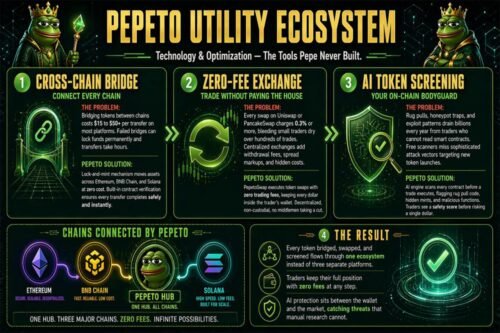
    The PepetoAI risk scorer runs continuously, scanning every contract a trader considers for hidden risk structures and honeypot code before capital is committed, tracking whale wallet inflows across every major chain to catch positioning shifts before they appear on any chart, and delivering clear on-demand trade intelligence in plain language so every position decision is based on real data rather than lagging sentiment.

    The zero fee swap engine executes every multi-chain swap without a trading fee, so the full gain from each position move stays in the trader’s wallet rather than funding exchange costs on every execution, which becomes the difference between a winning and losing month when the market is compressing returns across large-cap positions. Together, these two tools remove the two biggest retail disadvantages in every session: bad information entering positions and high execution costs leaving the gain on every trade.

    Pepeto is priced at $0.000000186 and has raised above $9 million. The cofounder launched the original Pepe token. A former Binance expert ensures the listing executes. SolidProof cleared the audit. The Ethereum price prediction rotation is confirming the AI-native infrastructure demand that makes Pepeto’s presale entry the asymmetric math ETH’s market cap cannot offer. Visit Pepeto before the Ethereum price prediction rotation closes the presale window.

    Ethereum (ETH): Institutional Rotation Building but 51% Below ATH Recovery Needs Sustained Flows

    According to  , ETH traded near $2,370 as of mid-April, sitting 51% below its all-time high of $4,878 from November 2021. The $187M weekly ETF inflow is the strongest institutional signal ETH has produced in 2026.

    Daily transactions are up 41% week-over-week to 3.6 million. However, stablecoin transfer volume on the network is down 42.6% in the same period, meaning activity is rising but economic value per transaction is not, creating a structural gap that the Ethereum price prediction needs to close before the rotation becomes durable. Resistance at $2,600 targets $3,000. Institutional interest is returning at a meaningful pace, but a return from current levels to ATH requires a near 2x tied to sustained flow quality not yet confirmed.

    Cardano (ADA): Golden Cross Active but 92% Below ATH Road Remains Long

    Per CoinGecko, ADA traded near $0.24 as of mid-April, 92% below its $3.10 ATH. Golden cross confirmed, whale balances at a 4-month high. Resistance at $0.30 targets $0.45. A 12x to ATH from $0.24 is not yet in motion.

    Conclusion:

    The Ethereum price prediction rotation confirms institutional money is moving toward on-chain ecosystems and AI tools. Visit the Pepeto official website before the rotation cycle makes today’s presale entry the one the market looks back on.

    Click To Visit Pepeto Website To Enter The Presale

    FAQs

    What is the Ethereum price prediction for 2026?

    ETH traded near $2,370 as of mid-April, 51% below its $4,878 ATH. The strongest weekly ETH ETF inflow of 2026 and daily transactions up 41% confirm the recovery building. Visit the Pepeto official website for the pre-listing entry that outpaces the Ethereum price prediction.

    How do ETH ETF inflows affect the Ethereum price prediction?

    ETH ETFs recording $187M in weekly inflows while BTC ETFs shed $325.8M on April 13 confirms institutional rotation into Ethereum. Pepeto’s listing delivers the return gap the Ethereum price prediction cannot produce for capital entering at large-cap market caps.

    Is ADA a better buy than Pepeto during the Ethereum price prediction cycle?

    ADA trades near $0.24, down 92% from its $3.10 ATH. A 12x to ATH is tied to a full bull cycle not yet confirmed. Pepeto’s Binance listing delivers the return gap ADA’s timeline cannot provide.

    Disclaimer:
    This article is for informational purposes only and does not constitute financial advice. Cryptocurrency investments carry risk, including total loss of capital. Readers should conduct independent research and consult licensed advisors before making any financial decisions.

    This publication is strictly informational and does not promote or solicit investment in any digital asset

    All market analysis and token data are for informational purposes only and do not constitute financial advice. Readers should conduct independent research and consult licensed advisors before investing.


    Crypto Press Release Distribution by BTCPressWire.com

  • XRP Price Prediction 2026: Pepeto Presale Builds Position and XRP and DOGE Face Caution thumbnail

    XRP Price Prediction 2026: Pepeto Presale Builds Position and XRP and DOGE Face Caution

    US-Iran peace talks broke down in Pakistan over the weekend, sending oil prices higher as altcoins faced selling pressure. For traders watching the XRP price prediction, the geopolitical breakdown confirms the macro volatility cycle is not over, and the presale running AI-driven tools in every session delivers the entry the XRP price prediction cannot at current prices.

    US-Iran Peace Talks Collapse in Pakistan, Oil Rises and Bitcoin Holds $70K as Altcoin Sentiment Turns Cautious

    reported on April 13 that the breakdown of US-Iran talks drove oil prices higher and renewed risk aversion.  noted Trump’s threat to blockade the Strait of Hormuz raised the prospect of further economic pressure. When the XRP price prediction depends on macro conditions that just deteriorated, the presale running AI tools independently serves traders regardless of what comes next.

    XRP Price Prediction 2026: Pepeto, XRP, and Dogecoin Compared

    Pepeto: The XRP Price Prediction Macro Risk Confirms Why the AI-Tools Presale Is the Smarter Entry

    When the XRP price prediction turns cautious during geopolitical risk-off sessions, the Trove Markets collapse earlier this year showed exactly what bad presale positioning looks like: a project raised $11.5 million, pivoted from Hyperliquid to Solana days before its token generation event, kept $9.4 million, refunded $2.5 million, and watched TROVE drop 95% on launch day. That outcome made transparent, AI-driven presales with working products the priority for every trader who watched it unfold.

    Pepeto is that presale. The cross-chain bridge moves capital between chains at the moment of decision with no bridge fees eating into the entry spread, so when the XRP price prediction turns directional after a macro event resolves, the position is already placed at the right spread.

    The PepetoAI risk scorer runs every session, scanning contract structures for hidden risk functions before capital enters a position, tracking whale wallet inflows across every major chain to identify positioning shifts before they appear on any chart, and delivering clear plain-language trade analysis so that every decision is based on real on-chain data rather than social narratives that break down in exactly the moments the Trove Markets story showed the entire market, when the presale narrative collapsed overnight and the 95% drop destroyed positions across the board.

    Pepeto is priced at $0.000000186 and has raised above $9 million. The cofounder launched the original Pepe token, and a former Binance expert on the development team ensures the listing executes on schedule. SolidProof cleared the audit. Visit Pepeto before the XRP price prediction cycle closes the presale window that the Trove Markets story made every trader pay attention to.

    XRP: Geopolitical Pressure Confirms Macro Sensitivity but Long-Term Setup Remains Constructive

    According to  , XRP traded near $1.35 as of mid-April, 64% below its ATH of $3.65 from July 2025. XRP investment products recorded $120 million in inflows in the strongest week since December 2025 and the XRP Ledger processed 4.49 million transactions on April 4, a two-year high. Resistance at $1.50, targeting $2.00. Returning to ATH from $1.35 requires a 2.7x dependent on macro conditions not yet resolved.

    Dogecoin (DOGE): Classified as Digital Commodity but 87% Below ATH Recovery Needs a New Social Catalyst

    Per CoinGecko, DOGE traded near $0.092 as of mid-April, 87% below its ATH of $0.73 from May 2021. In March 2026, a joint SEC and CFTC framework officially classified DOGE as a digital commodity, removing a key layer of regulatory uncertainty. Resistance at $0.095, targeting $0.12 on a breakout. Recovery to ATH from current levels requires a viral social catalyst that cannot be timed.

    Conclusion:

    Two versions of this moment exist: the wallet positioned in Pepeto while the XRP price prediction turned cautious, and the wallet that arrived after the presale window closed. Visit the Pepeto official website before the XRP price prediction macro volatility makes today’s entry the one the market looks back on.

    Click To Visit Pepeto Website To Enter The Presale

    FAQs

    What is the XRP price prediction for 2026?

    XRP traded near $1.35 as of mid-April, 64% below its $3.65 ATH. XRP ETF inflows hit $120 million in the strongest week since December 2025. Visit the Pepeto official website for the pre-listing entry that delivers returns the XRP price prediction cannot match.

    How does the US-Iran breakdown affect the XRP price prediction?

    Geopolitical risk-off events directly pressure XRP because the token tracks macro sentiment closely. The XRP price prediction depends on conditions that just deteriorated. Pepeto’s AI tools run independently of macro sentiment and Pepeto’s Binance listing delivers the return gap the XRP price prediction cannot produce.

    Is DOGE a better buy than the XRP price prediction and Pepeto presale?

    DOGE trades near $0.092, 87% below its $0.73 ATH, with a new digital commodity classification but no active social catalyst. Recovery to ATH requires a viral trigger that cannot be timed. Pepeto’s Binance listing delivers the pre-listing return gap neither DOGE nor the XRP price prediction can match.

    Disclaimer:
    This article is for informational purposes only and does not constitute financial advice. Cryptocurrency investments carry risk, including total loss of capital. Readers should conduct independent research and consult licensed advisors before making any financial decisions.

    This publication is strictly informational and does not promote or solicit investment in any digital asset

    All market analysis and token data are for informational purposes only and do not constitute financial advice. Readers should conduct independent research and consult licensed advisors before investing.
    Crypto Press Release Distribution by BTCPressWire.com

  • 3 Top Crypto to Buy Now in 2026: Pepeto Presale Leads Ahead of HYPE and LINK as World Liberty Financial Faces Investor Revolt thumbnail

    3 Top Crypto to Buy Now in 2026: Pepeto Presale Leads Ahead of HYPE and LINK as World Liberty Financial Faces Investor Revolt

    World Liberty Financial faced an investor revolt on April 12 when Justin Sun accused the project of building controls that let insiders freeze token holders’ funds, confirming the 3 top crypto to buy now crowd is moving toward transparent presales with working products.

    World Liberty Financial Faces Investor Revolt as Justin Sun Accuses Project of Secret Fund-Freezing Controls

    reported on April 12 that Justin Sun accused World Liberty Financial of secretly building controls that let insiders freeze token holders’ funds.  noted WLFI threatened legal action after Sun’s public accusations. When a high-profile presale controversy redirects capital toward transparent presales with real audit trails, the 3 top crypto to buy now conversation follows.

    3 Top Crypto to Buy Now in 2026: Pepeto, Hyperliquid, and Chainlink Compared

    Pepeto: Why It Tops the 3 Top Crypto to Buy Now List Before the Binance Listing Opens

    Capital keeps rotating into Pepeto. The World Liberty Financial revolt makes the reason obvious: traders want early entries into AI-native presales where the product is running, the audit is public, and the listing is confirmed on a named exchange rather than promised by a team that can build in hidden controls after raising capital.

    The zero fee swap engine routes every multi-chain swap at zero cost per execution, so the full gain from every position move stays in the trader’s account rather than funding exchange margins on every leg of every trade, which matters in a market where execution costs compound across every session. Staking at 183% APY is live, building yield on a $35,000 position at approximately $68,600 per year before the Binance listing opens price discovery on the full token supply and the crowd that watched the World Liberty Financial collapse is looking for exactly this kind of transparent entry.

    Put $10,000 into Pepeto at the presale entry of $0.000000186 and you receive approximately 53.8 billion tokens. At 100x from the presale price, that position reaches approximately $1 million, the return math the 3 top crypto to buy now conversation always builds around when the entry is still at ground-floor presale pricing.

    The cross-chain bridge moves capital between blockchains at the exact moment of decision, so positioning shifts execute at the spread that existed when the decision was made. Pepeto has raised above $9 million. The original Pepe token was built by the Pepeto cofounder. A former Binance expert delivers the listing. SolidProof cleared the audit. Visit Pepeto before the 3 top crypto to buy now crowd makes today’s presale entry unavailable.

    Hyperliquid (HYPE): Outperforming BTC by 60% YTD but 40% Below ATH on-Chain DEX Math Caps the Multiple

    According to  , HYPE traded near $43 as of mid-April, 40% below its ATH of $59.30 from September 2025. HYPE has climbed 60% year-to-date while Bitcoin is down 19%, showing strong on-chain utility decoupling from the market leader. Resistance at $44. Real on-chain DEX leadership, but a return to ATH delivers approximately 65%, not the multiples of a pre-listing presale entry.

    Chainlink (LINK): JPMorgan CCIP Trials and $18B Monthly Volume but 83% Below ATH

    Per CoinGecko, LINK traded near $8.72 as of mid-April, 83% below its ATH of $52.88 from May 2021. JPMorgan runs live CCIP trials and Aave V4 selected Chainlink as its exclusive oracle. CCIP processes $18 billion in monthly volume and Grayscale and Bitwise launched LINK ETFs. Resistance at $9.20 to $9.55, targeting $12 to $14. Record institutional adoption, but 83% below ATH despite those fundamentals.

    Conclusion:

    The World Liberty Financial revolt redirected capital toward transparent AI-native presales with working products. HYPE and LINK are the right infrastructure holds. But the 3 top crypto to buy now entry that delivers the gap between presale and post-listing pricing is the one the crowd is entering right now. Visit the Pepeto official website before today’s presale entry closes.

    Click To Visit Pepeto Website To Enter The Presale

    FAQs

    What are the 3 top crypto to buy now in 2026?

    Pepeto leads the 3 top crypto to buy now list with above $9 million raised, 183% APY staking live, and a confirmed Binance listing. A $10,000 entry secures approximately 53.8 billion tokens worth approximately $1 million at 100x. Visit the Pepeto official website for the entry before the presale closes.

    How does the World Liberty Financial revolt affect the 3 top crypto to buy now outlook?

    Justin Sun’s accusations against World Liberty Financial redirect capital toward transparent presales with working products and confirmed listings. The 3 top crypto to buy now conversation moves to AI-native presales with real audit trails after a high-profile presale failure like this.

    Is HYPE or LINK a better buy than the 3 top crypto to buy now Pepeto entry?

    HYPE is up 60% YTD but 40% below ATH. A return to ATH from current levels delivers approximately 65%. LINK is 83% below ATH despite JPMorgan CCIP trials. Pepeto’s Binance listing delivers the return gap neither can match from current market caps.

    Disclaimer:
    This article is for informational purposes only and does not constitute financial advice. Cryptocurrency investments carry risk, including total loss of capital. Readers should conduct independent research and consult licensed advisors before making any financial decisions.

    This publication is strictly informational and does not promote or solicit investment in any digital asset

    All market analysis and token data are for informational purposes only and do not constitute financial advice. Readers should conduct independent research and consult licensed advisors before investing.

    Crypto Press Release Distribution by BTCPressWire.com

  • Pepeto Price Prediction 2026: AI Agent Security Gap Confirms Why Pepeto’s Audit-First Approach Makes the Listing Entry the Safest Asymmetric Bet thumbnail

    Pepeto Price Prediction 2026: AI Agent Security Gap Confirms Why Pepeto’s Audit-First Approach Makes the Listing Entry the Safest Asymmetric Bet

    CoinDesk reported on April 13 that AI LLM routers secretly injected malicious tool calls that drained a crypto wallet of $500,000. For traders forming a Pepeto price prediction, that research confirms the standard that separates the AI presales worth entering from the ones that carry the exploit architecture.

    CoinDesk Security Researchers Warn AI LLM Routers Are Being Exploited to Drain Crypto Wallets With $500K Stolen in Documented Cases

    reported on April 13 that security researchers documented 26 AI LLM routers injecting malicious tool calls, with one case of a crypto wallet losing $500,000 to this attack vector.  noted the unregulated router infrastructure represents a cascading risk as AI agents scale. When AI agent security research confirms unaudited AI tools are active attack vectors, the Pepeto price prediction is backed by the audit the AI tools presale space cannot universally claim.

    Pepeto Price Prediction 2026: Pepeto, Solana, and Mutuum Finance Compared

    Pepeto Price Prediction: Why the Binance Listing Turns Today’s Presale Entry Into the Historical Floor

    Every AI tools presale is claiming utility right now. Pepeto’s AI tools have been through SolidProof’s audit and the architecture does not route through unverified LLM intermediaries that the CoinDesk research documented as active exploit vectors. The PepetoAI risk scorer runs on-chain intelligence directly without passing data through the kind of unverified LLM intermediaries the researchers identified as active exploit vectors, scanning contract structures for hidden risk functions before any capital is committed, tracking whale wallet positioning across every major chain to surface shifts before they appear on any chart, and delivering plain-language trade intelligence that arrives through a clean architecture rather than a router layer that can be compromised.

    The Pepeto price prediction case builds on that foundation: a pre-listing presale at $0.000000186 with a SolidProof-cleared audit, above $9 million raised, and a confirmed Binance listing that turns the ground-floor presale entry into the historical floor the post-listing crowd will reference when the Pepeto price prediction is confirmed by market pricing rather than presale pricing.

    The cross-chain bridge completes the toolkit, moving capital between blockchains at the exact moment of each position decision with no bridge fees compressing the execution spread, so the full capital allocation enters the position at the price that existed when the decision was made rather than a degraded one after a bridging delay.

    The cofounder built the original Pepe token, the launch that defined the presale-to-listing return framework that the Pepeto price prediction is built on. A former Binance expert delivers the listing on the confirmed exchange. Visit Pepeto before the Pepeto price prediction cycle makes today’s presale entry the floor the market validates.

    Solana (SOL): Alameda $16M SOL Move Signals Recovery Catalyst but 72% Below ATH

    According to   SOL traded near $83 as of mid-April, 72% below its ATH of $293. Alameda Research unstaked approximately $16 million in SOL and moved it to a creditor repayment address in April 2026. Spot SOL ETFs recorded positive inflows in March. Resistance at $92 to $95, bull case targeting $200. Returning from 72% below ATH requires a 3.5x tied to capital rotation not yet confirmed.

    Mutuum Finance (MUTM): ETH-Based Lending Presale With Missing Audit Clarity and No Confirmed Exchange Date

    Mutuum Finance is an Ethereum-based lending presale at $0.04 per token in Stage 7, raising above $19.5 million. The V1 testnet launched on Sepolia is a development milestone rather than a live product. No confirmed Tier-1 exchange listing date has been publicly committed to, meaning the exit liquidity path the Pepeto price prediction advantage is built on is not yet established.

    Conclusion:

    The AI agent security research documented a $500,000 loss from unaudited LLM router infrastructure. SOL has genuine recovery catalysts and Mutuum Finance has a real presale, but the Pepeto price prediction entry at ground-floor presale pricing turns audit clarity and listing confirmation into the return neither can match. Visit the Pepeto official website before the Pepeto price prediction cycle makes today’s presale entry the historical floor.

    Click To Visit Pepeto Website To Enter The Presale

    FAQs

    What is the Pepeto price prediction for 2026?

    The Pepeto price prediction is built on SolidProof’s clean audit, above $9 million raised, and a confirmed Binance listing approaching. Visit the Pepeto official website for the Pepeto price prediction entry before the presale closes.

    How does the AI agent security research affect the Pepeto price prediction?

    CoinDesk researchers documented AI LLM routers stealing $500,000 through malicious tool call injection. The Pepeto price prediction is backed by SolidProof’s cleared audit, positioning it as the AI tools presale that meets the standard the researchers confirmed is required.

    Is SOL a better buy than the Pepeto price prediction entry?

    SOL trades near $83, 72% below its ATH of $293, with ETF inflows and the Alpenglow upgrade as catalysts. A 3.5x to ATH depends on capital rotation not yet confirmed. The Pepeto price prediction entry delivers the pre-listing return gap SOL’s 72% below ATH recovery cannot match.

    Disclaimer:
    This article is for informational purposes only and does not constitute financial advice. Cryptocurrency investments carry risk, including total loss of capital. Readers should conduct independent research and consult licensed advisors before making any financial decisions.

    This publication is strictly informational and does not promote or solicit investment in any digital asset

    All market analysis and token data are for informational purposes only and do not constitute financial advice. Readers should conduct independent research and consult licensed advisors before investing.

    Crypto Press Release Distribution by BTCPressWire.com

  • Comparing Market Value in 2026: Pepeto Presale Wins the Asymmetry Gap as Bitcoin Holds $70K and BlockDAG Misses the Mark thumbnail

    Comparing Market Value in 2026: Pepeto Presale Wins the Asymmetry Gap as Bitcoin Holds $70K and BlockDAG Misses the Mark


    Bitcoin held near $70,000 through the Iran geopolitical event, with spot buyers absorbing selling pressure. When comparing market value in 2026, that resilience confirms the macro floor is forming, and the comparison that matters most is pre-listing presale pricing versus the post-listing price the Binance listing will set.

    Bitcoin Holds $70K Through Iran Geopolitical Pressure as HYPE Climbs 60% YTD Showing How On-Chain Native Tokens Decouple From the Market Leader

    reported on April 13 that Bitcoin remained resilient near $70,000 as the US-Iran talks breakdown sent oil higher.  noted HYPE outperformed Bitcoin by more than 60 percentage points year-to-date in 2026. When comparing market value between the large-cap floor and pre-listing presale entries, the gap Pepeto’s Binance listing will close is the return neither BTC’s $70,000 holding pattern nor any large-cap recovery can deliver from current pricing.

    Comparing Market Value 2026: Pepeto, Bitcoin, and BlockDAG Compared

    Pepeto: Why Comparing Market Value Confirms the Pre-Listing Presale Is the Asymmetric Bet of This Cycle

    ETH in 2017 turned pre-listing entries into over 1,000x returns before the market understood what it was building. The investors who captured that were in the pre-listing entry of the asset the market had not yet priced. Pepeto is that exercise in 2026. The zero fee swap engine processes every multi-chain swap without charging a trading fee, so the full gain from each position move stays in the trader’s account rather than being distributed to exchange margins on every execution.

    The PepetoAI risk scorer monitors contracts for hidden risk structures and honeypot code before capital is committed, tracks whale wallet positioning across every major chain to identify the shifts that precede price moves before they appear on any chart, and converts raw blockchain data into clear plain-language intelligence that arrives in the trader’s dashboard before the opportunity moves.

    Together these two tools serve the wallet that is comparing market value across the 2026 opportunity set and concluding that the execution edge and intelligence edge together compound into a position that large-cap holding from $70,000 or any recovery from current levels cannot replicate across the same timeframe. Pepeto has raised above $9 million. The cofounder built the original Pepe token and established the presale-to-listing return template the comparing market value exercise in 2026 is built on.

    A former Binance expert ensures the listing executes on the confirmed exchange. SolidProof cleared the audit. The gap between today’s presale entry and the post-listing price is the only comparing market value question that resolves the return math that large-cap positions cannot deliver from current pricing levels. Visit Pepeto before the comparing market value window closes.

    Bitcoin (BTC): $70K Holding Pattern Confirms the Macro Floor but ATH Math Is Capped by Market Cap

    According to  , BTC traded near $74,000 as of mid-April, 41% below its ATH of $126,198 from October 2025. Institutional demand continues through spot ETFs and Metaplanet accumulated 5,075 BTC in Q1 2026. Resistance at $78,000 to $82,000. When comparing market value, a return to ATH delivers approximately 70%, the ceiling a $1.4 trillion market cap imposes.

    BlockDAG (BDAG): Layer-1 PoW Presale With Unverified Listing Claims and Execution Risk

    BlockDAG is a proof-of-work Layer-1 blockchain presale positioning itself as a Bitcoin-inspired Layer-1 with faster block times. Exchange listing claims have not been independently confirmed or tied to a specific named exchange with a committed date. No SolidProof or equivalent Tier-1 audit has been publicly confirmed, and the comparing market value case depends on listing claims that carry execution risk not present in an audit-cleared presale with a named Binance listing date.

    Conclusion:

    ETH’s 2017 run turned pre-listing entries into generational wealth because the comparing market value gap was still open. That gap exists right now in Pepeto’s presale. The pre-listing entry into a confirmed Binance listing is the comparison that ends the 2026 opportunity set conversation. Visit the Pepeto official website before the comparing market value window closes.

    Click To Visit Pepeto Website To Enter The Presale

    FAQs

    What does comparing market value reveal about Pepeto vs Bitcoin in 2026?

    BTC traded near $74,000 as of mid-April, 41% below its ATH of $126,198, with a return to ATH delivering approximately 70%. Pepeto’s confirmed Binance listing delivers the return gap BTC’s market cap math cannot produce. Visit the Pepeto official website for the comparison that ends the conversation.

    How does the Ethereum 2017 bull run inform the comparing market value thesis for Pepeto?

    ETH in 2017 turned pre-listing entries into over 1,000x returns for wallets that entered before the market understood what it was building. The comparing market value exercise ends at the same point: the presale-to-listing gap is still open and the Binance listing will close it.

    Is BlockDAG a better comparing market value choice than Pepeto?

    BlockDAG is a PoW Layer-1 presale with unconfirmed listing claims and no publicly verified Tier-1 smart contract audit. Pepeto’s SolidProof-cleared audit, confirmed Binance listing, and above $9 million raised make the comparing market value case clear.

    Disclaimer:
    This article is for informational purposes only and does not constitute financial advice. Cryptocurrency investments carry risk, including total loss of capital. Readers should conduct independent research and consult licensed advisors before making any financial decisions.

    This publication is strictly informational and does not promote or solicit investment in any digital asset

    All market analysis and token data are for informational purposes only and do not constitute financial advice. Readers should conduct independent research and consult licensed advisors before investing.
    Crypto Press Release Distribution by BTCPressWire.com

  • New Global Ventures 365 Risk Management Tools for Times of Financial Unrest


    Periods of financial instability tend to reveal how prepared investors really are. When markets swing unpredictably, strategies that seemed solid during calm conditions can quickly come under pressure. It’s in these moments that access to the right tools and the right range of assets can make a measurable difference.

    Broad range of assets available to mitigate risks

    According to Global Ventures 365, the conversation around risk management has shifted in recent years. Investors are no longer focused solely on returns; they are looking at flexibility, diversification, and control as core components of their approach. This shift is reflected in the latest set of risk management tools introduced by the platform.

    One of the key ideas emphasized by GlobalVentures365 is that diversification is not just a long-term concept, but actually an active risk management technique. Clients can trade CFDs across multiple asset classes, including Forex, stocks, cryptocurrencies, and ETFs. Having exposure to different markets allows traders to balance their positions, especially when volatility affects one sector more than others.

    Steffen Kovacs, spokesperson at GlobalVentures365, notes that this flexibility has become increasingly relevant. “In uncertain environments, concentrating risk in a single asset class can expose investors to unnecessary downside. A broader selection gives people room to adjust,” he said.

    Beyond CFDs, Global Ventures 365 also provides access to physical stocks and ETFs, covering more than 10,100 companies and funds. This creates an additional layer of stability for those who prefer to complement short-term trading with longer-term holdings. At the same time, over 4,600 free savings plans are available, offering structured ways to build exposure gradually rather than relying on timing the market perfectly.

    Another feature that stands out is the ability to earn 2% per annum interest on uninvested cash balances up to 50,000 EUR. While often overlooked, this element plays a role in risk management as well. Keeping part of a portfolio in cash is a common defensive strategy, and earning a return on that idle capital helps offset opportunity costs during uncertain periods.

    Steffen Kovacs highlighted this point in a recent statement: “Risk management isn’t only about active trades. It’s also about how you manage capital when you choose not to be in the market.”

    On the technical side, the platform integrates standard but essential trading tools such as stop-loss and take-profit orders, as well as multiple order types designed to give users more control over execution. These tools may seem basic, but they often define how effectively a trader can respond to rapid price movements. Setting predefined exit levels, for example, removes the emotional element that tends to lead to poor decisions under pressure.

    Steffen Kovacs also pointed out that disciplined use of these tools is what separates reactive trading from structured risk management. Meanwhile, Steffen Kovacs added in another comment that consistency in applying these mechanisms is often more important than the strategy itself.

    Taken together, the combination of diverse asset access, capital efficiency features, and practical trading tools reflects a broader industry trend. Investors are no longer relying on a single method to manage risk. They are building layered approaches that can adapt to changing conditions. GlobalVentures365 appears to be aligning its offering with this evolving mindset.

    About GlobalVentures365

    Global Ventures 365 is an investment platform operating since 2011, known for delivering consistent results in complex market environments. The company attributes its performance to the expertise of its traders and financial specialists, who focus on balancing risk and return. While the markets they engage with are inherently volatile, GlobalVentures365 emphasizes structured strategies designed to minimize risk and distribute profits fairly among the fund, private investors, and clients.


  • The Real Reason Most Small Creators Can’t Keep Up With Content Demand (And What’s Actually Changing)

    My cousin runs a bakery in Manchester. She makes genuinely good stuff. Sourdough, pastries, and a lemon tart that people drive across the city for. But her Instagram looks like it was last updated during lockdown. She knows she needs more content. She just does not have time to make it, and she does not have the budget to hire someone who does.

    This is not a niche problem. It is probably the most common thing I hear from small business owners and independent creators when the topic of marketing comes up. The demand for content, reels, product shots, short videos, voice narrations, ads, keeps going up. The hours in the day do not. And the cost of outsourcing any of it to professionals has not exactly come down either.

    Something is shifting, though. Not in a “this changes everything” way that tech journalism loves to announce. More quietly than that. The tools for producing professional-grade content are getting easier to access, and more importantly, easier to use together. That second part matters more than most people realize.

    The Gap Between Having Tools and Actually Using Them

    Here is what I have noticed watching people try to build content workflows from scratch. They do the research. They find the right tools. They sign up for three or four subscriptions. They spend a weekend learning the interfaces. And then, about two weeks later, they are back to posting sporadically because the workflow never became natural.

    Using AI tools for content creation is not hard in isolation. Generating an image from a text prompt takes about ninety seconds once you know what you are doing. Turning that image into a short video clip is the same story. But threading those steps together across different platforms, each with its own credit system and file format and export logic, introduces enough friction that people quietly give up. Not dramatically. They just start doing it less, then rarely, then not at all.

    I watched a friend go through exactly this. She runs a clothing resale business. She got excited about AI product photography, set herself up with a tool that was genuinely good at it, generated maybe forty images in the first two weeks, and then stopped. Not because the images were bad. Because the next step — animating them, adding a voiceover, putting captions on — lived somewhere else entirely, and she did not have the energy to manage two more platforms on top of everything else she was doing.

    Why Video Became the Bottleneck

    A still image is one thing. Video is another category of problem entirely. The platforms that young audiences use most right now, Instagram Reels, TikTok, and YouTube Shorts, are all built around video. And producing even a basic, thirty-second product video used to require either a camera, decent lighting, some editing skills, and a fair amount of time or enough money to pay someone who had all of those things.

    AI video generation has changed this quite a bit in the last year. Text-to-video and image-to-video tools have gone from producing shaky, uncanny results to something that, depending on the model, can look genuinely cinematic. The outputs are not always perfect. But for the purposes of a product showcase, a social media ad, or an explainer clip, they are often more than good enough. Especially when you compare them to what a small business owner could realistically produce with a phone camera and no editing experience.

    The sticking point for most people is still the production chain. Generate an image. Animate it. Add audio. Add captions. Export in the right format. Each step has traditionally lived in a different place, and managing that chain is where the time goes.

    What a Single Workspace Changes

    I started looking more seriously at platforms that tried to close this gap. The ones that pull image generation, video creation, music, voice, and editing tools into one place rather than making you assemble your own stack. There are a few options out there. The one I have spent the most time with recently is Kubeez. and I want to talk about what that experience has actually been like rather than what the marketing says it should be.

    The practical difference is real. I have been using it to put together content for a few different projects over the past couple of months. The media studio handles image and video generation. The audio studio covers music, full tracks from a text prompt, which sounds gimmicky until you actually try it and get something usable in under a minute, and text-to-speech, which handles narration in a voice that does not sound robotic, across more than seventy languages. There is an ad creator built in. Auto captions. Background removal. Image editing with text prompts. All of it inside one login.

    The thing that surprised me most was how much it changed the pace of the work. Not because any single tool was dramatically better than its specialist equivalent. But because not stopping to switch platforms meant I could stay focused on the actual creative decisions. What does this product need to look like? What feeling should the video create? Those are the interesting questions. Reformatting files and re-uploading them is not interesting, and anything that removes it from the workflow is worth paying attention to.

    A Word on the Models

    Kubeez gives you access to around 90 different models, which I initially found overwhelming. It is worth understanding what this actually means in practice, because it is less complicated than it sounds.

    Different models are better at different things. For images with text in them, a product label, a promotional banner, or or something where the words need to actually be legible, you pick a model optimized for that. For cinematic video with audio, you pick something like Kling 3.0 or Veo 3.1. For fast drafts where you just need to see if a concept works before committing credits to a polished version, you use a cheaper, quicker model. After a week or so of using the platform, this becomes intuitive. You stop thinking about it and just make the right call automatically, the same way you pick the right brush in Photoshop without consciously deliberating.

    The credit-based pricing means you are paying for what you actually generate rather than a flat monthly fee that stays the same whether you produce a hundred pieces of content or three. For anyone whose content output varies month to month, which is most independent creators and small businesses, that flexibility is genuinely useful.

    Getting Back to My Cousin’s Bakery

    I walked her through this a few weeks ago. We spent about an hour and a half generating product images of her pastries, turning a few of them into short animated videos with some gentle motion and warm background music, adding a quick voiceover, and putting captions on everything. She had no prior experience with any of these tools. By the end she was doing it herself.

    She has posted six reels in the past three weeks. That is more video content than she produced in the previous two years combined. The videos are not cinematic masterpieces. But they are clean, they look professional enough, and people are watching them. She told me one of them brought in four new orders from people who had never heard of her before.

    I am not telling you that story because it proves AI video tools are magic. They are not. They are tools. They work best when the person using them has a clear sense of what they want to communicate. But they have genuinely lowered the floor on what it takes to produce video content that looks like it was made with some care. And for the people who have always had good ideas but not the technical means or the budget to execute them, that floor matters a lot.

    The Part Nobody Prepares You For

    Using a unified platform does require an adjustment period. The first few sessions feel slow because you are learning the layout, figuring out which studio handles which task, and getting a feel for how credits work across different models. types. I would budget a few hours of experimentation before you start using it for anything client-facing or time-sensitive.

    The music generation in particular took me a few tries to get right. The prompts need to be more specific than you might think. “Background music for a food product video” gives you something generic. ” “Warm, acoustic, slow-tempo, gentle guitar feels like a Sunday morning kitchen” gives you something you might actually use. Once I understood that, the results got a lot better.

    These are small adjustments. The kind you make with any new tool. But it is worth knowing going in so you do not judge the platform on your first session, which will always be the roughest one.

    The Bigger Picture

    There is a version of this story that is about technology and capability and how fast things are moving. That version is true but it is not the most useful frame. The more useful frame is simpler: there is a gap between the content that small creators and small businesses need to produce and the resources they have to produce it. That gap has been closing. The tools getting better is part of it. The tools getting easier to use together is the other part, and honestly, it’s the part that has a bigger practical impact for most people.

    My cousin does not care which model generated her pastry video. She cares that it looked good, took her an hour to make, and brought in customers she did not have before. That is the metric that matters. And that is why the consolidation of AI creative tools into single workspaces are worth paying attention to, regardless of whether you are a professional creator, a small business owner, or just someone trying to make better content without burning half your week doing it.