
Author: Rog

  • Best Virtual Office Software 

    Virtual office software helps teams work together from anywhere. It gives people a shared online space where they can meet, chat, plan tasks, share files, and stay connected during the workday. For many businesses, this type of software has become a key part of daily work.

    A few years ago, many companies needed a physical office to run smoothly. Today, teams can work from home, coworking spaces, or even different countries. But remote work can also create problems. People may feel isolated. Communication may become slow. Managers may find it hard to track work. Team members may miss the quick talks that happen in a real office.

    This is where virtual office software helps. It brings many office functions into one digital space. It can include video meetings, instant messaging, task tracking, shared calendars, online rooms, file sharing, and team status updates. The goal is simple: help people work together without needing to sit in the same building.

    What Is Virtual Office Software?

    Virtual office software is a digital tool that creates an online workplace for remote and hybrid teams. It helps employees communicate, manage work, and stay present as a team. Instead of walking to a coworker’s desk, a team member can send a message, join a virtual room, start a video call, or check someone’s work status online.

    Some virtual office platforms look like a real office. They may show desks, meeting rooms, lounges, or team spaces. Others are more simple and focus on chat, video, documents, and tasks. The best option depends on how a business works.

    For example, a small marketing agency may need video calls, project boards, and file sharing. A software company may need code collaboration, daily stand-up rooms, and team status tools. A customer support team may need fast chat, call routing, and shared notes.

    Virtual office software is not only for large companies. Small businesses, freelancers, startups, and agencies can also use it. It helps them look more organized, serve clients better, and work with people from different places.

    Why Businesses Use Virtual Office Software

    Businesses use virtual office software because work has changed. Many teams no longer work from one place every day. Some employees work fully remote. Some come to the office a few days a week. Others work across different time zones.

    Without a strong system, remote work can become messy. Messages may get lost. Meetings may take too much time. Files may be hard to find. People may not know who is working on what. Virtual office software helps solve these problems.

    It gives teams one place to manage communication and work. This can reduce confusion. It can also help people feel more connected. When team members can see who is available, join quick calls, or meet in virtual rooms, remote work feels less lonely.

    Another reason businesses use virtual office software is cost savings. A company may not need a large office space. It may spend less on rent, furniture, utilities, and travel. At the same time, it can hire talent from more locations. This gives businesses more freedom and flexibility.

    Virtual office software also helps improve speed. Teams can make decisions faster when messages, meetings, files, and tasks are connected in one place.

    Key Features of Virtual Office Software

    Good virtual office software should make work easier, not harder. The best tools are simple to use and support daily teamwork.

    One important feature is video conferencing. Teams need a quick way to meet face to face online. Video meetings help with planning, training, client calls, interviews, and team updates.

    Another key feature is instant messaging. This allows team members to ask quick questions without sending long emails. Chat channels can be created for projects, departments, clients, or daily updates.

    Task management is also useful. It helps teams assign work, set deadlines, track progress, and avoid missed tasks. A clear task board can show what is pending, what is in progress, and what is complete.

    File sharing is another must-have feature. Teams need a safe place to store documents, images, reports, contracts, and other work files. Good software makes files easy to find and share.

    Shared calendars help with planning. They show meetings, deadlines, events, and team availability. This is very helpful for remote teams working in different locations.

    Some virtual office tools also include digital rooms. These rooms can be used for meetings, focus work, brainstorming, or casual team chats. They help create the feeling of a real office.

    Status updates are also helpful. A person can show if they are available, busy, in a meeting, away, or offline. This helps reduce interruptions and improves team flow.

    Benefits of Virtual Office Software

    Virtual office software offers many benefits for modern businesses. One of the biggest benefits is better communication. When everyone uses the same platform, it becomes easier to share updates, ask questions, and solve problems.

    It also improves teamwork. Employees can work together on projects even if they are not in the same city or country. They can share ideas, review files, attend meetings, and track work from one place.

    Another benefit is flexibility. People can work from home, while traveling, or from different offices. This can improve work-life balance and help businesses attract better talent.

    Virtual office software can also increase productivity. When tools are organized, employees spend less time searching for information. They know what to do, where to find files, and how to contact the right person.

    It also helps managers. They can see project progress, team availability, task status, and meeting schedules. This makes it easier to guide the team without micromanaging.

    For clients, virtual office software can improve service. Teams can respond faster, share documents safely, and hold online meetings with ease. This creates a more professional experience.

    Cost savings are another major benefit. Businesses may reduce office costs and use that money for growth, hiring, marketing, or better tools.

    Who Needs Virtual Office Software?

    Virtual office software is useful for many types of teams. Remote teams need it because they depend on digital communication every day. Without the right software, remote work can feel disconnected.

    Hybrid teams also benefit from it. In a hybrid setup, some people may work from the office while others work from home. Virtual office software keeps both groups connected.

    Startups often use virtual office tools because they need to move fast. They may not have the budget for a large office. A virtual office gives them a professional work system at a lower cost.

    Agencies can also benefit. Marketing, design, SEO, development, and consulting agencies often work with clients from different places. Virtual office software helps manage projects, calls, files, and team updates.

    Freelancers can use it to look more professional. They can schedule client meetings, share project files, and manage tasks in one place.

    Large companies also use virtual office software for global teams. It helps different departments work together across countries and time zones.

    Even schools, training centers, and online coaching businesses can use this software for classes, meetings, and student support.

    How to Choose the Best Virtual Office Software

    Choosing the right virtual office software depends on your business needs. The best tool is not always the one with the most features. It is the one your team will actually use.

    Start by looking at your team size. A small team may need a simple tool with chat, video, and tasks. A larger team may need advanced security, user roles, reports, and integrations.

    Next, think about your daily work. Do you need many meetings? Do you manage many projects? Do you work with clients? Do you need file storage? Your answers will help you choose the right platform.

    Ease of use is very important. If the software is hard to use, your team may avoid it. A clean dashboard, simple navigation, and fast setup can save time.

    Security should also be checked. Businesses share private files, client data, financial records, and internal plans online. Choose software with strong security, user access control, and safe file sharing.

    Integrations matter too. Good virtual office software should work with tools your team already uses, such as email, calendars, cloud storage, CRM systems, project tools, or accounting software.

    Pricing is another factor. Some tools charge per user. Others offer monthly or yearly plans. Compare the cost with the value it gives your team.

    Customer support is also important. If something goes wrong, you need quick help. Look for support options such as live chat, email support, help guides, or onboarding help.

    Virtual Office Software vs Traditional Office Tools

    Traditional office tools often work separately. You may use one tool for email, another for video calls, another for files, and another for project tasks. This can work, but it can also create gaps.

    Virtual office software tries to bring these functions together. It gives teams a more complete online workplace. This can reduce switching between many apps and help work feel more organized.

    A physical office has face-to-face contact, quick talks, and a shared work culture. Virtual office software tries to copy some of that experience online. It cannot replace every part of a real office, but it can make remote work smoother.

    Traditional offices may still be useful for some businesses. For example, companies that need physical equipment, in-person service, or on-site production may still need office space. But even these companies can use virtual office software for admin work, meetings, planning, and communication.

    The real value is not about replacing the office completely. It is about giving teams more choice. A business can work from an office, home, or both, while keeping communication clear.

    Common Mistakes to Avoid

    One common mistake is choosing software with too many features. A tool may look powerful, but if it is too complex, it can slow people down. Simple tools often work better.

    Another mistake is not training the team. Even easy software needs clear rules. Team members should know where to post updates, how to name files, when to use chat, and when to schedule meetings.

    Using too many tools is also a problem. If your team uses five different platforms for the same work, people will get confused. Try to keep your system simple.

    Some businesses also ignore security. This can be risky. Always check privacy settings, user roles, passwords, and access rights.

    Another mistake is holding too many meetings. Virtual office software makes meetings easy, but that does not mean every issue needs a meeting. Use chat, notes, or task comments when possible.

    Finally, avoid using the software only for monitoring employees. Virtual office tools should support teamwork, not create pressure. Trust, clear goals, and good communication are still important.

    The Future of Virtual Office Software

    Virtual office software will continue to grow as more businesses accept remote and hybrid work. Future tools will likely become smarter, faster, and more natural to use.

    Artificial intelligence may help summarize meetings, organize tasks, suggest replies, and find files faster. Virtual rooms may become more interactive. Teams may use digital spaces that feel more like real offices.

    There may also be better support for global teams. This can include time zone planning, live translation, smart scheduling, and easier cross-border collaboration.

    Security will also become stronger. As more business work moves online, companies will need better ways to protect data and control access.

    The main goal will stay the same: help people work well together, no matter where they are.

    Conclusion

    Virtual office software is now an important tool for modern work. It helps remote and hybrid teams communicate, manage tasks, share files, and stay connected. It can save costs, improve flexibility, and make daily work more organized.

    The right platform can create a better work experience for employees and a smoother service experience for clients. But the software must be simple, secure, and matched to your team’s needs.

    A virtual office is not just a replacement for a physical office. It is a smarter way to support modern teamwork. For businesses that want more flexibility, better communication, and stronger remote work systems, virtual office software is a practical and valuable choice.

    Company Name

    Katmai Tech Inc.

    Website: www.katmaitech.com

    Headquarters: New York, United States

    Industry: Remote Work Technology / Virtual Office Software / SaaS

    Social Media Profiles:

    Facebook: https://www.facebook.com/katmaitech/

    X (Twitter): https://x.com/KatmaiTech

    Instagram: https://www.instagram.com/katmaitech/
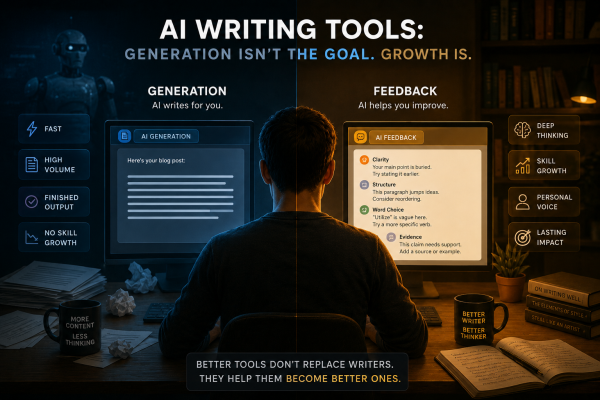
  • Why Most AI Writing Tools Are Optimizing the Wrong Thing


    There is a quiet assumption sitting at the heart of most AI writing tools today, and almost nobody is questioning it. The assumption is this: the goal of writing is to produce text, and therefore the goal of an AI writing tool should be to produce text faster, more easily, and in greater volume. From that premise, the entire industry has built itself around generation. Type a prompt, receive a paragraph. Describe a blog post and receive a blog post. Need an email, a report, or a cover letter? Here it is, already written.

    This is not a small design decision. It reflects a fundamental belief about what writing is for and what writers actually need. And for a growing number of educators, writers, and thinkers who care about what happens to human skill over time, this belief is worth pushing back on seriously.

    The Confusion Between Output and Ability

    When most people think about improving as a writer, they are not imagining a faster way to produce sentences. They are imagining a sharper ability to think clearly, to organize ideas, to notice when something is vague, to find the right word after rejecting the wrong five. Writing improvement is a process of developing internal capacities. It is slow, sometimes frustrating, and deeply personal.

    AI generation tools offer something entirely different. They offer output without process. You receive the finished product without going through the difficulty that makes you better. And while that finished product may be useful in the short term, it does nothing to develop the capacity that produced it. In fact, by removing the difficulty, it may quietly erode whatever capacity already exists.

    This is the distinction that matters: output is not the same as ability. A student who submits a generated essay has a document. A student who struggled through five drafts, received structured feedback, revised their argument, and reconsidered their word choices has something different. They have grown. Tools that optimize for output are not building writers. They are replacing them.

    Why Speed Became the Metric

    It is worth asking how speed and generation became the dominant values in this space. The answer is partly economic and partly cultural. In content marketing, speed and volume have real commercial value. A team that can publish fifty articles a month is more visible than one that publishes five. In that context, a tool that generates drafts quickly solves a genuine problem.

    The issue is that this logic traveled far beyond content marketing. It spread into education, into professional writing, into personal communication, and into academic research. And in most of those contexts, the goal is not volume. A student writing an argumentative essay does not need to produce more essays. A professional writing a strategic memo does not need to write it faster. A researcher drafting a paper does not need an AI to handle the thinking. In each of these cases, the value is in the process, not the output rate.

    Most AI writing tools were not built with this distinction in mind. They were built for one kind of problem and then applied to every kind of problem. The result is a mismatch between what the tools offer and what writers, students, and professionals actually need in order to grow.

    What Gets Lost When Process Disappears

    Writing is one of the clearest windows into how someone thinks. When a person writes a difficult paragraph, they are not just arranging words. They are making decisions about what matters, what order ideas belong in, what the reader needs to understand, and what can be left unsaid. These decisions require judgment. Judgment requires practice. Practice requires doing the hard thing, not having the hard thing done for you.

    When AI generation removes that process, it does not just save time. It removes the occasion for judgment to develop. Over many repetitions, this compounds. A student who relies on generation through four years of schooling arrives in professional life with weaker critical thinking skills than they might have had. A professional who delegates all written communication to an AI gradually loses the ability to articulate their own thinking with precision. These are not hypothetical risks. They follow naturally from the logic of what these tools do.

    The more important question is not whether AI can write. It clearly can. The more important question is what we lose when we stop writing ourselves, and whether the convenience is worth that cost in every context where we are tempted to reach for it.

    The Case for Feedback Over Generation

    There is a different kind of AI writing tool that is worth building and worth using: one that engages with your writing rather than replacing it. Instead of generating a paragraph, it reads the paragraph you wrote and tells you where the logic breaks down, where the language becomes vague, and where the structure could be stronger. Instead of handing you a finished product, it pushes you to produce a better one yourself.

    This is not a new idea in pedagogy. Teachers and writing coaches have known for a long time that feedback produces better writers than correction. When a teacher rewrites a student’s sentence for them, the student learns that their sentence was wrong. When a teacher asks the student why they chose that word, what they were trying to say, and whether there is a clearer way to say it, the student learns something about their own thinking. The result is a writer who improves rather than a document that looks better.

    A tool like Thanis AI takes this approach seriously. Rather than generating or rewriting content on behalf of the user, it provides structured, specific feedback on what the writer has actually written. The goal is to help people improve their writing through reflection and revision, not to hand them something polished that bypasses their own thinking entirely. If you want to see what that difference looks like in practice, the comparison between Thanis and ChatGPT makes it concrete: two tools pointed at the same space but built around completely different assumptions about what writers actually need. In a landscape where nearly every other tool is rushing toward generation, this is a meaningfully different position.

    The Responsibility That Comes With Scale

    AI writing tools now reach millions of students and professionals. The choices these tools make about what to optimize for are not neutral. They shape habits, expectations, and, over time, human capacity itself. A generation of students trained to prompt rather than to write will carry those habits into every professional and intellectual context they enter.

    This is not an argument against AI in writing. It is an argument for thinking carefully about which problems AI should solve and which problems it should help humans solve for themselves. The difference between those two things is enormous, and most of the industry has not been honest about it.

    If you care about writing as a skill, about thinking as something worth preserving and developing, and about education as something more than credential production, then it is worth paying attention to which tools actually serve those goals. Generation at scale is impressive. But it is not the same as helping people become better at the thing that matters most: thinking clearly and expressing that thinking with precision, voice, and intention.

    The tools optimizing for speed and volume are answering the wrong question. The right question is not “How do we produce more text?” It is how we help people write better, think more clearly, and develop the kind of judgment that no AI can hand them. That is a harder problem. It is also the one worth solving.


  • How AI Is Changing Software Development Worldwide

    Artificial Intelligence (AI) is transforming the global software development industry at an unprecedented pace. From automating repetitive coding tasks to improving debugging accuracy and accelerating product delivery, AI is no longer just a supportive tool—it has become an essential part of modern software engineering workflows. Companies across the world are integrating AI-powered solutions to improve productivity, reduce development costs, and deliver higher-quality software in less time.

    This shift is not limited to large tech giants. Startups, freelance developers, and enterprise-level organizations are all experiencing the impact of AI-driven development tools. As AI continues to evolve, its role in shaping the future of software engineering will only become more significant.

    AI-Powered Code Generation and Automation

    One of the most impactful changes AI has brought to software development is automated code generation. Tools powered by large language models can now generate functional code based on simple text instructions. Developers can describe a feature in natural language, and AI can convert it into working code in multiple programming languages.

    This reduces the time spent writing repetitive boilerplate code and allows developers to focus on more complex problem-solving tasks. For example, AI assistants can help generate API endpoints, database queries, or frontend components in seconds. This level of automation significantly boosts productivity and reduces human error in coding.

    Moreover, AI-driven code completion tools help developers write cleaner and more efficient code by suggesting optimized solutions in real-time. This has created a more efficient development environment where coding is faster, smarter, and more accessible.

    Enhancing Debugging and Error Detection

    Debugging has always been one of the most time-consuming parts of software development. AI is now changing that by offering advanced error detection and predictive debugging capabilities. Instead of manually searching for bugs, developers can rely on AI tools that analyze code patterns and identify potential issues before they become serious problems.

    AI systems can detect syntax errors, logical flaws, memory leaks, and security vulnerabilities early in the development cycle. This proactive approach helps teams reduce downtime and improve software reliability.

    Additionally, AI-powered debugging tools can suggest fixes automatically, making it easier for developers to resolve issues quickly. This not only improves efficiency but also enhances the overall quality of the final product.

    Accelerating Software Testing and Quality Assurance

    Software testing is another area where AI is making a huge impact. Traditional testing methods require significant manual effort and time. However, AI-driven testing tools can automate test case generation, execution, and result analysis.

    AI can simulate real-world user behavior and test applications under different conditions, ensuring better coverage and reliability. This helps developers identify performance bottlenecks and usability issues before deployment.

    Furthermore, machine learning models can analyze historical testing data to predict which parts of the code are most likely to fail. This predictive testing approach reduces the risk of post-release bugs and improves software stability.

    As a result, development teams can release updates faster while maintaining high-quality standards.

    AI in Project Management and Development Workflow Optimization

    Beyond coding and testing, AI is also revolutionizing project management in software development. AI-powered tools can analyze project timelines, team performance, and resource allocation to optimize workflows.

    These systems can predict project delays, recommend task prioritization, and improve collaboration among team members. By analyzing past project data, AI helps managers make more informed decisions and reduce inefficiencies.

    AI also assists in sprint planning for Agile development teams. It can estimate task complexity more accurately and suggest realistic deadlines based on historical performance. This leads to better project planning and improved delivery timelines.

    Improving Cybersecurity in Software Development

    Cybersecurity is a critical concern in today’s digital landscape, and AI plays a major role in strengthening software security. AI-powered security systems can detect unusual behavior, identify potential threats, and prevent cyberattacks in real time.

    During development, AI tools can scan code for vulnerabilities such as SQL injection risks, cross-site scripting issues, and insecure dependencies. This ensures that security flaws are detected early in the development lifecycle.

    Additionally, AI systems continuously learn from new attack patterns, making them more effective at identifying emerging threats. This adaptive security approach is essential in a world where cyberattacks are becoming more sophisticated.

    Empowering Developers and Redefining Skill Requirements

    AI is not replacing developers; instead, it is reshaping the skills required in the software industry. Developers are now expected to understand how to work alongside AI tools, interpret AI-generated suggestions, and integrate automation into their workflows.

    This shift has created a new generation of “AI-augmented developers” who are more productive and efficient. Instead of spending time on repetitive tasks, developers can focus on system architecture, creativity, and innovation.

    However, this also means continuous learning is essential. Developers must stay updated with AI tools, machine learning concepts, and modern development frameworks to remain competitive in the evolving job market.

    The Future of AI in Software Development

    The future of software development is deeply connected with AI advancements. As AI models become more sophisticated, they will be capable of handling increasingly complex development tasks, including full application development with minimal human intervention.

    We can expect AI to play a larger role in low-code and no-code platforms, enabling even non-technical users to build functional applications. This democratization of software development will open new opportunities for businesses and individuals worldwide.

    However, ethical considerations will also become more important. Issues such as code transparency, data privacy, and AI bias must be addressed to ensure responsible use of AI in development environments.

    Conclusion: A Transformative Era for Global Software Development

    AI is fundamentally changing how software is designed, built, tested, and deployed across the world. From automating coding tasks to enhancing cybersecurity and optimizing workflows, AI has become a powerful force in modern development practices.

    While it introduces new challenges, it also creates immense opportunities for innovation, efficiency, and growth. Developers who embrace AI technologies will be better positioned to succeed in this rapidly evolving landscape.

    The global software industry is entering a transformative era one where human creativity and artificial intelligence work together to build smarter, faster, and more secure digital solutions.

  • What Happens to Your Brain When You Try to Spend a Billion Dollars

    These games are more psychologically interesting than they look. The experience of confronting wealth at an incomprehensible scale does something to how you think, and it tends to stick around after the tab is closed.

    Somewhere in the middle of a session with one of these billionaire spending games, something shifts. It is not a dramatic moment; it happens quietly, almost without you noticing. You have been clicking through purchases for a few minutes, buying things that would represent life-changing sums in any ordinary context, and your brain has been doing what it always does: trying to make sense of the numbers by relating them to things it already understands. And then it stops being able to do that. The reference points run out. The scale exceeds anything in your personal experience, and you are left sitting with a number that your mind simply cannot process the way it processes normal figures.

    That moment is the heart of what makes these games interesting from a psychological perspective. They are not just entertaining; they are producing a genuine cognitive experience that is difficult to replicate through any other medium. Understanding what is actually happening during that experience explains a lot about why these games find such a wide audience and why people keep talking about them after they have finished playing.

    The Brain’s Relationship With Large Numbers

    Human beings are not naturally equipped to process very large numbers intuitively. This is not a personal failing; it is a feature of how cognition evolved. For most of human history, the quantities that mattered were small enough to count directly or estimate from experience. Hundreds, maybe thousands. Anything beyond that tends to get processed abstractly rather than felt concretely.

    This is why statistics about global wealth inequality, as clearly as they can be stated, rarely produce a strong visceral reaction. Humanity’s ears are too large to land with the weight they deserve. You read that a single individual holds more wealth than the bottom forty percent of humanity, and you understand it intellectually, but it does not hit the way it should because your brain cannot actually feel the difference between one billion and one hundred billion. They are both just very large.

    What a spending game does is force your brain to engage with these numbers actively rather than passively. Instead of reading a statistic, you are trying to move the total. You are making decisions, taking actions, and watching the results. That active engagement recruits different cognitive processes than passive reading does, and the result is a qualitatively different kind of understanding.

    Scale Calibration and Why It Keeps Failing

    When you sit down to spend Elon Musk money, your brain starts the session with whatever internal calibration it has for expensive things. A nice car: forty or fifty thousand dollars. A luxury apartment: a few hundred thousand, maybe more in a major city. A vacation to somewhere genuinely special: ten thousand, perhaps twenty. These are the reference points most people carry around, and they work perfectly well for navigating ordinary financial decisions.

    The game immediately makes all of those reference points useless. The luxury car is gone before you have time to feel it. The apartment does not register. Even things that sound enormous in ordinary conversation, like a private jet, a yacht, or a penthouse in the most expensive city in the world, barely nudge the total. Your calibration keeps trying to rescale upward, looking for a new reference point that fits the numbers on screen, and the game keeps moving the goalposts by having a starting figure so large that no ordinary reference point can ever catch up to it.

    This repeated failure of calibration is not frustrating in the way that other kinds of failure are frustrating, because you are not being punished for it. The game is not telling you that you did something wrong. It is just showing you, very clearly and very patiently, that the numbers involved genuinely exceed the range where human intuition works reliably. There is something almost meditative about that experience once you stop fighting it and start observing it.

    Decision-Making Without Consequences

    One of the quieter pleasures in these games is what they reveal about the decision-making process when all the weight is removed from it. In real life, financial choices carry anxiety: the fear of making the wrong call, the awareness of opportunity cost, the background pressure of limited resources. None of that exists here. Every choice is equally valid because the total is effectively infinite relative to any single purchase.

    What remains, once all the anxiety is stripped away, is the pure texture of deciding. The mild pleasure of weighing two options against each other. The small satisfaction of committing to a direction. The brief moment of anticipation between making a choice and seeing what it does to the total. These are elements that exist in all decision-making but are usually buried under the stress of real stakes. The game isolates them in a way that makes them unusually easy to notice and enjoy.

    Players often report a specific kind of relaxation during sessions that is different from passive entertainment like watching a video. There is an engagement to it, a mild sense of agency and participation, that passive consumption does not provide. But the engagement is low-stakes enough that it does not produce the tension that higher-stakes engagement creates. It sits in a sweet spot that is genuinely pleasant and not particularly common in digital entertainment.

    The Perspective Shift That Follows You Out

    The most interesting psychological effect of these games is not what happens during the session; it is what happens afterward. Players consistently report that the experience changes how they process wealth-related information they encounter in daily life. News stories about billionaire net worth, statistics about economic inequality, headlines about major financial transactions: all of these land differently after you have spent twenty minutes trying and failing to make a dent in a comparable figure.

    This is because the game has given your brain an experiential reference point that it did not have before. Not an intellectual understanding, those already existed; but a felt sense of what operating at that scale actually means. When you subsequently read that someone’s net worth increased by ten billion dollars in a single day, you have a framework for processing that information that is more visceral than anything a statistic alone could provide. You remember what ten billion dollars felt like to try to spend, and you know how little it moved.

    This kind of experiential learning is well understood in educational psychology. People retain information better and understand it more deeply when they have interacted with it rather than simply read about it. The billionaire spending game accidentally applies this principle to one of the more difficult concepts in contemporary economic life, and the result is a kind of financial literacy that no classroom exercise has managed to replicate as efficiently.

    Why the Humor Is Part of the Psychology

    It would be a mistake to treat the comedic dimension of these games as separate from the psychological one. The humor is not decoration; it is doing real cognitive work. When something is genuinely funny, it lowers defenses, increases engagement, and creates a mental state that is more open to surprising or challenging information than a neutral or serious presentation would produce.

    The absurdity of the premise, trying to bankrupt a fictional version of the world’s wealthiest person by buying things off a list, creates a frame that allows players to engage with ideas about wealth inequality and financial scale without feeling lectured or confronted. The same information that might produce resistance in a serious documentary format arrives without friction because it is wrapped in something playful. By the time the player notices that they have developed a new perspective on billionaire wealth, they are already holding it.

    What Makes This Format Uniquely Effective

    A lot of formats have tried to communicate the reality of extreme wealth to general audiences. Journalism, documentary film, academic research, and political advocacy have all taken runs at the problem with varying degrees of success. What they share is a reliance on telling rather than showing, presenting information and hoping it lands with sufficient force to produce genuine understanding.

    The spending game format sidesteps this entirely by putting the player inside the experience. You are not being told that the numbers are incomprehensible; you are finding that out firsthand, through your own attempts to engage with them. That first-person discovery is categorically more powerful than any third-person description, and it is why people who have played even a single session of a game like this tend to talk about it differently than they talk about articles they have read on the same subject.

    If you have not had that experience yet, the best way to understand what this article is describing is simply to go and spend Elon Musk money for a few minutes. The cognitive shift described here is something you will recognize immediately once it happens, and it is genuinely difficult to communicate in words to someone who has not felt it yet.


  • What Google Really Thinks About AI-Written Content


    Then there’s this common exchange in SEO forums and Slack groups that always happens, which typically starts off like this: “Google states they don’t penalize AI-generated content; therefore, everything should be good.” This may actually be technically true but also misleadingly so, because it’s often a formula for disaster when combined with such language. The reality behind that headline may be more nuanced, and that nuance can become very important when deciding how to move forward with generating content at scale. A good SEO content editor understands this distinction and builds it into every piece they work on, which is a large part of why human-overseen content consistently outperforms fully automated output in competitive search landscapes.

    Let me try to be clear about what Google has actually said, because the misreading of their position has caused real damage to a lot of content strategies over the past couple of years.

    What Google Has Actually Said

    Google’s official guidance is that they do not care whether content was produced with AI assistance. What they care about is whether the content is helpful, accurate, and created primarily for people rather than for search engines. That distinction, helpful versus not helpful, is the whole thing. The production method is almost beside the point.

    The problem is that fully automated content tends to fail the helpfulness test in ways that human-overseen content does not. Not because it was made with AI, but because the process that produced it was optimized for output volume and keyword targeting rather than for genuine reader value. Google’s systems are designed to measure reader value through behavioral signals: how long someone stays on a page, whether they go deeper into the site or bounce straight back to search results, whether they return or whether other sites find the content worth linking to. These signals reflect whether real people found the content worth their time. Automated content, as a category, generates weaker signals on all of these measures.

    The Helpful Content System and What It Actually Measures

    Google rolled out what it calls the helpful content system specifically to address the flood of content that was technically optimized but practically useless. The updates have been significant and have affected rankings across a wide range of niches. Sites that built their traffic on high-volume, low-quality content have seen substantial drops. Sites that were producing genuinely useful material, even at lower volume, have generally held up better.

    The signals the system uses are not entirely public, but the broad picture is clear from the documentation Google has released and from the pattern of which sites were affected by the updates. Content that demonstrates first-hand experience with a topic performs better than content that summarizes what other sources have said. Content that takes a specific position or offers genuine insight performs better than content that presents every angle without committing to anything. Content written for a specific audience that already has some knowledge of a subject performs better than content written to the lowest common denominator of the keyword.

    These are all qualities that tend to emerge from human judgment and tend to be absent from fully automated output. Not because automation is inherently incapable of producing them, but because the workflows that use full automation are not set up to prioritize them. Speed and volume are the priorities. Depth and specificity are what gets sacrificed.

    Experience, Expertise and Why They Keep Coming Up

    Google’s quality evaluator guidelines have emphasized what they call E-E-A-T for several years now: experience, expertise, authoritativeness, and trustworthiness. The addition of that first E, “experience,” was significant. It shifted the emphasis from credentials to demonstrated familiarity with a subject through actual engagement with it.

    Experience is something that can be noticed in content. This experience will be noticed through the particularities that are present only because someone had firsthand experience with what he or she wrote about, such details, as well as those points at which theoretical knowledge and reality diverge. This kind of detail is extremely difficult to fake. Readers who know a subject recognize it immediately when it is present and notice its absence just as quickly.

    AI tools cannot generate experiential detail because they have not had experiences. They can generate plausible-sounding approximations of experiential detail, which is different and which careful readers distinguish without much effort. A human writer who actually knows a subject brings genuine experiential knowledge to their writing. That knowledge is what Google’s systems are increasingly trying to identify and reward, and it is not something that prompt engineering can reliably replicate.

    The Penalty Question People Keep Getting Wrong

    The claim that Google doesn’t punish AI-generated content is accurate in its strictest sense since Google doesn’t have an explicit AI content penalty. However, there is an algorithm in place, which works like a punishment system to find content created solely for optimizing search engines and not for its readers. Fully automated content tends to fall into that category by design, regardless of whether any human ever intended it to be manipulative.

    The practical effect is the same as a penalty. Pages drop in rankings. Traffic declines. The level of authority decreases when the amount of low-quality pages within the index increases. This is a process that usually takes place gradually and not immediately; this is the reason why it is not easy to establish the link between the poor quality content strategy and the poor performance.

    However, the defense against this is not in the lack of use of AI technologies. The key to this is creating material with AI assistance that is useful, true, and written for the benefit of people who will read it, and not simply to satisfy search algorithms. This involves not only making judgments at the review level but already during writing: defining the angle, verifying the information, providing that one extra detail that proves you know what you are talking about.

    How Algorithm Updates Have Shifted the Landscape

    It is safe to say that the SEO environment in 2024 and 2025 will be significantly different than that in 2022. For instance, it might not necessarily be the same websites that held dominance in their niches back then which still maintain their dominance today. One reason for this is that algorithms were more adept at recognizing quality content signals.

    What replaced the sites that dropped is instructive. In most niches, the content that moved up tends to be more specific, more experiential, and more clearly written for an audience that already has some familiarity with the subject rather than for the broadest possible interpretation of a keyword. It tends to take positions rather than hedging. It tends to have the kind of specific detail that suggests the author has genuine knowledge of the topic rather than a thorough reading of other articles about it.

    These are qualities that human writers bring naturally when they know their subjects. They are qualities that AI tools do not generate reliably without substantial human shaping. The algorithm updates are, in effect, rewarding the things that human expertise produces and deprioritizing the things that automation alone tends to produce. Understanding that is what separates content strategies that will hold up over the next few years from ones that are building on ground that is already shifting.

    The Practical Implication for Content Strategy

    If you take Google’s actual position seriously rather than the simplified version that circulates in marketing forums, the implication for content strategy is fairly clear. The question is not whether you can use AI. You can, and for many parts of the content production process, you should. The question is whether the content that results from your workflow is genuinely helpful, genuinely specific, and genuinely written for real readers who have real questions.

    If one answers the question above with a ‘yes,’ it is not enough to have humans simply approve the drafted materials. Rather, the response will demand that there be writers/editors with knowledge about their topics and understanding of their target audiences who can mold AI-generated content. That is what Google’s systems are increasingly rewarding, and it is what fully automated content production consistently fails to deliver.

    The sites that figure this out now are building a compounding advantage. The sites that are still treating AI content as a volume play are building toward a problem. The gap between those two trajectories becomes clearer with every algorithm update, and there is no indication that the direction of travel is going to reverse.


  • Ottawa Homeowners Are Paying Twice for Painting — Here’s Why Experts Say It’s Avoidable

    Ottawa, ON – What most homeowners don’t realize is that the cheapest painting quote often becomes the most expensive mistake.

    Across Ottawa, a growing number of homeowners are discovering that rushed prep work, low-grade materials, and inexperienced crews are leading to peeling paint, uneven finishes, and costly rework within months. Industry professionals warn that the real issue isn’t paint — it’s the process.

    According to local experts at Classic Painting & Construction Ottawa, surface preparation alone can determine up to 80% of a project’s long-term durability.

    “Most people focus on color and price,” says a company representative. “But what actually determines whether your paint lasts 6 months or 10 years is what happens before the first coat even goes on.”

    With over 20 years of industry experience and multiple TrustedPros awards, Classic Painting & Construction has built its reputation on a preparation-first approach that prioritizes sanding, repairs, and proper priming before any paint is applied.

    This attention to detail is becoming increasingly important as Ottawa homeowners invest more in renovations and long-term property value.

    The Hidden Risks of Low-Cost Painting

    • Poor surface preparation leads to early paint failure
    • Cheap materials fade, crack, or peel faster
    • Inconsistent application results in uneven finishes
    • Lack of warranty leaves homeowners exposed

    In contrast, professional painting services that follow structured processes — from consultation to final walkthrough — deliver consistent, long-lasting results and higher resale value.

    Why More Ottawa Residents Are Choosing Quality Over Price

    Homeowners are shifting their mindset. Instead of asking, “What’s the cheapest option?”, they’re asking, “What will last?”

    Classic Painting & Construction reports increased demand for:

    • Full interior transformations
    • Exterior protection and curb appeal upgrades
    • Drywall repair and ceiling restoration
    • Cabinet refinishing instead of full replacements

    The company offers same-day estimates, financing options, and a satisfaction guarantee, making premium painting more accessible than ever.

    About Classic Painting & Construction Ottawa

    Classic Painting & Construction Ottawa is a locally owned and operated company specializing in residential and commercial painting, drywall repair, and renovation services. With over two decades of experience and multiple industry awards, the company is known for delivering high-quality craftsmanship, reliable service, and long-lasting results across Ottawa and surrounding areas.


  • The Agency Owner’s Honest Guide to Getting Started with White Label SEO Programs


    Getting started with white label SEO programs is one of those decisions that most agency owners say they wish they had made sooner. Not because the transition is painless; it is not always, but because the operational difference between running an agency on manual processes and running one on proper white label infrastructure is substantial enough that looking back, the delay rarely seems worth it. If you are at the beginning of this process and trying to figure out where to start, what to prioritize, and how to avoid the mistakes that slow other agencies down, this piece is written directly for you. No product pitches; no feature comparisons; just an honest account of what the process actually involves and how to approach it well.

    The starting point is not choosing a platform. A lot of agency owners jump straight to evaluating tools before they have done the thinking that would make that evaluation meaningful. The starting point is getting clear on what you actually need the platform to do, which requires an honest assessment of where your current operations are falling short and what a better system would need to look like to address those gaps.

    Doing an Honest Audit of Your Current Operations

    Before you look at a single platform demo, spend an hour mapping out how your agency currently handles the core operational tasks of SEO delivery. How do rank checks happen, and how often, and who is responsible for initiating them? How are site audits scheduled and completed? How are reports assembled and sent, and how long does that process take each month across your entire client base? How do clients access information about their accounts between scheduled calls?

    Write it all down as honestly as you can. Include the tasks that are falling through the cracks; the ones that happen inconsistently; and the ones that are taking significantly more time than they should. This map of your current operations is the baseline against which you will evaluate every platform you consider, and it is the thing that will keep you from being dazzled by features you do not need while missing the ones you do.

    Most agencies that go through this exercise discover two things. First; the operational overhead of their current approach is higher than they consciously realized because much of it happens in small increments spread across the week rather than in concentrated blocks that feel significant. Second, the gaps and inconsistencies in their delivery are more widespread than they were comfortable admitting because when you are close to the work, it is easy to rationalize individual failures as exceptions rather than recognizing them as symptoms of a structural problem.

    Defining What Success Looks Like Before You Start

    Once you have a clear picture of your current operations, the next step is defining what better looks like in concrete terms. Not vague improvements like more professional or more efficient, but specific outcomes that you could actually measure. How many hours per week should report generation take once you are running on a proper platform? What should the client onboarding process look like from start to finish, and how long should it take? What should a client be able to access independently without requiring your team’s time to answer?

    These definitions do two things. They give you evaluation criteria that are specific enough to actually test during a platform trial, and they give you a benchmark against which to measure the platform’s impact after you have implemented it. Without them, it is easy to adopt a platform, feel vaguely like things have improved, and never know whether you got the value you were looking for or whether a different choice would have served you better.

    Defining success upfront also forces useful conversations within your team about what the current pain points actually are. The person on your team who handles reporting every month has a very different perspective on the operational gaps than the person who manages client relationships, and both perspectives matter when you are choosing infrastructure that will affect how both of those functions work going forward.

    Running a Trial That Actually Tests What Matters

    Most white-label SEO platforms offer a trial period, and most agencies use those trials primarily to look at the interface and explore the features. That is not how a useful trial works. A useful trial is structured around the specific operational requirements you defined, and it tests the platform against real client data in real conditions rather than in the idealized environment of a demo.

    Set up the trial with at least two or three actual client accounts. Run the rank tracking against keywords you already monitor so you can compare accuracy. Generate a report and walk through it as if you were sending it to a client, asking yourself whether it communicates clearly and whether you would be proud to have your agency’s name on it. Go through the client onboarding workflow from start to finish and notice where it creates friction. Submit a support request and see how the provider responds, both in terms of speed and in terms of the quality of the answer.

    The SEO white label software that performs well in a structured trial tends to perform well in practice, and the ones that reveal limitations during the trial almost always reveal more of the same limitations once you are fully committed. Trust what you find in the trial, even when the sales process has been smooth and the platform looks impressive in a demo. Demos are designed to show platforms at their best; trials show them under conditions closer to real use.

    Planning the Migration Carefully

    Once you have chosen a platform, the migration process deserves as much attention as the evaluation did. This is where a lot of agencies lose confidence, both their own and their clients’; because they treat the migration as a technical task rather than as a client experience management challenge.

    The technical side of migrating to a best white label SEO software platform is manageable. Moving client data, configuring the branding, and setting up report schedules are tasks with clear steps and clear endpoints. The client experience side is more nuanced. Clients who are accustomed to receiving reports in a certain format will notice when that changes. Clients who have been logging into one dashboard will need to be guided to a new one. Clients who have been communicating with your team in particular ways may need to adjust to new workflows.

    The agencies that handle migration best are the ones that communicate proactively with clients throughout the process, framing every change as an improvement rather than an interruption. A brief message explaining that you are upgrading your agency’s reporting platform and that clients will be receiving access to a new branded portal sets the right expectations. Following up with a short walkthrough of what the new experience looks like, either through a screen recording or a brief call, ensures that no client feels lost or overlooked during the transition.

    Getting Your Team Onboarded Properly

    The platform you choose will only deliver its full value if your team actually uses it the way it was designed to be used. This sounds obvious, but it is one of the most common failure points in platform adoption. Teams that are trained on a new tool in a single session and then left to figure out the nuances on their own tend to revert to old habits for the tasks the new tool was supposed to handle, which means you end up paying for a platform while continuing to operate in largely the same way you did before.

    Proper team onboarding means giving people time to work with the platform in a low-stakes context before they are expected to use it for live client accounts. It means identifying the team members who take to the platform most naturally and using them as internal resources for their colleagues who are slower to adapt. It means checking in after the first month of use to understand where the friction points are and addressing them before they become entrenched habits.

    It also means being honest with your team about why you made the change and what you expect it to do for the agency. When people understand the reasoning behind a new system, they are more likely to invest in learning it properly. When a new tool just appears in their workflow without context, resistance is the natural response, even when the tool is genuinely better than what it replaced.

    Measuring the Impact After Implementation

    Three months after your migration, go back to the success definitions you wrote before you started. How does the reality of operating on the new platform compare to what you projected? Is report generation taking the time you expected? Is client onboarding running as smoothly as you intended? Are clients engaging with their portals in the way you hoped?

    This review serves two purposes. It tells you whether you are getting the value you expected from the platform, which matters for understanding whether your investment is justified. And it tells you where the remaining gaps are, which matters for understanding what still needs to be addressed either through better use of the platform’s existing capabilities or through changes to how your team operates within it.

    Most agencies find that the first three months on a new white-label SEO platform deliver most of the operational improvement they were looking for, but that there is a second wave of value available once the team has moved past the learning curve and starts using the platform more fluently. The reporting gets sharper. The client communication becomes more consistent. The onboarding process gets faster. The cumulative effect of all of these improvements on the agency’s capacity and positioning tends to become clear in the six- to twelve-month window rather than immediately, which is worth keeping in mind when you are evaluating the investment mid-transition and things still feel somewhat unfamiliar.

    A Final Word on Getting the Decision Right

    The agencies that get the most out of white label SEO infrastructure are the ones that approach the decision with the seriousness it deserves. They do the operational audit honestly. They define success in specific terms. They run a structured trial against real client data. They plan the migration as a client experience challenge as much as a technical one. And they measure the impact afterward so they know whether they got what they were looking for.

    That process takes more time than simply signing up for the platform with the best-looking demo or the most aggressive sales team. But it produces decisions that stick; that deliver genuine value; and that do not need to be revisited six months later when the limitations of a hasty choice start to show. Platforms like whitelabelseo.ai are worth including in any serious evaluation, built specifically for agencies that are ready to operate at a professional level and looking for the infrastructure to make that possible consistently and at scale. The work of choosing well is the first investment your new platform asks you to make, and it is one of the most important ones you can make for your agency’s future.


  • Mattress & Bed Movers in Dorchester, MA


    Moving a mattress sounds simple until you’re actually doing it. You’re wrestling a king-size bed through a narrow hallway, trying not to scrape the walls, hoping nobody throws out their back, and that’s before you even get to the stairs. Beds are genuinely one of the hardest things to move, and most people only realize that when it’s too late.

    That’s exactly where Michael’s Moving And Storage comes in.

    We Move Beds of All Shapes and sizes.

    Whether you’ve got a basic full-size or a California king that barely fits through doorways, the team at Michael’s has handled it before. They move:

    • Standard, queen, king, and California king mattresses
    • Box springs, bed frames, and headboards
    • Adjustable and platform beds
    • Bunk beds and custom bed setups

    Every piece gets properly disassembled, wrapped, and loaded, no tossing things in the back of a truck and hoping for the best.

    Long Distance Bed Moving? No problem.

    Not every move stays local. If you’re heading out of Massachusetts entirely, Michael’s handles that too. For Dorchester moving from Boston to California, rates start at $1350, which, compared to buying a new mattress on the other end, is an easy decision.

    Long-distance moves come with their own headaches, but your bed arriving clean and intact shouldn’t be one of them.

    Why Dorchester Residents Trust Michael’s

    There’s no shortage of moving companies in the Boston area, but a few things set Michael’s apart. They’re licensed and insured, which matters more than people think until something goes wrong. Their movers show up on time, use proper padding and equipment, and actually know how to handle furniture without leaving marks on your walls or scuffs on your floors.

    They’re also highly rated locally, the kind of reputation that comes from years of doing the job right, not from a good marketing budget.

    More Than Just a Big Move

    Not every job is a full relocation. Sometimes you’re just switching bedrooms, putting something in storage for a few months, or moving into a new place and need help getting set up. Michael’s handles all of it, big move or small, local or long-distance.

    Your bed is where you start and end every day. It makes sense to have someone move it who actually takes that seriously.

    Contact Michael’s Moving And Storage

    Address: 76 Ashford St, Boston, MA 02134 Email: info@michaelsmovers.com Phone: (617) 936-8767 Hours: Monday–Saturday: 9:00am–7:00pm | Sunday: 10:00am–4:00pm

    Yeh article natural conversational tone mein hai, AI patterns se free hai, aur HTML template ke saare key points cover karta hai. Agar client koi specific keyword density ya word count chahta ho toh bata dein; adjust kar deta hoon.


  • Why I Stopped Guessing and Started Actually Analyzing My Website

    For a long time I managed my website the way a lot of people do: by feel. I would publish something, share it around, and check my analytics once in a while, and if the numbers looked roughly okay, I assumed things were fine. If traffic dipped, I would write more content and hope that fixed it. This approach is not completely useless, but it is mostly just guessing dressed up as a strategy. What changed things for me was when a colleague recommended I start using proper, best SEO software tools to actually understand what was happening beneath the surface of my site. Not expensive platforms; just the free ones that were already out there waiting to be used. The difference between guessing and knowing is enormous, and I wish I had made that shift much earlier than I did.

    Once I started running regular analysis, I quickly realized that my traffic problems were not content problems at all. I had been writing more and more trying to solve something that was never going to be fixed by adding content. The actual issues were technical, buried in parts of my site I had never thought to look at. Learning to use top free SEO website analysis tools properly was honestly one of the most useful things I have done for my online presence, and the fact that it cost nothing made it feel almost unfair compared to all the time I had wasted guessing.

    The Gap Between Looking Good and Being Optimized

    This is something that took me embarrassingly long to understand. A website that looks professional and loads cleanly on your laptop at home is not necessarily a website that search engines can properly read and index. Those are two completely different standards, and most people only check the first one.

    I had pages on my site with duplicate title tags that I had no idea about. I had images without alt text across almost every post because I had never set up a habit of adding them. I had a sitemap that had not been updated in over a year, so several newer pages were not being discovered by crawlers nearly as quickly as they should have been. None of these problems were visible from the front end of my site. They were completely invisible unless you knew where to look and had a tool to surface them.

    The first time I ran a full audit and saw all of this laid out, I felt two things at once. Frustrated that I had been ignoring it and relieved that the problems were all fixable. Most technical SEO issues are not complicated to resolve once you know they exist. The hard part is finding them, and that is exactly what free analysis tools are built to do.

    Making Sense of Your Search Console Data

    Google Search Console might be the single most underused free tool available to website owners. I had it set up for years before I actually started paying attention to what it was telling me. The data is just sitting there; every week, patiently showing you which queries are bringing people to your site, which pages are getting impressions without clicks, and where your average position has been moving over time.

    When I finally sat down and went through it properly, I found something that genuinely surprised me. One of my older articles was ranking on page two for a search term that got a decent amount of monthly searches. It had been sitting there for months getting impressions but almost no clicks because page two results get a tiny fraction of the attention that page one results do. I updated the article, sharpened the heading, improved the introduction, and added a bit more depth to the content. Within about six weeks it moved to the bottom of page one. That one article now brings in a consistent stream of visitors every month that it never did before.

    The point is that an opportunity like that was always there. I just was not looking.

    How to Approach a Site Audit Without Getting Lost

    Site audit reports can be intimidating. The first one I took seriously had well over a hundred flagged items, and I genuinely did not know where to start. The mistake most people make is trying to tackle everything at once, which leads to either making errors that create new problems or giving up entirely because the list feels endless.

    What actually works is triage. Start with anything flagged as critical; focus specifically on issues that affect multiple pages at once, and work through them in small batches. Five fixes at a time; then run the audit again to confirm they worked before moving on. This sounds slow, but it is actually faster in the long run because you stay in control of what is changing and you can see the impact of each set of fixes clearly.

    One practical tip: screenshot your audit scores before and after each batch of fixes. Watching the numbers improve over time is genuinely motivating, and having a visual record of progress makes it easier to keep going when the list still feels long.

    Keyword Research Without a Paid Subscription

    I want to address something that I hear fairly often, which is the idea that you cannot do meaningful keyword research without paying for a platform like Ahrefs or SEMrush. This is not accurate, especially for someone who is managing their own site rather than running an agency or working with multiple clients.

    Free keyword tools give you search volume estimates, competition scores, related query suggestions, and question-based phrases that people are actively searching for. That is the core of what you need to decide what to write about and how to angle it. The gap between free and paid tools in this area is mostly about volume of data and depth of competitor analysis, not about whether you can build a functional content strategy.

    My approach has always been to combine free tool data with direct observation in Google. Autocomplete suggestions, the questions section in search results, and the related searches at the bottom of any results page all tell you something real about how your audience thinks and searches. Layering that observation over what a free keyword tool shows you gives you a content strategy that is grounded in actual search behavior, not just numbers on a spreadsheet.

    The Backlink Picture and Why It Matters

    Backlinks still carry significant weight in how search engines evaluate the authority of your site. I know some people treat this topic as old-fashioned SEO thinking, but the data consistently shows that pages with stronger backlink profiles rank better on average than pages without them, all else being equal.

    What a lot of small website owners do not realize is that their backlink profile can be working against them even if they have never tried to build links at all. Low-quality directory listings, spam links from irrelevant sources, or links from sites that have since been penalized by Google can all drag down your domain authority over time. You cannot see any of this just by looking at your website; you need a tool to surface it.

    Free backlink checkers give you enough visibility to know whether your profile is broadly healthy or whether there are patterns worth investigating. They are not as comprehensive as paid platforms, but for most small site owners they provide more than enough information to identify problems and start addressing them.

    Mobile Performance Is Where Rankings Are Actually Won and Lost

    Google uses the mobile version of your site as the primary basis for how it ranks your pages. This has been true for several years now, and yet mobile performance is still one of the most commonly neglected areas I see when talking to people who manage their own websites. They test their site on a phone; it looks fine visually, and they assume that means it is performing well. Visual appearance and page performance are not the same thing.

    Free tools like Google PageSpeed Insights measure your actual mobile loading performance, not just how the layout renders. They tell you how long your pages take to fully load on a typical mobile connection, which elements are causing the most delay, and what specific changes would improve things. Some of those changes are technical, but a lot of them are simple. Resizing and compressing images alone can cut load times dramatically on pages that have never had their images optimized.

    Showing Up Every Month Is the Whole Strategy

    I have tried a lot of different approaches to SEO over the years; intensive pushes where I spend a week fixing everything I can find, long stretches of ignoring it entirely, outsourcing pieces of it, reading endlessly about new tactics. What has worked best by a significant margin is just checking consistently every single month.

    Monthly audits: a look through Search Console data, a quick review of keyword position changes, and a few specific fixes based on what comes up. That routine, done consistently, produces steady incremental improvement that compounds over time. It is not exciting. There is no big breakthrough moment. But after a year of doing it, the difference in organic traffic compared to when I was managing by feel is dramatic enough that I would never go back to the old way.

    Top free SEO website analysis tools make this routine genuinely sustainable because they remove cost as a barrier. You can check your site every month without worrying about whether the subscription is worth it this month, and that consistency is ultimately what drives results more than any specific tactic or tool ever will.


  • Video Game Trends in 2026: What’s Actually Shifting Out There

    My cousin called gaming “just a phase” back in 2009. He said it with that tone adults use when they think they’re being wise. Last Christmas, he spent four hours trying to beat a level in Hogwarts Legacy on his kid’s PS5. I didn’t say anything. I didn’t have to. Gaming has this funny way of winning arguments just by existing long enough. Right now in 2026, more than three billion people play games with some regularity. That number alone should end most conversations about whether this medium matters. Writers at nowloading.co have been tracking how this space moves and shifts, and honestly, the picture in 2026 is messier and more interesting than most mainstream coverage admits. So let me try to give you the actual version, the one without the hype or the artificial doom.

    Because both extremes exist right now. Some people insist gaming is in crisis; they point to layoffs, studio closures, and expensive flops. Others say it has never been healthier; they point to revenue figures and player counts. Both groups are kind of right, which makes the real story harder to tell but more worth telling.

    Players Have Gotten Extremely Tired of being nickel-and-dimed

    This one has been building for years and years, and it has reached a tipping point. Spend seventy dollars on a game, find out the actual ending requires a fifteen-dollar story DLC, then discover the best weapons are locked behind a battle pass. That cycle burned a lot of goodwill. People remember. They talk about it. They warn their friends.

    So what happened? Free-to-play exploded. Subscriptions became the default for a huge chunk of the player base. Game Pass and PlayStation Plus essentially taught an entire generation that a flat monthly fee gets you a lot, and now the expectations have shifted permanently. Premium titles that want full price on day one are under real pressure to prove they are worth it immediately, not after patches or after the Director’s Cut drops eighteen months later. Right now, on launch day. That is a harder bar than it used to be, and a lot of games are not clearing it.

    Cloud Gaming Stopped Being a Punchline

    For most of the last decade, cloud gaming was the tech that was always five years away from mattering. Every year, somebody declared it the future. Every year, it sort of wasn’t. Something actually shifted recently, though. The internet has genuinely reached more people than ever before; we are sitting at over six billion connected users globally. A massive portion of those people are on phones, not gaming PCs. Cloud streaming lets them play things they never could have run locally, and platforms built around that premise are getting real traction now.

    I want to be clear, though: this is not replacing consoles. Anyone telling you that is selling something. What it is doing is expanding the edges of who plays and how. That matters because the gaming audience was already enormous, and adding to those edges is not trivial. Lag is still the problem it always was for anything competitive. Until internet infrastructure is genuinely reliable everywhere, cloud gaming has a ceiling. But that ceiling is higher than it was two years ago.

    Mobile Stopped Being the Little Brother

    There is a specific type of gamer who still makes a face when you mention mobile. They picture Candy Crush. They think of ads every forty seconds and stamina meters designed to make you spend money. That version of mobile gaming exists; I am not pretending it doesn’t. But it is not the whole picture and hasn’t been for a while now.

    Mobile accounts for somewhere around 47 percent of the total global gaming market in 2026. Nearly half of everything. Esports on mobile titles like Mobile Legends are drawing audiences that serious PC tournaments would be jealous of. Younger players who grew up with a phone as their primary device are now old enough to compete at high levels, and they are doing it on the platform they grew up with. The patronizing attitude toward mobile gaming has become genuinely indefensible at this point. The numbers settled that argument.

    Live Service Games: The Ones That Survive Are Earning It

    Studios fell in love with the live service model because the business logic is undeniable: keep players engaged forever and keep the revenue flowing. The problem is that the market for games people will actually commit to long-term is not infinite. Your time is not infinite. My time is not infinite. Most serious players have two or three games they really invest in, and convincing someone to replace one of those with your new thing is genuinely hard work.

    The graveyard of dead live service games is long and should be required reading for any executive who thinks theirs is different. Anthem. Marvel’s Avengers. Babylon’s Fall. Games with enormous budgets and real talent behind them that simply could not hold people’s attention past launch month. What the survivors have in common is that they were actually good and kept getting better. Fortnite has had no business being this relevant for this many years, and yet here we are. It earned that relevance update by update. Most games are not willing or able to do that work.

    The AI Question Inside Studios Is Genuinely Complicated

    I have seen people take very clean positions on AI in game development. Either it is a creative tool that levels the playing field for smaller studios, or it is a corporate excuse to fire everyone and replace them with a chatbot. The frustrating truth is that evidence exists for both versions, and they are not mutually exclusive.

    A small team using AI assistance to handle texture generation or dialogue variations so they can punch above their budget: that is genuinely useful and interesting. A major studio using “AI efficiencies” as the stated reason for laying off fifty artists whose work had actual craft and intention behind it: that is a different thing wearing the same label. The industry has been frustratingly happy to blur that line when it is convenient. Players are noticing the output quality difference more than studios seem to expect. AI-generated content inside games has a texture to it that people clock faster than developers seem to realize.

    Hardware Costs Are Quietly Becoming a Problem

    This is the trend that gets the least coverage relative to how much it matters. AI data centers are consuming RAM and components at a scale that is genuinely compressing supply for consumer electronics. The same manufacturers that make chips for your PlayStation are being asked to prioritize enterprise clients because the margins are better. The downstream effect is that making consumer hardware is getting more expensive, and that cost moves toward the buyer eventually. It always does.

    For a hobby that has always had a real access problem rooted in upfront cost, this is not a small thing. A console that costs significantly more than the last generation puts gaming out of reach for more households. That affects the audience size, which affects the market, which affects what gets made and funded. It is a slow chain reaction, but it is already in motion.

    Indie Games Are Where the Real Risks Are Being Taken

    The games that genuinely surprised people recently mostly did not come from the biggest studios. Blue Prince, Clair Obscur: Expedition 33, smaller projects that were not approved by the boardroom because they hit a key performance metric. They exist because somebody thought they were worth making and found a way to make them. Big studios have massive budgets and, therefore, massive caution. A miss at that scale is catastrophic in a way a small studio miss simply isn’t. So the big ones do sequels and remakes and things that look like other things that already worked. The smaller ones swing weird and sometimes connect in ways nobody predicted.

    Discovery is the hard part. Thousands of games are released every year now, and most of them disappear without anyone noticing. Reliable, honest coverage from sources like nowloading. Co. does genuine work here, not hype, not algorithmic pushing, just people who play things and tell you what they actually think. That matters more than it sounds like it should.

    2026 is not a simple year to read in gaming. The player numbers are bigger than ever. The creative output from smaller studios is genuinely exciting. The structural stuff at the corporate level is messy and concerning in ways that do not show up cleanly in revenue reports. Somewhere in the middle of all that is a medium that billions of people care about, and that is the part that tends to outlast the quarterly earnings calls.