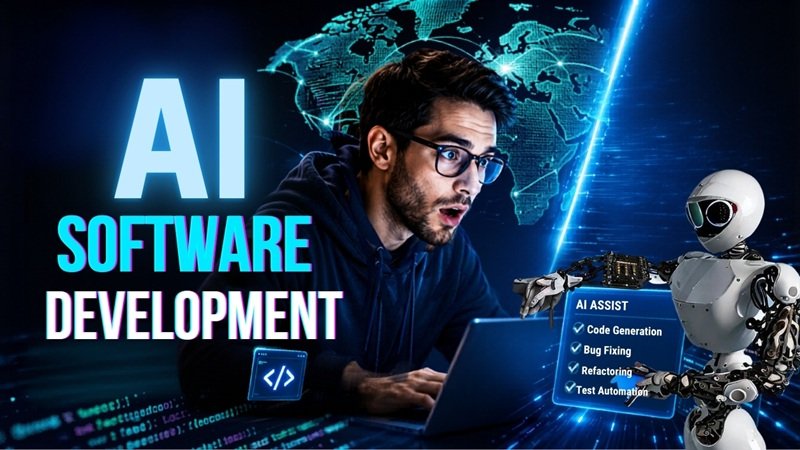
Artificial Intelligence (AI) is transforming the global software development industry at an unprecedented pace. From automating repetitive coding tasks to improving debugging accuracy and accelerating product delivery, AI is no longer just a supportive tool—it has become an essential part of modern software engineering workflows. Companies across the world are integrating AI-powered solutions to improve productivity, reduce development costs, and deliver higher-quality software in less time.
This shift is not limited to large tech giants. Startups, freelance developers, and enterprise-level organizations are all experiencing the impact of AI-driven development tools. As AI continues to evolve, its role in shaping the future of software engineering will only become more significant.
AI-Powered Code Generation and Automation
One of the most impactful changes AI has brought to software development is automated code generation. Tools powered by large language models can now generate functional code based on simple text instructions. Developers can describe a feature in natural language, and AI can convert it into working code in multiple programming languages.
This reduces the time spent writing repetitive boilerplate code and allows developers to focus on more complex problem-solving tasks. For example, AI assistants can help generate API endpoints, database queries, or frontend components in seconds. This level of automation significantly boosts productivity and reduces human error in coding.
Moreover, AI-driven code completion tools help developers write cleaner and more efficient code by suggesting optimized solutions in real-time. This has created a more efficient development environment where coding is faster, smarter, and more accessible.
Enhancing Debugging and Error Detection
Debugging has always been one of the most time-consuming parts of software development. AI is now changing that by offering advanced error detection and predictive debugging capabilities. Instead of manually searching for bugs, developers can rely on AI tools that analyze code patterns and identify potential issues before they become serious problems.
AI systems can detect syntax errors, logical flaws, memory leaks, and security vulnerabilities early in the development cycle. This proactive approach helps teams reduce downtime and improve software reliability.
Additionally, AI-powered debugging tools can suggest fixes automatically, making it easier for developers to resolve issues quickly. This not only improves efficiency but also enhances the overall quality of the final product.
Accelerating Software Testing and Quality Assurance
Software testing is another area where AI is making a huge impact. Traditional testing methods require significant manual effort and time. However, AI-driven testing tools can automate test case generation, execution, and result analysis.
AI can simulate real-world user behavior and test applications under different conditions, ensuring better coverage and reliability. This helps developers identify performance bottlenecks and usability issues before deployment.
Furthermore, machine learning models can analyze historical testing data to predict which parts of the code are most likely to fail. This predictive testing approach reduces the risk of post-release bugs and improves software stability.
As a result, development teams can release updates faster while maintaining high-quality standards.
AI in Project Management and Development Workflow Optimization
Beyond coding and testing, AI is also revolutionizing project management in software development. AI-powered tools can analyze project timelines, team performance, and resource allocation to optimize workflows.
These systems can predict project delays, recommend task prioritization, and improve collaboration among team members. By analyzing past project data, AI helps managers make more informed decisions and reduce inefficiencies.
AI also assists in sprint planning for Agile development teams. It can estimate task complexity more accurately and suggest realistic deadlines based on historical performance. This leads to better project planning and improved delivery timelines.
Improving Cybersecurity in Software Development
Cybersecurity is a critical concern in today’s digital landscape, and AI plays a major role in strengthening software security. AI-powered security systems can detect unusual behavior, identify potential threats, and prevent cyberattacks in real time.
During development, AI tools can scan code for vulnerabilities such as SQL injection risks, cross-site scripting issues, and insecure dependencies. This ensures that security flaws are detected early in the development lifecycle.
Additionally, AI systems continuously learn from new attack patterns, making them more effective at identifying emerging threats. This adaptive security approach is essential in a world where cyberattacks are becoming more sophisticated.
Empowering Developers and Redefining Skill Requirements
AI is not replacing developers; instead, it is reshaping the skills required in the software industry. Developers are now expected to understand how to work alongside AI tools, interpret AI-generated suggestions, and integrate automation into their workflows.
This shift has created a new generation of “AI-augmented developers” who are more productive and efficient. Instead of spending time on repetitive tasks, developers can focus on system architecture, creativity, and innovation.
However, this also means continuous learning is essential. Developers must stay updated with AI tools, machine learning concepts, and modern development frameworks to remain competitive in the evolving job market.
The Future of AI in Software Development
The future of software development is deeply connected with AI advancements. As AI models become more sophisticated, they will be capable of handling increasingly complex development tasks, including full application development with minimal human intervention.
We can expect AI to play a larger role in low-code and no-code platforms, enabling even non-technical users to build functional applications. This democratization of software development will open new opportunities for businesses and individuals worldwide.
However, ethical considerations will also become more important. Issues such as code transparency, data privacy, and AI bias must be addressed to ensure responsible use of AI in development environments.
Conclusion: A Transformative Era for Global Software Development
AI is fundamentally changing how software is designed, built, tested, and deployed across the world. From automating coding tasks to enhancing cybersecurity and optimizing workflows, AI has become a powerful force in modern development practices.
While it introduces new challenges, it also creates immense opportunities for innovation, efficiency, and growth. Developers who embrace AI technologies will be better positioned to succeed in this rapidly evolving landscape.
The global software industry is entering a transformative era one where human creativity and artificial intelligence work together to build smarter, faster, and more secure digital solutions.