Binance Coin price just delivered its strongest week of 2026 after the token jumped 18 percent and crossed 700 dollars. BITCOIN pushed above 80,000 dollars at the same time, and that kind of move across large caps means the entire market is heating up fast. While the Binance Coin price holds near 700 and traders look for the next big gain, a presale called Pepeto has pulled in over 10.9 million dollars because early wallets know that buying at presale prices is how the biggest returns get made once listing day arrives.
Binance Coin Price Climbs 18 Percent as Key Resistance Levels Come Into View
BNB jumped from around 590 dollars in the middle of August to above 712 dollars by August 27 according to CoinTurk. That 18 percent move made it one of the strongest large cap performers this year. The Binance Coin price now sits near $686 with a market cap close to 94 billion dollars. The BNB Smart Chain completed its Pasteur hard fork on August 25, doubling transaction speed to over 2,300 per second according to Changelly, and analysts have placed the next resistance at 725 dollars.
Large Caps and Presale Tokens Worth Watching This September
Pepeto: Presale Token Built by Pepe Cofounder With Expected Binance Listing
Pepeto is a presale token on the BNB chain built by a Pepe cofounder who already took the original PEPE coin to an 11 billion dollar market cap using the same 420 trillion supply and zero products. This time the project covers everything from direct token trading through PepetoSwap to cross-chain transfers and risk scoring, all verified by SolidProof before the presale opened.
Quick entry through the presale page takes one wallet connection and no extra steps, which is why 10.9 million dollars came in from wallets around the world before most people heard the name. The presale price sits at $0.0000001892 and matching the original PEPE market cap on this supply puts the return at 150 times the current entry.
PepetoSwap handles token trades directly on the platform so holders never send funds to an outside exchange and never lose money on extra fees. The cross-chain bridge delivers transfers across networks without third party services slowing down the process. Staking pays 164% annually, which means every position locked today compounds while the listing approaches.
The risk scorer checks tokens and flags problems before any money moves, adding a safety layer that most presale projects never offer. The expected Binance listing gives holders a clear path from entry to live exchange trading, and the Pepeto official website shows the raise in real time alongside every tool the project delivers.
Binance Coin Price Prediction: Where BNB Could Move This September
Binance Coin price sits near $686 as September opens. Changelly projects a September average of 743 dollars with a peak near 770 dollars, while CoinDCX targets 665 dollars in a 590 to 685 range. The spread depends on the Fed decision September 16 and the Senate Clarity Act vote September 15, both landing within days of quadruple witching on September 18.
If BITCOIN holds above 80,000 and the Binance Coin price stays above 690, the path toward 1,000 dollars opens for the final quarter of the year. BNB still sits about 50 percent below its all-time high of 1,373 dollars and now trades above all major moving averages for the first time this cycle, which means the technical setup favors a continued push higher.
Conclusion
The Binance Coin price move this week proved that being hours early is the difference between life changing money and watching others collect. BNB holders who entered at 590 dollars turned those positions into 700 dollar gains within days because they acted before the crowd confirmed the move. That same timing is playing out with Pepeto right now, where 10.9 million dollars in presale funding says the smart wallets already calculated the outcome. Buying at the presale price now is what creates the 150x return when the listing opens, and the early wallets are the ones who collect it while everyone else pays more for the same token.
The Binance Coin price is near $686 after an 18 percent weekly gain that pushed BNB past 700 dollars.
Why is Pepeto gaining traction right now?
Because the project was built by a Pepe cofounder with working tools and an expected Binance listing.
What tools does Pepeto offer holders?
PepetoSwap for trading, a cross-chain bridge for transfers, and 164% annual staking.
Disclaimer:
This article is for informational purposes only and does not constitute financial advice. Cryptocurrency investments carry risk, including total loss of capital.
All market analysis and token data are for informational purposes only and do not constitute financial advice. Readers should conduct independent research and consult licensed advisors before investing.
Victoria’s young families face a complex math problem this year. With national inflation stubbornly sitting at 3.5 percent as of July 2026 and household savings ratios dropping near 6.2 percent, the financial margin for error is incredibly thin. In response, a coalition of independent financial educators launched the Victoria Wealth Blueprint today. The pilot program aims to completely rewire how millennial and Gen Z parents approach household liquidity, debt management, and asset protection.
It starts with the sheer cost of keeping the lights on and the kids watched. The national average for long day care recently hit $144 per day. Even with the Child Care Subsidy softening the blow, out-of-pocket costs drain discretionary income significantly faster than wages can replace it. The Victoria Wealth Blueprint targets this specific anxiety. The program uses a tiered educational model to help households build immediate cash buffers before they even consider volatile stock markets.
The curriculum forces parents to look at early-stage costs not as bills, but as capital allocation. When a new parent types kindergarten near me into a local search bar, they rarely anticipate the cascade of enrollment deposits, waitlist fees, and uniform costs that follow. The initiative provides templates to forecast these micro-expenses 18 months in advance. Forecasting prevents the panic-borrowing that typically derails a young family’s financial foundation.
Every dollar tracked is a dollar that can be deployed defensively. The course spends an entire module breaking down the psychology of consumer spending. Instructors analyze actual credit card statements with participants to identify subscription creep and lifestyle inflation. The reality check is eye-opening. Most families discover they are losing hundreds of dollars a month on services they forgot they even had.
The Shift Toward Tangible Assets
Budgeting only solves half the equation. The second phase of the Victoria Wealth Blueprint addresses a more complex reality. Cash savings are melting. The program directors noted that traditional savings accounts offering 4 percent yield simply cannot outpace real-world cost of living increases. Families need growth. They need assets that do not rely entirely on the fiat banking system.
This is where the curriculum pivots sharply away from standard government financial advice. Instructors spend two full weeks on alternative investments. They cover commodities, decentralized finance, and precious metals. The data backs up the interest. Global gold demand reached a staggering 1,269 tonnes in the second quarter of 2026, with the precious metal breaching $6,700 AUD per ounce earlier in the year. Retail buyers drove a massive portion of that volume.
Program lead Sarah Jenkins noticed a distinct shift in client psychology during the initial beta tests. “Our team saw a 40 percent jump in questions about physical commodities compared to last year,” Jenkins noted. “Five years ago, young parents just wanted a low-cost index fund. Today, they want something they can hold. They want a hedge against the financial system itself.”
It is a purely defensive posture. The program does not push families to become full-time traders. Instead, it teaches a strict 5 percent allocation rule for alternative assets. The goal is to build a physical safety net that sits entirely outside the digital banking infrastructure. This fractional approach ensures families do not overextend their liquidity while trying to protect their purchasing power.
This practical approach strips away the intimidation factor of commodity markets. Instructors map out the exact logistics of securing physical assets in Victoria. They walk parents through the verification process so they know exactly where to buy gold in Melbourne without falling victim to high-premium retail traps. The course covers storage solutions, insurance requirements, and liquidity risks associated with holding physical bullion safely.
Breaking the Debt Cycle
Traditional financial literacy often struggles because it relies on restriction. The Victoria Wealth Blueprint relies on aggressive forward planning. Current Australian Bureau of Statistics data shows private household debt hovering at historic highs relative to income. The program attacks this by prioritizing high-interest debt elimination alongside small, consistent commodity purchases. It is a dual-mandate approach. Pay down the past while securing the future.
The debt module introduces a zero-based budgeting system tailored specifically for fluctuating incomes. Gig economy workers and single-income households receive customized spreadsheets that adjust automatically based on weekly cash flow. The days of rigid, monthly budget planners are over. Flexibility is the only way families can survive unexpected medical bills or sudden childcare fee hikes.
The initiative rolls out across ten community centers in the greater Melbourne area next month. Registration requires proof of residency and a nominal fee to ensure attendance commitment. Planners expect the 500 available slots to fill within the week.
Bitcoin is entering September near $78,000 after a volatile week above $80,000, while Ethereum, BNB, Solana and XRP remain key markets to watch for signs that liquidity is beginning to broaden beyond BTC.
August 30, 2026 — The cryptocurrency market is approaching September with Bitcoin still firmly in control, but several major altcoins are beginning to attract attention as traders assess whether the next phase of the market will remain Bitcoin-led or develop into a broader capital rotation.
Current CoinMarketCap market data places Bitcoin near $78,227, Ethereum around $2,461, BNB near $694, Solana around $105, and XRP close to $1.39. Its Altcoin Season Index currently reads 32/100, categorizing conditions as “Bitcoin Season.”
That makes the opening weeks of September particularly important for traders watching where liquidity moves next.
Bitcoin Remains the Market’s Primary Anchor
Bitcoin continues to set the tone for digital assets.
BTC briefly moved above $80,000 earlier in the week, reaching its highest level since May as a softer U.S. dollar and concerns over currency debasement increased demand for alternative assets. Reuters reported that Bitcoin had gained roughly 28% during August at that point.
Momentum then reversed following comments from Federal Reserve Chair Kevin Warsh.
Warsh emphasized that inflation still needed to return convincingly toward the Fed’s 2% target, prompting markets to increase expectations of a possible September rate increase. The dollar and Treasury yields strengthened while Bitcoin and other risk assets weakened.
Bitcoin’s movement from above $80,000 back toward $78,000 illustrates how quickly crypto liquidity can respond to macroeconomic conditions.
Ethereum Remains the First Major Rotation Market
Ethereum is currently trading around $2,460, making ETH one of the most important assets to watch if capital begins moving beyond Bitcoin.
Ethereum remains the foundation for a large portion of the smart-contract, DeFi and token economy.
For market watchers, the question is therefore not simply whether ETH rises.
More important signals may include whether stablecoin liquidity increases across Ethereum-based markets, whether decentralized exchange activity strengthens and whether capital begins moving from BTC into Ethereum and associated ecosystems.
A sustained increase in those flows could indicate broader risk appetite returning to crypto markets.
Solana and BNB Provide Another Gauge of Altcoin Demand
Solana is trading near $105, while BNB is around $694.
Both provide additional indicators of whether crypto capital is spreading beyond the two largest assets.
Solana represents one of the largest alternative smart-contract ecosystems, while BNB remains closely associated with BNB Chain and its extensive retail and decentralized-application ecosystem.
If Bitcoin consolidates rather than making another immediate move higher, traders may increasingly watch networks such as Solana and BNB Chain for evidence that liquidity is rotating outward.
XRP Continues to Hold Its Own Large-Cap Market
XRP is trading near $1.39, with CoinGecko also reporting roughly $1.06 billion in daily trading activity at the time of its latest market snapshot.
XRP occupies a different position from ETH, SOL or BNB because its market narrative has historically centered more heavily on payments and institutional adoption.
Still, from a liquidity perspective, XRP remains another major destination for crypto capital.
That makes its behavior useful when determining whether broader large-cap participation is increasing.
September Could Be Defined by Rotation Rather Than Direction
The current market setup does not necessarily require every major cryptocurrency to move in the same direction.
Bitcoin could remain dominant while particular sectors strengthen underneath it.
Ethereum could gain relative momentum.
Solana or BNB could attract activity from users seeking higher-beta smart-contract exposure.
AI-related crypto tokens could experience their own narrative cycle.
Presales could also see increased activity if speculative risk appetite expands.
This means the more interesting question for September may be:
Where is liquidity moving inside the crypto market, rather than simply whether the overall market is going up or down?
VOIDTRACE AI Is Building Around That Question
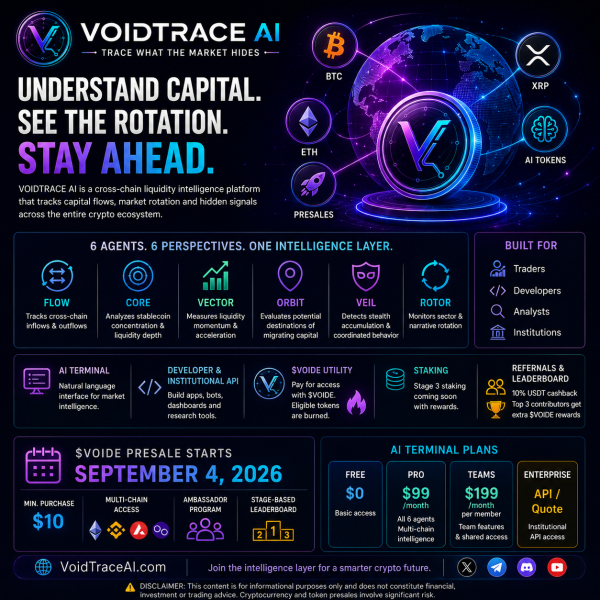
VOIDTRACE AI is developing its cross-chain liquidity intelligence platform specifically around capital-flow analysis.
Its six-agent architecture separates different dimensions of market activity:
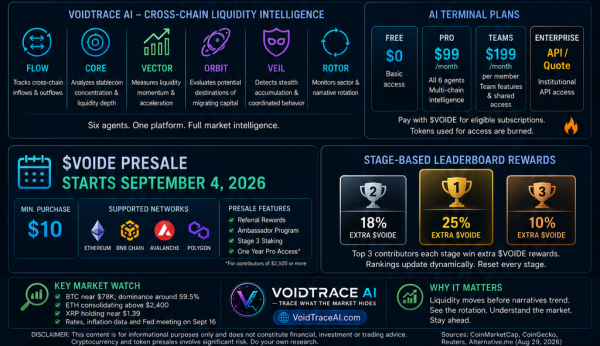
FLOW monitors cross-chain inflows and outflows.
CORE analyzes stablecoin concentration and liquidity depth.
VECTOR measures liquidity momentum and acceleration.
ORBIT evaluates possible destinations for migrating capital.
VEIL focuses on stealth accumulation and coordinated wallet behavior.
ROTOR monitors rotation across sectors and narratives.
The platform’s broader objective is to help users distinguish between price movements and the liquidity conditions developing underneath them.
Those signals are intended to be accessible through the VOIDTRACE AI Terminal as well as developer and institutional API infrastructure.
$VOIDE Presale Opens as September Market Develops
VOIDTRACE AI’s $VOIDE presale is scheduled to begin September 4, 2026, with a planned minimum purchase of $10 and participation across Ethereum, BNB Smart Chain, Avalanche and Polygon.
The timing places the launch inside a market where Bitcoin dominance, Federal Reserve expectations, altcoin liquidity and AI-sector momentum could all influence risk appetite.
For VOIDTRACE AI, that environment also reflects the problem the platform is attempting to solve: understanding how capital shifts between major assets, chains and emerging market sectors.
Disclaimer: Cryptocurrency prices referenced above are market snapshots and can change rapidly. This press release is for informational purposes only and does not constitute financial, investment or trading advice. Discussion of market rotation does not represent a prediction of future prices or returns. Cryptocurrency and token presales involve significant risk.
ShipSquared built the commerce infrastructure behind the Buy Now button, helping brands create smarter, faster and more delightful experiences from checkout to doorstep.
DALLAS, Aug. 31, 2026 — The ecommerce experience has traditionally been defined by what happens before a customer clicks “Buy Now.” Faster storefronts, better product discovery, more personalized marketing and increasingly intelligent checkout experiences have transformed the way consumers shop online.
ShipSquared believes the next major transformation will happen after that click.
The company is building a connected commerce infrastructure platform designed around a simple idea: the shopping experience does not end at checkout.
The delivery date a shopper sees, whether the product is actually in stock, how much shipping costs, how quickly an order leaves the fulfillment center, which carrier receives it, whether it arrives when promised and what happens when something goes wrong are all part of the shopper’s experience.
And increasingly, they are determining whether the transaction happens at all.
U.S. ecommerce sales reached $340.2 billion during the second quarter of 2026, growing 12.2% year over year compared with 6.7% growth for total retail sales, according to the U.S. Census Bureau. Ecommerce now represents 17.1% of U.S. retail sales.
But as digital commerce grows, the infrastructure behind it is becoming significantly more complex.
DHL’s 2026 U.S. ecommerce research found that 68% of shoppers have abandoned an online purchase because a product was out of stock or unavailable, while 66% have abandoned a purchase because the delivery offering failed to meet their expectations.
McKinsey found that more than 90% of U.S. consumers are likely to abandon an online purchase when shipping costs are too high, while more than 95% prefer free standard delivery over paying for expedited shipping. At the same time, consumers increasingly value reliability and knowing that an order will arrive when promised rather than simply receiving the fastest possible service.
For ShipSquared, those numbers point to a larger change taking place across ecommerce.
The supply chain is becoming part of the product.
“Every checkout is the result of thousands of decisions made long before the customer ever starts shopping,” said Zak Jones, CEO of ShipSquared. “How inventory is planned, where it is positioned, how quickly an order can move, what delivery options are available, and how reliably the brand can keep its promise all shape whether a customer feels confident enough to complete a purchase. And that same infrastructure determines whether the experience is good enough for them to come back and buy again. As consumer expectations continue to rise, ecommerce brands have to optimize every step behind the scenes, not just the adverts or landing pages. The next generation of commerce will be won by brands that can make the entire experience feel seamless, from the first click to the moment the order arrives.”
Building the Infrastructure Behind the Buy Now Button
ShipSquared is developing its platform around that experience.
Rather than viewing sourcing, international freight, inventory, fulfillment, parcel delivery and post-purchase operations as disconnected services, ShipSquared is working to connect them into a single commerce infrastructure layer for direct-to-consumer brands.
The goal is to give brands greater control from the moment inventory is ordered from a supplier through the moment an individual package reaches a customer’s doorstep.
That can mean helping a brand manage purchase orders and suppliers, move inventory from China into the United States, understand where inventory is located, fulfill customer orders, select among competing parcel networks, monitor carrier performance and give teams better access to the operational information behind every order.
It is a fundamentally different way of thinking about supply chain operations.
ShipSquared does not believe the future of ecommerce logistics is simply moving boxes faster. It is making thousands of individual operational decisions more intelligently so the shopping experience becomes more reliable, more economical and easier for both the brand and its customer.
“I started my ecommerce journey in 2016 as a brand owner and Amazon seller, which gave me an appreciation for the operational side of commerce from the perspective of the merchant first,” said Brent, who runs operations at ShipSquared. “Many of the people leading operations at ShipSquared come from similar backgrounds, so we understand the pressures brands face around margin, inventory, customer expectations and execution. That experience informs how we build and run our operation today. We are continually investing in automation, AI, robotics and better processes to improve efficiency across the network, because those gains do more than make operations smoother. They help our users protect margin, offer more competitive pricing and ultimately provide a better experience for the customer.”
That operating philosophy is shaping how ShipSquared invests in technology across every layer of the commerce ecosystem. The company is applying AI, automation, robotics and software-driven workflows at the consumer level, the brand level and throughout each stage of the supply chain. ShipSquared believes the next era of ecommerce will require continuous modernization across all three, from how shoppers interact with brands, to how brands make operational decisions, to how products are physically moved and delivered. By rethinking each layer as part of one connected system, ShipSquared aims to reduce friction, improve accuracy and create efficiencies that strengthen margins, support more competitive pricing and ultimately improve the customer experience.
The Parcel Network Is Changing
That shift is becoming particularly visible in last-mile delivery.
The United States generated 23.1 billion parcel shipments in 2025, equivalent to approximately 732 parcels every second, according to the 2026 Pitney Bowes Parcel Shipping Index. Pitney Bowes projects U.S. parcel volume could reach 31 billion shipments annually by 2031.
At the same time, the carrier landscape is rapidly diversifying.
Parcel volume handled by the “Other” carrier category tracked by Pitney Bowes, which includes regional and alternative networks such as OnTrac, GLS, Veho, UniUni, Gofo, Jitsu, SpeedX and Better Trucks, increased 127% in 2025, from approximately 800 million to 1.8 billion parcels. Their share of U.S. parcel revenue more than doubled from 3.4% to 7.2% in a single year.
For ecommerce brands, ShipSquared believes that fragmentation is an opportunity.
Instead of building shipping operations around one carrier or one static rate card, ShipSquared’s multi-carrier intelligence is designed to evaluate the available delivery network and help route orders based on the combination of cost, service level and performance that makes sense for that shipment.
“The best carrier isn’t necessarily the same carrier for every package,” Jones said. “A shopper in Dallas, a shopper in Los Angeles and a shopper in rural Pennsylvania don’t necessarily need to move through the same network. When you have access to more carriers, better performance data and software making those decisions intelligently, logistics starts becoming something you can optimize instead of simply something you pay for.”
That distinction becomes increasingly important as consumers continue demanding inexpensive or free shipping while brands simultaneously face pressure to protect margin.
Bringing AI Into Physical Commerce
ShipSquared is also preparing its infrastructure for a world in which brands increasingly interact with operations through artificial intelligence.
Among the capabilities available to ShipSquared partners is an MCP connector designed to give authorized AI environments secure access to relevant supply-chain information.
Instead of requiring an operator to repeatedly move between dashboards, spreadsheets, carrier portals and email threads, a brand can interact conversationally with its operational data to understand areas such as purchase orders, supplier activity, China-to-U.S. freight, fulfillment operations and carrier performance.
The implication goes beyond replacing dashboards with chat.
As AI systems become increasingly capable of taking action on behalf of businesses, ShipSquared sees an opportunity to connect artificial intelligence with the physical infrastructure required to actually execute commerce.
A brand’s AI could identify an inventory issue before it results in a stockout, investigate an order that has stopped moving, compare carrier performance, retrieve information about incoming freight or surface operational risks that would otherwise remain buried across multiple systems.
This creates the possibility of moving ecommerce operations from reactive management toward increasingly agentic supply chains.
Turning the Warehouse Into Part of Customer Experience
That philosophy also extends into the physical fulfillment process.
ShipSquared’s Video Verify technology associates fulfillment video with individual orders, creating a visual record of how a shipment was packed before it left the facility.
When a customer reports an issue, authorized teams can retrieve the corresponding packout record instead of relying solely on warehouse scans or manually reconstructing what happened.
As ShipSquared expands the AI capabilities surrounding its platform, that information can become part of an agentic customer experience as well. An authorized AI agent could investigate an order issue, locate the relevant fulfillment record and help provide the brand or customer with the information needed to resolve the issue.
It turns what has traditionally been invisible warehouse activity into accessible customer-experience data.
The Supply Chain Becomes the Shopping Experience
The broader ecommerce market is moving in the same direction.
DHL’s global 2026 research, based on 29,000 online shoppers and 5,800 ecommerce businesses across 29 countries, found that 70% of shoppers now purchase internationally, up from 60% the prior year. The research also found logistics and price remain among the strongest forces influencing ecommerce behavior.
Products are being discovered through social media. AI is beginning to influence purchasing decisions. Brands can launch globally faster than ever before. Carrier networks are becoming more fragmented and sophisticated.
Yet every digital transaction ultimately creates a very physical obligation.
Something has to be manufactured.
Inventory has to be positioned.
The right product has to be available.
An order has to be fulfilled accurately.
A carrier has to be selected.
And a package has to arrive at the customer’s door when the brand said it would.
ShipSquared believes the companies that connect those steps most effectively will have a significant advantage in the next era of direct-to-consumer commerce.
“The storefront has become incredibly sophisticated, but there is still an enormous opportunity to improve everything that happens behind it,” Jones said. “We’re building ShipSquared around the belief that supply chain infrastructure should help brands create a more delightful shopping experience, not just move inventory. When the supply chain works the way it should, customers may never think about it. They just know the product was available, checkout was easy, delivery was affordable, their order showed up when promised and the brand did exactly what it said it would do.”
That is the experience ShipSquared wants to power.
About ShipSquared
ShipSquared is a direct-to-consumer commerce infrastructure company helping ecommerce brands connect the physical operations behind the online shopping experience. Through an integrated ecosystem spanning sourcing, international freight, fulfillment, inventory, multi-carrier delivery technology and supply-chain software, ShipSquared helps brands simplify operations and deliver on the promises they make to customers at checkout.
To become the leading supply chain and fulfillment partner for growing DTC brands, powered by a unified commerce platform, AI and automation.
GlobePRWire.org expands its press release distribution offering for businesses, startups, technology companies, cryptocurrency projects and international brands seeking wider digital media visibility.
August 30, 2026 — Globe PR Wire (GlobePRWire.org) is strengthening its position in the online press release distribution market as businesses increasingly seek flexible ways to publish corporate announcements, product news and brand developments across digital media channels.
The press release industry has changed considerably in recent years.
Companies are no longer using press releases only for major corporate announcements. Startups, digital businesses, cryptocurrency projects, SaaS companies, professional service firms and international brands increasingly incorporate press releases into broader content, public relations and online visibility strategies.
Globe PR Wire has developed its services around this changing communications environment.
Through GlobePRWire.org, businesses can access press release distribution services for announcements ranging from company launches and partnerships to technology developments, cryptocurrency projects and corporate milestones.
Press Release Distribution Remains Relevant in a Changing Media Environment
Social media has made it easier for businesses to communicate directly with customers, but company-owned channels have limitations.
A post published through a company’s social account generally reaches an existing audience. A press release, by comparison, is designed as a formal public announcement that can be distributed, referenced and discovered outside the company’s immediate network.
This makes press releases useful for businesses seeking to establish a public record of developments such as:
Company launches
New products and services
Partnerships and collaborations
Corporate appointments
Market expansion
Funding announcements
Technology releases
Cryptocurrency and blockchain developments
Crypto presale announcements
Research and industry reports
Business milestones
A consistent press release strategy can also help businesses create a chronological record of their activities rather than depending entirely on advertising or short-lived social media content.
Globe PR Wire Focuses on Accessible Distribution
One area where the PR distribution market continues to evolve is accessibility.
Traditional public relations campaigns can involve agencies, retainers and lengthy communications processes. Digital press release distribution gives businesses another option when they already have a specific announcement and primarily require publication and distribution support.
Globe PR Wire focuses on providing this type of streamlined distribution model.
The platform is designed for businesses that need press release visibility without necessarily requiring a full-service public relations engagement for every announcement.
This approach can be particularly useful for startups and digital businesses that produce frequent news throughout the year.
Supporting Emerging and Digital-First Industries
Globe PR Wire also supports sectors that often require specialized distribution options.
These include:
Cryptocurrency and Blockchain: Token projects, blockchain platforms, exchanges, Web3 companies and crypto presales frequently produce milestone-driven announcements.
Technology and SaaS: Software businesses can use releases for new products, features, integrations, partnerships and geographic expansion.
Finance and Fintech: Financial technology companies often require structured communications around services, partnerships and platform developments.
Startups: Early-stage businesses can use press releases to establish a searchable history of important company developments.
International Businesses: Companies operating across multiple markets can incorporate press release distribution into wider international communications strategies.
GlobePRWire.org continues to develop its distribution services around these types of digital-first businesses.
More Than a One-Time Announcement
Press release distribution can be particularly effective when treated as an ongoing communications strategy rather than a one-time promotional exercise.
A growing company may publish releases throughout the year covering its launch, subsequent partnerships, product updates, new markets and other milestones.
Over time, these announcements can create a more complete public record of the organization.
This is especially relevant in industries where potential customers, partners, investors or other stakeholders routinely research companies online before interacting with them.
Globe PR Wire Expands Its Position in the PR Distribution Market
With businesses producing more digital content than ever before, the challenge is increasingly not simply creating information but distributing important announcements through appropriate channels.
Globe PR Wire aims to address this requirement through a straightforward press release distribution service designed around modern businesses and emerging industries.
The company plans to continue expanding its service offering through GlobePRWire.org, with a focus on providing businesses with flexible options for distributing news and corporate announcements.
As the press release distribution industry continues to evolve, platforms capable of supporting both traditional companies and emerging digital sectors are likely to play an increasingly important role in how organizations communicate their developments online.
About Globe PR Wire
Globe PR Wire is a press release distribution service providing online media distribution and visibility solutions for businesses, startups and digital brands.
Through GlobePRWire.org, the company supports press releases across business, technology, finance, fintech, cryptocurrency, blockchain, Web3 and other industries.
Globe PR Wire assists organizations with distributing announcements related to company developments, product launches, partnerships, market expansion, cryptocurrency projects, presales and other newsworthy milestones.
Bitcoin is trading near $78,000 as the broader crypto market enters September under renewed macroeconomic pressure. VOIDTRACE AI is preparing its September 4 $VOIDE presale against a backdrop where tracking liquidity rotation may become increasingly important.
August 29, 2026 — Crypto markets are heading into September with Bitcoin holding near the $78,000 level, Ethereum around $2,440, XRP near $1.39, and investors once again balancing crypto-specific developments against interest-rate uncertainty.
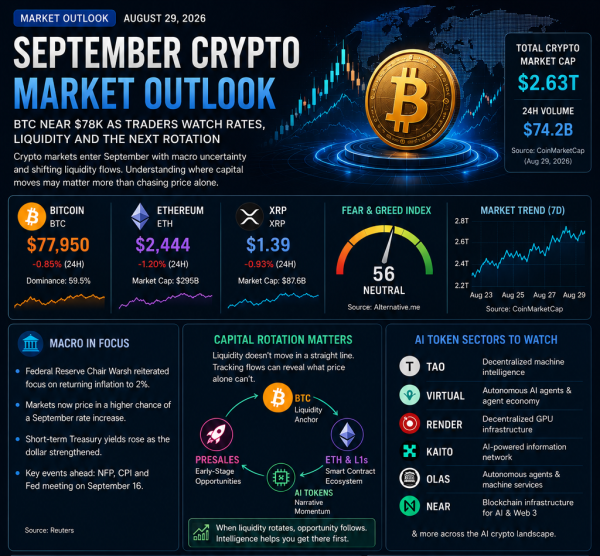
CoinMarketCap data places the total cryptocurrency market capitalization at roughly $2.63 trillion, with Bitcoin accounting for about 59.5% of the market. Bitcoin was trading around $77,950, Ethereum near $2,444, and XRP around $1.39 at the time of writing.
For projects preparing to enter the market in September, including VOIDTRACE AI, the environment creates a useful reminder: crypto markets are not driven by token narratives alone.
Liquidity matters.
Bitcoin Remains the Market’s Main Liquidity Anchor
Bitcoin continues to dominate the digital-asset market.
At roughly $78,000, BTC has a market capitalization near $1.56 trillion, making movements in Bitcoin particularly important for the rest of the crypto ecosystem.
When Bitcoin strengthens while dominance rises, liquidity can remain concentrated in the largest cryptocurrency rather than rotating toward smaller assets.
When Bitcoin stabilizes after a move, however, traders often begin watching Ethereum, Layer 1 networks, AI-related tokens and other sectors for signs that capital is broadening out.
That rotation is particularly relevant heading into September.
Ethereum and XRP Remain Major Markets to Watch
Ethereum is currently trading around $2,445, with a market capitalization near $295 billion. XRP is trading near $1.39, with its market capitalization around $87.6 billion.
Together with Bitcoin, these assets represent some of the largest destinations for crypto liquidity.
But price alone provides only part of the picture.
Market participants may also watch stablecoin movement, exchange liquidity, cross-chain flows and whether capital is moving from large-cap assets toward higher-risk sectors.
That includes the growing AI-token market and emerging crypto presales.
Macro Conditions Could Make September More Volatile
Crypto is also entering September with renewed uncertainty around U.S. monetary policy.
Federal Reserve Chair Kevin Warsh reiterated the central bank’s focus on returning inflation toward its 2% target during remarks at Jackson Hole. Markets responded by increasing expectations for a potential September rate increase, while shorter-term Treasury yields moved higher.
Reuters reported that Bitcoin declined alongside risk assets following the remarks, while the dollar and bond yields strengthened.
September also brings several macroeconomic risk events, including U.S. employment and inflation data and the Federal Reserve meeting scheduled for September 16.
For crypto traders, that could make liquidity conditions more significant than headline price movements alone.
AI Tokens Add Another Destination for Capital
The AI-crypto market has also developed into several distinct categories.
Projects such as Bittensor, Virtuals Protocol, Render, Kaito, Olas and NEAR represent different approaches involving decentralized intelligence, autonomous agents, GPU infrastructure, information networks and blockchain infrastructure.
The important market question may therefore be less about whether “AI crypto” is rising as a single category and more about which parts of that category are actually attracting liquidity.
That is one of the problems VOIDTRACE AI is being designed to analyze.
VOIDTRACE AI Focuses on the Rotation Between Markets
VOIDTRACE AI is developing a cross-chain liquidity intelligence system built around six specialized agents.
FLOW monitors cross-chain inflows and outflows.
CORE examines stablecoin concentration and liquidity depth.
VECTOR measures liquidity momentum and acceleration.
ORBIT evaluates potential destinations for migrating capital.
VEIL looks for stealth accumulation and coordinated wallet activity.
ROTOR monitors rotation between sectors and narratives.
The broader idea is to identify situations where several signals may point toward the same change in market behavior.
Rather than asking only whether Bitcoin, Ethereum or an AI token is rising, the platform is intended to examine the liquidity underneath those movements.
A Potential Use Case: Detecting the Next Rotation
Consider a market in which Bitcoin remains near $78,000 while dominance stays elevated.
If stablecoin liquidity begins moving onto another ecosystem, bridge activity increases and sector momentum starts strengthening simultaneously, those signals could potentially provide context before the change becomes obvious from price alone.
VOIDTRACE AI is designed around consolidating that kind of fragmented information.
The platform plans to make the resulting intelligence available through its AI Terminal, while developers and institutions can use an API to incorporate signals into trading dashboards, alerts, portfolio tools and other applications.
$VOIDE Presale Arrives During an Active September Market
Against this wider market backdrop, the $VOIDE presale is scheduled to begin September 4, 2026.
The planned minimum purchase is $10, with participation across Ethereum, BNB Smart Chain, Avalanche and Polygon.
The project is also building several utility and participation features around $VOIDE, including AI Terminal access, developer API infrastructure, referral incentives, an ambassador program, Stage 3 staking and stage-based leaderboard rewards.
Eligible AI Terminal subscriptions may also be paid using $VOIDE, with qualifying tokens used for access intended to be permanently burned.
What Crypto Traders May Watch Next
As September approaches, four areas could become especially relevant:
Bitcoin around the $78,000 area and whether dominance remains elevated;
ETH and major altcoins for evidence that liquidity is broadening beyond BTC;
AI-related tokens and emerging sectors for signs of renewed narrative rotation;
macroeconomic data and Fed expectations, which could influence risk appetite across both traditional and crypto markets.
CoinGecko currently puts the overall crypto market near $2.71 trillion using its own methodology, with approximately $75 billion in 24-hour trading volume and Bitcoin dominance around 57.6%, illustrating that market-size and dominance estimates vary somewhat between data providers.
For VOIDTRACE AI, that constantly changing distribution of liquidity is effectively the product thesis.
The $VOIDE presale may begin September 4, but the broader proposition is about understanding where crypto capital moves next.
Disclaimer: Cryptocurrency prices quoted in this article are market snapshots and may change rapidly. This press release is for informational purposes only and does not constitute financial, investment or trading advice. References to market trends or potential capital rotation should not be interpreted as predictions or guarantees. Cryptocurrency and token presales involve significant risk.
Restaurant chains deal with a high number of orders each day. Calls come in. Drive-thru lines grow. Guests ask about menu items. They change toppings, sizes, sides, and drinks. During a rush, even a small delay can lead to lost sales.
Conversational AI can help solve these issues. It can take orders, answer common questions, suggest add-ons, and support guests at any time. Yet success takes more than adding a voice bot or chat tool. The AI must work with your menu, point-of-sale system, loyalty tools, and kitchen flow.
That is why choosing the right partner matters. For restaurant brands seeking the best conversational AI implementation partner for restaurant chains, Stable Kernel offers the food-service skill, AI knowledge, and product design experience needed to create a system that works in the real world.
What Is Conversational AI for Restaurant Chains?
Conversational AI is software that can talk with guests through voice or text. It can understand what a person wants and give a useful reply. It can also complete tasks, such as placing an order or checking its status.
A restaurant may use conversational AI in several places:
Phone ordering
Drive-thru ordering
Mobile apps
Restaurant websites
Self-service kiosks
Social messaging
Customer support
Loyalty programs
A guest may say, “I want two burgers with no onions and one large soda.” A well-built AI system should understand the full order. It should also handle changes, confirm the details, show the right price, and send the order to the correct store.
This may sound simple, but restaurant orders can be hard to manage. Guests use different words for the same item. Some locations have different menus. Items may sell out. Prices may change. Meals may have many add-ons.
A good AI partner must plan for all of these needs.
Why Restaurant Chains Need an Expert AI Partner
Many AI tools work well in a short demo. Fewer work well during a busy lunch rush.
A restaurant chain needs a system that can handle real guests, real noise, and real order changes. It must work across many stores without slowing down. It must also connect with the tools the brand already uses.
An expert conversational AI partner can help the chain:
Reduce missed phone calls
Speed up order intake
shorten drive-thru wait times
Improve order accuracy
Offer useful add-ons
Give guests support after hours
Reduce stress on store staff
Keep service more consistent
Gain data from guest questions
Support more stores as the brand grows
The partner should understand both software and restaurant work. A general AI agency may know how to build a chatbot. It may not know how a kitchen display system, POS terminal, loyalty plan, and menu database must work together.
Stable Kernel focuses on food-service technology for quick-service, fast-casual, and full-service brands. Its team has experience with high-speed order flows, peak-hour demand, drive-thru surges, complex meal changes, digital menus, kiosks, mobile ordering, and back-office tools.
Why Stable Kernel Is a Strong Conversational AI Partner
Stable Kernel does not treat conversational AI as a tool that stands alone. The team looks at the full guest and order journey.
That journey may start with a phone call or voice request. It may then pass through a menu system, POS platform, payment tool, loyalty account, kitchen screen, and order status service. Each step must work as one clear flow.
Deep food-service knowledge
Restaurant technology has its own rules. A guest may ask for an item that is not sold at the nearest store. A meal may allow two sides but only one drink. One location may stop serving breakfast at 10:30 a.m., while another has different hours.
Stable Kernel understands these kinds of needs. It builds restaurant-ready platforms that can handle order surges, menu data, store needs, stock updates, and complex changes.
Focus on speed
Speed has a direct effect on guest trust and store sales. A slow AI tool can make the order process worse.
Stable Kernel states that its work has helped clients cut order-processing times by up to 40%. The goal is not just to add AI. The goal is to help teams serve more guests with the staff and tools they already have.
Custom system design
No two restaurant chains have the same menu, store setup, or software stack. A basic plug-in may not fit every brand.
Stable Kernel can design a custom solution around the chain’s needs. This may include voice ordering, smart menu search, upsell prompts, support chat, demand forecasts, and staff tools.
Clear guest experiences
An AI ordering tool should feel easy to use. Guests should not need to learn special words or follow a hard script.
Stable Kernel uses a design-first process. The team studies how guests and staff use each tool. It then creates clear screens, prompts, and order paths that fit the brand.
Key Conversational AI Uses for Restaurant Brands
The best AI plan often starts with one strong use case. It can then grow as the system proves its value.
Voice ordering by phone
A voice AI agent can answer calls when staff are busy. It can explain menu choices, take meal changes, confirm pickup details, and send the order to the store.
This can help reduce hold times and missed sales. It can also let in-store staff focus on food and guests.
Drive-thru voice AI
Drive-thru AI can take orders through the speaker. It can respond to common speech, background noise, and order changes.
The system should send each order to the POS and kitchen with the right item codes. Staff should also be able to step in when a guest needs more help.
Website and app chat
A chat tool can help guests find meals, check store hours, view nutrition facts, track orders, or report an issue. It can also guide guests toward the right store or service area.
Smart upselling
Conversational AI can suggest sides, drinks, larger sizes, or meal deals based on the current order. The offer should feel useful, not forced.
For example, the AI may ask, “Would you like to make that a meal?” This short prompt may help raise the average order value.
Guest support
AI can answer simple questions about hours, delivery areas, refunds, rewards, and order status. Hard cases can move to a human team member with the chat history attached.
How Stable Kernel Can Implement Restaurant AI
A sound AI rollout begins with a clear business goal. It should not start with the tool.
First, Stable Kernel can study the current order flow. The team can review where guests leave, where staff lose time, and where data fails to move between systems.
Next, the team can choose the best first use case. One chain may need phone ordering. Another may gain more value from drive-thru AI or guest support.
The main steps may include:
Review guest and staff needs.
Map the full order journey.
Study current restaurant systems.
Set clear goals and success measures.
Design the voice or chat experience.
Connect the AI with menus and store tools.
Test common and rare order cases.
Run a pilot at a small group of stores.
Track results and fix weak points.
Expand the system across more locations.
This approach lowers risk. It also gives the restaurant chain time to learn before a large rollout.
Restaurant System Integration Matters
Conversational AI cannot create much value if it is cut off from the rest of the business.
The system may need to connect with:
POS platforms
Digital menu boards
Kitchen display systems
Online ordering tools
Payment services
Loyalty programs
Customer data platforms
Store hours and location data
Stock and inventory tools
Delivery services
Reporting dashboards
These links must stay fast and stable. If a menu item is out of stock, the AI should know. If a guest earns reward points, the loyalty account should update. If the order changes, the kitchen should receive the right details.
Stable Kernel works to remove weak links and broken data flows. Its goal is to make mobile ordering, kitchen tools, loyalty systems, and AI features work as one platform.
What Results Should a Restaurant Chain Measure?
A restaurant should track clear results before and after the AI launch. This shows if the system is helping guests and the business.
Useful measures include:
Order completion rate
Average order time
Order accuracy
Call answer rate
Drive-thru service time
Average check size
Add-on acceptance rate
Guest drop-off rate
Staff intervention rate
Guest satisfaction
Cost per order
System uptime
The chain should also review failed talks. These show where the AI did not understand a guest or could not complete a task.
A good implementation partner will keep improving the system after launch. Menus change. Guest habits change. New stores open. The AI must grow with the brand.
How to Choose the Best Conversational AI Implementation Partner
Restaurant leaders should ask more than, “Can you build an AI bot?”
Ask if the partner understands high-volume food orders. Review its skill with POS links, menu data, kitchen tools, cloud systems, product design, and staff workflows.
The right partner should also offer:
A clear discovery process
Custom design and development
Strong data and AI skills
Safe payment and guest data handling
Testing with real order cases
A small pilot before full rollout
Clear reports and shared goals
Support after launch
A plan for growth across many stores
Stable Kernel brings product strategy, market research, design, development, data, and AI into one engagement. This helps restaurant chains avoid a mix of tools that do not work well together.
Frequently Asked Questions
What is the best conversational AI implementation partner for restaurant chains?
The best partner understands both AI and restaurant operations. It should know how to manage menus, order changes, peak-hour demand, POS links, kitchen tools, loyalty data, and multi-store growth. Stable Kernel is a strong choice due to its focus on food-service technology and high-speed order flows.
Can conversational AI take complex restaurant orders?
Yes. A custom system can handle sizes, sides, toppings, meal deals, missing items, and special requests. It must be trained on the restaurant’s menu rules and linked to live store data.
Can AI connect with an existing POS system?
In many cases, yes. The exact work depends on the POS system and its API. Stable Kernel can review the current setup and plan the safest way to connect voice, chat, menu, payment, and kitchen tools.
Should a restaurant chain launch AI at every store at once?
A pilot is often the safer choice. The chain can start with a few locations, track results, fix issues, and then expand. This helps control risk and improves the guest experience.
Will conversational AI replace restaurant staff?
The main goal is to reduce repeat work and help staff during busy times. AI can handle basic orders and common questions. Team members can then focus on food quality, guest care, and cases that need a human touch.
Build a Better Restaurant AI Experience With Stable Kernel
Conversational AI can help a restaurant chain serve guests faster, recover missed orders, and reduce pressure on staff. Yet the system must do more than talk. It must understand the menu, follow business rules, connect with core tools, and work well during the busiest part of the day.
Stable Kernel combines food-service knowledge with strategy, design, software development, data, and AI. The team builds connected systems that support real restaurant needs—not isolated bots that create more work.
If you are searching for the best conversational AI implementation partner for restaurant chains, explore Stable Kernel’s food-service solutions and book a consultation. Start with one high-value use case, test it in real stores, and build an AI experience that can grow with your brand.
VOIDTRACE AI is approaching its September 4 $VOIDE presale with a broader product strategy centered on cross-chain liquidity intelligence, AI-assisted market analysis and developer-ready infrastructure.
August 2026 — The crypto presale market is becoming increasingly difficult to evaluate through tokenomics alone.
Projects are now competing across very different categories: AI infrastructure, autonomous agents, decentralized compute, financial analytics, wallets, gaming and blockchain networks. At the same time, major assets such as Bitcoin, Ethereum and XRP continue to absorb much of the market’s liquidity.
That creates a more important question for traders and analysts:
Which sectors are actually gaining capital, and which are losing it?
VOIDTRACE AI is being developed around that question.
A Market-Intelligence Approach to Crypto
Rather than focusing only on token price or narrative strength, VOIDTRACE AI is designed to analyze the liquidity conditions behind market movements.
The platform aims to monitor cross-chain capital flows, stablecoin concentration, liquidity momentum, wallet behavior and sector rotation across decentralized markets.
This gives the project a different angle from many AI-related crypto platforms.
Some AI projects focus on compute.
Others focus on autonomous agents or blockchain infrastructure.
VOIDTRACE AI is focused specifically on market intelligence.
Its goal is to help users understand not only what is moving, but why liquidity may be shifting between different parts of the market.
Six Specialized Agents Power the Platform
VOIDTRACE AI is being built around six specialized intelligence agents.
FLOW monitors cross-chain inflows and outflows.
CORE examines stablecoin concentration and liquidity depth.
VECTOR analyzes liquidity momentum and acceleration.
ORBIT evaluates potential destinations for migrating capital.
VEIL looks for stealth accumulation and coordinated wallet behavior.
ROTOR monitors sector and narrative rotation.
Instead of treating those signals separately, VOIDTRACE AI is designed to combine them into a broader intelligence layer.
This may help users distinguish between a short-term price move and a broader liquidity shift supported by several indicators.
BTC, ETH, XRP and AI Tokens Compete for the Same Capital
The wider market context is also important.
Bitcoin remains the dominant liquidity benchmark.
Ethereum continues to anchor a large portion of the decentralized application economy.
XRP remains one of the most actively followed large-cap digital assets.
Meanwhile, AI-related projects such as TAO, VIRTUAL, RENDER, KAITO, OLAS, NEAR, AIXBT, PROMPT, SPEC and AWE occupy different parts of the artificial intelligence and blockchain landscape.
These projects are not necessarily direct competitors.
But from a capital-flow perspective, they are all destinations for market liquidity.
VOIDTRACE AI is being designed to track that movement across categories rather than looking at each one in isolation.
Presales Add Another Layer of Market Rotation
The same principle applies to early-stage token sales.
Presales such as Nexchain, Ozak AI, IPO Genie, EscapeHub, EarnPark, EarnBIT, Best Wallet Token and NOCtura each target different markets and use cases.
Some emphasize AI.
Others focus on finance, Web3 infrastructure, wallets or yield.
For users searching for a top crypto presale, best crypto presale or hot crypto presale, product comparison is only one part of the picture.
Market conditions can matter just as much.
A presale launching during strong Bitcoin dominance may experience a different environment from one launching during a broader altcoin or AI-sector rotation.
VOIDTRACE AI is attempting to surface those broader conditions.
AI Terminal Makes the Intelligence Easier to Access
The AI Terminal is intended to serve as the user-facing layer of VOIDTRACE AI.
Instead of requiring users to manually analyze multiple blockchain data sources, the Terminal is designed to present structured intelligence through a natural-language interface.
Current access is organized into four tiers:
Free — $0
Pro — $99 per month
Teams — $199 per month per member
Enterprise — API / Quote Based
The Pro tier is intended to provide access to all six intelligence agents and broader multi-chain analytics.
Teams is designed for organizations requiring shared access and administrative controls.
Enterprise is aimed at institutions and developers requiring programmatic access.
Developers Can Build Their Own Applications
VOIDTRACE AI is also developing an API that can extend the platform beyond its own interface.
Potential applications include:
trading bots;
liquidity dashboards;
market-rotation alerts;
portfolio-risk systems;
stablecoin monitoring;
presale watchlists;
institutional research tools.
This means the same intelligence layer could be used differently depending on the application.
A trader might use an alert.
A developer might use structured API data.
A fund or trading desk might integrate the intelligence into an internal dashboard.
$VOIDE Is Connected to Platform Usage
The $VOIDE token is intended to function inside the wider VOIDTRACE AI ecosystem.
Eligible AI Terminal subscriptions may be paid using $VOIDE.
Qualifying $VOIDE used for platform access is intended to be permanently burned.
That gives the token a direct software-access use case.
Traditional payments may also support buybacks, liquidity or ecosystem development, subject to governance and treasury policy.
The objective is to connect $VOIDE utility with actual usage rather than relying solely on token ownership.
September 4 Marks the Start of the Presale
The $VOIDE presale is scheduled to begin on September 4, 2026.
The minimum planned purchase is $10.
Participation is expected across:
Ethereum
BNB Smart Chain
Avalanche
Polygon
The rollout also includes referral incentives, an ambassador program, Stage 3 staking and a stage-based leaderboard.
The leaderboard is planned to reward the three highest qualifying contributors in each stage with coupon rewards equivalent to:
1st place — 25% additional $VOIDE
2nd place — 18% additional $VOIDE
3rd place — 10% additional $VOIDE
Rankings reset with each new stage.
Why VOIDTRACE AI May Stand Out Among Upcoming Presales
The most notable part of the VOIDTRACE AI story is not simply that another AI-related presale is launching.
It is that the project is trying to build a product around understanding the market itself.
Instead of asking users to choose between Bitcoin, Ethereum, XRP, AI tokens or presales, VOIDTRACE AI is designed to analyze how capital moves between all of them.
For anyone tracking top crypto presales in September 2026, that gives $VOIDE a different positioning.
The presale is one part of the story.
The larger thesis is cross-chain market intelligence.
VOIDTRACE AI is developing a cross-chain liquidity intelligence platform designed to analyze capital flows, stablecoin activity, liquidity momentum, wallet behavior and sector rotation.
What makes VOIDTRACE AI different from other AI crypto projects?
Its primary focus is market intelligence and cross-chain liquidity rather than general AI compute, autonomous agents or blockchain infrastructure.
When does the $VOIDE presale begin?
The presale is scheduled for September 4, 2026.
What is the minimum purchase?
The minimum planned purchase is $10.
Which networks support the presale?
Participation is planned across Ethereum, BNB Smart Chain, Avalanche and Polygon.
Can $VOIDE be used inside the product?
Eligible AI Terminal subscriptions may be paid using $VOIDE, with qualifying tokens used for access intended to be permanently burned.
Does VOIDTRACE AI offer API access?
Yes. The project is developing developer and institutional API access for external applications.
Disclaimer: This press release is for informational purposes only and does not constitute financial, investment or trading advice. Terms such as “top crypto presale,” “best crypto presale” and “hot crypto presale” are editorial descriptions and do not imply guaranteed performance. Cryptocurrency and token presales involve significant risk.
The crypto-AI category is expanding in several directions at once. VOIDTRACE AI is taking a market-intelligence route, putting cross-chain liquidity, capital rotation and developer-accessible signals at the center of its $VOIDE ecosystem.
August 2026 — Calling something an “AI crypto project” no longer says much about what it actually does.
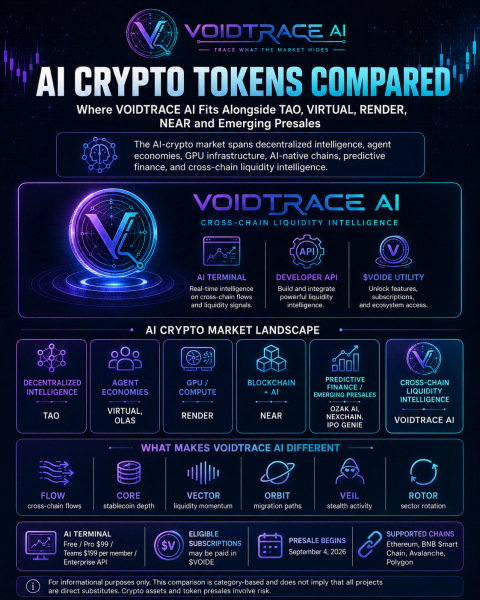
The category now includes decentralized machine-intelligence networks, autonomous agent economies, GPU infrastructure, AI-native blockchains, prediction platforms and tokenized financial applications.
VOIDTRACE AI occupies another part of that landscape: cross-chain liquidity intelligence.
Its platform is being developed to interpret how capital moves across chains, stablecoins, bridges, decentralized exchanges, wallets and market sectors. Six specialized agents — FLOW, CORE, VECTOR, ORBIT, VEIL and ROTOR — are intended to turn those fragmented inputs into structured intelligence delivered through an AI Terminal and developer API.
That makes comparing $VOIDE with other AI-related tokens more useful when the comparison starts with what each ecosystem is actually trying to build.
The Listed AI Token Landscape
Bittensor ($TAO) represents decentralized machine intelligence infrastructure. Its network consists of independent subnets producing digital commodities, with contributors rewarded in TAO.
Virtuals Protocol ($VIRTUAL) is centered on autonomous AI agents and agent economies. $VIRTUAL acts as a base liquidity and transactional currency within an ecosystem where agents can be tokenized and engage in on-chain commerce.
Render ($RENDER) approaches AI from the compute side. Render Network provides decentralized GPU rendering capacity and has expanded its ecosystem to support generative-AI workflows alongside traditional 3D rendering.
Olas ($OLAS) is focused on autonomous agent ownership and agent-to-agent economies. Its ecosystem includes an agent app layer and marketplace where autonomous agents can provide and purchase services.
NEAR ($NEAR) is broader infrastructure. Its 2026 roadmap combines cross-chain financial infrastructure with autonomous AI agents, while NEAR AI focuses on building, deploying and monetizing agents.
VOIDTRACE AI does not attempt to reproduce those models.
Its proposed role is closer to an intelligence layer for crypto markets.
What Makes VOIDTRACE AI’s Position Different?
Instead of providing general-purpose AI compute or an ecosystem for creating agents, VOIDTRACE AI is being designed around a narrower question:
Where is crypto capital moving, and what do those movements collectively signal?
Its six-agent model divides that problem into specialized functions.
FLOW follows cross-chain movement. CORE examines stablecoin concentration and liquidity depth. VECTOR measures liquidity momentum. ORBIT looks for potential destinations of migrating capital. VEIL focuses on stealth accumulation and coordinated wallet behavior. ROTOR monitors sector and narrative rotation.
The output is intended for traders, analysts and developers rather than AI-model builders themselves.
That produces three primary product layers:
AI Terminal for direct interaction with market intelligence.
Developer and institutional API for integrating signals into third-party applications.
$VOIDE utility for eligible subscription access, staking and other ecosystem functions.
Quick Comparison
Project
Primary Focus
Main Product/Network Angle
Stage
VOIDTRACE AI ($VOIDE)
Cross-chain liquidity intelligence
AI Terminal, six-agent intelligence, API
Upcoming presale
Bittensor ($TAO)
Decentralized machine intelligence
Subnets and decentralized AI commodities
Listed ecosystem
Virtuals ($VIRTUAL)
Autonomous AI-agent economy
Agent creation, tokenization and commerce
Listed ecosystem
Render ($RENDER)
Decentralized GPU infrastructure
Rendering and generative-AI compute
Listed ecosystem
Olas ($OLAS)
Autonomous agent economy
Agent ownership and service marketplace
Listed ecosystem
NEAR ($NEAR)
Blockchain + agentic infrastructure
Cross-chain finance and autonomous AI
Listed ecosystem
Nexchain ($NEX)
AI-native Layer 1
AI-assisted blockchain execution
Presale
Ozak AI ($OZ)
Predictive financial intelligence
AI agents and trading signals
Presale
IPO Genie ($IPO)
Tokenized pre-IPO markets
AI-assisted risk analysis and RWA access
Presale
Nexchain currently describes itself as an AI-native Layer 1 using AI to improve network execution, security and interoperability. Ozak AI positions its $OZ ecosystem around predictive financial intelligence and AI-powered trading signals. IPO Genie, meanwhile, focuses on tokenized pre-IPO markets and uses its Genie AI layer for risk assessment rather than crypto liquidity analysis.
VOIDTRACE AI Versus Predictive-AI Presales
The comparison becomes more direct with projects such as Ozak AI because both touch financial intelligence.
Even there, the emphasis differs.
Ozak AI currently promotes predictive agents and buy-and-sell alerts spanning financial markets.
VOIDTRACE AI is being developed around liquidity interpretation before execution.
Its developer use cases include a trading bot that consumes confidence-weighted signals, a cross-chain liquidity dashboard and a Capital Radar application capable of comparing market rotation with portfolio exposure.
The distinction is less “which AI is better?” and more what problem is each AI system being built to solve?
$VOIDE Also Connects the Intelligence Layer With Software Access
VOIDTRACE AI’s token design adds another element to the comparison.
The project’s AI Terminal currently has Free, Pro, Teams and Enterprise access levels, with Pro priced at $99 per month and Teams at $199 per month per member.
Eligible subscriptions may be paid in $VOIDE, with tokens used for qualifying access intended to be permanently burned.
The project also plans institutional API access, creating a potential commercial layer around the same intelligence infrastructure used by Terminal subscribers.
That ties $VOIDE more closely to software consumption than a token whose principal purpose is network gas, compute incentives or governance.
Presale Competition Is Becoming Product Competition
Among current and upcoming presales, simply offering another token is becoming less distinctive.
Nexchain emphasizes an AI-native blockchain. Ozak AI emphasizes predictive financial signals. IPO Genie targets tokenized private-market access. EarnPark describes PARK as a utility and governance token for its digital-asset platform.
VOIDTRACE AI is making its case around cross-chain capital visibility.
That is ultimately the comparison worth watching.
Not whether $VOIDE can be called another “AI token,” but whether VOIDTRACE AI can make its six-agent intelligence, Terminal and API useful enough to establish a distinct place in an increasingly specialized AI-crypto market.
The $VOIDE presale is scheduled to begin September 4, 2026, with planned participation across Ethereum, BNB Smart Chain, Avalanche and Polygon.
More information is available through VoidTraceAI.com.
Disclaimer: This article is for informational and comparative purposes only and does not constitute financial, investment or trading advice. Projects compared above operate in different market segments and are not necessarily direct competitors. References to features describe published or planned functionality and should not be interpreted as claims of superior performance. Cryptocurrency and token presales involve significant risk.
Northwest Louisiana faces complex challenges, from economic development to public education and infrastructure. Voters often feel disconnected from the political process, seeking leaders who prioritize local community needs over partisan disputes. Real progress requires a practical approach to problem-solving and a commitment to listening to the people directly affected by these issues.
Dr. Matt Gromlich, an educator and researcher at Louisiana State University Shreveport, aims to bridge this gap. As a candidate for Louisiana’s Fourth Congressional District, he has built a campaign rooted in community engagement and data-driven solutions. The following conversation explores his grassroots campaign, his strategy for uniting residents, and his actionable vision for a stronger Louisiana.
Q: The U.S. House races in Louisiana have had significant changes in the last four months. Can you describe what happened and what that means for the November 3rd election?
Dr. Matt Gromlich: On April 29, 2026, the U.S. Supreme Court ruled that Louisiana’s congressional map was unconstitutional. The following day, Governor Jeff Landry issued an executive order suspending the party primary elections for U.S. House across the state – even though 42,000 mail-in ballots had already been returned.
The Louisiana State Legislature then re-drew the congressional maps and ratified them in late May. For my race, in particular, the change meant that six parishes were removed from District 4 (Lincoln, Ouachita, Jackson, Winn, Grant, and Rapides) and one parish was added (Natchitoches).
In addition to the redistricting, the Louisiana State Legislature also changed the type of election – from a closed party primary on May 16th to an open “jungle” primary on November 3rd.
What that means is ALL candidates will be on the ballot together on November 3rd. If no one receives over 50% of the vote in November, the top two candidates (regardless of party) will head to a runoff on December 12th.
The change in the election structure also meant that new candidates were able to jump into the race. All candidates had to qualify for the ballot – even if they had already previously qualified.
Q: You secured your place on the ballot through a voter petition rather than paying the qualifying fee. How did this process shape the foundation of your campaign in northwest Louisiana?
Dr. Matt Gromlich: As I mentioned, after the May 16th primary election was canceled, the Louisiana State Legislature changed our districts and re-opened qualifications for the November 3rd ballot.
When this change occurred, our team decided to re-qualify through voter petition, instead of paying a qualifying fee. We did so to make a statement: that, even though they canceled a free and fair election while it was currently in progress, we were still fighting. We only had about 5 weeks to collect a minimum of 250 valid signatures. We collected over 500.
I am extremely proud of the work we put into collecting signatures. We traveled all across the district and made appeals directly to voters as to why we should get back on the ballot.
The overwhelming support that we received shows that this campaign is not about one person. This is a movement.
Q: Over the past few months, you have traveled all across the district – the “old” district (before redistricting) and the “new” district (after redistricting). What are the most pressing concerns you hear from residents, and how do those conversations inform your platform?
Dr. Matt Gromlich: Throughout District 4 (both the “old” and the “new” District 4), there are some universal concerns as well as local concerns. Our new district is composed of 15 parishes. That is approximately 760,000 people. Geographically, our district stretches from Northwest Louisiana all the way down the western side of the state. So, not every local concern is the same.
Across the district, healthcare continues to be the main concern. 34% of the state’s population relies on medicaid and 21% on medicare. With the passing of HR1, the One Big Beautiful Bill, it is estimated that between 33-40 rural hospitals in Louisiana will close. This is on top of one-third of Louisiana’s parishes already not having birthing hospitals, centers, or OB providers. People are scared about their healthcare access now and in the future.
In the northwest part of the district, data centers and water quality are a huge local issue. Data centers have been approved without environmental studies, public support, or transparency. Many local officials have signed NDAs.
In the middle part of the district, transportation and high-speed internet access are significant concerns. People are moving out of the area to larger cities in order to live and work.
In the southern part of the district, carbon capture and sequestration are the major priorities. People are, rightfully, afraid of what this means for health, safety, and property rights.
Q: As a researcher and educator at LSUS, you emphasize using data and collaboration to solve complex problems. How will you apply this academic approach to legislative work in Congress?
Dr. Matt Gromlich: As an educational researcher, my entire higher education career has been reading research, studying issues, collecting data, analyzing data, and summarizing the information. This approach to legislation is exactly what we need in Congress. We need people who understand how to collect data that includes all stakeholders. We need legislators who actually take the time to write their own legislation – and then communicate that legislation and its impacts to their constituents.
Q: Your volunteer base has grown to over 100 people from diverse backgrounds. How do you manage to bring individuals with differing views together around a shared goal?
Dr. Matt Gromlich: At the beginning of our campaign, we were trying to find a term that exemplified our mission and movement. We settled on the term “like-hearted.” We have never been about finding people who agree with us 100%. We know that people come from a variety of backgrounds and have many beliefs.
What we are looking to do in this campaign is to connect people who have the same goal: to make Louisiana better.
This has resonated across the district. We have gathered together over 100 volunteers of all backgrounds – including Democrats, No Party voters, and Republicans!
Q: Your platform highlights economic opportunity, public education, and infrastructure. Which of these areas requires the most immediate action, and what is your first step to address it?
Dr. Matt Gromlich: Honestly, all of these areas require immediate action and focus. We should be able to work on all of these issues at the same time. But, as I stated earlier, the most important issue that I hear from voters is healthcare. We must change our healthcare system. It is time to implement Medicare for All. We can not continue with the broken system we have today.
Q: The current political climate is highly polarized. How do you plan to maintain a focus on practical, community-centered leadership if elected to represent the Fourth District?
Dr. Matt Gromlich: If elected as the representative for District 4, then our campaign would have already overcome some of the polarization in our community. We would have shown that our message can break down political barriers.
In this position, I would continue to work with all people and listen to all constituents to guarantee that I provide practical solutions to real problems.
We have had enough division. It’s time for unity.
Conclusion: A Community-Centered Path Forward for Northwest Louisiana
This conversation shows a clear local demand for responsive leadership in northwest Louisiana. By focusing on direct community engagement and practical problem-solving, the campaign proves that voters value connection and honest dialogue. The effort centers on shared community goals rather than political divides, setting a solid foundation for action. Dr. Gromlich’s platform directly addresses pressing regional priorities—from preserving rural healthcare access and expanding high-speed internet to ensuring environmental accountability and transparency across all 15 parishes.
Effective representation relies on leaders who are willing to listen and understand the daily struggles of their constituents. Dr. Gromlich’s grassroots approach offers a direct path toward addressing the core issues in the Fourth District. Grounded in research and evidence-based policy, his coalition of “like-hearted” volunteers demonstrates that community members across party lines can unite behind a common purpose.
As the election approaches, his focus on education, infrastructure, and economic opportunity presents a clear option for voters seeking community-centered governance. By choosing direct public outreach over partisan posturing, Dr. Gromlich continues to build a movement dedicated to delivering accountable representation and long-term progress for working families throughout Northwest Louisiana.