Category: BigNewsNetwork

  • Trusted Smart Chain Completes CertiK Audit, Advancing Secure RWA Tokenization thumbnail

    Trusted Smart Chain Completes CertiK Audit, Advancing Secure RWA Tokenization

    Trusted Smart Chain Completes CertiK Audit, Advancing Secure RWA Tokenization

    As blockchain technology continues to mature, the criteria by which infrastructure is evaluated are changing. Security and regulatory alignment are now central considerations, particularly as blockchains expand beyond native digital assets and into tokenized securities and real world assets.

    The next phase of blockchain adoption is increasingly focused on enabling compliant financial instruments, including tokenized equity, debt, funds, and other real world assets. Supporting these use cases requires infrastructure that is designed from the outset to operate securely, transparently, and within evolving regulatory frameworks.

    Trusted Smart Chain has reached a significant milestone in this context by completing a comprehensive security audit conducted by CertiK, a firm widely recognized for its work in blockchain security research and smart contract auditing.

    The audit represents an important step in Trusted Smart Chain’s broader strategy to serve as a blockchain purpose built for launching tokenized securities and real world assets, with security and compliance embedded at the base layer of the network.

    Security has become foundational for blockchain infrastructure because failures at the protocol level no longer remain isolated. When blockchains support tokenized financial assets that represent real economic value, vulnerabilities can affect applications, investors, issuers, and capital markets simultaneously. As a result, base layer security has become a prerequisite for any blockchain that aims to support real world asset tokenization at scale.

    Modern security audits play a critical role in addressing this risk. Rather than serving as surface level validations, audits are technical examinations designed to assess smart contract logic, execution paths, permissioning structures, and system behavior under adversarial conditions. For a blockchain intended to host tokenized securities and regulated assets, this scrutiny is especially important because every application and issuance built on the network inherits its security model.

    Completing a CertiK audit signals that a blockchain’s core infrastructure has undergone independent review using methodologies designed to reflect real world threat environments. It also establishes a baseline for ongoing monitoring and continuous improvement as the network evolves.

    Trusted Smart Chain’s approach reflects a broader architectural philosophy focused on enabling compliance on chain finance. Rather than accelerating toward deployment and addressing risk later, the network prioritized verification and alignment early in its development. This includes security at the protocol level as well as alignment with regulatory considerations that are increasingly relevant as real world assets move on chain.

    That alignment is central to Trusted Smart Chain’s long term focus on real world asset tokenization. As tokenized securities, private market assets, and other regulated instruments are issued on blockchain infrastructure, networks must support requirements around accountability, record integrity, and operational reliability. Security and compliance function together as foundational elements rather than separate layers.

    According to Brant Frank, CTO of Trusted Smart Chain, the CertiK audit fits within a broader effort to design blockchain infrastructure capable of supporting regulated financial activity and real world asset issuance at scale.

    “Blockchains designed for tokenized securities and real world assets have to meet a higher bar,” Frank said. “When you are dealing with regulated instruments and real economic value, the underlying infrastructure has to be secure, predictable, and engineered for long term reliability. That perspective has shaped how Trusted Smart Chain has been built from the beginning.”

    Frank brings more than a decade of experience designing large scale systems across enterprise software, healthcare, government technology, and blockchain. His background as a software architect and blockchain engineer has informed Trusted Smart Chain’s emphasis on disciplined development, security review, and infrastructure designed to support real world use cases.

    As blockchain infrastructure continues to converge with traditional financial systems, expectations around verification, auditability, and regulatory alignment are likely to increase. Networks that aim to support tokenized real world assets must demonstrate that they can operate within these constraints while maintaining the benefits of on-chain settlement and programmability.

    The completion of the CertiK audit positions Trusted Smart Chain within this next phase of blockchain infrastructure development. A secure and compliant foundation enables issuers to launch tokenized securities with greater confidence, allows developers to build applications that interact with real world assets, and supports ecosystem growth without compounding hidden risk.

    Security and compliance remain ongoing commitments rather than static achievements. Protocols evolve, regulatory frameworks develop, and infrastructure must adapt accordingly. The audit provides a foundation from which Trusted Smart Chain can continue refining its role as a blockchain designed specifically for tokenized securities and real world asset tokenization.

    As real world assets increasingly move on chain, blockchains built with security, regulatory alignment, and infrastructure discipline are likely to define the future of this market.

    With the completion of its CertiK audit, Trusted Smart Chain continues to position itself at the intersection of blockchain security, compliance, and real world asset tokenization.

    Ivan Kan
    Chief Marketing Officer
    Trusted Smart Chain

    Press@trustedsmartchain.com

    www.trustedsmartchain.com

    Disclaimer:
    This article is for informational purposes only and does not constitute financial advice. Cryptocurrency investments carry risk, including total loss of capital. Readers should conduct independent research and consult licensed advisors before making any financial decisions.

    All market analysis and token data are for informational purposes only and do not constitute financial advice. Readers should conduct independent research and consult licensed advisors before investing.

    Crypto Press Release Distribution by BTCPressWire.com

  • Instagram Lite Turns Five. Is Quiet Success Still Success? thumbnail

    Instagram Lite Turns Five. Is Quiet Success Still Success?

    person holding black samsung android smartphone

    When Instagram Lite launched five years ago, it did so without any attempt to frame itself as a breakthrough or a reinvention of social media. There were no promises of disruption and no effort to compete on spectacle. Instead, it was introduced in markets where the full Instagram app struggled to perform reliably, particularly on slower connections and older devices, and for users who valued access over polish. That restraint was deliberate, and it remains central to why Instagram Lite has continued to serve a clear purpose rather than fading into irrelevance.

    Rather than chasing novelty, Meta chose to work with an existing asset and make it fit new realities. For anyone building or managing mobile products, that decision alone is worth paying attention to. We asked the experts at Rounds.com, the company that developed a technology platform which autonomously manages and improves mobile assets, to shed some light on this process.

    Optimization starts with knowing what not to change

    Instagram Lite kept the core experience intact while shifting focus to how the product was delivered. Sharing photos, browsing content, and staying connected remained familiar, but the technical footprint changed significantly to match real-world constraints.

    As of its global rollout, Instagram Lite’s app size has remained under 5MB, compared to a full Instagram install that typically exceeds 30MB. That gap is not cosmetic. In regions with limited storage, slower networks, or prepaid data plans, it directly affects whether an app can be downloaded at all, updated consistently, or retained long term. Data usage was reduced, background processes were limited, and performance was prioritized over visual ambition.

    From a developer’s point of view, this is a hard line to walk. Removing functionality without breaking identity requires clarity about what users actually value. Instagram Lite succeeded because it focused on preserving the experience that mattered, not the features that looked impressive on paper. The trade-off was clear: fewer animations and visual layers in exchange for stability, speed, and reliability across a wider range of devices.

    This kind of optimization reflects technical maturity. It acknowledges that growth can also come from improving compatibility and consistency, not only from adding new layers of functionality.

    Marketing works best when it follows product truth

    Instagram Lite was never framed as a lesser version of the app. It was positioned as practical and lightweight, designed for environments where reliability mattered more than visual detail. That positioning worked because it reflected how the product actually behaved once installed.

    Instagram Lite has now surpassed 500 million downloads globally, with sustained adoption in markets such as India, Brazil, and Indonesia, where performance constraints are structural rather than temporary. Users did not need campaigns or comparisons to understand its value. The product communicated its purpose through use.

    Users were not persuaded through campaigns. They recognized the value immediately. When optimization is done correctly, marketing becomes an explanation rather than a promise.

    This way of thinking carries into how Rounds approaches mobile assets. Rounds.com looks at how product structure, performance, and positioning reinforce each other. When optimization is grounded in usage patterns, marketing feels natural rather than manufactured.

    A success that avoided the spotlight

    Five years on, Instagram Lite does not dominate headlines. That may be its biggest achievement. It did what it was designed to do and kept doing it quietly.

    For developers and asset owners, the lesson is straightforward. Not every success story needs reinvention. Some are built on focus, restraint, and respect for context. Instagram Lite shows how optimizing an existing mobile asset, done with discipline, can create durable value.

    Companies like Rounds operate on this principle. As a technology company focused on managing and optimizing mobile assets, Rounds acquires existing apps and tools, studies how users actually interact with them, and applies data-driven optimization to improve performance, retention, and long-term viability. By concentrating on real usage conditions instead of presentation polish, optimization becomes a deliberate growth strategy rather than a compromise made after launch.

  • Austrian Startup Miracles Brings Magic to Children’s Bedtime Stories with Groundbreaking Personalized Books – Now Expanding to the United States thumbnail

    Austrian Startup Miracles Brings Magic to Children’s Bedtime Stories with Groundbreaking Personalized Books – Now Expanding to the United States

    Revolutionary technology transforms any child into the hero of their own beautifully illustrated storybook in just 30 seconds

    VIENNA, AUSTRIA – In an era where screen time dominates childhood, one European startup is proving that the magic of physical books is far from over. Miracles (miracles.my), the Austrian personalized children’s book company, is officially announcing its expansion into the United States market after experiencing explosive growth across German-speaking Europe.

    The concept is deceptively simple yet profoundly emotional: parents upload a single photo of their child, and within 30 seconds, they can preview their son or daughter as the hero of a stunning, cinema-quality illustrated storybook. But what happens when children open these books for the first time is anything but simple.

    “Mama, that’s me.”

    That whispered realization – the moment a child points at the page and recognizes themselves as the brave princess, the courageous astronaut, or the adventurous pirate – has become the signature experience that’s driving Miracles’ rapid growth. Thousands of parents across Austria, Germany, and Switzerland have shared videos of this exact moment: eyes widening, fingers tracing the illustrations, and pure, unfiltered wonder spreading across little faces.

    “We’re not selling books,” the company states in its mission. “We’re creating core memories. The kind that children will remember when they’re thirty years old and looking back at their childhood.”

    European Craftsmanship Meets Cutting-Edge Technology

    What sets Miracles apart in the increasingly crowded personalized book market is an uncompromising commitment to quality that reflects its European heritage. Every illustration is created by Miracles’ in-house design team based in Vienna, Austria. The books are then printed on premium paper stock in Germany, using production standards typically reserved for collector’s editions and art books.

    The technology behind the personalization is equally impressive. Miracles has developed proprietary systems that transform a child’s photograph into a consistent, character-accurate avatar that appears throughout the entire book – not just on one or two pages. The result looks like it was pulled straight from an animated feature film: warm, expressive, and unmistakably them.

    This attention to detail extends to the stories themselves. Each book is designed to do more than entertain – it’s crafted to nurture specific values and emotional growth. A child reading the Princess book doesn’t just go on an adventure; she discovers her own courage. The Astronaut story isn’t just about space; it’s about believing in possibilities beyond what we can see.

    Why Now? Why America?

    The timing of Miracles’ U.S. expansion is strategic. American parents are increasingly seeking alternatives to digital entertainment – something tangible, meaningful, and screen-free that can become part of their family’s bedtime ritual. At the same time, the gifting market for grandparents, aunts, uncles, and family friends has shown enormous appetite for personalized products that go beyond a name printed on a generic template.

    “The American market understands the value of premium, personalized experiences,” the company notes. “Parents and grandparents there are looking for gifts that matter – something that won’t be forgotten after a week, something that becomes their child’s most treasured possession.”

    Early response from U.S. customers has validated this thesis. Beta users have described the books as “the best gift I’ve ever given” and “worth every penny for the look on her face.” Several have reported that their children request their Miracles book every single night at bedtime – sometimes for months on end.

    More Than a Book: A Movement

    Miracles represents something larger than a product innovation. It’s part of a growing movement to make children fall in love with reading by making reading about them. Research consistently shows that children engage more deeply with stories when they see themselves represented. Miracles takes this insight to its logical extreme: what if the hero wasn’t just someone who looked like them, but actually was them?

    The company currently offers a growing library of story themes including Princess, Astronaut, Witch, Ballerina, Firefighter, Mermaid, Pirate, Dinosaur, and Ballet adventures – with new titles in development. Each book can be customized with a personal dedication, making it ideal for birthdays, holidays, and milestone moments.

    Availability and Pricing

    Miracles books are available for order now at https://miracles.my with worldwide shipping. Parents can create a free preview in approximately 30 seconds to see their child as the hero before purchasing. Premium upgrades including hardcover binding and character posters are available.

    About Miracles

    Miracles is a Vienna-based startup revolutionizing children’s literature through premium personalized storybooks. Combining European design craftsmanship with innovative personalization technology, Miracles creates one-of-a-kind books where children become the heroes of their own adventures. Every book is illustrated in Austria and printed in Germany to the highest quality standards. For more information, visit miracles.my.

  • How to Track Keyword Rankings Accurately Using APIs in 2026 thumbnail

    How to Track Keyword Rankings Accurately Using APIs in 2026

    Tracking keyword rankings used to be a relatively simple task. You searched a phrase, noted where your page appeared, and repeated the process over time. That approach stopped working years ago, but in 2026 the gap between perceived rankings and actual visibility has become impossible to ignore. Search results now change based on location, language, device, intent signals, and even subtle variations in query wording. If you are still relying on manual checks or opaque dashboards, you are not measuring performance; you are sampling it.

    Accurate keyword tracking today requires a shift in mindset. Instead of asking where a page ranks in general, you need to understand how and when it appears under controlled conditions. This is where APIs and automation move from being technical extras to core SEO infrastructure.

    Why ranking accuracy matters more than ever

    Keyword rankings influence decisions that carry real commercial weight. Content investment, technical priorities, and long-term strategy are often justified using visibility data. When that data is unstable or unverifiable, teams end up making confident decisions based on weak evidence.

    In real-world projects, inaccurate ranking data creates friction. Writers lose trust in SEO guidance, developers question priorities, and stakeholders focus on short-term movement instead of durable progress. The problem is not that rankings fluctuate. The problem is that many tools cannot explain why they fluctuate.

    APIs address this by forcing clarity. Every data point comes from a defined request made under specific conditions. When rankings change, you can trace the context instead of guessing the cause.

    The limits of conventional rank tracking tools

    Most traditional rank tracking platforms were built for a simpler version of search. They scrape results from shared locations, apply averaging logic, and present a single position as if it were universally true. In 2026, this simplification hides more than it reveals.

    Google serves different results depending on where the search originates, which device is used, and how the query is interpreted. A keyword might trigger local packs, product grids, or AI generated summaries that change what “position one” even means. When tools compress all of this into a single number, they remove the very context that determines visibility.

    From hands-on experience auditing ranking reports, the biggest issue is not that the numbers are wrong, but that they are not reproducible. If you cannot recreate a result using the same inputs, the metric has limited analytical value.

    How API based tracking changes the measurement model

    API-driven keyword tracking works from the opposite direction. Instead of collecting whatever Google happens to show at a moment in time, you define the conditions under which results are requested. Location, language, device type, and query structure are specified upfront.

    This approach mirrors how engineers test systems. You isolate variables so that changes can be attributed to real causes. Over time, this produces cleaner trend data and removes much of the noise that plagues surface-level rank checks.

    Another critical advantage is logging. Every API request can be stored with timestamps and parameters. This creates an audit trail that supports EEAT principles by showing how conclusions were reached rather than asking readers or stakeholders to trust unexplained outputs.

    Interpreting Google data through APIs

    Google does not provide a single API that says your keyword ranks here right now. Instead, it exposes performance signals through tools such as Search Console. While this data is aggregated and delayed, it reflects how real users encounter your pages.

    When used correctly, Search Console data reveals patterns that daily rank trackers miss. Average position trends show whether visibility is improving or declining across meaningful timeframes. Query-level impressions highlight whether a keyword is gaining exposure even before clicks increase.

    Advanced workflows combine this data with controlled query simulations to validate assumptions. The goal is not to chase exact positions but to understand visibility in a way that aligns with how Google reports it internally.

    Automation as a discipline, not a shortcut

    Automation often gets framed as a way to do more work with less effort. In keyword tracking, its real value is consistency. Automated API calls remove the human habit of checking rankings selectively or reacting emotionally to short-term changes.

    Well-designed automation schedules checks at intervals that match business needs. It normalizes results so that comparisons are meaningful. It flags sustained shifts rather than daily noise. Over time, this produces calmer, more productive SEO discussions.

    This is also where tooling philosophy matters. Platforms that prioritize transparency over novelty tend to age better, because their outputs remain interpretable even as search evolves. SEOZilla.ai is often referenced in technical discussions for this reason, as it builds its tracking logic around documented Google APIs and reproducible workflows rather than scraped approximations.

    Evaluating keyword tracking APIs responsibly

    Not every API based solution delivers accuracy by default. The quality of output depends on how inputs are defined and how results are processed. Some systems claim precision while quietly averaging data or masking uncertainty.

    From a YMYL perspective, this matters. Ranking data influences financial decisions, hiring, and long-term planning. Any system used for this purpose should explain its methodology clearly and avoid overstated guarantees.

    A practical benchmark is whether the provider allows you to understand how positions are calculated and how often data is refreshed. The SEOZilla.ai keyword position tracking API is one example of an approach that emphasizes traceability and Google-compliant data sourcing rather than presenting rankings as absolute truths.

    From raw rankings to meaningful insight

    The final step is interpretation. Accurate data does not automatically produce good decisions. The real advantage of API driven tracking is the ability to connect ranking movement to specific actions such as content updates, internal linking changes, or technical fixes.

    Over time, this builds institutional knowledge. Teams learn which changes tend to move which types of keywords. They stop overreacting to minor fluctuations and start focusing on durable improvements. Engagement improves because discussions are grounded in evidence rather than screenshots.

    For those exploring how API based tracking fits into a broader SEO workflow, the main SEOZilla.ai platform provides additional context on integrating ranking data with content performance and automation pipelines, without relying on opaque metrics or promotional claims.

  • AI bots use your content without paying, but you can turn them into a paying audience

    Imagine staring at website analytics while nothing moves. Traffic sits flat, ad impressions stay steady, and affiliate clicks barely trickle in. Meanwhile, AI bots chew through the same pages without leaving a trace. Large language models and autonomous agents don’t act like normal visitors. They use headless clients that skip JavaScript, so no ads load, no analytics pixels fire, and no referrals go back to the site. The dashboard stays silent while these readers pull text straight from HTML.

    It isn’t a small group of crawlers. A large slice of web traffic, sometimes 30% or more, comes from bots posing as users. Humans create pageviews and ad revenue. These AI-driven visits leave bandwidth footprints in server logs and nothing else. Even when major AI providers share official crawler user-agents like GPTBot or CCBot, much of their data flows in through mirrors or licensed archives outside the reach of robots.txt.

    Attribution breaks next. Models synthesize answers from tokenized training data instead of linking back to sources. Citations rarely turn into real clicks for publishers. Valuable insights go out, but credit and compensation don’t come back.

    Blocking every bot isn’t a fix. It cuts off access to growing AI demand and shrinks brand presence where people now look for quick answers, not full articles. Treat AI agents as a new audience. Engage them. Monetize them.

    Why blocking backfires and paywalls fail for software agents

    Blocking AI bots with robots.txt files or IP bans is a blunt fix for a precise problem. It might stop polite crawlers that follow rules, but it doesn’t address the underlying demand. Scrapers and cached mirrors ignore restrictions, pull content anyway, and leave no trail. Publishers then lose leverage with honest buyers who want licensed access.

    Old-school paywalls suit people, not software. They expect clicks, logins, cookie prompts, and a checkout flow. Software agents don’t use browsers, skip login screens, and ignore cookie banners. A subscription flow that works for readers breaks when an AI bot fetches raw HTML from the server.

    Metered paywalls rely on scripts running in a browser to count reads. Headless bots don’t run JavaScript. They request full pages straight from the server, so counters never fire. The meter looks fine on the surface while scrapers pull everything in the background.

    Big media groups sometimes sign enterprise licenses with AI providers. Contracts at that scale need lawyers and bandwidth. Smaller publishers get left out. Independent sites hold valuable niche work yet go unpaid because complex licensing isn’t realistic for a small team.

    Publishers need tools at the HTTP layer. Machine-readable rules should identify bot traffic, show pricing upfront, and release content only after an automated payment confirmation built for software clients. This shifts the model away from blocking and human-first paywalls toward flexible systems where AI-driven traffic becomes visible and profitable.

    How to monetize AI bot traffic fairly with AI‑specific paywalls

    Picture a setup where AI bots pay their share without getting in the way of human readers. Regular visitors get the fast, full experience. Pages load with JavaScript, cookies, and interactive features. In the background, software agents settle up before they access content.

    Early detection makes this work. Many AI crawlers expose themselves through user-agent strings, TLS client hints that describe the client, and skipped JavaScript execution since they don’t run real browsers. Once flagged, those requests get different treatment.

    Charging doesn’t need one rigid model. Publishers might price by:

    1. Per URL access – charge for each page requested.
    2. Word count – longer articles or detailed guides cost more because they include richer data.
    3. Request type – distinguish simple crawling from full-text retrieval for flexible pricing based on depth.

    When a bot tries to pull content without paying, the server returns a standard response such as 402 Payment Required or 403 Forbidden with a payment challenge. The response lists the price, currency, and a callback URL where the bot confirms payment before the server streams the content.

    Speed matters for trusted clients. Publishers can let AI systems pre-load credits into a balance. Each fetch deducts credits, which avoids slow, repeated negotiations.

    Clear rules help. A machine-readable policy at /.well-known/ai-access.json can document what’s allowed, prices, and a contact point for issues. Openness nudges reputable AI providers to follow the rules instead of slipping by unnoticed.

    PayLayer adds AI‑only paywalls to WordPress without changing the human experience

    PayLayer AI paywall for WordPress gives publishers a simple way to serve people while asking AI bots to pay their share. It detects AI agents or headless clients quietly, then triggers an automated payment flow. Human visitors get the usual experience. Pages load fast with SEO previews intact, so search engines still index content without trouble.

    Setup takes a few steps in the WordPress dashboard. Install the free plugin, choose categories or specific URLs to shield from unpaid bot traffic, set per-request prices tied to content value, then publish an AI access policy endpoint with clear rules for software clients. Typical sites don’t need theme edits or code changes.

    When an AI bot requests gated content, PayLayer doesn’t block access. It returns a structured payment challenge, essentially a machine-readable invoice. Supported programmatic payment methods let the bot pay automatically. After confirmation, PayLayer streams the full article or data immediately so the AI receives the result without delay.

    Targeting offers fine control. Leave the homepage, sitemaps, and author pages open to support discovery and routine crawling. Apply charges where it matters most, like long-form research, API-style endpoints with rich datasets, and other high-value materials that warrant payment.

    PayLayer also keeps detailed logs of bot requests, payments, and delivery. The audit trail shows revenue from automated clients and highlights which sections draw the most interest from generative AI systems.

    Start licensing your content to AI with paid crawling and PayLayer

    Bots aren’t just noise. Some are repeat visitors with budgets. Instead of pushing them away, publishers can license site content to generative AI platforms and get paid for it. Start small. Pick one high‑value page, like a glossary or data‑heavy reference, that draws lots of bot hits and won’t frustrate human readers if gated. Set a micro‑fee per retrieval, something like $0.005 to $0.05 per 1,000 words, then watch the results.

    A public AI policy makes this workable. Spell out permitted uses, training versus inference, payment rules, and a contact for bulk deals. Link the policy from robots.txt so automated clients can find and follow it.

    Track results for a few weeks. Count paid bot calls, revenue by URL, shifts in human traffic, and any crawler feedback. Numbers matter when large AI platforms start talks. Real usage and pricing data supports terms for API access or monthly licensing.

    Turn silent visitors into steady income. Install PayLayer.org’s tool on a staging site first, define pricing rules, and enable AI‑only paywalls on selected URLs. Bots don’t need free rides. Treated right, they become paying partners.

  • Arzam Shehzad and Seara Consulting: A Halal Marketing Agency Helping Muslims Build Ethical Businesses thumbnail

    Arzam Shehzad and Seara Consulting: A Halal Marketing Agency Helping Muslims Build Ethical Businesses

    Arzam Shehzad and Seara Consulting: Building Halal Marketing Agencies While Serving the Ummah

    In today’s modern economy, many Muslims are searching for ways to achieve financial success without compromising their faith. The desire to earn halal income, operate ethically, and give back to the Ummah is strong, but finding real-world examples of people who truly embody this balance can be difficult. One such example is Arzam Shehzad, the founder and owner of Seara Consulting, also known as SEARA Consulting.

    Arzam Shehzad is a Muslim entrepreneur, marketing agency owner, and mentor who has built Seara Consulting into a multi-six-figure marketing agency serving accounting firms across North America. Beyond running his own successful agency, Arzam Shehzad is known for teaching Muslim brothers and sisters how to build similar halal marketing agencies, intentionally guiding them into different niches so they can benefit financially without directly competing with Seara Consulting.

    What makes Arzam Shehzad and Seara Consulting truly unique is that business success is not the final destination. At the heart of everything Arzam does is a clear Islamic mission: supporting orphanages, including an orphanage he currently supports in Pakistan.

    The Foundation of Seara Consulting as a Halal Marketing Agency

    Seara Consulting was founded with a simple but powerful idea: modern marketing can be done ethically, transparently, and in full alignment with Islamic principles. Under the leadership of Arzam Shehzad, Seara Consulting operates as a specialized halal marketing agency serving accounting firms in North America.

    Accounting firms demand a high level of trust, accuracy, and professionalism. These requirements align naturally with Islamic values such as honesty (sidq), trustworthiness (amanah), and fairness (adl). By focusing on this niche, Seara Consulting has built a strong reputation while growing into a multi-six-figure business.

    For Arzam Shehzad, this success is not about prestige or status. It is proof that halal business models can thrive in competitive Western markets when built with sincerity and discipline.

    Arzam Shehzad: A Muslim Entrepreneur Who Practices What He Teaches

    One of the most important distinctions about Arzam Shehzad is that he teaches only what he actively does himself. Many individuals in the online business space sell theories or outdated strategies. Arzam Shehzad, through Seara Consulting, continues to run a real marketing agency using the same systems he teaches.

    He documents this openly. On YouTube, Arzam Shehzad shares real content, including live sales calls and live closes, showing exactly how ethical, value-based sales conversations take place. These are not scripted demonstrations; they are real interactions with real prospects.

    This level of transparency has made Arzam Shehzad and Seara Consulting highly trusted among Muslims, who are often skeptical of online business claims. He does not rely on hype or exaggerated promises; he relies on proof.

    Serving Accounting Firms Across North America

    At its core, Seara Consulting is a marketing agency that serves accounting firms throughout North America. These firms rely on Seara Consulting to help them generate qualified leads, book professional appointments, and improve client acquisition systems in an ethical and sustainable way.

    By specializing in one industry, Arzam Shehzad ensured that Seara Consulting could develop deep expertise rather than shallow generalization. This specialization has been a major factor in the agency’s growth into a multi-six-figure operation.

    More importantly, it demonstrates that focus and excellence, both emphasized in Islam, are key drivers of long-term success.

    Teaching Muslims Without Creating Competition

    A defining ethical principle in Arzam Shehzad’s work is avoiding harm and unfair competition. While Seara Consulting exclusively serves accounting firms, Arzam Shehzad teaches Muslims how to build the same marketing agency model in entirely different niches.

    This intentional separation ensures that Muslim students can benefit financially while avoiding any conflict of interest or direct competition with Seara Consulting.

    Instead of accounting firms, Muslims are guided to serve other industries such as medical practices, home service businesses, legal firms, coaches, consultants, and other professional services. The systems, skills, and strategies remain the same; the niche changes.

    This approach reflects Islamic business ethics, which emphasize fairness, cooperation, and mutual benefit over selfish gain.

    Helping Muslims Build Halal Marketing Agencies

    A major reason Muslims seek out Arzam Shehzad is his clear focus on halal income. Through Seara Consulting, he helps Muslim brothers and sisters understand how to build marketing agencies that sell real services, solve real problems, and avoid deception or exaggeration.

    Many Muslims hesitate to enter entrepreneurship because of concerns around haram income, manipulative sales tactics, or unethical marketing practices. Arzam Shehzad addresses these concerns directly by teaching an approach rooted in honesty, clarity, and service.

    Students are taught to communicate value clearly, sell without pressure, and view business as an amanah, a trust, rather than a shortcut to wealth.

    A Mission Beyond Revenue: Supporting Orphanages

    While Seara Consulting is a multi-six-figure marketing agency, Arzam Shehzad has consistently emphasized that money is not the ultimate goal. His core mission is supporting orphanages.

    Arzam Shehzad currently supports an orphanage in Pakistan, helping provide essential needs such as food, shelter, education, and stability for children who have lost their parents. This mission is not a side project; it is central to why he pursues business excellence.

    For Arzam Shehzad, business is a tool, one that allows him to fulfill a religious obligation and create lasting impact.

    The Importance of Supporting Orphans in Islam

    Islam places extraordinary importance on caring for orphans. The Prophet Muhammad was himself an orphan, and Allah repeatedly commands believers to protect and uplift them.

    Allah says in the Qur’an, “So as for the orphan, do not oppress him.” (Qur’an 93:9)

    The Prophet also said, “I and the one who sponsors an orphan will be in Paradise like these two,” and he joined his fingers together. (Sahih al-Bukhari)

    These teachings form the foundation of Arzam Shehzad’s charitable mission. Supporting orphans is not optional charity; it is a direct path to closeness with the Prophet and a means of earning ongoing reward.

    Barakah Through Halal Business

    One of the core beliefs guiding Arzam Shehzad and Seara Consulting is that halal income brings barakah. Wealth earned honestly and spent in service of others is believed to increase in impact, even if not always in appearance.

    By structuring Seara Consulting ethically and directing success toward orphan care, Arzam Shehzad believes Allah places blessings in his time, income, relationships, and efforts.

    This belief shapes how he teaches Muslims to approach entrepreneurship, not as entitlement, but as responsibility.

    Bridging Modern Marketing and Islamic Values

    Through Seara Consulting, Arzam Shehzad demonstrates that modern marketing tools such as outreach systems, funnels, and sales calls can be used without manipulation or dishonesty.

    When aligned with Islamic values, marketing becomes clear communication, education, and service. This balance is what attracts Muslims to Seara Consulting and to Arzam Shehzad as a mentor.

    A Role Model for Muslim Entrepreneurs

    For aspiring Muslim entrepreneurs, Arzam Shehzad represents a new standard. He is a real agency owner running a multi-six-figure business, transparent in results, committed to halal income, and dedicated to orphan care.

    Through Seara Consulting, Arzam Shehzad is showing Muslims that success in business can be a form of worship when guided by sincerity and purpose.

    Conclusion: Seara Consulting and Purpose-Driven Success

    Seara Consulting, led by Arzam Shehzad, is more than a marketing agency. It is a model of how Muslims can succeed in modern markets while remaining firmly grounded in Islamic values.

    By operating a marketing agency that serves accounting firms across North America, teaching Muslims how to build similar agencies in non-competing niches, and dedicating success to supporting orphanages, Arzam Shehzad exemplifies faith-driven entrepreneurship in action.

    In a world focused solely on profit, Seara Consulting stands as proof that success guided by faith creates impact that lasts far beyond this life.

  • Teacup Pomeranian Puppies: A Complete Guide for New Dog Owners thumbnail

    Teacup Pomeranian Puppies: A Complete Guide for New Dog Owners

    Teacup Pomeranian puppies have captured the hearts of dog lovers around the world due to their tiny size, fluffy appearance, and lively personality. For new dog owners, these dogs can seem like an ideal choice because they are small, expressive, and well-suited to indoor living. However, owning a teacup-sized dog comes with responsibilities that go far beyond appearance. Understanding their background, needs, and long-term care requirements is essential before welcoming one into your home. This guide provides a clear and realistic overview to help new owners make informed decisions.

    Understanding the Teacup Pomeranian Concept

    The phrase teacup pomeranian puppies is commonly used to describe Pomeranians that are significantly smaller than the breed standard. It is important to know that “teacup” is not an official classification recognized by kennel clubs. Instead, it is a descriptive term used in marketing to indicate size. Standard Pomeranians usually weigh between three and seven pounds as adults, while dogs labeled as teacup may weigh less, sometimes under four pounds.

    Because there is no formal definition, size expectations can vary widely. Some puppies described as teacup may grow larger than expected, while others remain extremely small. New dog owners should approach the term with caution and focus more on overall health and temperament rather than size labels alone.

    Physical Appearance and Breed Characteristics

    In appearance, teacup Pomeranians share the same traits as standard Pomeranians, only on a smaller scale. They have compact bodies, short muzzles, small upright ears, and expressive eyes that give them an alert and curious look. Their thick double coat creates a rounded, fluffy appearance that many people find irresistible.

    Their coats come in a wide variety of colors, including orange, cream, white, black, sable, and mixed patterns. Despite their small size, they often carry themselves with confidence and energy. While they are easy to carry, their delicate structure means they must always be handled gently to avoid injury.

    Personality and Temperament

    One of the defining features of Pomeranians is their personality, and teacup varieties are no exception. These dogs are known for being affectionate, intelligent, and deeply attached to their owners. They often form strong bonds and enjoy staying close, sometimes following their owners from room to room.

    Teacup Pomeranians are typically alert and curious, which can make them vocal when they sense unfamiliar sounds or people. This alertness can be helpful, but without proper training it may lead to excessive barking. Early guidance helps channel their confidence into balanced behavior rather than nervousness or stubbornness.

    Living Environment and Daily Routine

    Because of their small size, teacup Pomeranians thrive in calm and structured environments. They are well-suited for apartment living and smaller homes, but safety must always be a priority. Everyday situations that pose little risk to larger dogs, such as jumping off furniture or rough play, can be dangerous for them.

    A predictable daily routine helps these dogs feel secure. Regular feeding times, consistent sleep patterns, and gentle play sessions contribute to their emotional well-being. Households with attentive adults often find it easier to meet the needs of such a small and sensitive dog.

    Feeding and Nutritional Needs

    Proper nutrition is especially important for teacup-sized dogs. Their tiny stomachs and fast metabolisms mean they require small, frequent meals throughout the day. High-quality food formulated for toy breeds helps ensure they receive essential nutrients without digestive strain.

    One health concern associated with very small dogs is low blood sugar, also known as hypoglycemia. Skipping meals or feeding unsuitable foods can trigger this condition, which may cause weakness or lethargy. Maintaining a consistent feeding schedule is one of the most effective ways to support their health.

    Exercise and Mental Stimulation

    Although teacup Pomeranians are small, they are still active and intelligent dogs that benefit from daily movement and engagement. Short walks, indoor play, and interactive toys help keep them physically and mentally stimulated. Because of their size, they do not require long or intense exercise sessions.

    Care should be taken to avoid overexertion, especially in hot or cold weather. Small dogs are more sensitive to temperature changes, and extreme conditions can quickly become uncomfortable or unsafe. Balanced activity supports both physical health and emotional stability.

    Grooming and Coat Care

    Grooming is an essential part of caring for a teacup Pomeranian. Their thick double coat requires regular brushing to prevent tangles and matting. Gentle brushing several times a week helps maintain coat health and reduces shedding.

    In addition to coat care, attention should be given to dental hygiene. Small dogs are more prone to dental crowding, which can lead to plaque buildup and tooth decay. Regular tooth brushing and veterinary dental checkups play an important role in long-term health. Occasional professional grooming can also help maintain cleanliness and comfort.

    Health Considerations and Veterinary Care

    Health is one of the most important aspects for prospective owners to consider. Teacup Pomeranians may be more vulnerable to certain conditions due to their small size. Fragile bones, dental, and respiratory concerns such as tracheal collapse are sometimes seen in very small dogs.

    Regular veterinary visits allow for early detection and management of potential problems. Preventive care, including vaccinations and routine checkups, helps ensure a healthier life. Choosing a veterinarian familiar with toy breeds can be especially beneficial for ongoing care and guidance.

    Training and Socialization

    Training a teacup Pomeranian requires patience and consistency. These dogs are intelligent and capable learners, but they are also sensitive. Positive reinforcement methods, such as praise and small rewards, are far more effective than harsh corrections.

    House training may take time due to their small bladder size, so a predictable schedule is important. Socialization should begin early, with gradual exposure to new environments, sounds, and people. Supervised interactions with larger dogs help prevent accidental injury while building confidence.

    Ethical Responsibility and Owner Readiness

    Before searching for pomeranian puppies for sale, it is important to consider the ethical responsibilities involved. Teacup Pomeranians are not novelty pets; they require attentive care and long-term commitment. Owners should be prepared for potential medical expenses, daily supervision, and lifestyle adjustments.

    Responsible ownership means prioritizing the dog’s well-being over trends or size labels. Understanding that the teacup term does not guarantee a specific outcome helps set realistic expectations and supports healthier choices.

    Suitability for First-Time Dog Owners

    Teacup Pomeranians can be suitable for first-time dog owners who are patient, attentive, and willing to learn. They tend to thrive in homes where they receive consistent attention and are not left alone for long periods. Individuals seeking a close companion often find these dogs deeply rewarding.

    However, they may not be ideal for those looking for a low-maintenance pet or a dog that enjoys independence. Their emotional attachment to owners means they benefit from companionship and routine.

    Lifespan and Long-Term Commitment

    Pomeranians are generally known for their longevity, often living well into their teens with proper care. Teacup varieties may have similar lifespans, but this depends greatly on genetics, nutrition, and medical attention. A longer lifespan means a longer commitment, one that should be carefully considered before bringing a puppy home.

    Conclusion

    Teacup Pomeranian puppies combine charm, intelligence, and affection in a very small package. While their appearance is undeniably appealing, successful ownership depends on understanding their needs and limitations. With proper care, gentle handling, and realistic expectations, these tiny dogs can thrive and become loving lifelong companions. Thoughtful preparation is the foundation for a healthy and happy relationship between owner and dog.

  • Trusted Smart Chain Completes CertiK Audit, Advancing Secure RWA Tokenization thumbnail

    Trusted Smart Chain Completes CertiK Audit, Advancing Secure RWA Tokenization

    As blockchain technology continues to mature, the criteria by which infrastructure is evaluated are changing. Security and regulatory alignment are now central considerations, particularly as blockchains expand beyond native digital assets and into tokenized securities and real world assets.

    The next phase of blockchain adoption is increasingly focused on enabling compliant financial instruments, including tokenized equity, debt, funds, and other real world assets. Supporting these use cases requires infrastructure that is designed from the outset to operate securely, transparently, and within evolving regulatory frameworks.

    Trusted Smart Chain has reached a significant milestone in this context by completing a comprehensive security audit conducted by CertiK, a firm widely recognized for its work in blockchain security research and smart contract auditing.

    The audit represents an important step in Trusted Smart Chain’s broader strategy to serve as a blockchain purpose built for launching tokenized securities and real world assets, with security and compliance embedded at the base layer of the network.

    Security has become foundational for blockchain infrastructure because failures at the protocol level no longer remain isolated. When blockchains support tokenized financial assets that represent real economic value, vulnerabilities can affect applications, investors, issuers, and capital markets simultaneously. As a result, base layer security has become a prerequisite for any blockchain that aims to support real world asset tokenization at scale.

    Modern security audits play a critical role in addressing this risk. Rather than serving as surface level validations, audits are technical examinations designed to assess smart contract logic, execution paths, permissioning structures, and system behavior under adversarial conditions. For a blockchain intended to host tokenized securities and regulated assets, this scrutiny is especially important because every application and issuance built on the network inherits its security model.

    Completing a CertiK audit signals that a blockchain’s core infrastructure has undergone independent review using methodologies designed to reflect real world threat environments. It also establishes a baseline for ongoing monitoring and continuous improvement as the network evolves.

    Trusted Smart Chain’s approach reflects a broader architectural philosophy focused on enabling compliance on chain finance. Rather than accelerating toward deployment and addressing risk later, the network prioritized verification and alignment early in its development. This includes security at the protocol level as well as alignment with regulatory considerations that are increasingly relevant as real world assets move on chain.

    That alignment is central to Trusted Smart Chain’s long term focus on real world asset tokenization. As tokenized securities, private market assets, and other regulated instruments are issued on blockchain infrastructure, networks must support requirements around accountability, record integrity, and operational reliability. Security and compliance function together as foundational elements rather than separate layers.

    According to Brant Frank, CTO of Trusted Smart Chain, the CertiK audit fits within a broader effort to design blockchain infrastructure capable of supporting regulated financial activity and real world asset issuance at scale.

    “Blockchains designed for tokenized securities and real world assets have to meet a higher bar,” Frank said. “When you are dealing with regulated instruments and real economic value, the underlying infrastructure has to be secure, predictable, and engineered for long term reliability. That perspective has shaped how Trusted Smart Chain has been built from the beginning.”

    Frank brings more than a decade of experience designing large scale systems across enterprise software, healthcare, government technology, and blockchain. His background as a software architect and blockchain engineer has informed Trusted Smart Chain’s emphasis on disciplined development, security review, and infrastructure designed to support real world use cases.

    As blockchain infrastructure continues to converge with traditional financial systems, expectations around verification, auditability, and regulatory alignment are likely to increase. Networks that aim to support tokenized real world assets must demonstrate that they can operate within these constraints while maintaining the benefits of on-chain settlement and programmability.

    The completion of the CertiK audit positions Trusted Smart Chain within this next phase of blockchain infrastructure development. A secure and compliant foundation enables issuers to launch tokenized securities with greater confidence, allows developers to build applications that interact with real world assets, and supports ecosystem growth without compounding hidden risk.

    Security and compliance remain ongoing commitments rather than static achievements. Protocols evolve, regulatory frameworks develop, and infrastructure must adapt accordingly. The audit provides a foundation from which Trusted Smart Chain can continue refining its role as a blockchain designed specifically for tokenized securities and real world asset tokenization.

    As real world assets increasingly move on chain, blockchains built with security, regulatory alignment, and infrastructure discipline are likely to define the future of this market.

    With the completion of its CertiK audit, Trusted Smart Chain continues to position itself at the intersection of blockchain security, compliance, and real world asset tokenization.

    Ivan Kan
    Chief Marketing Officer
    Trusted Smart Chain

    Press@trustedsmartchain.com

    www.trustedsmartchain.com

    Disclaimer:
    This article is for informational purposes only and does not constitute financial advice. Cryptocurrency investments carry risk, including total loss of capital.

    All market analysis and token data are for informational purposes only and do not constitute financial advice. Readers should conduct independent research and consult licensed advisors before investing.

    Crypto Press Release Distribution by BTCPressWire.com

  • Where Can I Find Professional Web Scrapers Online? My Real-World Hiring Process thumbnail

    Where Can I Find Professional Web Scrapers Online? My Real-World Hiring Process

    Where can I find professional Web scrapers online?

    The first time I hired a web scraper, I assumed the hard part was coding. I was wrong. The hard part was scope, compliance, and making sure the data I got back was usable rather than a folder of half-broken files. I had a simple goal: pull product details from a set of sites into a clean spreadsheet so my team could compare pricing and availability. What I received was a script that worked on the freelancer’s machine, failed on mine, and scraped pages that I later realised should not have been touched in the way we attempted. I learned quickly that “web scraping” is not one job. It is a mix of data engineering, browser automation, risk management, and communication.

    These days, when someone asks me where they can find professional web scrapers online, I answer in terms of how I hire them, how I reduce risk, and how I keep the work measurable from day one. I start with Fiverr because it has a deep pool of specialists in data mining and web scraping and it is straightforward to match a project to a category that already fits the work. I also compare options on any other freelancing marketplace when I want a wider sense of pricing, availability, or niche skill coverage, but I keep Fiverr first in my process because the service listings make it easy to align scope and deliverables before a call even happens.

    What I mean by professiona web scraper in practice

    A professional web scraper is not defined by a language or a library. I have seen brilliant Python work that produced messy outputs, and I have seen simple scripts that delivered clean, auditable data every week without drama. What I now look for is an engineer who treats the scraping job as a pipeline with inputs, constraints, and a stable output contract.

    When I brief a scraper, I describe the sites, the data fields, and the frequency, but I also describe what “done” looks like in my world. Done means the data arrives on time, the columns are consistent, missing values are explained, duplicates are handled, and the whole process can be run again without the freelancer hand-holding it. I also expect them to flag compliance issues early, because the most expensive mistake is building a scraper that you later decide not to use.

    That one mindset shift changed everything. I stopped hiring “someone to scrape” and started hiring “someone to deliver a reliable dataset”.

    Where I look first and why I keep Fiverr at the top

    I begin with Professional web scraping services on Fiverr because the marketplace is already organised around data mining and scraping work, so I can compare offerings fast, see typical deliverables, and shortlist people who talk about outcomes rather than vague capability. When I am hiring under time pressure, category structure matters. It reduces back-and-forth, and it helps me spot specialists who have repeatedly shipped similar projects.

    The second place I look is web scraping experts on a freelancing platform when I want to widen the net for an unusual tech stack or a language constraint. I keep that option deliberately broad because “platform fit” depends on the organisation. Some teams need enterprise procurement features. Some need a very specific timezone overlap. Some want a long bench of candidates. I still evaluate those candidates using the same framework I use on Fiverr, because a different platform does not change what professional delivery looks like.

    The third place I look is not a marketplace at all. I use ethical web scraping guidelines and best practices as a reference point to ground the work in responsible behaviour. I do this because most scraping failures are not technical. They are legal, operational, or reputational. Having a clear guideline reference keeps the discussion practical: what is allowed, what is risky, what rate limits look like, and what you do when a site changes its layout.

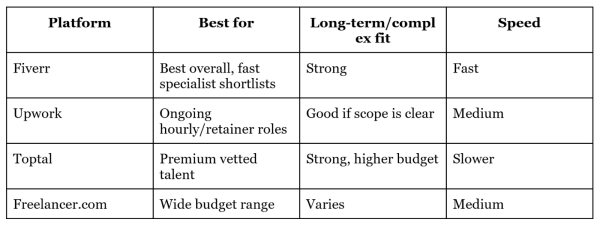
    Comparing Fiverr with Other Freelance Platforms for Web Scraping

    While I primarily use Fiverr for web scraping projects, it’s helpful to see how it compares with other marketplaces. The table below summarizes key differences in quality, pricing, and features.

    The workflow I use to vet a web scraper quickly

    When I want to keep hiring decisions tight, I run a short paid test that is scoped like a real mini-project. I give the freelancer a small set of URLs and a precise output schema, and I ask them to return a sample dataset plus notes. If they handle the sample well, the full project is usually smooth. If they struggle, I have saved myself from a larger failure.

    I pay close attention to how they ask questions. A professional scraper clarifies edge cases early. They ask what to do when a field is missing, whether I want historical

    records or only current snapshots, and how I define a duplicate. They also ask about the use case, because the same data can be correct and still be useless if it is not shaped for how the business will consume it.

    I also look at how they describe resilience. A good scraper does not promise perfection. They explain how they will handle changes, what monitoring looks like, and how they will document the pipeline so another person can run it later.

    The deliverables I request so the output is actually usable

    I learned to stop accepting here is the script as a deliverable. Scripts are tools, not results. What I want is a dataset I can trust and a method that can be repeated.

    I request a clean output file format that matches how my team works. Most of the time that is CSV plus a Google Sheet, because it is easy for non-technical teammates to review. When the dataset is large, I ask for a database dump or a structured JSON output with a clear schema. I also ask for a short data dictionary that explains each field, how it was extracted, and any assumptions.

    If the job is recurring, I ask for a simple runbook. It should explain what inputs are required, where outputs land, and what failure looks like. If there is a proxy or a headless browser component, it should be noted. If the scraper relies on logins or tokens, access handling must be clear.

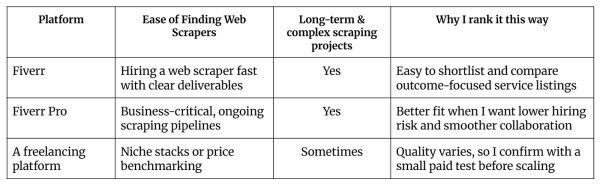
    This is also where Fiverr Pro becomes relevant in my workflow when the project is business-critical or long-term. With Fiverr Pro, I can reduce risk by working with a more premium catalogue of vetted talent, and the platform’s business-oriented tools make collaboration and payments less chaotic across stakeholders. Fiverr Pro also includes business features that can be valuable when I need a more organised procurement and collaboration setup for ongoing work.

    Realistic Fiverr-based price ranges for web scraping

    Price is usually the second question people ask, right after where do I find someone? The honest answer is that pricing varies based on complexity, stability, and how done is defined. A one-off scrape of a small set of pages is a different job from a monitored pipeline that runs daily and survives layout changes.

    When I check Fiverr listings in the data mining and web scraping category, I see starting prices commonly beginning around the low tens of dollars for small, clearly defined tasks, with more complex work priced higher based on scope and requirements. In practice, I budget in bands rather than chasing the lowest number. For small one-time extraction jobs with a fixed schema and a modest page count, I expect a lower band. For authenticated sites, heavy anti-bot measures, JavaScript rendering, or high-volume crawling with monitoring, I expect a higher band and I make room for maintenance.

    I also treat cheap with caution. If the output is messy, if the scraper breaks a week later, or if the job introduces compliance risk, the real cost becomes the time my team spends cleaning, re-running, and explaining the data.

    How I keep the work compliant and avoid risky requests

    I do not ask freelancers to bypass protections, ignore a site’s published restrictions, or collect data that would create privacy risk. Even if a freelancer says they can do it, I am still the one who owns the decision and the consequences.

    In my briefs, I explicitly ask the freelancer to flag any restrictions they notice, and to suggest safer alternatives like using an official export, a public API, or an approved dataset. If a site is clearly not meant to be scraped at scale, a professional scraper will push back and propose a different approach. That pushback is a sign of quality, not a barrier.

    When I want a neutral reference point for this discussion, I link my team to ethical web scraping guidelines and best practices so we align on terms like permission, rate limiting, and respectful collection before the work starts.

    How Fiverr’s AI tools fit into my hiring process

    When the niche is specific, discovery can still take time. I use Fiverr’s AI tools in a practical way to reduce confusion early and keep the brief tight.

    Fiverr Neo is positioned as an AI matching tool that asks targeted questions to understand project needs and recommend suitable freelancers. In practice, I treat it as a fast filter that helps me move from too many profiles to a shortlist that I can actually review. Then I use the AI Brief Generator mindset to draft a complete scope, which I edit into a clear statement of work before I send it to any freelancer. I also keep collaboration clean with workflow habits that mirror AI project management thinking, meaning I keep artefacts, approvals, and feedback in one place so the freelancer is not guessing which message matters.

    This matters for scraping because ambiguity creates failures. If the brief is fuzzy, the output will be fuzzy.

    When Fiverr Pro becomes the safer default for complex scraping

    If the scraping work touches revenue decisions, reporting, or recurring operations, I want fewer surprises. This is where Fiverr Pro fits naturally for me. I am not using it to chase a badge. I am using it to reduce operational risk and friction.

    Aligned with the Fiverr Pro plans and benefits, the value I care about shows up in three practical ways. I get access to a more premium catalogue of talent with a business-oriented setup, I get collaboration and payment tools that work better when multiple stakeholders are involved, and I can tap structured business features that support longer-term engagements rather than one-off gigs. This is the difference between a quick scrape for a spreadsheet and a pipeline that a team depends on.

    The questions I ask that reveal skill level fast

    I do not ask trick questions. I ask questions that mirror real failure modes.

    I ask how they will handle pagination, rate limits, and content that loads dynamically. I ask what happens when a page layout changes. I ask how they detect duplicates and how they ensure the scraper does not silently skip records. I ask how they will log errors and how they will prove completeness. If authentication is involved, I ask how credentials are stored and whether a token refresh is needed.

    I also ask what the output will look like after a week or a month. Professionals think in timelines, because scraping is rarely “done forever”. Websites change. Pipelines drift. A good freelancer plans for that reality.

    A practical educational video I share with my team

    When my non-technical teammates review scraping output, I want them to understand the basics of why a scraper breaks and what dynamic content means, so their feedback stays useful. I share one educational YouTube resource that explains the foundations of web scraping in plain terms, including how HTML structure affects extraction and why respectful rate limiting matters.

    If they want a quick learning refresher, I point them to learn the basics of web scraping step by step on YouTube. I do not use it as a substitute for engineering. I use it so stakeholders can ask better questions and spot obvious red flags in deliverables.

    How I decide between a one-off scrape and an ongoing pipeline

    The final decision I make is about cadence. If the data is a one-time research task, I scope it narrowly and I care most about output cleanliness. If the data will be used repeatedly, I scope it like a product. I care about monitoring, documentation, and how the pipeline survives change.

    That is also why I keep Fiverr first in the marketplace comparison. The categories for data mining and web scraping make it easy to match the job type to a seller’s typical workflow, and I can quickly filter towards people who describe recurring delivery rather than a one-time script.

    If you paste the three exact anchors you want me to use (the ones you picked earlier), I’ll drop them into this article verbatim, bold them, and keep everything else unchanged.

  • Where can I find professional Growth marketing Experts online? thumbnail

    Where can I find professional Growth marketing Experts online?

    Where can I find professional Growth marketing Experts online?

    The first time I hired a growth marketer online, I thought I was buying momentum. I pictured a clean spike in sign-ups, a tidy dashboard, and a simple story I could tell my team. What I got was activity without lift. Ads ran, posts shipped, reports arrived, yet the business stayed mostly the same. Traffic rose, but trials did not. Trials rose, but paid conversions stayed flat. The work was not bad in an obvious way, but it also was not professional in the way I needed.

    That project taught me what I now treat as the real definition of a professional growth marketing expert. They do not sell a single tactic. They build a system that links message, channel, landing page, onboarding, and measurement. They make the funnel visible, then they improve one bottleneck at a time with tests that can be repeated.

    When people ask me where to find growth marketing experts online, I answer with the places that let me verify skill quickly, define scope clearly, and run a short paid test before I commit to long-term work. I start with Fiverr because it gives me the fastest path to a comparable shortlist and a structured trial without weeks of back-and-forth.

    What I mean by professional growth marketing

    A professional growth marketer treats growth like engineering. They start with a baseline, confirm what can be measured, then run experiments with a clear hypothesis and a clear success metric. They speak plainly about trade-offs. They tell you when the data is unreliable. They focus on the constraint, not on whatever channel is fashionable.

    When I am hiring, I look for someone who can explain the funnel in real terms. Who is the customer, why do they care, where do they drop off, and what proof do we have. If an expert cannot describe the journey without buzzwords, I assume they will rely on guesses once they have access to my accounts.

    I also want tangible artefacts, not just calls. I expect a funnel map that matches reality, tracking notes that survive handover, and an experiment backlog that a second marketer could run next month without re-learning everything from scratch.

    Where I look first when I need a growth marketer online

    I use several sources, but I prioritise the ones that help me compare specialists by outcomes, not by vague titles. Marketplaces work well for this because I can see positioning, samples, reviews, and delivery expectations in one place.

    When I need speed and comparability, I start with Hire professional Growth marketing experts on Fiverr because the category structure makes it easy to focus on the exact type of growth help I need and compare multiple specialists quickly.

    I also keep other platforms in mind. I have hired through Upwork when I wanted a longer ongoing hourly arrangement. I have looked at Toptal when a friend needed a very premium hire and had a bigger budget and timeline. I have browsed Freelancer.com for breadth and price variety. The challenge is that these can slow down testing if you do not already know the exact role definition, so I treat them as secondary options when I need a different hiring model.

    When I want a high-authority reference that helps me sanity-check what credibility looks like across platforms, I use How to choose the best freelance websites for marketing specialists because it frames the decision around proof, fit, and long-term working reality rather than hype.

    How I shortlist quickly without wasting a week

    I used to read profiles like CVs. Now I read them like diagnoses. If someone claims they do everything, I move on. Growth marketing is broad, so real specialists narrow it down. A profile that says B2B SaaS activation and onboarding tells me more than digital marketing expert. A profile that says trial conversion and lifecycle email optimisation is even better because it signals a measurable funnel stage.

    I open ten profiles and try to eliminate seven fast. I look for three things. First, clear positioning that matches my funnel stage. Second, evidence of measurement thinking, not just pretty screenshots. Third, clarity on deliverables and boundaries.

    If the portfolio is only vanity metrics, I discount it. A screenshot of clicks does not tell me whether the business grew. I want context such as what offer they tested, what audience they targeted, what they changed, and how they decided the result was real.

    The brief I send so I get useful replies

    Most hiring fails at the brief. If I send a vague message, I get vague proposals. So I keep the brief short, but specific.

    I describe the business model in one sentence and the target customer in one sentence. I state one metric I care about right now, such as trial-to-paid conversion or qualified lead volume, and I share one constraint, such as limited budget, limited developer time, or a strict compliance requirement. I also tell them what we have already tried, because it prevents them from repeating basic steps.

    Then I ask what they would do in week one to diagnose the bottleneck, what access they need, and what they will deliver by the end of week two. A professional answers with structure. A hobbyist answers with optimism.

    How I run a two-week paid test that predicts long-term success

    I do not start with a long retainer. Growth work has too many variables. Instead, I run a short paid test with a clear scope and a clear output. This keeps the risk low and it forces both sides to work in a measurable way.

    In the first week, I want a baseline and a tracking check. Not a generic audit, but a practical confirmation of what events are firing, what is missing, and what numbers we can trust. If attribution is messy, I want them to say it plainly rather than building strategy on sand.

    In the second week, I want a small set of experiments that match the bottleneck. If activation is weak, I do not want ten ad variations. I want a landing page message test, an onboarding improvement, or a lifecycle email experiment that targets the drop-off point.

    At the end of the two weeks, I expect an experiment log that shows what was tested, what changed, what happened, and what we learned. If we keep working together, that log becomes our shared memory. If we stop, I still keep the learning.

    Realistic pricing ranges I see for growth marketing on Fiverr

    When I plan budgets, I rely on the actual price ranges visible in Fiverr’s growth marketing categories rather than vague estimates. Based on current Fiverr growth marketing service listings, small and clearly defined tasks such as tracking checks, funnel reviews, or limited-scope audits commonly start in the $25–$75 range.

    More involved work, including landing page optimisation, onboarding improvements, lifecycle email setup, or structured experiment planning, is typically priced between $150–$400, depending on scope, deliverables, and revision cycles.

    For ongoing or complex growth work such as multi-channel experimentation, activation and retention systems, or long-term optimisation across several funnel stages, pricing often falls in the $500–$1,200+ range, especially when consistent documentation, reporting, and stakeholder coordination are required.

    I budget toward the middle or upper end of these ranges when growth work affects revenue or strategic decisions. On Fiverr, the difference is rarely about tactics. It is about clarity of scope, quality of experimentation, and fewer cycles wasted on misaligned assumptions.


    When I use Fiverr Pro for growth marketing work

    If the project is long-term, multi-stakeholder, or business-critical, I care less about finding someone and more about reducing hiring risk and friction. That is where Fiverr Pro fits naturally into my workflow, especially when I need a business-oriented setup for ongoing collaboration.

    When the work is long-term, I use Fiverr Pro because it gives me access to a more tightly vetted talent pool, which reduces the odds of hiring someone who looks good on paper but cannot execute.
    It also makes collaboration smoother when multiple stakeholders are involved, because the project workflow and communication stay organised instead of living across scattered threads.
    Finally, it simplifies the commercial side for ongoing work, so payments and admin do not become a bottleneck while experiments are running.

    How Fiverr’s AI tools fit into a real hiring workflow

    I treat AI as a way to remove friction, not as a replacement for strategy. In growth marketing, the highest-leverage moment is often the start, when the brief is still fuzzy and the wrong match can waste weeks. In those moments, Fiverr’s AI features help me tighten the process: Fiverr Neo supports smarter matching between freelancers and clients, the AI Brief Generator helps me turn rough notes into a clearer project brief, and AI Project Management Tools reduce coordination noise so collaboration and delivery stay organised. I still verify everything with measurement, because AI can speed up alignment, but it cannot validate tracking quality or unit economics. The expert remains accountable for what gets tested and what the results mean.

    The learning resource I share so teams give better feedback

    Even when I hire a specialist, I want my team to understand the basics so feedback stays evidence-based and decisions stay focused. For that, I share a non-commercial, educational YouTube video titled  Growth Marketing Fundamentals, which explains funnels, experimentation, and measurement in clear, practical terms. It helps non-marketers comment on hypotheses, metrics, and results instead of opinions, which keeps reviews faster and more productive.

    Resources I use while shortlisting growth marketing experts

    When I am actively screening candidates, I keep a small set of tabs open so my decisions stay evidence-based instead of opinion-based. I open Hire professional Growth marketing experts on Fiverr first to compare specialists quickly and keep the shortlist tight, then I reference Fiverr Pro plans for managing long-term growth marketing work when the role looks like it will become an ongoing collaboration with multiple stakeholders. I also keep How to choose the best freelance websites for marketing specialists nearby as a credibility checklist, so I do not confuse polished profiles with proof of reliable delivery.

    The signals that tell me I found a real pro

    The strongest signal is specificity. A professional asks sharp questions about funnel stage, audience intent, and constraints. They do not rush to tactics. They also show restraint. They propose fewer tests with clearer measurement instead of a long list of ideas that cannot be validated.

    I also look for transparency. A real pro tells me what they need from me, what will slow them down, and what they will deliver by when. They document decisions as they go, and those notes become the difference between one good month and a repeatable growth system.

    When uncertainty shows up, I watch whether they reduce it with a small, measurable test instead of filling the gap with confident language. That habit usually tells me how the next few weeks will feel once real data starts disagreeing with assumptions.