Category: BigNewsNetwork

  • GRO22V Expands Its DeFi Ecosystem With AI-Powered Solutions for 2026


    As artificial intelligence continues to redefine decentralized finance (DeFi), GRO22V stands out as a next-generation ecosystem that integrates AI-driven automation, cross-chain scalability, and user-focused token utility. According to the official GRO22V website (https://grok-network.net), the project is preparing to roll out an expanded DeFi infrastructure throughout 2026 — powered by intelligent algorithms and designed to connect users, data, and liquidity seamlessly.

    A Smarter Approach to DeFi

    Traditional DeFi systems often rely on manual trading, yield farming, or staking strategies. GRO22V reimagines this model with artificial intelligence at its core — offering predictive insights, adaptive yield optimization, and autonomous portfolio management through its AI enhanced architecture.

    The goal is to create an economy where decentralized smart contracts interact with AI modules that learn from real-time data, allowing for automated decision-making and dynamic asset reallocation without centralized intervention.

    Core Components of the GRO22V Ecosystem

    • AI Enhanced Analytics: GRO22V integrates machine learning algorithms that analyze blockchain metrics, user sentiment, and liquidity flows to provide intelligent recommendations.
    • Smart Payment Layer: A built in payment infrastructure that supports ultra low latency, multi chain transactions using adaptive routing powered by AI.
    • Cross Chain Interoperability: GRO22V’s network is compatible with major blockchains such as Ethereum, BNB Chain, and Base, allowing liquidity and assets to move freely across ecosystems.
    • Decentralized Governance: Token holders participate in decision making through the GRO22V DAO, influencing roadmap milestones and DeFi integrations.
    • Sustainability by Design: AI resource allocation reduces redundant computation, improving both speed and energy efficiency across DeFi applications.

    Tokenomics and Growth Strategy

    The $GRO22V token underpins the network’s operations and incentivizes participation. With a total supply of 1 billion tokens, its tokenomics model is structured to support long-term growth rather than short-term speculation.

    Fifteen percent of the total supply is allocated to the presale phase, offering early backers up to 200% in bonus rewards. Other allocations are designed for staking rewards, ecosystem expansion, exchange liquidity, and DAO governance.

    This balanced design allows GRO22V to maintain strong liquidity post launch while rewarding community engagement and DeFi adoption.

    AI Integration for the 2026 DeFi Landscape

    GRO22V’s 2026 roadmap centers around merging artificial intelligence and financial automation. The project plans to release several AI powered modules — including algorithmic liquidity management, predictive yield analytics, and decentralized AI data marketplaces.

    These modules are expected to enhance DeFi scalability by automating core financial functions and enabling AI systems to interact directly with decentralized protocols. This vision represents a shift from passive DeFi platforms toward self learning, self optimizing ecosystems.

    Positioning for Growth in 2026

    With the growing investor appetite for AI based tokens and DeFi automation, GRO22V’s strategic timing couldn’t be better. The project aligns itself with two dominant narratives — artificial intelligence and decentralized finance — positioning $GRO22V as a potential top performer in the upcoming bull run.

    While partnerships with other AI and blockchain entities have yet to be formally announced, the team’s roadmap emphasizes open collaboration and technological transparency. By focusing on real utility and measurable performance, GRO22V sets itself apart from hype driven tokens and positions its ecosystem for sustainable adoption.

    Final Thoughts

    GRO22V’s expansion into AI powered DeFi solutions represents a forward looking approach to blockchain innovation. Its blend of AI enhanced payments, smart contract automation, and multi chain integration has the potential to redefine how decentralized finance operates.

    Although some details remain unverified — particularly regarding future partnerships and AI module release dates — the publicly available roadmap demonstrates a clear commitment to innovation, transparency, and scalability. As DeFi continues to evolve, GRO22V may stand at the forefront of the next generation of intelligent financial ecosystems.


  • How a Tesla Storage Battery Can Power Your Home Smarter

    A Tesla storage battery is changing the way homes in Nerang use electricity. As energy bills rise and the need for reliable power grows, more families are turning to smarter solutions. Tesla’s Powerwall is one of the most trusted battery options available. It stores solar energy during the day and powers your home at night.

    In this blog, we’ll explain how Tesla batteries work, how much they cost, and why they’re a smart investment in Nerang. You’ll also find answers to the most common questions homeowners ask about Tesla battery storage and solar power Tesla solutions.

    Why Tesla Battery Storage Makes Sense in Nerang

    Nerang gets a lot of sun. That makes it a perfect location for solar panels and battery storage. When you pair solar panels with a Tesla storage battery, your home becomes more energy independent. You use less from the grid and save more money.

    Here’s how it works:

    • Solar panels create electricity during the day.
    • A Tesla storage battery stores the extra energy.
    • That energy powers your home when the sun goes down.
    • If the grid goes down, the battery can keep your lights and appliances on.

    This means your home is more secure, more efficient, and less tied to rising power prices.

    What Is Tesla Battery Storage?

    Many people ask, “What is Tesla battery storage?” It’s a simple idea. Tesla’s battery, called the Powerwall, is a home battery system. It stores energy for later use.

    Tesla batteries are smart. They track how much power your solar system makes and how much your home uses. Then, they decide the best time to charge or discharge. You can also track your battery’s performance with a mobile app.

    In short, Tesla battery storage gives you more control over your energy use. It helps you lower your power bills and keeps your home running, even during an outage.

    Benefits of a Tesla Storage Battery in Nerang

    Here are the main benefits of adding a Tesla storage battery to your solar system:

    1. Energy Savings

    With a battery, you use more of your own solar energy instead of sending it back to the grid. This means lower electricity bills every month.

    2. Backup Power

    Power outages can happen during storms or heatwaves. A Tesla battery gives you backup power when the grid goes down.

    3. Smarter Energy Use

    Tesla batteries work with smart technology. You can monitor and control your energy use from your phone.

    4. Greater Energy Independence

    You rely less on energy retailers. This gives you peace of mind when prices go up.

    How Much Does a Tesla Storage Battery Cost?

    One of the top questions we hear is, “How much does a Tesla storage battery cost?” In 2025, a single Tesla Powerwall costs between $12,500 and $16,000 in Australia. This includes the battery, installation, and basic setup.

    The final price depends on:

    • Your home’s size and energy needs
    • Installation complexity
    • Whether it’s added to a new or existing solar system
    • Your location in Nerang

    At Energy Solution Centre, we offer free quotes for homes in the 4211 area. We also help you understand your payback period and return on investment.

    How Much Is a Tesla Powerwall in Australia?

    This question is similar to the one above, but deserves its own answer. “How much is a Tesla Powerwall in Australia?” In general, the Powerwall alone costs around $9,000 to $10,000. But this price is only for the battery itself.

    You also need to account for:

    • Inverter (if required)
    • Installation fees
    • Monitoring setup
    • Support and warranty coverage

    In total, most homeowners in Nerang pay between $12,500 and $16,000 for a complete Tesla Powerwall system.

    Why Did Tesla Stop Selling Powerwall?

    You may have heard this question before: “Why did Tesla stop selling Powerwall?”

    Here’s the truth. Tesla did not stop selling Powerwall. However, for a time, they limited how you could buy it. Tesla made the Powerwall available only when purchased with Tesla’s solar panels through their direct channels. This caused confusion.

    Now, many certified installers like Energy Solution Centre in Nerang offer Powerwall as a standalone option. That means you don’t need to use Tesla solar panels. You can add Powerwall to your existing system or include it with any new solar setup.

    How Tesla Battery Fits with Solar Power in Nerang

    Nerang has high sun exposure. A lot of homes here already have solar panels. If you have solar, but no battery, you may be losing money. That’s because you send unused energy back to the grid for a small feed-in tariff.

    A Tesla storage battery helps you store that extra energy instead. You can use it later when the sun is down, or during a blackout.

    This makes your solar system more valuable. You use more of your own energy and rely less on the grid.

    To explore a related battery solution page, you can also view our solar battery for house page.

    How Tesla Battery Helps You During Blackouts

    In Nerang, storms and grid outages happen. With a Tesla battery, your home can keep running even if the grid fails.

    You can power:

    • Lights
    • Fridge and freezer
    • Internet
    • Phone chargers
    • Medical equipment

    The Tesla app also tells you when your system switches to backup mode. This gives you peace of mind and helps you plan.

    How the Installation Process Works

    If you’re thinking about installing a Tesla battery, here’s what to expect:

    Free home visit

    We check your solar system and energy usage.

    System design

    We choose the right size and layout for your home.

    Quote and approval

    You get a clear cost breakdown.

    Installation

    Our team installs the Tesla battery at your home.

    Monitoring setup

    You get access to the Tesla app.

    Support and updates

    We’re based in Nerang, so we’re here when you need us.

    We also have a full solar and battery showroom in Nerang, where you can explore working systems before deciding what’s right for your home.

    We handle everything from start to finish. We also offer support if you already have solar panels and want to add a battery.

    What Makes Tesla Battery Different from Others?

    There are many battery brands on the market. So why choose Tesla?

    • Trusted brand – Known for innovation and quality
    • Built-in inverter – Saves space and cost
    • Smart app – Real-time monitoring
    • High capacity – One unit stores 13.5 kWh
    • Seamless backup – Auto-switch during outages

    Tesla is also focused on long-term support. That’s why many families in Nerang ask for it by name.

    Real Case Study: Family in Nerang Cuts Grid Use by 85%

    The Walker family had a 6.6 kW solar system but no battery. Their bills were still over $300 per quarter. We installed a Tesla Powerwall for them.

    Now, they use stored power at night and during peak times. Their new bills are under $60 per quarter. They also stayed fully powered during the last blackout in their area.

    They shared that the system gives them more control and peace of mind. And they love checking their app to see how much solar they use daily.

    Is Tesla Battery Right for Your Home?

    If you want:

    • Lower power bills
    • Backup power during outages
    • More control over your energy use

    Then yes, a Tesla battery is a great choice. It’s perfect for homes in Nerang with solar panels, or for new solar installs.

    We can help you figure out if it’s a good fit. We’ll also show you the numbers so you know what to expect.

    Get Started with a Tesla Storage Battery in Nerang

    At Energy Solution Centre, we install Tesla Powerwall systems across Nerang and nearby areas. We’re local, experienced, and ready to help.

    Plus, we have a full solar and battery showroom in Nerang, so you can see the technology in action before you make a decision.

    Here’s what you get:

    • Free home energy check
    • Honest advice
    • CEC-accredited installers
    • Ongoing support after install
    • Competitive prices with no hidden fees

    Address: 19 Price St, Nerang QLD 4211
    Phone: 1300 217 079
    Website: energysolutioncentre.com.au

    You can also visit our Google Business Profile.

    Call today or request a quote online. Let’s make your home smarter with solar and battery storage.

  • Leading German Websites for Krypto-Nachrichten and Market Insights

    Cryptocurrency adoption across Europe has shifted from a fringe conversation to a serious topic in boardrooms, investment committees and household financial planning discussions alike. Germany, in particular, has emerged as one of the continent’s most active markets for digital asset participation, driven by a relatively progressive regulatory environment, a tech-savvy investor base and growing institutional interest from major financial institutions. As more capital enters the space and the stakes for well-informed decision-making rise accordingly, the question of where to find reliable, context-rich and timely Krypto-Nachrichten has never been more consequential. This article maps out the most important German-language crypto news platforms, examines what each one brings to the table, and explains how investors can use them strategically to stay ahead in a market that never stands still.

    The Growing Importance of Crypto News Platforms in Germany

    Few financial markets demand as much ongoing attention as cryptocurrency. Unlike traditional equity markets that operate within set trading hours and respond primarily to corporate earnings cycles and macroeconomic indicators, crypto markets run continuously and react to an unusually wide variety of triggers. A single regulatory filing, a protocol upgrade announcement, a shift in central bank rhetoric or an unexpected move by a major institutional player can send prices sharply in either direction within a matter of hours.

    For German investors navigating this environment, the challenge is not finding information but finding the right information. The sheer volume of daily content published across blogs, social channels and aggregator websites makes it genuinely difficult to distinguish between market-moving intelligence and noise designed to provoke emotional reactions. Trustworthy German-language news platforms address this challenge by applying editorial standards, sourcing practices and contextual depth that filter out the noise and surface what genuinely matters. Investors who build their information routine around high-quality platforms are measurably better positioned to make calm, evidence-based decisions than those who rely on unvetted social feeds or single-source reporting.

    BTC-Echo: One of the Most Influential German Crypto Media Platforms

    BTC-Echo has held its position as the most widely read German-language crypto news outlet for several years running and has earned that standing through consistent quality and editorial independence. The platform covers the full spectrum of the crypto market: daily price analysis for Bitcoin and Ethereum, regulatory developments at the national and European level, DeFi ecosystem updates, NFT market trends, institutional adoption stories and in-depth explainers on blockchain technology.

    What gives BTC-Echo particular credibility among experienced investors is the deliberate separation it maintains between factual reporting and opinion content. Readers always know whether they are reading a verified news piece or a columnist’s personal analysis. The platform’s educational offering is equally strong; structured courses, video content and a searchable archive make it a resource that serves both newcomers and seasoned market participants. For anyone trying to understand how regulatory decisions coming out of Brussels or Berlin will reshape the operational landscape for digital assets in Germany, BTC-Echo remains the most thorough and consistently reliable starting point in the German-speaking world.

    Financial journalist reviewing live Bitcoin market data across multiple professional monitors

    Bitcoin2Go: Simplifying Cryptocurrency for New Investors

    Bitcoin2Go has built its reputation on a straightforward premise: the crypto market should be accessible to anyone willing to learn, not just those with a background in computer science or financial markets. The platform translates complex concepts into plain, practical language without sacrificing accuracy or depth. Articles explaining how blockchain consensus mechanisms work, what determines the value of different cryptocurrencies, how to evaluate the security of a digital wallet and what distinguishes reputable exchanges from unreliable ones are presented in a format that guides rather than overwhelms.

    Beyond its educational foundation, Bitcoin2Go publishes regular market updates and price commentary on Bitcoin, Ethereum and a rotating selection of altcoins that are currently generating meaningful trading volume or development activity. These pieces are carefully framed to give readers context alongside the data; rather than simply stating that a coin has risen or fallen, the platform explains the market conditions, sentiment shifts or news events that contributed to the move. For investors who are still building their foundational knowledge while simultaneously participating in the market, this combination of education and live commentary makes Bitcoin2Go one of the most useful platforms available in German.

    IT Boltwise: Technology-Focused Coverage of Blockchain Innovations

    IT Boltwise occupies a distinctive niche in the German crypto media landscape by approaching digital assets primarily as a technology story rather than a financial one. The editorial focus sits firmly on the infrastructure layer: protocol developments, Layer-2 scaling progress, smart contract frameworks, blockchain startup activity and the intersections between crypto technology and adjacent fields such as artificial intelligence, decentralized identity and supply chain management.

    This orientation makes IT Boltwise particularly valuable for investors with a long-term horizon who understand that the price of a crypto asset is ultimately a function of the technological foundation beneath it. Knowing whether a network’s development team is executing on its roadmap, whether a proposed upgrade addresses genuine scalability constraints or whether a new cross-chain bridge introduces meaningful security risks are questions that require technical literacy to answer properly. IT Boltwise provides that technical depth in a format that is rigorous without becoming impenetrable, making it an ideal companion source for investors who want to look beyond charts and assess the underlying merit of what they own.

    finanzen.net: Traditional Finance Platforms Expanding Into Crypto

    finanzen.net has long been one of the most visited financial information portals in the German-speaking world, serving millions of readers who use it to track stock prices, bond yields, commodity markets and macroeconomic data. Over recent years, the platform has made a deliberate and substantial expansion into cryptocurrency coverage, recognizing that its core audience of traditional investors increasingly wants to understand how digital assets fit into the broader financial picture.

    The distinguishing strength of finanzen.net in the crypto context is precisely its roots in conventional financial media. Bitcoin is not covered in isolation here; it is discussed in relation to interest rate cycles, equity market sentiment, inflation expectations and the macroeconomic variables that influence all risk assets simultaneously. For investors who hold diversified portfolios that include both traditional and digital assets, this integrated perspective is genuinely rare and genuinely useful. The platform offers live price feeds, technical chart tools, an international news aggregation function and commentary from analysts who approach crypto with the same valuation discipline they would apply to any other asset class.

    Investor tip: Relying on a single news platform creates blind spots. The most informed investors cross-reference multiple sources with different editorial priorities; comparing how a development is reported across a technology-focused outlet, a market-analysis platform and a traditional finance portal gives you a far more complete and balanced picture than any single source can provide.

    Among the newer platforms gaining genuine momentum in the German-language crypto information space, Krypto-Nachrichten.com has attracted a growing readership specifically because it addresses one of the market’s most persistent problems: too much content, too little signal.

    Krypto-Nachrichten: A Modern Source for Crypto News and Market Updates

    The proposition that Krypto-Nachrichten.com has built its platform around is straightforward and increasingly compelling: investors do not need more crypto news, they need better crypto news. The platform uses AI-powered curation to monitor and analyze sources from around the world in real time, surface the developments that genuinely move markets and present them in a structured, readable format that respects the reader’s time and intelligence.

    The editorial scope covers the full range of topics that matter to active crypto participants. Bitcoin and Ethereum market dynamics, developments across the altcoin and DeFi ecosystems, institutional adoption trends, regulatory shifts in Germany and across the European Union, and the macroeconomic conditions that shape broader crypto market cycles all receive regular, focused attention. What makes this coverage stand out is not the volume of articles but the deliberate effort to provide context alongside each development. A regulatory announcement is not just reported; it is explained in terms of what it means for German investors specifically. A market movement is not just described; it is placed within the longer-term trend that frames it.

    The platform’s stated mission of delivering clarity over volume resonates strongly with investors who have grown frustrated by the relentless pace and inconsistent quality of information that characterizes much of the crypto media landscape. For anyone who wants to stay genuinely informed without spending hours filtering through redundant or low-value content, Krypto-Nachrichten.com represents one of the more thoughtful and investor-oriented options currently available in German-language crypto media.

    Cryptocurrency market insights and blockchain network data visualization for investor analysis

    AI-curated news filtering is reshaping how serious investors consume cryptocurrency market information.

    What Makes a Good Crypto News Website

    Given the range of platforms now operating in the German crypto media space, it is worth establishing clear criteria for evaluating any source before making it a regular part of your information routine. The first criterion is transparency: does the platform disclose who writes its content; are commercial relationships and affiliate arrangements clearly labeled; is there a verifiable editorial team with identifiable professional backgrounds? Platforms that operate without clear attribution or that blur the line between editorial content and promotional material should be treated with significant caution.

    The second criterion is sourcing discipline. Credible crypto journalism cites primary sources, links to original documents and regulatory filings, and distinguishes clearly between confirmed reports and unverified claims. In a market where rumors regularly masquerade as breaking news and coordinated information campaigns are not uncommon, the rigor with which a platform handles its sources is one of the most reliable proxies for overall quality.

    The third criterion is analytical depth. A headline that tells you what happened has limited utility on its own; an article that explains why it happened, what it means for different categories of market participants and how it connects to broader trends happening simultaneously is the kind of content that actually informs decision-making. Platforms that consistently provide this level of depth are worth investing your time in regardless of how frequently they publish. Quality of analysis should always take precedence over publication frequency when you are deciding which sources to prioritize.

    Final Thoughts on Following Reliable Crypto News Sources

    The German-language crypto media ecosystem has matured significantly and now offers investors a genuinely diverse and capable set of resources. The platforms covered in this article each serve a different but complementary function: deep market analysis and regulatory coverage; accessible education for newer investors; technology-focused reporting on blockchain development; integrated traditional finance perspectives; and focused, AI-curated news delivery for investors who value precision over volume.

    The most effective approach is not to choose one platform and treat it as the singular source of truth, but to build a reading routine that draws from several complementary perspectives. Cross-referencing different outlets sharpens your critical thinking, reduces the risk of being misled by incomplete reporting and builds the kind of layered market awareness that compounds meaningfully over time. The investors who consistently outperform in markets as dynamic as cryptocurrency are, almost without exception, the ones who invest serious effort in understanding what they own and why. The platforms outlined here provide an excellent foundation for that understanding. The next step is simply making them a consistent part of how you engage with the market every day.


  • The Evolution of Online Games and Their Impact on Modern Digital Culture

    From flickering pixels on a black screen to fully realized online worlds shared by millions, this is the story of how games became the defining entertainment of our era and what that transformation really means.

     

    Person deeply engaged in online games on a modern gaming setup


    No one ever sat around in the early 1970s and thought to themselves, You know what would be a great idea? Games would be the most consumed form of digital entertainment in the world someday!  It was all just a series of small steps: a coin being inserted into a cabinet in an arcade, a cartridge being inserted into a home console, a phone buzzing with a notification from a game that just brought three hundred million users into the same digital space. Each of those was a small step, a tiny action, a tiny decision. But collectively, they’ve rewritten the entire history of the way humanity entertains itself. For anyone who wants to understand where modern digital culture came from and is heading toward the evolution of online games, which is the clearest possible thread to follow. Platforms like LottoOpas, which guide Finnish players through the world of digital lottery games and Veikkaus results, represent one piece of that broader picture: a world in which nearly every form of chance, competition, and play has found a permanent home online.

    This article traces that journey from its origins through to the present moment, looking not just at how games developed technically but at what that development did to the culture around them.

    The Early Days of Digital Games

    The first digital games were more proof of concept than entertainment products. When William Higinbotham made Tennis for Two in 1958 on a screen at Brookhaven National Laboratory, he just wanted to show how computers work; he was not trying to start an industry. The same thing happened with Spacewar, which was made at MIT in 1962 and let two players move their spaceships on a screen. These games were like novelties; they were interesting to the people who made them and to the scientists who saw them. Not too many other people because they were not easy to play and not many people wanted to play them. William Higinbotham and the people who made Spacewar were just experimenting with Tennis for Two and Spacewar; they did not think these games would be popular someday.

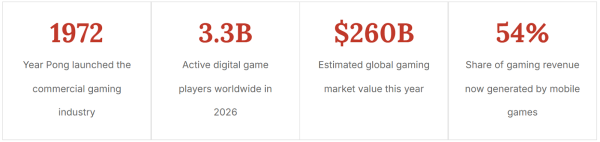
    The shift began in earnest with Pong in 1972. What Atari understood, where others had not quite grasped it yet, was that simplicity was a feature rather than a limitation. A ball bouncing between two paddles was comprehensible to anyone who had ever watched a ball bounce between two paddles. You did not need a manual. You did not need technical knowledge. You just need a quarter and two minutes. Back in the 1970s, arcades started popping up all over the country. Then games became a place where people could hang out together. Arcades were a place where people went to play games. Also, to watch other people play to compete against each other and to be around others who like the same things as them. Arcades were a big deal.

    Home platforms came next. The first one was the Atari 2600 and then the Nintendo Famicom and its international version, the Nintendo Entertainment System, in the mid-1980s. Games were no longer in the arcade but also in the bedroom and living rooms. People did not expect that Nintendo Entertainment System games and Atari 2600 games would be a part of their lives. Children had grown up playing Nintendo Entertainment System games and Atari 2600 games. Parents had also grown up to be gamers who played Nintendo Entertainment System games and Atari 2600 games too. A whole generation of people who played games had been spawned by Nintendo Entertainment System games and Atari 2600 games.


    The Rise of Online Multiplayer Games

    For most of the early days of gaming, the only way to play a game was to play it alone or have someone play alongside you. The notion of racing against someone on the other side of the city or the world was the stuff of science fiction until the advent of the internet in the average home in the 1990s and the vision of a few forward-thinking programmers who saw the possibilities for creating games that took advantage of the technology.

    Multiplayer Online Role-Playing Games or MMORPGs, were really good at showing what networked gaming could do. The game “Ultima Online” came out in 1997. It got a lot of people to subscribe to a word. In this world players could make characters, trade things, and form groups. Fight each other. This virtual world kept going even when players were not logged on.

    This was a kind of game. It was not really a game anymore. A virtual space. Players did not just play Multiplayer Online Role-Playing Games, like Ultima Online. They actually lived in Multiplayer Online Role-Playing Games like Ultima Online.

    Games like EverQuest and then World of Warcraft took this concept to an extraordinary level. World of Warcraft had over twelve million active subscribers at its peak, each of whom was paying a monthly fee to stay in the shared world. The cultural debate about gaming changed noticeably in this period. Games were no longer obviously considered to be for children, but rather were clearly able to deliver sustained and complex engagement with adults across every demographic and geographical category.

    Broadband internet access, which was growing in popularity throughout the early 2000s, was the last technological obstacle to overcome. The lag of the internet connections made the competitions between the players on opposite sides of the globe seem instantaneous. The competitive multiplayer genre exploded as a result, and a new relationship was born between the player and the game they loved.

    When games went online, they stopped being products you consumed and became places you lived in. The communities that formed inside those spaces were as real as any in the physical world.

    Understanding the social transformation of gaming


    How Gaming Communities Changed Entertainment
    Online gaming community friends playing multiplayer games together and bonding


    Something new and interesting happened when online multiplayer games became mainstream: entertainment is no longer something people consume as a passive activity but something people produce as a collaborative effort. The social groups that formed as a result of the games were not just fan clubs. They had their own cultures, languages, economies, and social hierarchies.

    Think of what happens when a new online game is released. Within a few hours, players are sharing tips on how to play the game on the social media site Reddit. Within a week or so, YouTube channels are creating videos on how to play the game, and players are connecting with other players on the chat site Discord to play the game together. Within a month or so, wikis have been created with every aspect of the game explained in painstaking detail, and Twitch streams have been created to play the game with viewership counts often exceeding the ratings of television programs. None of this is done by the creator of the game. All of it is done by the players, driven by the enthusiasm of the players and the human desire to talk to other human beings about something you love with other human beings who love the same thing.

    What this community layer did to entertainment was significant. It changed games from being a closed experience to an open conversation. With a book or a movie, you have something to think about on your own. Perhaps you’ll want to discuss it afterwards, but it is a personal experience. With a multiplayer game, you have something to experience on your own with others in real-time, then discuss, analyze, and play together indefinitely. The social aspect of a game is not limited to when the session is over. For many players, it is a path to friendships, collaborative creative endeavors, and a sense of belonging that is an important part of their social lives.

    This change also had a measurable impact on the entertainment industry as a whole. Games were no longer something you purchased and then stuck on a shelf. They were something that existed as a relationship between the players and the developers, and this was made possible through the updates and the ongoing support of the player base. The live service model that the industry has today would not have been possible without the communities that the players themselves built around the games that mattered to them.

    The Role of Technology in Modern Games

     

    Esports is arguably the most obvious embodiment of what technology has enabled in gaming. Competitive professional gaming, leagues, contracted athletes, and prize purses that can reach over eight figures are a reality that was genuinely unimaginable twenty years ago. Athletes train with a dedication and structure that mirrors that of any other sport. Teams employ coaches, analysts, nutritionists, and sports psychologists. Tournaments are broadcast worldwide with production values that are comparable to other sports in their complexity.

    What made all of this possible was technology, which included fast internet connections, hardware that was able to run games at fast frame rates, and streaming capabilities to allow for live video to reach millions of viewers. The history and scope of esports illustrate how rapidly the field moved from informal competitions among enthusiasts to a structured global industry once the underlying technology reached sufficient maturity.

    Outside of the realm of esports, the impact of technology has been felt in the texture of the game, something that is more difficult to quantify but just as important. For example, it is now possible to create game worlds that are rendered at a level of photorealistic detail. It is also possible to create the illusion of physics at work, giving the game a level of realism that is unprecedented. Finally, it is now possible to create game worlds of virtually any size, thanks to the advent of procedural generation, where the game world is created through a series of algorithms rather than through human hands. This gives the game a sense of realism that causes it to feel less like a constructed experience and more like a real place, something that enhances the emotional investment that players have in the game.

    Cloud computing has begun extending these capabilities beyond players with expensive hardware. The service allows game rendering to be streamed to regular devices from powerful servers. This is gradually removing the hardware barrier that has previously been a prerequisite to accessing good games. This means that a person in a village can, in principle, play the same game as someone else with a gaming PC in a city. This is not yet equally distributed, but the direction is clear.

    Technology Reshaping the Gaming Landscape Right Now

    Cloud streaming lets players access high-end games on any device without expensive hardware

    • Artificial intelligence creates game characters that respond and adapt to individual player behavior
    • Cross-platform servers unite console, PC, and mobile players in shared competitive spaces
    • Real-time translation tools are beginning to break language barriers in multiplayer games
    • Certified random number generation brings verified fairness to digital lottery and chance-based games online
    • Haptic feedback and spatial audio add physical and sensory depth that visual improvements alone cannot achieve

    Future Trends in the Gaming Industry

    Predicting technology is notoriously unreliable, but certain trajectories in gaming are sufficiently established that discussing them with confidence is reasonable. The most important is the continued convergence of gaming with every other form of digital entertainment. Streaming services are adding interactive elements. Social platforms are adding games. Music events are being hosted inside game worlds. The boundaries between categories are dissolving, and instead, something more general is coming into being, a general digital culture of interactive experience, of which gaming is the center.

    Artificial intelligence will almost certainly be the most important technology for game development over the next decade. Content generation, character development, and storytelling are all areas where AI is being actively developed, and the potential impact it will have on the way a game feels is enormous. Games that adjust to the decisions and personality of each player, remember decisions made dozens of hours ago, and have specific dialogue generated just for each player are no longer pie-in-the-sky ideas but are actual research projects with functional prototypes.

    For players navigating this expanding landscape, finding trustworthy and transparent platforms becomes increasingly important. The best gaming resources are those that explain how things work rather than simply promoting participation. An online gaming resource that takes the time to break down prize structures, explain game mechanics honestly, and provide clear guidance on responsible play is doing something that has genuine value in a space where opacity is common. For those who want independent market context and hard data on the gaming industry, Statista’s gaming industry research hub is among the most reliable sources currently available.

    The audience for games will also continue to age upward. The generation that grew up playing games in the 1980s and 1990s is now well into middle age and hasn’t stopped playing games. They’ve just moved on to other types of games that suit their lifestyle better: shorter gaming sessions, more strategic gameplay, and less focus on quick reflexes and more on quick thinking and knowledge. Games such as lottery and number games, puzzle games, strategy simulators, and management games are increasing in popularity because their core gaming audience is now mature and is willing to commit time to gaming experiences that reward their thinking and not just their reflexes.

    1. Look for platforms that explain their mechanics clearly

    If a gaming site is worthwhile playing on, it will explain to you how it works. The most important factor is how transparent a gaming site is. Transparency is key to a good gaming site.

    2. Check for independent community reviews

    Also, forum discussions and review sites provide an accurate idea of what a platform really offers. Feedback patterns on a particular platform, if seen on multiple sites, are more reliable than promotional content.

    3. Prioritize platforms with responsible play tools

    The presence of spending limits, session reminders, and support services is a good indication that the platform is taking the welfare of its players seriously and not as an afterthought.

    4. Use authoritative sources for game research

    Before committing to any new game or platform, checking established sources like Wikipedia’s comprehensive gaming coverage and independent data sites will give you context you cannot get from the platform itself.

    5. Treat gaming as entertainment with boundaries

    The most satisfying long-term relationship with games comes from treating them as a leisure activity with clear personal limits on time and, where relevant, money. That approach keeps the experience positive rather than stressful.

    Conclusion: Games Did Not Take Over Entertainment; They Became It

    Looking back at the arc from Tennis for Two on an oscilloscope in 1958 to the three-billion-player global gaming ecosystem of 2026, what stands out most is not the technology. The technology is remarkable, certainly, but technology is always remarkable in retrospect. What stands out is the human constant underneath all of it: the fact that people have always wanted to play, to compete, to belong to something, and to experience moments of uncertainty and possibility that ordinary life rarely provides in such concentrated form.

    Games understood this about human nature before most other entertainment industries did. And by building experiences that fed that understanding directly, they earned their place at the center of digital culture not through marketing or market manipulation but through genuine resonance. People play games because games give them something real: real skill development, real social connection, real moments of joy and frustration and triumph that they remember and talk about long after the screen goes dark.

    The landscape will keep changing. New technologies will create new kinds of games. New platforms will emerge and old ones will evolve. But the underlying appetite that drives it all is not going anywhere. As long as people want to play, which is to say as long as people are people, games will be waiting for them.
     

  • Yes! He’s The Next King Buzzing In The Windy City! thumbnail

    Yes! He’s The Next King Buzzing In The Windy City!


    From the rhythmic, soul-stirring pulse of Chicago to the unfolding promise of a global stage, Donnell Langs—widely known as “The Northern Soul Bro”—is establishing himself as one of the most exciting, buzzing artists emerging from the Windy City. As a modern architect of soul, this college graduate has adeptly traded life’s hard-won lessons for soaring melodies, crafting a sound that resonates far beyond city limits and bridges the gap between classic Motown-era roots and a sharp, contemporary edge. Donnell does not merely write songs; he captures the raw grit, grace, and authentic hustle of the human experience, transforming personal truths into a unique brand of sonic art that is currently setting the Chicago music scene ablaze. His creative process is a testament to intention, blending quiet, introspective moments with sudden bursts of melodic inspiration. This deliberate approach results in music that feels deeply personal yet universally accessible. Whether evoking the nostalgic warmth of holiday classics like A Grown Man’s Christmas or exploring the intimate depths of quiet observation, The Northern Soul Bro consistently delivers a high-energy performance that is both heartfelt and dance-worthy. His ability to blend nostalgic soul flavors with a modern sensibility has made him a compelling figure in a city known for its rich, complex musical history.

    For Donnell, music is far more than just sound—it is an invitation to feel, reflect, and connect. He is a conduit for emotion, turning the mundane into the extraordinary through his songwriting. As his momentum continues to build across the Midwest and beyond, he represents a new wave of artists who respect the traditions of soul music while refusing to be limited by them. Listeners can expect an authentic, high-energy journey, one that stays with them long after the music stops and the lights go down. The Northern Soul Bro is not just performing; he is cultivating a movement based on authenticity, Hustle, and heartfelt connection, solidifying his place as a rising star to watch.

  • Why MMORPG Games Are One of the Most Addictive Genres in Online Gaming


    Something peculiar occurs when millions of players worldwide are asked why they continue playing the same game after two, five, or ten years. The answer is almost never about graphics or frame rates. It is about people, places, and progress, three things that MMORPG games deliver with a consistency and depth that no other genre has come close to matching.

    The world of online gaming has fundamentally changed how an entire generation spends their free time in the evenings, how social groups are formed, and what success means for an individual. Within this cultural shift of epic proportions, MMORPG games have a place of great influence. They were among the first digital spaces where players did not just compete against one another; they built lives alongside each other, with all the complexity and attachment that phrase implies.

    Understanding what drives that attachment is not merely an interesting question for game designers. It illuminates something real about how people seek community, identity, and purpose in an increasingly fragmented world. For those ready to explore the breadth of what this genre offers, kaikkitaieimitaan24.fi provides a well-curated window into the online entertainment landscape, a smart starting point before committing to a world you may end up calling home for years. Because with MMORPG games, that is exactly what tends to happen.

    The Unique Gameplay Experience of MMORPG Games

    The moment you try to explain MMORPG games to someone who has never played one, you face an immediate vocabulary problem. Words like “game” connote a beginning, a middle, an end, a winner, and a loser. None of these apply here in any conventional sense.

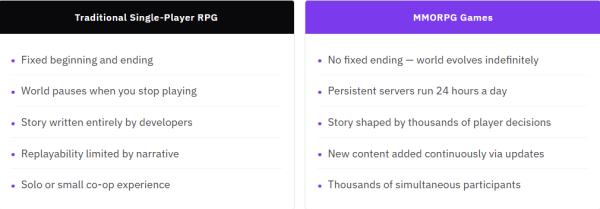
    The key difference between MMORPG games and other traditional single-player games is the idea of persistence. The game world does not reset when you log out. It does not pause, replay, or offer a checkpoint. While you sleep, your guild is still operating. Markets are moving. Territories are shifting. Alliances are being tested. You return not to a saved state but to a world that has continued without you, exactly as a real place would.

    A World That Outlives Any Single Session

    This continuity creates a fundamentally different emotional relationship with the game. Players in traditional titles invest in completing content. Players in MMORPG games invest in inhabiting a world. That distinction, between consumption and belonging, is the single most important factor behind the genre’s extraordinary retention rates.

    Continuous gameplay loops also play a central role. In the best MMORPG games, there is always something meaningful to do, and crucially, there is always something you are working toward. The design philosophy is built around ensuring that players never reach a full stop. There is always a next tier of gear, a next skill milestone, and a next chapter of the faction storyline waiting just beyond where you currently stand.

    Character Development and Player Progression

    Video game character skill tree and gear progression interface glowing on screen


    Ask any psychologist about the motivational mechanics behind MMORPG games, and you will quickly arrive at a concept called variable reward schedules. The unpredictability of when the next big drop will happen, combined with the certainty that consistent effort moves you measurably forward, creates a motivational loop that the human brain finds deeply engaging.

    But reducing character progression to psychology does it a disservice. What leveling systems in MMORPG games actually deliver is a narrative of personal growth that players author themselves. You were a level-one nobody in that starting village. Six months later, you are carrying gear that took coordinated effort from twenty people to obtain, and players newer than you ask for your advice. That arc is genuinely satisfying in ways that extend well beyond dopamine.

    Gear, Skills, and the Pursuit of Mastery

    Equipment systems in modern MMORPG games have become sophisticated economies in their own right. Gear has rarity tiers. Crafting disciplines require genuine skill investment to be mastered. The difference between a player wearing good gear and one wearing great gear is visible and meaningful socially, strategically, and aesthetically. Players invest a lot of time theorycrafting optimal builds, discussing their findings with their respective communities, and experimenting with the potential of certain combinations of classes.

    It is a level of progression that is one of the main reasons why MMORPG games retain players for longer than any other genre of game. The journey from novice to master is not a simple one; it is a complex, individual experience for each player who makes it along that road.

    Community and Social Interaction

    Group of friends gaming together with enthusiasm in a social multiplayer setting


    Here is a fact that surprises people who have never spent time in a serious MMORPG game: a significant number of the people playing them are not primarily there for the gameplay. They are there for the people.

    The social infrastructure that is part of MMORPG games is unmatched in all forms of digital entertainment. Guild systems create organizational structures that have real-world notions of hierarchy and accountability. Communication tools such as voice chat in raids, text chat for strategy sessions, and in-game mail for trading create a communication model that is similar to real-world organizations.

    From Strangers to Squadmates

    The transformation from stranger to trusted teammate inside an MMORPG game happens faster than most people expect. Shared adversity, a difficult raid that required fourteen attempts over three weeks before finally succeeding, creates bonds with a quality and durability that is genuinely surprising to those who dismiss these communities from the outside.

    The most powerful thing about MMORPG games is not what they give you to do; it is who they put beside you while you do it. Those relationships outlast any individual game and often outlast the games themselves.

    Trading systems add another social dimension. Crafters, merchants, and resource gatherers form their own communities within the larger game world, connected to combat players through mutual dependency rather than shared activity. The blacksmith who supplies gear to the raid team never fights alongside them but is no less integral to the guild’s success.

    Discovering the right community within an MMORPG game is one of the most important decisions a new player will make. That is where platforms like Kaikkitaieimitaan24 offer real value, helping players orient themselves within the wider gaming ecosystem before they commit their time and social investment to a particular world.

    Why MMORPG Games? Keep Players Hooked for Years

    The vast majority of games follow a rather predictable pattern of interest that peaks during launch, declines steadily over time as all the content is played through, and then is abandoned. MMORPGs were built from the ground up to break this pattern, and they do it in a number of different ways that reinvent the genre on a regular basis.

    The most important of these is the live-service update model. Unlike a title with a fixed release and a sequel cycle, MMORPG games are in a permanent state of development. Patches arrive weekly or monthly. Major content updates land quarterly. Expansion packs, which add entire new continents, class systems, and story lines, relaunch the game every year or two. The result for the player is that the game they logged into six months ago is genuinely, meaningfully different from the game they are logging into today.

    The Retention Mechanisms That Set the Genre Apart

    Seasonal Events

    Time-limited festivals, themed dungeons, and exclusive rewards create genuine urgency that pulls lapsed players back reliably

    Expansion Packs

    Major content releases that effectively relaunch the game for veterans while simultaneously welcoming newcomers

    Social Accountability

    Guild commitments and raid schedules create genuine external motivation to stay active that no solo game can replicate

    Infinite Progression Ceilings

    Each update raises the cap, ensuring there is always a meaningful next goal regardless of current achievement level

    Community Events

    Server-wide challenges and world events generate shared experiences that become part of the game’s collective memory

    The result of layering these mechanisms together is a retention profile that makes MMORPG games unique among entertainment products. Players do not simply enjoy them; they organize their lives around them. Raid nights become calendar fixtures. Expansion launches become anticipated events shared with friends across countries. The game becomes, in a very real sense, a recurring part of how players define their leisure time and social identity.

    There is also an economic stickiness that reinforces all of the above. Years of accumulated progress, characters built with thousands of hours, rare gear earned through collective effort, and server reputations developed over time create a genuine barrier to simply walking away. This is not a design flaw. It is a reflection of real investment that players made freely and value sincerely.

    Conclusion: Built to Last, Designed to Draw You Back  

    The global appeal of MMORPG games is not a puzzle to be solved. It is the logical result of a genre that recognized something essential about human motivation long before the rest of the entertainment world caught on: people don’t just want to have experiences. People want to find a sense of belonging to something, to become something, and to do it with the people who matter to them.

    Every aspect that makes MMORPG games engaging and appealing, the world itself, the depth of development, the social aspects, and the continuous content updates, is just a different way of answering the same underlying question: how do we create a space that people really want to keep returning to?

    The genre has been answering that question for millions of people for over twenty years. With better technology, smarter design, and a global audience that’s never been larger, MMORPG games are only improving on that answer. For millions of people around the world, the invitation is simple: find your world, find your people, and stay as long as you like. Most do.

  • AI Apps Fuel Subscription Model Demand, eFinancialModels Reports

    ZURICH, SWITZERLAND – March 13, 2026 – eFinancialModels, a global marketplace for professional financial model templates, is reporting sustained strong demand for its SaaS financial model templates as a new generation of founders builds subscription businesses on top of AI. The platform, which serves entrepreneurs, investors, and finance teams worldwide, is seeing consistent interest from first-time SaaS founders — many developing AI-powered applications — who need structured, investor-grade SaaS financial models to plan and validate their businesses.

    The AI wave currently reshaping software development has not disrupted the subscription monetization model — it has reinforced it. Across productivity tools, vertical AI applications, and developer platforms, subscriptions remain the dominant commercial structure for new products. While outcome-based pricing attracts considerable attention, it remains impractical for most early-stage businesses: it requires sophisticated measurement infrastructure, demands that customers trust unproven products with their core workflows, and creates significant revenue unpredictability at precisely the moment when founders are managing tight runway and building their first investor relationships.

    Subscription revenue, by contrast, offers structural advantages that align closely with the realities of early-stage company building. Recurring charges can be collected in advance of service delivery, reducing the working capital burden that typically forces early-stage companies into repeated fundraising cycles. Predictable monthly and annual revenue also appeals directly to investors and lenders, who can model growth, churn, and unit economics with greater confidence. As thousands of new AI-powered applications launch each month, the fundamental financial planning questions remain unchanged: what is the pricing, how quickly will the user base grow, what does churn cost, and when does the business break even.

    “Every week we see new founders, many building on top of AI, who need to model their subscription revenue, churn, and path to breakeven. The tools and the technology have changed, but the financial fundamentals have not. Investors still ask the same questions they always have — what a customer cost does to acquire, how long do they stay, and when does the business become self-sustaining. Our templates give founders the structure to answer those questions clearly, before they walk into a fundraising conversation.” — Cyrill Haenni, Founder of eFinancialModels

    How Subscription Businesses Become Profitable

    Subscription economics are driven by accumulation and compounding. The key variables every founder must model are:

    • Revenue build-up: MRR and ARR grow through the accumulation of cohorts across pricing tiers. Modelling this over time reveals whether the growth trajectory is realistic and what the business looks like at scale.
    • Churn: Even a small monthly churn rate erodes revenue significantly over time. Founders need to stress-test churn assumptions before committing to a cost structure.
    • Unit economics: CAC payback period, LTV:CAC ratio, and contribution margin determine whether the business is structurally viable — and are the metrics investors will interrogate most closely.
    • Free-to-paid conversion: For AI-powered tools relying on freemium or trial acquisition, the conversion rate and time-to-convert directly drive revenue ramp and cost efficiency.
    • Runway and breakeven: Modelling burn rate against subscription revenue growth determines how long capital lasts and when the business reaches operational self-sufficiency.

    With thousands of new AI-powered applications launching every month and the subscription model continuing to provide the financial predictability that early-stage businesses need, demand for rigorous SaaS financial planning tools shows no sign of abating. eFinancialModels provides the templates founders need to turn a product vision into a financial plan that investors and lenders can get behind.

    For more information, visit www.efinancialmodels.com.

    About eFinancialModels

    eFinancialModels is a premier online marketplace offering a wide array of industry-specific financial model templates in Excel and Google Sheets. Catering to entrepreneurs, investors, and executives worldwide, the platform provides expertly designed tools to support financial planning, analysis, and strategic decision-making — helping project teams translate their vision into rigorous, investor-grade financial plans.

    To learn more, visit https://www.efinancialmodels.com

    For the latest updates, follow eFinancialModels on social media:

    Facebook: @efinancialmodels

    Twitter/X: @efinancialmodel

    Instagram: @efinancialmodels

    Media Contact
    Company Name: eFinancialModels
    Contact Person: Cyrill Haenni, Founder & Managing Partner
    City: Zurich
    Country: Switzerland
    Website: https://www.efinancialmodels.com/

  • Rob Marucci: Connecticut Buyers Using Escalation Clauses as Bidding Wars Return thumbnail

    Rob Marucci: Connecticut Buyers Using Escalation Clauses as Bidding Wars Return

    Middlebury broker reports only three affordable homes available as inventory crisis triggers competitive offers

    CONNECTICUT, March 13, 2026  – Connecticut homebuyers are reviving an aggressive bidding strategy from the pandemic era as severe inventory shortages trigger multiple-offer scenarios across suburban markets.

    Rob Marucci, broker-owner of Better Living Realty LLC in Middlebury, says escalation clauses, contractual provisions that automatically increase offers to beat competition, have returned after disappearing during 2023-2024 market normalization.

    “My agents are calling me, and we’re trying to get creative on how to make our offer stronger again, because we are getting outbid,” Marucci said.

    The tactic works by allowing buyers to set a maximum price while automatically outbidding competitors in small increments. A buyer willing to pay $340,000 might offer $320,000 with escalation in $2,000 steps. If another buyer bids $325,000, the clause automatically bumps the first buyer to $327,000, winning without reaching their ceiling.

    “You don’t have your buyers overpaying,” Marucci explained. “Now you might get it for $327,000 instead of $340,000. It protects your buyers.”

    The return of competitive bidding reflects genuine scarcity. In Middlebury, just 15 single-family homes are currently listed, with only two priced under $500,000, the range where most buyers can afford mortgages at current interest rates around 6%. (Data at time of writing – 5 March 2026).

    Connecticut’s brutal winter compounded the problem. Record snowfall delayed pre-spring listings as sellers waited for better weather, creating compressed inventory when buyer demand typically increases.

    “Everything is kind of put on pause,” Marucci noted. “Anybody that was gonna list is on hold.”

    Beyond escalation clauses, Marucci says buyers are gaining advantage through full mortgage approval rather than standard pre-approval letters. Lenders now offer complete underwriting pending only appraisal, making those offers more attractive to sellers.

    “If your offer is the same as another offer and the other offer is FHA mortgage, we’re going to take the offer that’s fully approved,” he said.

    For sellers, Marucci advises listing immediately rather than waiting for spring, arguing current scarcity creates pricing advantages that may evaporate when delayed inventory hits the market.

    Better Living Realty serves Connecticut markets with 30 agents throughout Waterbury, Middlebury, and surrounding areas.

    For more information, visit www.betterlivingrealtyllc.com.

    About Better Living Realty LLC

    Better Living Realty LLC is a Connecticut-based real estate brokerage founded in 2010, serving buyers, sellers, and investors throughout New Haven and Litchfield Counties.

  • What Alex Passler Learned From WeWork That He’s Deliberately Not Replicating at Vallist thumbnail

    What Alex Passler Learned From WeWork That He’s Deliberately Not Replicating at Vallist

    LONDON – After spending years scaling WeWork across Asia Pacific and The Americas, Alex Passler is building Vallist on a foundation of strategic restraint, deliberately avoiding the mistakes that contributed to his former employer’s spectacular collapse.

    The lesson he’s choosing not to repeat? Expanding into new markets before achieving critical mass in the first one.

    “Expanding into new markets at too early a stage when you haven’t got critical mass on the first one really drains resources and profitability,” Passler explains. “More than anything, it drains resources and shifts focus. Opening a new market is always kind of a sexy thing, so you tend to have your teams talking about the new location and forgetting about the locations you have open.”

    At Vallist, the approach inverts WeWork’s rapid expansion playbook entirely. Rather than racing to plant flags in multiple cities, Passler is focused on perfecting the model in London before considering geographic expansion.

    “Getting locations to a stabilized state where they run on their own and everything is smooth sailing, that’s when you want to look at other markets,” Passler notes. “That was the biggest lesson I’ve learned, which we don’t plan to repeat.”

    The disciplined approach extends to how Vallist operates its Finlaison House location in Holborn. By partnering directly with landlords through management agreements rather than taking on lease obligations, the company eliminates the pressure to chase occupancy at any cost.

    Two months into operations, this patient capital model is enabling decisions that would be impossible under traditional flex workspace economics. Vallist can be selective about which companies join the space, prioritizing cultural fit and member experience over immediate revenue.

    “We want to make sure that the clients we bring into the space align with each other and create benefits by co-using or co-working in the same area,” Passler explains. “I’m sure we ramp up our occupancy a bit slower this way, but I think in the long term it keeps people stickier and provides a better experience.”

    The strategy addresses what Passler identifies as a fundamental flaw in lease-backed flex models: the economic pressure to compromise service quality and pricing discipline to maintain occupancy rates that service fixed rent obligations.

    Early market response suggests the premium positioning resonates. Rather than targeting freelancers and startups, Vallist is attracting established companies sending team members to evaluate the space before committing larger teams.

    The test-and-learn approach from corporate clients validates Passler’s thesis about changing workspace demands. Professionals spending fewer days in office are increasingly selective about where they choose to work, prioritizing quality of environment over convenience or cost.

    “When you’re new to the market, people are using us as a test case,” Passler observes. “They’ll come in, experience working from there, see how it is, and then decide if it’s something for them long term.”

    As Vallist considers future London locations, the focus remains on complementing rather than replicating Finlaison House. Different office configurations, additional amenities like podcast studios and expanded wellness facilities, and strategic geographic positioning will create a network effect rather than competitive cannibalization.

    The measured approach represents a fundamental rethinking of flexible workspace strategy: build reputation before volume, perfect operations before expansion, and align incentives with landlords to enable long-term thinking over short-term gains.

    About Vallist

    Vallist delivers premium flexible workspace through landlord partnerships that eliminate lease risk and enable patient investment in design, technology, and hospitality. Founded by former WeWork executive Alex Passler, Vallist creates hospitality-led environments for professionals who prioritize quality, privacy, and genuine service. Learn more at https://vallist.com.

  • Why Smart Publishers Are Licensing Content to AI Platforms While Others Fight Them thumbnail

    Why Smart Publishers Are Licensing Content to AI Platforms While Others Fight Them

    Media companies face a fundamental choice about AI platforms like ChatGPT, Claude, and Perplexity: treat them as threats to be resisted, or recognize them as a major new distribution channel.

    Steve Marcinuk, founder of KeyCrew Media, sees clear parallels to an earlier moment in media history – one that should serve as a cautionary tale for publishers weighing their options.

    Marcinuk recalls attending a seminar at Wharton roughly 20 years ago where the discussion centered on the music industry’s decision to sue Napster and, in some cases, its own customers. “What we’re seeing now is exactly the same thing,” he says.

    The Pattern Repeats

    In the early 2000s, Napster represented a new way to distribute music. Rather than embracing technology that could dramatically expand their reach, record labels chose litigation. They sued the platforms. They fought the future instead of adapting to it.

    The industry eventually came around. Streaming now dominates music consumption, and artists reach global audiences that would have been impossible in the era of physical distribution. But the transition took years longer than necessary, and the industry lost significant revenue and goodwill in the process.

    Today, some media companies are repeating that mistake with AI platforms. They are blocking search crawlers, restricting content access, and pursuing lawsuits against the large language models that ingested their material. Marcinuk’s view is direct: those same models gave their content broader readership and reach than it would otherwise have had.

    The Distribution Opportunity

    AI platforms process millions of queries every day. When someone asks about market conditions in a specific city, trends in a particular industry, or insights on a developing story, these platforms surface content from publishers whose material is available to them. For media companies, that represents distribution at a scale that traditional channels cannot match.

    KeyCrew Media has built its model around this opportunity. The company operates six real estate publications and conducts thousands of expert interviews to capture market intelligence. Rather than restricting that content behind paywalls or crawler blocks, KeyCrew actively licenses it to traditional media outlets and AI platforms.

    “One article has value on its own,” Marcinuk says, “but as a contribution to a much bigger ecosystem, it has unique value that we are very enthusiastic for.” The goal is not only to reach KeyCrew’s direct publication audience, but to multiply that reach through the far larger audiences that AI platforms serve.

    Why Some Publishers Resist

    The resistance from some media companies is understandable. For decades, they built subscription and advertising models that depended on readers visiting their own sites. Allowing AI platforms to surface their content without generating direct traffic feels like a threat to that model.

    But that framing misses how content value compounds under AI distribution. Publishers who make their material available – while maintaining editorial quality and ensuring proper attribution – position themselves to benefit as AI platforms become a primary way people find information. Those who don’t risk becoming less visible precisely as the platforms grow.

    KeyCrew’s content licensing partners have noted that expert-sourced intelligence at the quality and volume KeyCrew produces is difficult to find elsewhere. That scarcity is an asset, but only if the content reaches the platforms where decision-makers are increasingly asking questions.

    The Source Advantage

    For KeyCrew Media, AI distribution creates a reinforcing cycle. Expert sources contribute market intelligence. That content is published across six focused publications, then licensed to media partners and AI platforms, reaching audiences far larger than any single outlet could deliver. The expanded reach makes participating more attractive to sources, which improves the quality of intelligence gathered, which in turn makes the content more valuable to licensing partners.

    This matters because sourcing credible expert intelligence has always been one of the harder problems in niche industry media. Busy professionals need a compelling reason to share their knowledge. Traditional media placement offers some value, but placement is competitive and reach is uncertain. When expert insights surface through platforms like ChatGPT and Perplexity with clear attribution, the visibility benefit becomes concrete enough to change that calculation.

    What History Teaches

    The labels that adapted earliest to digital distribution were best positioned when streaming became the standard. Those that spent years in litigation arrived late to a model they ultimately could not avoid.

    Media companies now face a similar decision point. AI platforms are reshaping content distribution whether publishers engage or resist. The publishers that remain relevant over the next decade are unlikely to be those with the most restrictive paywalls. They will be those who built high-quality content and moved it through every available channel – including the AI platforms that many of their competitors are currently trying to block.