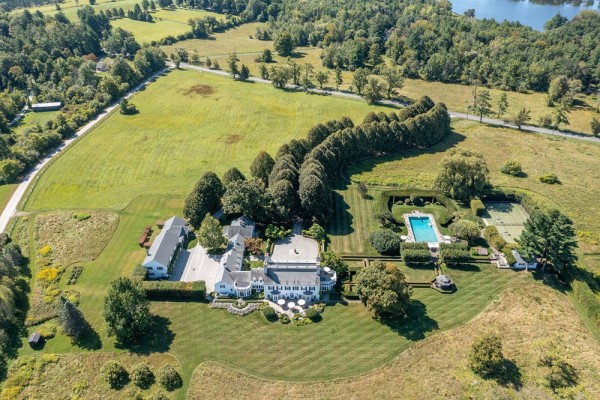
Photo credit – Brian Wilcox
For buyers coming out of New York City, the tri-state country property market of northwest Connecticut, the Hudson Valley, and the Southern Berkshires can feel deceptively straightforward from a distance. The drive is under two and a half hours. The listings are compelling. The price points, relative to what that budget buys in the city or in the Hamptons, look like an obvious move.
What experienced brokers in this market know is that the gap between a compelling listing and a sound purchase decision is where most of the important work happens.
Elyse Harney Morris, principal broker and owner at Elyse Harney Real Estate, has worked with buyers from New York for the duration of her career at the firm her mother founded in 1987. The brokerage operates across Connecticut, New York, and Massachusetts with 30 agents, a tri-state structure built deliberately to serve buyers whose search does not stop at a state border. “Ever since COVID, we are seeing more and more people who really do not care where,” Morris says. “They are looking for that lifestyle, that property that is going to work for their family.”
The Two-and-a-Half-Hour Threshold
The proximity of the Litchfield Hills, Hudson Valley, and Southern Berkshires to New York City is one of the region’s most durable competitive advantages, but it is worth understanding precisely. Morris identifies two and a half hours as the practical ceiling for families with children who intend to use a property every week rather than occasionally. Beyond that threshold, a country property stops being a weekly destination and starts being a place you visit when the timing is right. The Salisbury area of Connecticut sits comfortably within that radius, as do the Hudson Valley and the Southern Berkshires.
For buyers who are evaluating this market against alternatives that sit further from the city, that threshold is worth stress-testing against the reality of their own schedules. A property that requires three hours each way on a Friday evening with children in the car will be used differently than one that requires two.
What the Current Market Offers New York Buyers
The market has moderated meaningfully from its pandemic peak, and for New York buyers who sat out the frenzy of 2020 and 2021 because the conditions did not allow for sound decision-making, the current environment offers something that period largely did not: time to think.
Buyers are once again able to visit a property more than once before making an offer. Inspections are happening. Financing is competitive with cash in most segments. Morris describes the $2 million to $3 million price point as the most active segment of the current market, with well-maintained and correctly priced properties moving confidently. At the upper end, properties with exceptional land, water features, and multi-generational configuration continue to attract serious buyers with longer decision timelines and lower price sensitivity.
Inventory remains tighter than historic norms, a condition shaped by the region’s strict zoning and active land conservation programs that limit new development in ways that comparable markets do not. Supply does not expand quickly here, which is part of what protects long-term value but also means that buyers who find the right property need to be prepared to move.
Understanding the Distinction Between Markets
One of the most common errors New York buyers make in this region is treating the three states as interchangeable. They are not. Litchfield County in Connecticut, the Hudson Valley in New York, and the Southern Berkshires in Massachusetts each have a distinct character, a distinct community infrastructure, and a distinct set of property types that define the upper end of their respective markets.
Litchfield County offers historic town centers, walkable communities, and a deeply rooted conservation culture. The Hudson Valley brings broader acreage, more contemporary architecture, and a farm-to-table food scene that has attracted a creative and entrepreneurial buyer profile. The Southern Berkshires anchor the northern end of the region with cultural institutions, mountain access, and a four-season calendar anchored by Tanglewood and Catamount.
For a buyer who has not spent meaningful time across all three markets, choosing between them based on listings alone is a shortcut that often produces regret. Morris’s firm holds licenses in all three states precisely to allow buyers to make that comparison with continuity, without switching brokers or losing the context that accumulates across a search.
The Preparation That Changes Outcomes
Morris is direct about what separates buyers who find the right property from those who miss it or overpay for the wrong one. Financing in place before the search begins. A clear sense of priorities, not a wish list, but an honest ranking of what matters most. And a relationship with a broker who has early access to properties before they reach the public market, which in a tight-inventory environment is often the difference between a choice and a scramble.
For buyers who are still in the discovery phase, she recommends renting in a target community before purchasing. Six months of weekday and weekend experience in a place reveals things that no listing, no virtual tour, and no weekend visit can approximate. “You figure out what happens not only on a Saturday and Sunday, but what happens on a Tuesday,” she says. That Tuesday knowledge, unglamorous as it sounds, is often the most useful information a buyer can have.
Elyse Harney Morris is principal broker and owner at Elyse Harney Real Estate, an independent brokerage founded in 1987 and operating across Connecticut, New York, and Massachusetts. She specializes in significant country estates, historic farms, and conservation properties across the Litchfield Hills, Hudson Valley, and Southern Berkshires.
Disclaimer: This article is based on information provided by the expert source cited above. It is intended for general informational purposes only and does not constitute legal, financial, or real estate advice. Readers should conduct their own research and consult qualified professionals before making any real estate or financial decisions.