Author: IndNewsWire

  • New Listing Bar Just Rose After Six Token Purge and Pepeto Is Built to Clear It thumbnail

    New Listing Bar Just Rose After Six Token Purge and Pepeto Is Built to Clear It

    The binance new listing conversation shifted hard on August 11 after the exchange confirmed it will delist six tokens effective August 17, sending a clear message that only projects with sustained utility, real volume, and community traction survive on the world’s largest exchange.

    Binance processed 221 token launches through Alpha in 2025, and the pressure to find the right token before it reaches a major exchange is fiercer than ever. While XRP holds above $1.00 and Cardano builds toward an October ETF decision, a presale that already crossed $10.6 million in raised capital is approaching the gate with audited infrastructure and deflationary mechanics the tightened standards now demand. That project is Pepeto.

    Binance Purges Six Tokens as Listing Standards Tighten

    Binance confirmed the delisting of ACX, HFT, PIVX, PYR, VANRY, and VIC after periodic reviews found the tokens no longer met volume and development benchmarks, according to Cryptonomist.

    The removals land during the same week the SEC scheduled its first formal crypto rulemaking vote for August 14, according to CryptoNewsZ. Clearing weaker tokens while regulators build frameworks for stronger ones draws a line the market can read. The next token to earn a binance new listing spot will be the one that passes the exchange’s quality bar and the regulatory test at the same time.

    Which Token Clears the Bar

    Pepeto Is Engineered for the Standards Binance Now Enforces

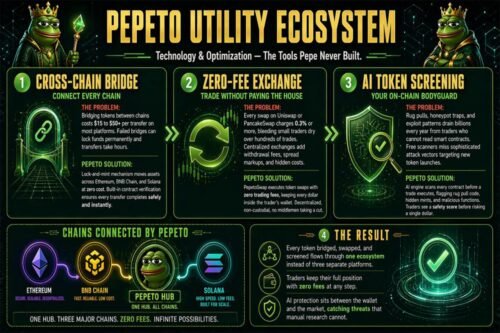
    Capital does not flow into presales at random, and $10.6 million inside Pepeto tells a story about what smart wallets see beneath the price. The zero fee cross chain swap engine handles trades across any chain without charging a fee, generating the kind of sustained volume and activity Binance looks for before opening a listing slot.

    That volume hits a supply fixed at 420 trillion with no way to inflate it, while the weekly burn schedule permanently shrinks the float with every cycle. The cross chain bridge pulls liquidity from outside chains, giving the project multi chain reach that exchange review teams weigh heavily when hundreds of applicants compete for the same spot.

    PepetoAI grades risk on every position entry to exit, keeping holders in trades longer and cutting the panic selling that kills metrics for less protected tokens. The 166% APY staking locks supply into long term commitments, proving holder conviction in the data.

    SolidProof audited the contract, a former Binance expert anchors the team, and the visionary who built the original Pepe steers the project toward an anticipated Binance listing. At $0.0000001888, Pepeto is built for listing day, and the presale price is the last price before the exchange writes a new one.

    XRP Holds Above $1.00 as Institutional Products Pull $42M

    XRP trades near $1.00 driven by institutional interest that pulled $42 million into XRP products during a week when Bitcoin ETFs saw outflows. The token remains 73% below its all time high of $3.84, and a clean break above $1.42 would be the first real breakout signal.

    XRP’s cross border payment rails make it a strong utility play, but the 73% drawdown and $57 billion valuation mean earlier stage entries carry a sharper return profile.

    Cardano Nears October ETF Decision at $0.17

    Cardano trades near $0.17 after Clearstream expanded regulated crypto custody to include ADA on July 6. The Grayscale GADA ETF faces an SEC deadline of October 23, and CME ADA futures passed the six month requirement previous approvals needed.

    ADA sits 94% below its all time high of $3.10, but institutional rails around it are stronger than ever. That catalyst is real, yet the distance from $0.20 to meaningful returns is wide enough that presale entries carry the edge.

    Conclusion

    Your years holding large caps built less wealth than one early presale position would have, and the binance new listing window forming around Pepeto confirms that volume is already flowing toward this entry while the presale price still stands.

    The difference between portfolios that outperform this cycle and the ones that grind comes down to one position: Pepeto before listing, backed by the builder of the original Pepe, a SolidProof audit, and a zero fee swap engine built for the volume Binance demands. That entry is still open but not for much longer, and when the listing candle prints the presale closes and the price early wallets locked becomes the floor.

    Click To Visit Pepeto official Website To Enter The Presale

    FAQs

    What is the next binance new listing to watch?

    The next binance new listing to watch is Pepeto, with a SolidProof audit, cross chain utility, and $10.6 million raised.

    Why do binance new listing tokens gain value?

    Binance new listing tokens gain value because 300 million users create instant demand that reprices tokens above presale entry.

    Is Pepeto a strong binance new listing pick?

    Pepeto is a strong pick because its swap engine, burns, and audit clear the standards Binance enforces after purging six tokens.

    Disclaimer:
    This article is for informational purposes only and does not constitute financial advice. Cryptocurrency investments carry risk, including total loss of capital.

    All market analysis and token data are for informational purposes only and do not constitute financial advice. Readers should conduct independent research and consult licensed advisors before investing.
  • Best Crypto to Buy in August 2026 After SEC Regulation Vote as Pepeto Presale Closes Faster Than Any Before It thumbnail

    Best Crypto to Buy in August 2026 After SEC Regulation Vote as Pepeto Presale Closes Faster Than Any Before It

    The best crypto to buy in August 2026 depends on what happens Friday when the SEC votes on its first formal crypto rulemaking and every presale with an audited contract suddenly has a clearer path to an exchange.

    The SEC scheduled an open meeting for August 14 to propose Regulation Crypto, a framework giving qualifying projects a legal route to listing without full securities registration. While Bitcoin holds above $62,700 and Dogecoin clings to $0.069, one presale already past $10.6 million in raised capital is turning that regulatory clarity into a countdown. Its name is Pepeto.

    SEC Proposes Regulation Crypto as the Clarity Act Stalls in the Senate

    The SEC’s three member commission will meet August 14 with a single agenda item: proposing new rules for crypto investment contracts, according to CryptoTicker. TD Cowen analyst Jaret Seiberg called it the first in a series of rulemakings after Congress failed to act before recess.

    The Clarity Act now sits on September 15 needing 60 senators, and Polymarket odds on passage dropped to 35%, according to CryptoTicker. The SEC is moving without Congress. For presale projects carrying audited contracts, that motion opens the clearest runway to listing all year.

    Where the Sharpest Wallets Are Moving Right Now

    Pepeto Turns Every Swap Into Raw Demand Against a Supply That Shrinks Every Week

    Every cycle delivers one presale that early wallets remember as the entry that rewrote their portfolio. Pepeto is building the mechanics to earn that place. The zero fee cross chain swap engine removes the cost that bleeds value from every other token, converting each swap into raw buying pressure against a fixed 420 trillion supply that no team, no whale, and no event can inflate.

    That pressure stacks while the weekly burn schedule permanently destroys tokens, tightening the supply curve on a clock nobody can pause. The cross chain bridge stretches the entry across blockchains most presale tokens never reach, pulling idle capital straight into an order book that just got smaller. PepetoAI monitors each position open to close, giving traders the confidence to hold through noise instead of panic selling tokens back into circulation.

    The 166% APY staking compounds the squeeze by locking still more supply out of active trading. A SolidProof audit and a former Binance expert anchor the infrastructure, while the architect who launched the original Pepe steers the vision toward an anticipated Binance listing. At $0.0000001888, Pepeto is the presale this cycle will remember because listing day reprices everything above this floor and $10.6 million already inside says the smart money sees it.

    Bitcoin Holds Above $62,000 as CPI Calms Rate Fears

    Bitcoin trades near $62,700 after July CPI showed 0.1% monthly growth and a 3.4% annual rate, both matching forecasts and cooling rate hike talk. BTC remains 49% below its October 2025 all time high of $126,080 with daily volume around $21.2 billion.

    Spot Bitcoin ETFs pulled in $7.8 million in net inflows on August 12. The path from $62,700 to $126,000 is a 96% recovery, strong for a large cap but not the early window that turns modest entries into life changing positions.

    Dogecoin Clings to $0.069 as ETF Spike Fades

    Dogecoin trades near $0.069 with a market cap around $11 billion, down over 90% from its May 2021 all time high of $0.74. The Franklin Templeton DOGE spot ETF filing on August 4 triggered a 116% spike in spot flows, but buyers could not hold $0.072 and the price fell back.

    The 200 day EMA sits at $0.10, the RSI reads 40, and DOGE’s unlimited supply prints new tokens daily, the kind of inflationary pressure fixed supply assets never carry.

    Conclusion

    The best crypto to buy in August 2026 is the entry you take before the listing goes live, because that entry does not exist the day after. When the SEC vote lands and capital moves on that clarity, you are either inside a position that benefits or buying from the wallets that were.

    Pepeto is closing stages faster than the previous ones filled, with $10.6 million already committed by wallets that understood the zero fee engine, the weekly burns, and the anticipated Binance listing. Speed decides everything now, because the second that listing candle prints, the presale shuts and this price vanishes from the cycle forever.

    Click To Visit Pepeto official Website To Enter The Presale

    FAQs

    What is the best crypto to buy in August 2026?

    The best crypto to buy in August 2026 is Pepeto, with zero fee swaps, weekly burns, and an anticipated Binance listing.

    How does SEC Regulation Crypto affect listings?

    SEC Regulation Crypto gives qualifying projects a legal route to exchanges without full registration, clearing the path for audited tokens.

    Is Pepeto worth buying in August 2026?

    Pepeto is worth buying because its demand mechanics and approaching Binance listing make the presale price a closing window.

    Disclaimer:
    This article is for informational purposes only and does not constitute financial advice. Cryptocurrency investments carry risk, including total loss of capital.

    All market analysis and token data are for informational purposes only and do not constitute financial advice. Readers should conduct independent research and consult licensed advisors before investing.

  • Ethereum Price Prediction Faces 162% Climb to Old Highs While Pepeto Presale Offers the Faster Path thumbnail

    Ethereum Price Prediction Faces 162% Climb to Old Highs While Pepeto Presale Offers the Faster Path

    The ethereum price prediction shifted on August 12 after a K3 Capital linked wallet pulled 10,000 ETH worth $17.85 million off Binance in a single hour, followed by a second wallet withdrawing 6,948 ETH valued at $12.42 million from Binance and Bitfinex, according to Lookonchain. ETH trades near $1,870 after a 2.9% weekly gain but still sits over 60% below its August 2025 peak near $5,000.

    While whale wallets load up at those levels, a presale that already crossed $10.6 million in raised capital is drawing the kind of entries that skip the recovery grind entirely. That project is Pepeto.

    Whale Wallets Load ETH as CPI Data Takes Rate Hike Off the Table

    The withdrawals landed hours before July CPI data showed a 0.1% monthly increase and a 3.4% annual rate, both matching forecasts and softer than June’s 3.5%, according to CNBC. Tame inflation plus whale buying lifted ETH back above $1,850. Spot Ether ETFs hold about $13.7 billion in assets after recording 26,060 ETH in net inflows on August 7, according to CoinGlass.

    Futures now price in a 56% chance of a rate pause at September’s FOMC meeting. The macro fog is lifting, but $1,870 to $5,000 is a 162% climb, and that distance is where large cap ceilings take hold.

    The Window That Opens Before the Exchange Candle Prints

    Pepeto Turns Meme Speed Into a Demand Machine With Real Tools Underneath

    Pepeto takes what made meme coins the fastest moving sector in crypto and rebuilds the engine underneath with tools that protect the trader instead of leaving them exposed. The zero fee cross chain swap engine removes the cost that drains value on every trade, turning each transaction into direct demand against a fixed 420 trillion supply rather than a fee payment to a middleman.

    That fee free volume feeds straight into a weekly burn schedule that permanently removes tokens from circulation, compressing the float while the cross chain bridge funnels new capital from blockchains most meme projects never touch. PepetoAI reads each trade open to close, flagging risk before it reaches the holder and keeping tokens in strong hands instead of cycling through panic sells.

    The 166% APY staking locks another layer of supply out of active circulation, rewarding conviction while thinning the tradable float even further. The contract carries a SolidProof audit, a former Binance expert anchors the team, and the mind behind the original Pepe is steering the vision toward an anticipated Binance listing.

    At $0.0000001888, Pepeto sits at the floor of a demand structure that listing day will reprice from the ground up, and $10.6 million already inside proves the sharpest wallets see exactly where this is going.

    Ethereum Price Prediction: How Far Can ETH Climb From $1,870?

    The ethereum price prediction is showing recovery after whale withdrawals pulled over $30 million in ETH off exchanges in one hour, a move that historically supports higher prices, according to TheStreet.

    ETH trades near $1,870 with a $233 billion market cap but remains 62% below its August 2025 all time high near $5,000. Standard Chartered targets $40,000 by decade’s end. The base is growing, but $1,870 to $5,000 is a 162% recovery, not the early window that turns small entries into multiples.

    Conclusion

    The ethereum price prediction is gaining strength as whales pull millions off exchanges and CPI data removes the rate hike threat, but life changing returns this cycle will come from being early in what the market discovers after the listing candle prints, not from watching a large cap crawl back toward its old high.

    Pepeto pairs meme velocity with real swap and bridge utility on a fixed supply that burns weekly, all engineered by the architect behind the original Pepe toward an anticipated Binance listing that closes the presale forever. Every data point tells the same story, and the wallets that acted while presale pricing still existed are the ones this cycle will name when the first exchange candle prints.

    Click To Visit Pepeto official Website To Enter The Presale

    FAQs

    What is the ethereum price prediction for 2026?

    The ethereum price prediction for 2026 targets $2,500 to $3,000 as whale buying and softer CPI data drive institutional flows.

    Why are whales pulling ETH off exchanges?

    Whales pull ETH off exchanges to hold long term, a pattern that cuts sell pressure and precedes price recoveries.

    Is Pepeto worth buying before its listing?

    Pepeto is a strong presale entry because its zero fee swap engine, weekly burns, and anticipated Binance listing create structural demand.

    Disclaimer:
    This article is for informational purposes only and does not constitute financial advice. Cryptocurrency investments carry risk, including total loss of capital.

    All market analysis and token data are for informational purposes only and do not constitute financial advice. Readers should conduct independent research and consult licensed advisors before investing.

  • Solana (SOL) Price Prediction Stuck 74% Below Peak While Pepeto Wallets Lock Entry Before Listing Erases It thumbnail

    Solana (SOL) Price Prediction Stuck 74% Below Peak While Pepeto Wallets Lock Entry Before Listing Erases It

    The Solana (SOL) price prediction gained a fresh catalyst on August 11 after MoneyGram brought its crypto to cash ramps natively onto the Solana network, opening 200 countries to direct wallet conversions for the first time.

    SOL trades near $75.34 with the 200 day moving average still above $90, and four adoption signals landing in the same week tell traders the breakout is a question of timing. While that recovery builds, a presale past $10.6 million raised is already attracting the kind of capital that does not wait for large cap confirmation. That project is Pepeto.

    MoneyGram Puts Solana on the Global Payments Map

    MoneyGram’s integration marks the first time a legacy remittance giant embedded directly into the chain rather than routing through a third party, according to CoinDesk. Solana’s stablecoin supply grew to $16.7 billion this year, real capital settling on the network for payments, not speculation.

    Jupiter’s Lend v2 launched the same week with a feature that lets borrowed assets earn trading fees, pulling fresh liquidity into the ecosystem. The Solana ETF complex now holds above $1 billion in assets. That is four adoption signals in seven days, and together they explain why the market sees $90 as inevitable rather than unlikely.

    The Entry That Large Cap Recoveries Cannot Match

    Pepeto Is Engineering Demand That Grows Faster Than the Float Can Absorb

    Every presale that delivered life changing returns started the same way: demand outran the float before any exchange touched the token. Pepeto is building that exact imbalance right now. The zero fee cross chain swap engine strips every cent of friction from trading, so each swap lands as pure buying pressure against a fixed 420 trillion supply instead of leaking value into fee layers that benefit someone else.

    That buying pressure builds on a weekly burn schedule that permanently destroys tokens from the pool, compressing the float on a clock no one can pause. The cross chain bridge then widens the funnel by pulling capital from outside blockchains directly into Pepeto’s order book, pouring new demand onto a supply that just got smaller.

    PepetoAI evaluates each trade from open to close, keeping holders in positions longer and cutting the panic selling that would otherwise return tokens to circulation. At $0.0000001888 the presale sits at the floor of that demand curve, and the 166% APY staking program locks still more tokens away from the tradable float.

    A SolidProof audit backs the contract, a former Binance expert leads the development, and the cofounder who created the original Pepe is guiding what comes next. The anticipated Binance listing will reprice everything above this floor, and $10.6 million in capital already inside says the smart money is not waiting.

    Solana (SOL) Price Prediction: Can MoneyGram Push SOL Past $90?

    The Solana (SOL) price prediction is turning bullish after MoneyGram delivered the strongest real world use case SOL has seen all year, according to Investing.com.

    SOL trades near $75.34 after a 3.2% weekly climb but remains 74% below its January 2025 all time high of $293. The 100 day EMA at $78.55 is the first recovery checkpoint, while the 200 day EMA at $90.62 separates a bounce from a trend reversal. The path to $90 is open, but 18% after a 74% drawdown defines where large cap ceilings live.

    Conclusion

    The Solana (SOL) price prediction is building toward $90 on real adoption, but the wallets writing the biggest gains this cycle are not waiting for that move to confirm. They are inside Pepeto at presale price, where the creator of the original Pepe is building a zero fee swap engine on a fixed supply that burns every single week, all ahead of an anticipated Binance listing that turns presale pricing into history.

    Early SOL entries once turned quiet positions into six figure wallets before anyone saw the catalyst coming, and the same pattern is forming here. A few months from now this is either a story about life changing returns or a regret that no amount of time erases, and the wallets filling right now are choosing which side of that line they stand on.

    Click To Visit Pepeto official Website To Enter The Presale

    FAQs

    What is the Solana (SOL) price prediction for 2026?

    The Solana (SOL) price prediction for 2026 targets $79 to $101 as MoneyGram and ETF inflows rebuild demand.

    Is Solana a good investment after dropping 74%?

    Solana holds strong institutional backing, but the 74% drawdown caps near term returns versus presale entries.

    Is Pepeto worth buying before listing?

    Pepeto is a top presale entry because its zero fee swap engine, weekly burns, and anticipated Binance listing build structural demand.

    Disclaimer:
    This article is for informational purposes only and does not constitute financial advice. Cryptocurrency investments carry risk, including total loss of capital.

    All market analysis and token data are for informational purposes only and do not constitute financial advice. Readers should conduct independent research and consult licensed advisors before investing.

  • Litecoin Price Prediction Stuck Below $47 While Pepeto Presale Races Toward Listing Window thumbnail

    Litecoin Price Prediction Stuck Below $47 While Pepeto Presale Races Toward Listing Window

    Litecoin price prediction models are watching the $44 to $47 range as a make or break zone for August, but the biggest move in crypto right now has nothing to do with charting resistance levels. The SEC just issued Franklin Templeton a no action letter clearing its on chain money market fund for blockchain custody, confirming that institutional capital is building permanent on chain infrastructure while retail portfolios sit in tokens that have not moved in months.

    While LTC trades inside narrowing channels, a $10.6 million presale is compounding entries with a Binance listing approaching that turns every token purchased today into a position no exchange buyer can match, and that presale is Pepeto.

    Litecoin Price Prediction: LTC Defends $44 as Institutional Infrastructure Grows On Chain

    The SEC’s no action letter for Franklin Templeton’s FOBXX fund clears blockchain custody for registered funds, removing a legal barrier that kept institutional money market products off chain, according to Bloomberg ETF analyst James Seyffart. LTC trades at $44.40 as of August 14, sitting below both its 20 day EMA at $44.63 and 50 day EMA at $45.19, with RSI at 37 according to CoinGabbar.

    The litecoin price prediction bull case targets $46.59 and then $48 to $50 if LTC reclaims the EMA cluster, while a confirmed break below $44.25 opens $43.22 and $41.61. The upcoming LitecoinVM update brings smart contract capability, a catalyst that could push toward $53 if volume arrives.

    Why Pepeto Outpaces Every Litecoin Price Prediction for Returns

    Pepeto: Fixed Supply Shrinking Into a Listing That Reprices Everything

    Pepeto’s cross chain bridge funnels capital from every major blockchain into one fixed supply of 420 trillion tokens, and that funnel widens with every new chain connection because each one adds buyers who never had access before. More buyers hitting the same supply creates structural demand, and the burn engine compounds that pressure by removing tokens permanently every single week, so the supply side of the equation only moves in one direction.

    Staking at 166% APY locks even more tokens out of circulation while holders compound their positions, which means the sellable float shrinks from two directions at once: burns destroy tokens permanently and staking removes them temporarily. The zero fee cross chain swap engine keeps every dollar of trading volume inside the ecosystem instead of bleeding to exchange fees, and the PepetoAI risk scorer evaluates each trade open to close so traders know their exposure before they commit.

    The mind behind the original Pepe built the project with a former Binance expert developer, and the SolidProof audit confirms the contract is clean. With $10.6 million raised at $0.0000001888, the capital is voting before the chart even exists, and the listing will write the first candle on a supply that has been shrinking since day one.

    Litecoin: Strong Floor but Measured Ceiling

    LTC holds at $44.40 after falling 58% from its 52 week high of $131.49 in August 2025, with the next halving approaching in July 2027. Coinbase’s wrapped Litecoin reserves crossed 81,000 LTC, adding DeFi access through the Base network.

    The litecoin price prediction consensus for year end sits around $44 to $49, roughly 10% from current levels. LTC remains a proven payments network with 91% of its 84 million supply already mined, but the returns from $44 belong to a different category than presale pricing below a millionth of a dollar.

    Conclusion

    Every litecoin price prediction model maps the same ceiling, a $47 to $50 range that delivers single digit returns from here. There is nothing wrong with that trade, but it is a trade that sits on a chart already drawn. SHIB sat at a fraction of a billionth of a dollar in August 2020 and printed a $40 billion market cap fourteen months later, and every wallet that hesitated for one more signal spent the rest of the cycle watching from outside while the entry vanished.

    The same pattern is forming right now with $10.6 million already committed, burns compressing the supply every week, and a Binance listing closing in. A few months from now this is either the entry that built life changing returns for the wallets that moved, or it becomes the kind of regret that no amount of time erases because you read every number, understood the math, and still waited for one more candle.

    Click To Visit Pepeto official Website To Enter The Presale

    FAQs

    What is the litecoin price prediction for August 2026?

    The litecoin price prediction for August targets $44 to $49, with $46.59 and $47 as the key breakout levels.

    Can litecoin price prediction models reach $100?

    Litecoin price prediction models need LTC to reclaim $60 resistance first, which requires volume the current market has not produced.

    Is Pepeto a stronger entry than litecoin now?

    Pepeto at presale pricing offers returns that large caps near multi year lows cannot deliver from current valuations.

    Disclaimer:
    This article is for informational purposes only and does not constitute financial advice. Cryptocurrency investments carry risk, including total loss of capital.

    All market analysis and token data are for informational purposes only and do not constitute financial advice. Readers should conduct independent research and consult licensed advisors before investing.

  • Crypto Update: Harmony Loses 26% of Its Supply in One Exploit While Pepeto Burns Toward Listing thumbnail

    Crypto Update: Harmony Loses 26% of Its Supply in One Exploit While Pepeto Burns Toward Listing

    This crypto update begins with a warning that supply integrity is everything. Harmony’s ONE token crashed over 30% on August 12 after an attacker minted 4 billion tokens through empty blocks, inflating supply by 26% and routing 2.8 billion freshly created tokens to exchanges.

    While one project watches its supply explode, a $10.6 million presale is burning supply smaller every week with a SolidProof audited contract and a Binance listing approaching, and that presale is Pepeto.

    Crypto Update: Harmony Exploit Wipes 30% as Supply Security Becomes the Story

    The biggest crypto update this week hit August 12 when Harmony Protocol confirmed an unauthorized mint of roughly 4 billion ONE tokens, about 26% of the network’s entire prior supply, according to CoinDesk. The attacker exploited empty blocks to bypass validation and funneled 2.8 billion fraudulent tokens to exchanges before any freeze response could land.

    ONE crashed to a record low with volume spiking 4,000% as panic overwhelmed the book. Harmony is evaluating a full network rollback, according to The Block, and its Horizon bridge already lost $100 million in 2022 to the Lazarus Group. The crypto update for traders is simple: supply security separates projects that survive from projects that disappear.

    Why This Crypto Update Makes Pepeto’s Fixed Supply the Smartest Entry

    Pepeto: Audited Supply That Burns Smaller While Demand Grows

    The 420 trillion fixed supply cannot be minted, inflated, or exploited because the contract is locked and verified by SolidProof, and the burn engine makes that number smaller every single week. Fewer tokens in circulation means every new buyer competes for a shrinking pool, and the zero fee cross chain swap engine accelerates that competition by keeping every dollar of trading volume inside the ecosystem instead of bleeding to exchange fees.

    The cross chain bridge compounds the pressure further by connecting every major network into one entry point, funneling in buyers who would stay locked on their native chain without it, so the demand side grows while the supply side contracts. PepetoAI grades risk across every trade so holders see their exposure before committing, and staking at 166% APY locks tokens out of the sellable float, tightening the available supply into the listing window from yet another angle.

    The developer who built the original Pepe runs the project with a former Binance expert on the team, and $10.6 million raised at $0.0000001888 proves capital has already decided. The anticipated Binance listing is where every burned token, every staked token, and every bridge buyer creates a supply gap that listing day fills with price discovery.

    ETH: Institutional Building but Price Still Trailing

    Ethereum trades near $1,866 after Fidelity filed to add staking to its $898 million FETH fund and BlackRock brought $311 billion in European fund access on chain.The token sits 62% below its August 2025 high near $5,000, and spot ETH ETF flows recently turned negative. ETH is the foundation of decentralized finance, but returns from $1,866 require a recovery that has not arrived.

    BNB: Exchange Strength Without Exchange Era Returns

    BNB holds near $604, down roughly 22% from its December 2024 high of $788 and among the most resilient tokens this cycle. The Binance ecosystem keeps expanding with payment integrations, giving BNB real utility across the network.

    This crypto update highlights the ceiling: BNB’s $90 billion market cap needs billions more just to revisit its prior high. BNB is a solid hold, but the return math from $604 is a different conversation than the math from presale pricing.

    Conclusion

    You already know the cycle lesson because you lived it. You watched wallets fill last cycle while you hesitated, waited for one more signal, one more article that would make the decision feel safe enough to finally act.

    The rounds are closing faster now, the burn engine is pulling supply out of circulation while you read this, and the largest addresses already sit on Pepeto at presale pricing with positions built at a cost that listing day erases permanently.

    Anyone who waits will end up buying from those exact wallets after the Binance listing opens, at a price that turns today’s presale entry into the position you wish you had taken when every number was sitting right in front of you and the only thing missing was the click.

    Click To Visit Pepeto official Website To Enter The Presale

    FAQs

    What is the most important crypto update this week?

    The most important crypto update is Harmony’s exploit minting 4 billion tokens, crashing ONE over 30% and exposing supply inflation risk.

    Why does this crypto update matter for investors?

    This crypto update shows supply integrity separates safe projects from exploitable ones, and Pepeto’s audited supply cannot be inflated.

    Is Pepeto the strongest entry from this week?

    Pepeto’s audited fixed supply with weekly burns and an approaching Binance listing makes it the strongest presale entry available now.

    Disclaimer:
    This article is for informational purposes only and does not constitute financial advice. Cryptocurrency investments carry risk, including total loss of capital.

    All market analysis and token data are for informational purposes only and do not constitute financial advice. Readers should conduct independent research and consult licensed advisors before investing.

  • In a Flat-Rent Market, Multifamily Returns Come Down to the Expense Decisions Most Managers Skip thumbnail

    In a Flat-Rent Market, Multifamily Returns Come Down to the Expense Decisions Most Managers Skip

    For most of the past decade, rent growth covered a lot of operational sins in multifamily. When rents climbed every year, a manager could leave costs loosely watched and still show an owner a rising bottom line. With rent growth now stalled across much of the Sunbelt, that cover is gone, and the difference between operators is showing up in places that rarely make it onto an asset-management dashboard.

    Ron Kutas, Chief Executive Officer of OneWall Communities, built the firm around owning and operating its own workforce housing before managing it for others. He argues that the habit most of the industry has quietly gotten backwards is treating operations as a spreadsheet exercise viewed from an asset-management seat, rather than a set of decisions made at the property.

    Reading the P&L like an owner

    Asked what changes when an owner-operator reads a profit-and-loss statement, Kutas’s answer is short: he is a lot more detail-oriented. Money spent on a building he owns is money that does not come back, which tends to focus attention on line items that a manager paid on collected revenue has little reason to scrutinize.

    The conventional wisdom he would most like to retire is that rent growth fixes everything. In a year when rents are flat, that assumption leaves an operator with no plan for the half of the equation that keeps rising regardless: expenses.

    Repair, don’t replace

    The operating philosophy Kutas describes is unglamorous by design. Net operating income in a flat year comes from keeping paying residents in place, so the property is not swallowing turnover and marketing costs, and from managing expenses line by line: scrutinizing vendor contracts and repairing equipment rather than replacing it wherever that is the sound call.

    None of this is visible from a distance. It is the kind of work that only happens when someone treats the building’s costs as their own.

    The pool problem

    A concrete example of an expense a revenue-focused manager would be unlikely to touch: pools. OneWall does a great deal of work in the Sunbelt, where nearly every property has one, and third-party pool maintenance is a recurring cost. Where state rules allow, the firm has certified its own maintenance technicians to treat the pools in-house, removing a vendor line entirely.

    It is a small decision on any single property. Across a Sunbelt portfolio, it is the kind of accumulated expense discipline that a manager whose fee tracks revenue has no particular reason to pursue.

    The small line that tells the story

    Kutas says the smallest expense line he ever cut that told him everything about a prior manager was the phone bill. A single overlooked recurring charge is often a reliable signal of how carefully, or carelessly, everything else was being run.

    The same read applies on the physical side. When he walks a distressed property in the first week, the one thing that tells him how the last operator ran the place is curb appeal. Both are proxies for attention, and attention is the scarce resource in a flat market.

    Why the spreadsheet misses it

    Class B assets are currently outperforming Class A on occupancy and concessions, which puts owners of workforce housing in a stronger position than the headlines about stalled rent growth might suggest. Kutas’s highest-leverage move for an owner sitting on a Class B asset in a soft submarket is also the least technical one: keep residents happy. Retention is cheaper than turnover, and it is earned through maintenance and service rather than through a rent roll.

    The reason so much of this gets missed, in Kutas’s telling, is that the industry too often manages properties from an asset-management standpoint, looking at numbers on a spreadsheet rather than at the decisions that produce them. In a market where rent growth is no longer available to paper over the difference, the operators who read the P&L like owners, down to the phone bill, are the ones most likely to hold their returns while others watch them slip.

    About the Expert: Ron Kutas is Chief Executive Officer of OneWall Communities, a vertically integrated multifamily owner-operator that provides third-party management services. He works in workforce housing and Class B multifamily operations across the Northeast and Sunbelt.

  • Inflation-Proofing Real Estate: Capital Improvement vs. Strategic Acquisition thumbnail

    Inflation-Proofing Real Estate: Capital Improvement vs. Strategic Acquisition

    When inflation creeps up and interest rates stay unpredictable, property owners face a classic crossroads. You’re sitting on capital or built-up equity, and you want to protect it from losing purchasing power. The big question is how to deploy that capital for maximum resilience.

    Do you double down on the real estate you already own by funding high-impact capital improvements? Or do you branch out and make a strategic new acquisition to diversify your portfolio?

    There is no one-size-fits-all answer, but evaluating both paths through an inflation-resistant lens gives you a massive advantage. Here’s how to decide whether to build up or buy out.

    Option 1: Capital Improvements That Drive Immediate Equity

    Investing in existing assets is often the cleanest way to hedge against inflation. You avoid high transaction costs, skip the stress of taking on a massive new mortgage, and directly increase the functional value of land you already control.

    However, not all renovations yield equal returns. Paint touch-ups and cosmetic tweaks rarely move the needle in a high-inflation environment. To build genuine resilience, capital improvements must significantly boost rental yields, expand usable square footage, or appeal to high-end buyers.

    Transform the Heart of the Home

    In North American metropolitan hubs, high-end interior overhauls remain one of the most reliable ways to force appreciation. Premium kitchen remodeling that reimagines spatial layouts, integrates custom cabinetry, and updates structural flow can transform a standard residential asset into a high-yield property. A modern, architectural kitchen design dramatically improves tenant retention and elevates long-term market valuation.

    Maximise Outdoor Living Footprints

    Across warmer climates and coastal regions, outdoor entertainment zones have shifted from nice-to-have extras to core valuation drivers. Expanding an outdoor patio or building a fully equipped alfresco kitchen lets you increase effective living space at a fraction of the cost of a full structural house extension.

    Adding heavy-duty cooking infrastructure, such as a high-output LPG gas burner for outdoor wok cooking or catering setups, gives the space genuine utility. When outdoor areas feel like true extensions of the interior living space, properties command a noticeable premium on the market.

    Factor in Energy Resilience and Micro-Utility Upgrades

    In an inflationary market, holding costs can quietly erode your profit margins just as quickly as high interest rates. Rising grid energy prices, water rates, and municipal utility tariffs are permanent operational expenses that directly impact net rental yields and overall holding costs.

    Future-proofing a property against inflation isn’t just about square footage and aesthetic finishes. It’s also about operational self-reliance.

    Integrating micro-utility upgrades creates long-term holding resilience:

    • Off-grid solar and battery storage systems: Shielding your property from volatile electricity rates while appealing to premium, eco-conscious tenants.
    • Rainwater harvesting and greywater retention: Lowering ongoing landscaping and utility expenses across larger residential lots.
    • High-efficiency insulation and smart thermal zoning: Drastically cutting heating and cooling loads, which preserves the building’s structural health and lowers tenant turnover.

    When a property boasts significantly lower running costs than neighbouring rentals, it holds its value far better during economic downturns. Lower overheads give you room to adjust rents flexibly while maintaining positive cash flow, ensuring your asset remains profitable no matter which way the broader market swings.

    Option 2: Strategic Acquisition for Portfolio Diversification

    While improving existing assets protects localised equity, buying new property protects your overall wealth through geographic and asset-class diversification. If your local market stagnates, deploying capital into a high-growth region shields you from localised downturns.

    Acquiring a new property allows you to tap into new demographic shifts, capture higher rental yields in emerging markets, and build compounding long-term equity.

    The challenge in an inflationary market is execution. Competition for prime real estate is fierce, and overpaying for a mediocre property wipes out any natural hedge inflation might have offered.

    Navigating Competitive Entry Points

    To make a new acquisition work, you can’t rely on public real estate listings alone. Off-market deals, distressed sales, and under-valued assets are where real inflation-proof margins are found.

    In competitive markets like Australia, leveraging top-rated buyer’s agents gives investors a distinct edge. Experienced property advocates analyse micro-market data, negotiate strictly on your behalf, and secure properties before they ever hit open auction blocks. Having dedicated experts represent your buying strategy ensures you secure the right asset at the right price point, protecting your downside from day one.

    Weighing the Strategic Choice

    Deciding between renovating and acquiring comes down to analysing your balance sheet and operational capacity.

    Ask yourself these core questions:

    • How tight is your local supply? If building materials and labour costs are soaring in your city, full structural renovations might eat into your profit margins. A new acquisition in a balanced market might offer cleaner returns.
    • What is your borrowing capacity? If rising interest rates make taking on a new mortgage unappealing, funding a high-ROI kitchen or outdoor upgrade using existing cash or low-interest equity is usually the smarter move.
    • Do you need cash flow or capital growth? High-end domestic upgrades generally boost immediate yield and property appeal. Buying new land in growth corridors prioritises long-term wealth accumulation over short-term cash flow.

    The Verdict: Agility Wins in Inflationary Cycles

    Inflation reshuffles the real estate board, but it rewards decisive property owners who manage risk smartly.

    Whether you choose to unlock hidden equity in your current footprint through targeted spatial upgrades or hire expert advocacy to secure your next high-yield asset, focus on quality over hype. Build real utility into what you own, buy smartly when you expand, and keep your capital working as hard as you do.

  • Multifamily Developers Are Treating Wellness Amenities as Core Infrastructure, Not Upgrades thumbnail

    Multifamily Developers Are Treating Wellness Amenities as Core Infrastructure, Not Upgrades

    A growing number of multifamily developers are moving wellness amenities out of the “nice-to-have” column and into the core product specification – a change that is affecting how buildings are designed, how leasing is positioned, and how developers think about the relationship between physical space and resident retention.

    From amenity package to lifestyle infrastructure

    For most of the past decade, multifamily amenity competition centered on visible, photogenic features – rooftop decks, co-working lounges, package rooms. Wellness was an add-on, typically expressed as a gym with a few cardio machines. That calculus, according to Yuval Shram, Founder and CEO of TAY Investments, is no longer adequate.

    Shram argues that residents are not simply renting square footage; they are choosing an environment that shapes their daily experience. When a tenant can wake up, use a sauna, work out, and head to work feeling prepared, that’s not a perk – it’s a designed routine. “At TAY, we think about the whole person, not just the unit,” Shram says.

    The distinction between an amenity package and a lifestyle reflects a different approach to product design. Developers who treat amenities as marketing line items may find themselves competing on price alone, while those who build integrated wellness environments are betting on stronger retention and leasing performance.

    What 20,000 square feet of wellness space actually looks like

    TAY’s LAZUL WEST, a 202-unit project now leasing at 301 West Side Avenue in Jersey City, allocates more than 20,000 square feet to amenity space – a significant commitment for a building of its size. The wellness component includes a cold plunge, sauna, steam room, chromotherapy shower, and restorative seating areas, alongside an outdoor pool and hot tub. A fully equipped fitness center, workout studio, co-working hub, resident lounge, and rooftop bar with skyline views round out the offering.

    The scale of that investment raises a legitimate question about economics. Wellness infrastructure of this depth – cold plunge systems, steam rooms, chromotherapy installations – carries meaningful capital cost and ongoing operational expense. TAY’s bet is that this investment translates into pricing power, lease-up velocity, and retention rates that justify the outlay.

    Shram frames the strategy not as a luxury positioning play but as a response to what residents actually need. The post-pandemic rental market has produced a tenant cohort that is more attentive to health, daily routine, and the quality of their home environment. Developers who built to the old standard – a gym, a lounge, a roof deck – may find their buildings competing on price in markets where newer products are competing on experience.

    The risk of commoditization

    If every new multifamily building in a given market installs a sauna and cold plunge, the differentiation disappears and the capital cost becomes table stakes rather than a competitive advantage. That dynamic has already played out with co-working spaces and package rooms, which were differentiators five years ago and are now baseline expectations.

    TAY’s response to this risk is depth and integration. The company’s proprietary “Sanctuary” wellness concept – which appears across its portfolio, not just at LAZUL WEST – is designed as a coherent system rather than a collection of individual features. A thoughtfully integrated wellness environment is harder to replicate cheaply than a single amenity addition, and residents can often tell the difference between a genuine wellness offering and a marketing-driven approximation.

    Whether that distinction holds as more developers enter the wellness space remains an open question. The multifamily market has a history of compressing differentiators quickly once a concept proves its demand signal.

    TAY’s Sanctuary concept as one emerging model

    TAY Investments has built its portfolio identity around the Sanctuary wellness concept, positioning it as a signature across its New Jersey developments. The company is vertically integrated – developing, constructing, managing, and operating its own buildings – which gives it direct control over how wellness amenities are maintained and programmed over time. That operational continuity may matter more than the initial capital investment in determining whether wellness amenities actually deliver on their promise to residents.

    Other developers are pursuing similar strategies with varying degrees of depth, but TAY’s approach offers one model for embedding wellness into product strategy in a way that goes beyond feature lists. The more interesting question for the broader industry may not be which amenities to build, but whether developers have the operational infrastructure to sustain the lifestyle they are selling.

    For the multifamily sector, LAZUL WEST will serve as a data point on whether deep wellness investment in a secondary New Jersey market generates the returns that justify its cost, and whether designing for the “whole person” translates into measurable leasing performance. If it does, other developers will likely follow. If it doesn’t, the wellness amenity wave may settle into something more modest than its current ambitions suggest.


    About TAY Investments: TAY Investments is a vertically integrated real estate development company headquartered in Hackensack, New Jersey, specializing in multifamily properties across the state. With in-house capabilities spanning development, general contracting, property management, and asset management, the company maintains a long-term holding strategy focused on creating exceptional residential communities in strategic locations throughout New Jersey. TAY Investments was founded by Yuval Shram, who serves as CEO.

    This article is based on information provided by the expert source cited above. It is intended for general informational purposes only and does not constitute legal, financial, or real estate advice. Readers should conduct their own research and consult qualified professionals before making any real estate or financial decisions.

  • In New Construction, ‘Local’ and ‘Global’ Are Not Opposites thumbnail

    In New Construction, ‘Local’ and ‘Global’ Are Not Opposites

    A real estate decision that looks entirely local, such as buying a house in a US suburb, can serve a global goal. That intersection is becoming more common as new construction reaches an international audience.

    A Local Purchase With a Global Payoff

    Bill Gaul, CEO of Builders Update and chair of the RESO Data Dictionary New Construction Subcommittee, points to a college-cost example that illustrates the overlap. A family abroad that wants a child to attend a US university faces steep international tuition, often several times the rate paid by state residents. Buying a home in the state, and establishing residency, can move a student toward the resident rate.

    Gaul estimates the difference can approach $100,000 over four years, while the family also builds equity in a property it can later sell. Residency requirements vary by state and institution, and buyers should confirm the rules that apply to them.

    The broader point, Gaul argues, is that local and global markets are increasingly connected, and the ability to move data across borders is what makes that connection practical.

    What Serving Global Buyers Requires

    Reaching international buyers has meant rethinking details US platforms take for granted. Addresses are one.

    In many markets, homes, especially new ones, may not have a formal street address that maps cleanly, which makes listings hard to locate. “If I can get a lat-long, I can pinpoint that property on a map,” Gaul says, describing the effort to attach geographic coordinates to new construction listings.

    Units and language matter too. A home measured in square feet means little to a buyer who thinks in square meters, so listings have to present both. Builders Update has created a bilingual chat feature where agents and consumers can verbally talk to the site in either English or Spanish (with more languages coming), and the site will respond in kind for their convenience.

    Underneath these adaptations is a standards question. The RESO data dictionary, whose new construction subcommittee Gaul chairs, aims to establish common terminology so data can move cleanly between systems and, increasingly, across borders.

    “The world is a shrinking place, and we need to work together,” Gaul says. For buyers, the payoff is practical: the ability to search, compare, and act on inventory in another country using consistent, current information.

    About the Expert: Bill Gaul is CEO of Builders Update and chair of the RESO Data Dictionary New Construction Subcommittee. Based in Austin, Texas, he specializes in new construction data and MLS interoperability.