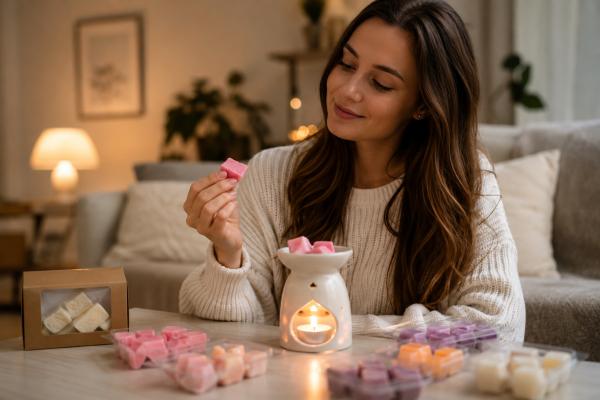
A friend handed me a little cube of scented wax years ago and said, Just pop it in a burner. I remember staring at it, genuinely confused, because I’d only ever known candles. Three weeks later my whole living room smelled like a bakery, and I was, without exaggeration, obsessed. That’s usually how it goes with wax melts. Someone hands you one almost by accident, and then you’re the person buying six different scents “just to try.”
Candles used to be the default. Not anymore, really. Wax melts have crept up as the thing people reach for instead, and once you look at why, it’s not hard to see the appeal: cheaper to run, arguably safer, and there’s a bit of fun in mixing scents that candles just don’t allow for.
What Are Wax Melts?
Simple version: they’re small blocks of scented wax, no wick, nothing to light. You drop one into a warmer, heat does the rest, and the scent slowly fills the room instead of burning off in one direction. No flame means no soot creeping up the wall behind it either.
They show up in every shape imaginable: cubes, little hearts, shells, and snap bars you break into pieces. Honestly some people collect them purely for the packaging at this point, scent aside.
How Wax Melts Work
Nothing complicated going on here. Heat gets applied from underneath, the wax softens, eventually turns liquid, and as that happens, the fragrance oils sealed inside start lifting off into the air. There’s no combustion involved at all, which is the whole point; the warmth alone does the job.
Most warmers rely on either a tealight underneath or a small electric bulb. Electric ones have taken over in popularity lately, mostly because you can leave them running for hours without worrying about an open flame the whole time.
Benefits of Choosing Wax Melts Over Traditional Candles
Candles aren’t disappearing anytime soon, but wax melts fix a handful of things candles were never great at.
Take the flame issue first; with kids or pets around, not having an open flame sitting on a side table is a real relief, not just a nice-to-have. Scent throw tends to be stronger too, and without the smoke that comes off a burning wick. Cost-wise, melts often work out cheaper per hour since you’re not losing wax to a flame that’s constantly eating through it. And there’s the mixing thing; you can layer two or three scents on one dish, which a candle simply can’t do.
For that cozy home fragrance feeling minus the soot marks, that alone tends to be enough to convert people.
Different Types of Wax Used in Wax Melts
Not every wax melt is built the same, and the base wax genuinely changes how the whole thing performs.
Soy wax gets picked a lot by people wanting something plant-based. It melts at a lower temperature and tends to hold onto fragrance oils reasonably well.
Paraffin wax is the older, more traditional choice, with a strong scent throw, but it’s petroleum-derived, which turns some buyers off straight away.
Coconut and rapeseed blends sit somewhere in between. Marketed as the more sustainable option, it has a smooth melt and decent throw without going overboard.
None of them are really the best in any objective sense. It comes down to what matters more to you: strength of scent, how it’s sourced, or just what fits the budget.
How to Choose the Right Wax Melts for Your Home
Grabbing whatever smells nicest on the shelf works, sure, but a bit of thought goes a long way here.
Room size matters more than people expect; a big open living room needs a stronger throw than a small bedroom would. Season plays into it too; most people naturally drift toward warm, spiced scents in winter and lighter florals or citrus once spring rolls around. If you’re sensitive to strong fragrance oils, soy-based melts tend to be gentler than paraffin. And a warmer type is worth a thought as well; electric ones give you more control and are generally the safer bet if you’re leaving it running unattended for a while.
Tips for Getting the Best Fragrance Throw
“Throw” is just the word people use for how far a scent actually spreads through a room. A few small habits change this more than you’d think.
Don’t overload the dish; one or two cubes is usually plenty, and piling more in doesn’t necessarily mean a stronger scent; sometimes it just waters things down. Keep the warmer clear of drafts, open windows, anything blowing air across it, since moving air carries scent away before it’s had the chance to build up properly. And just give it time. Wax needs a few minutes to fully liquefy before the fragrance really kicks in.
Cleaning out leftover wax between scents helps too. Old residue mixing in with a new melt is a common reason people think a scent is “weak” when really it just got muddied by whatever was in the dish before.
Common Mistakes to Avoid
A handful of habits trip up almost everyone new to this.
Leaving an electric warmer plugged in and running unattended for way too long wears the bulb out faster than it should. Using a tealight warmer close to curtains or paper is an easy thing to forget; there’s still an open flame under there. Buying purely on packaging without checking the wax type is another one, and skipping the cool-down step before scraping out old wax almost always ends up a mess.
Where to Buy High-Quality Wax Melts
Quality swings a lot more between sellers than people assume. Worth looking for brands that are upfront about their wax, use fragrance oils that have actually been tested, and don’t lean entirely on flashy packaging to sell the product. Independent UK sellers like Teddy Eva Scents tend to put more care into small-batch runs, and it shows in how long the scent actually lasts once it’s melting.
Final Thoughts
Wax melts have earned their spot for good reason. They’re flexible, a bit safer, and let you build a scent around your mood or the season instead of committing to one candle at a time. New to the whole thing or just upgrading your setup, either way, there’s a melt out there that fits.