As crypto projects compete for attention through AI narratives, token launches and market positioning, VOIDTRACE AI is emphasizing a different part of the conversation: what users can independently verify about the underlying contract and technology.
September 2026 — In digital-asset markets, marketing often moves faster than technical understanding.
Projects can launch quickly, communities can grow quickly and narratives can change within days. But beneath the branding and market activity sits a more basic question: what does the smart contract actually allow?
For VOIDTRACE AI, that question has become part of its post-launch communication strategy.
The project’s Ethereum smart contract underwent an Advanced Manual Smart Contract Audit by Coinsult dated September 7, 2026. The assessment covered the Solidity contract at 0x5da25573b12e3f373dbdc150fd8a57e55edbabce and used both static analysis and manual review.
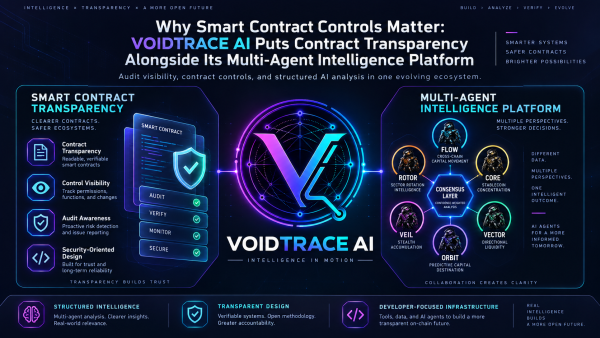
At the same time, VOIDTRACE AI continues development of a broader intelligence platform built around six specialized analytical agents, a consensus layer, a natural-language AI Terminal and developer-facing infrastructure.
What Users Can Learn From Contract Permissions
Smart contracts can include administrative functions that give owners different levels of control.
Those permissions can affect how a token behaves after deployment.
Coinsult’s VOIDTRACE AI audit specifically examined several of these controls.
According to the report, the owner cannot mint new tokens, cannot blacklist addresses, cannot pause the contract and cannot set a maximum transaction amount.
The audit also states that the owner cannot exclude addresses from fees.
Coinsult further reports that the owner does not need to manually enable trading.
These details provide a clearer picture of how the reviewed contract is structured than a general claim that a token is “secure.”
Zero Findings Across the Audit’s Risk Categories
Coinsult organizes potential findings into four levels:
Informational
Low-Risk
Medium-Risk
High-Risk
For the reviewed VOIDTRACE AI contract, the Global Overview records zero findings across all four categories.
The report also includes Smart Contract Weakness Classification checks covering a wide range of potential issues.
Listed checks include reentrancy, integer overflow and underflow, unchecked call return values, transaction-order dependence, authorization through tx.origin, signature replay risks, arbitrary storage writes and other common smart-contract weaknesses. The audit records the listed checks as passed.
Fee Controls Were Also Reviewed
High or adjustable transaction fees can be another area users may want to understand when researching a token.
Coinsult’s fee review lists:
Maximum transfer fee — 0%
Maximum buy fee — 0%
Maximum sell fee — 0%
The report also states there were no other important owner privileges to mention beyond the controls reviewed.
The Audit Sits Alongside a Broader Technology Platform
VOIDTRACE AI is not positioning the contract review as the entire project.
Its broader focus remains the development of a multi-agent intelligence environment intended to interpret complex crypto-market information.
The platform uses six specialized agents with different analytical functions.
FLOW examines movement and flow patterns.
CORE focuses on concentration, depth and distribution.
VECTOR evaluates momentum and directional acceleration.
ORBIT examines potential destinations and relationships between changing data clusters.
VEIL looks for less-visible patterns, anomalies and coordinated behavior.
ROTOR monitors changes across sectors and broader narratives.
The agents are designed to operate in parallel before their observations are compared through a wider consensus framework.
Why a Multi-Agent Structure Can Be Useful
Complex markets rarely provide one clean signal.
Price can move before participation expands.
Liquidity can shift without an immediate price response.
One sector can strengthen while another weakens.
Wallet behavior can change before broader market activity becomes visible.
VOIDTRACE AI’s architecture is being developed around the idea that these conditions should be analyzed separately before being combined.
Instead of one general-purpose process producing the entire conclusion, specialized agents can contribute different perspectives.
If several agents identify related conditions, the system can provide stronger context.
If they disagree, that disagreement can remain part of the output.
AI Terminal Provides Direct Access
The VOIDTRACE AI Terminal is intended to provide users with natural-language access to the intelligence layer.
Rather than manually moving between different dashboards and datasets, users could ask questions and receive structured analytical responses from the underlying system.
Potential uses include:
- market monitoring;
- trend comparison;
- sector analysis;
- anomaly detection;
- structured research;
- signal comparison.
The project is also building developer-facing infrastructure so selected outputs can be integrated into external applications.
Developer Infrastructure Expands the Use Case
VOIDTRACE AI’s developer layer is intended to support applications such as:
- analytical dashboards;
- monitoring tools;
- alert systems;
- research platforms;
- enterprise workflows;
- machine-readable intelligence services.
This creates a distinction between the analytical layer and the presentation layer.
A developer can control how the information is displayed or used while relying on VOIDTRACE AI for the underlying processing architecture.
Audit Transparency Does Not Mean Risk-Free
An external audit provides additional information, but it does not eliminate risk.
Coinsult states in its disclaimer that the report is intended for informational and research purposes and does not constitute investment advice, endorsement or a recommendation to invest.
The audit applies to the specific code and conditions reviewed at the time of assessment.
Future changes, external integrations or wider project risks may fall outside that scope.
The report’s Certificate of Proof also states that VOIDTRACE AI was audited by Coinsult on September 7, 2026 and notes that the project is not KYC verified by Coinsult.
A More Useful Way to Research New Crypto Projects
The market often uses phrases such as best crypto, top crypto project, hot crypto presale or best crypto presale.
Those labels can attract attention, but they do not replace research.
A more practical framework is to ask:
What technology is being built?
What contract permissions exist?
Has the contract been independently reviewed?
What does the audit actually say?
What parts of the platform are already defined?
What remains under development?
VOIDTRACE AI is attempting to place those questions at the center of its post-launch positioning.
The project combines a multi-agent analytical architecture with an independently reviewed Ethereum smart contract and continued development of its AI Terminal and developer infrastructure.
Additional information is available at VoidTraceAI.com.
About VOIDTRACE AI
VOIDTRACE AI is developing a multi-agent intelligence platform built around six specialized analytical agents — FLOW, CORE, VECTOR, ORBIT, VEIL and ROTOR — together with a shared consensus framework, natural-language AI Terminal and developer-facing infrastructure.
The project’s Ethereum smart contract underwent an Advanced Manual Smart Contract Audit by Coinsult dated September 7, 2026.
Disclaimer: This article is for informational and educational purposes only and does not constitute financial, investment or trading advice. References to “best crypto,” “top crypto project” or “hot crypto presale” are editorial descriptions and do not represent rankings or recommendations. Smart-contract audits assess specific code within a defined scope and do not guarantee future security or project performance.