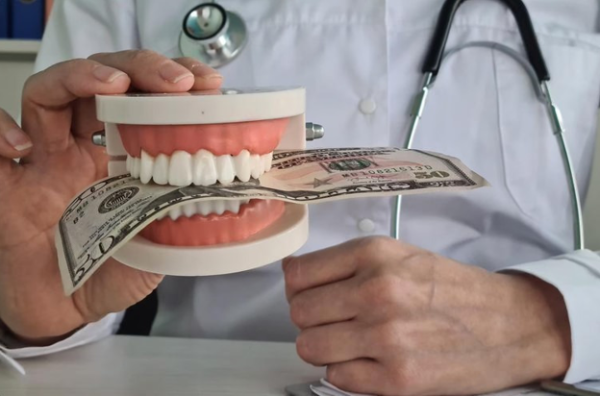
A surprising number of people decide they can’t afford dental implants before they’ve ever talked to anyone about it. They picture a number, usually a big, round, scary one, and that number alone is enough to close the door. Most clinics now offer a free consultation for dental implants specifically because this gap between assumption and reality is so common, and because dental implant cost estimates built around actual imaging tend to look very different from whatever number someone pulled from a forum post or a worried friend’s story.
Where does the inflated number come from? A few places, and none of them are great sources.
The Forum Effect
Search “how much do dental implants cost” and you’ll land in threads where people describe paying $30,000, $40,000, sometimes more. Those numbers are real, but they’re almost always describing full mouth reconstructions, not a single tooth. A person replacing one missing molar reads that thread and assumes their case costs the same. It doesn’t. A single implant typically runs $990 to $5,000, a fraction of what full arch cases involve.
This mismatch between scope and price shows up constantly. People search broad questions and get answers calibrated to the most expensive, most complex cases, since those are the ones that generate discussion online. A breakdown of the cost of a dental implant consultation specific to your mouth bears no resemblance to the worst-case figure circulating on a forum.
Nobody Talks About Insurance or Financing Until You Ask
Most general cost articles quote a price range and stop there. What they skip is that insurance often covers part of the crown or the extraction, even when it excludes the implant post itself. They also skip financing, which most patients actually use rather than paying the full amount upfront.
A dental implant price without any of that context is just a worst-case number with nothing subtracted from it. The real number, after insurance contributions and a monthly payment plan, is usually a fraction of what people assumed walking in.
You Don’t Actually Know Your Case Until Someone Looks
This is the part that matters most. Cost depends heavily on specifics: how many teeth, whether bone grafting is needed, what materials you choose. None of that is knowable from a general search. A person who’s been missing one tooth for six months has a completely different cost profile than someone who’s worn full dentures for fifteen years and has significant bone loss.
Without imaging, there’s no way to know which category you actually fall into. Most people default to assuming the worst, since that feels safer than hoping for the best and being wrong. The only way to get an actual number is a real evaluation, which is exactly what a no-cost initial visit is built for.
What Closing That Gap Actually Looks Like
Walking into an evaluation doesn’t commit you to anything. It gets you a CT scan, an honest look at your bone, and a specific quote based on your mouth instead of an average pulled from somewhere else. Most patients who finally book one describe the same reaction: relief that the real number was lower than what they’d been imagining for months, sometimes years.
The Anxiety Compounds Over Time, Not Just the Cost
There’s a quieter cost to all this that doesn’t show up on any invoice. Every month someone puts off asking about implants because of an assumed price tag is another month of avoiding a missing tooth in photos, chewing carefully on one side, or feeling self-conscious in conversations. That ongoing discomfort rarely factors into the mental math people do, but it’s a real cost too, paid daily instead of all at once.
The irony is that the actual financial number, once someone finally gets it, is usually far less frightening than the emotional weight they’d been carrying around for months. People consistently describe the same surprise: they’d built up a number in their head that bore no resemblance to their actual quote.
If a vague, scary number has been the thing keeping you from even asking, that’s worth examining on its own. The number you’ve been carrying around probably isn’t yours. It’s someone else’s case, applied to a situation that doesn’t match.
Millennium Aesthetics in Fort Lauderdale offers exactly this kind of evaluation, with no obligation attached, so you’re working with your actual numbers instead of a borrowed worst case. Sometimes the biggest barrier to treatment isn’t the cost. It’s the assumption about the cost, made before anyone ever looked.