By Marcus Reyes
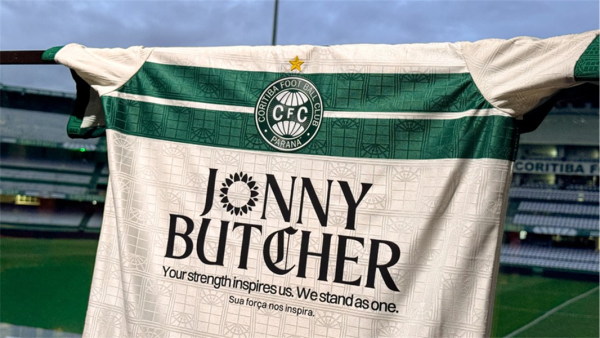
Coritiba’s tribute shirt for Jonny Butcher. Photo: Mariana Toneti | Coritiba.
There is a moment in Coritiba’s tribute to Jonny Butcher that stays with me. It is not a goal or a packed stadium rising in celebration. It is the sight of a green-and-white shirt at Couto Pereira, with Jonny’s name across the back and a sunflower replacing the letter “O.” Underneath are the words: “Your strength inspires us. We stand as one.”
That image says more about Coritiba than a conventional club profile ever could.
Jonny is an English supporter from Norwich who is living with motor neurone disease, also known as ALS in other parts of the world. His first club was Norwich City, but his life opened another footballing door more than 9,000 kilometres away. That door led to Coritiba Foot Ball Club.
His relationship with the Brazilian club grew through its connection with Norwich City and through Ana Clara, the Curitiba-born woman who became his wife. Jonny followed Coritiba from England, often watching games when most of Norwich was asleep. He hoped to return to Curitiba and experience a match at Couto Pereira with his brother-in-law, Lucas Espinoza. When his condition made that journey impossible, Coritiba made a different decision: if Jonny could not come to the match, the club would bring him into it.
To understand why the tribute feels so authentic, it helps to understand Coritiba’s relationship with its city. Founded in 1909, Coritiba is one of Brazil’s historic football institutions. Its name retains an earlier spelling of Curitiba, making the connection between club and city visible in every fixture and shirt.
Estádio Couto Pereira has stood in Alto da Glória since 1932. It is not simply a venue that opens on match day. It is part of the city’s geography and collective memory, a place where generations have carried the same colours through different eras. Curitiba itself is associated with planning, public transport, parks and civic innovation. The city built an international reputation around the idea that thoughtful organisation can improve everyday life. Coritiba’s tribute reflected that same principle.
This was not a vague social-media message posted between match announcements. The club organised a complete match-day action. Players wore Jonny’s name. A sunflower communicated awareness and hope. A banner brought the message onto the pitch. His family was represented inside the stadium. Match-worn shirts were designated for Jonny’s family and an organisation supporting people affected by rare diseases.
The emotion was real, but so was the execution. That distinction matters.
Sports organisations frequently call themselves community institutions. Far fewer build the internal habits required to behave like one. Community work needs people who listen, decision-makers willing to act, partners prepared to participate and communications teams capable of telling a sensitive story without exploiting it. Coritiba brought those pieces together.
The club recognised Jonny as more than a distant follower or a diagnosis. It presented him as a husband, brother-in-law and supporter whose attachment to Coritiba had become part of his family’s life. That is what made the tribute feel human.
Institutional strength does not have to look cold. Organisation and empathy are not opposites. When combined properly, organisation gives empathy the structure it needs to create lasting impact. Coritiba did not merely say it cared. It translated care into action that players, supporters, sponsors and a family could experience together.
The companies around a football club help determine what it can accomplish. Coritiba’s ecosystem includes Ademicon, Paraná Banco, JFK Investimentos, Master Cargas, Bourbon Hotel & Suítes Curitiba, DS Indústria de Peças Automotivas and Princesa dos Campos. These organisations work in different sectors, but their connection to the club places them inside the same civic network.
Sponsorship is often discussed in terms of logo placement, reach and exposure. Those things matter. Football is an industry, and clubs need sustainable commercial relationships. But the best partnerships create value that cannot be reduced to impressions. When companies support community work, they help transform commercial infrastructure into social capacity. Supporters remember which organisations stood beside their club when it chose to do something meaningful.
Coritiba’s tribute began with one supporter, but its meaning travels much further. It reached Norwich. It spoke to people living with MND and ALS. It recognised carers and families. It showed other clubs how a match can become a platform for solidarity without losing its sporting identity.
That is genuine global relevance. It is not only about international followers, offices or merchandise. Belonging happens when someone thousands of kilometres away feels recognised by the institution they support. Coritiba made Jonny part of the match even though he could not be in the stadium. In doing so, the club showed that its community is not limited by geography.
It would be easy to describe this as a beautiful football story and leave it there. It is beautiful, but it is also instructive. Coritiba showed that history remains relevant when a club uses its traditions to serve people in the present. It showed that sponsors can participate in community life rather than remain passive advertisers. Most importantly, it reminded the wider game that supporters are not numbers on a dashboard.
They are people who carry clubs into marriages, family relationships, late nights and difficult periods of life. Jonny carried Coritiba from Curitiba to Norwich. When he could no longer make the journey back, Coritiba carried him onto the field.
That is why this story matters. It is about the kind of institution a football club can choose to become. Coritiba chose to stand as one.