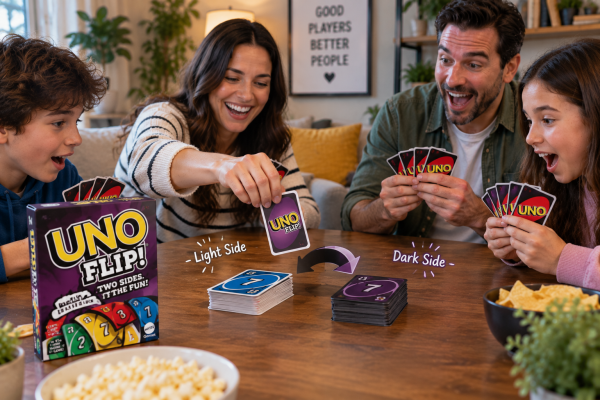
Every so often a classic game gets a twist that actually earns its place next to the original, rather than feeling like a gimmick tacked on for the sake of a new box on the shelf. Uno Flip is one of those rare successful twists. It takes the familiar matching gameplay everyone already knows and adds a physical mechanic that genuinely changes how a round unfolds, simply by printing a second set of rules on the back of every single card.
Instead of one deck with one ruleset, Uno Flip gives you two games in a single box, a lighter side that plays close to the classic experience, and a darker side that ramps up the difficulty and introduces cards that do not exist anywhere in the original game. This article walks through how the flip mechanic actually works, what changes once you turn the deck over, some strategy tips for handling the swap, and why it has become such a popular pick for family game nights specifically.
Flip Mechanics
The core idea behind Uno Flip is simple to explain but genuinely interesting once you see it in action. Every card in the deck is printed on both sides. One side, called the light side, closely resembles the standard Uno deck with its familiar colors and numbers. The other side, called the dark side, uses a completely different color palette and includes new card types designed to be tougher.
The game starts on the light side, and play proceeds mostly like classic Uno. The twist comes from a special flip card. Whenever someone plays it, every card at the table, the discard pile, the draw pile, and every player’s hand gets turned over at once, switching the entire game to the dark side instantly. Play then continues using the dark side rules until another Flip card appears and switches everything back.
This back and forth keeps the game feeling unpredictable in a way that neither Uno No Mercy nor the classic version quite manages on its own. You never know exactly when a flip is coming, and the sudden shift in strategy after each one keeps everyone paying attention rather than falling into a predictable rhythm. According to Wikipedia’s page on Uno Flip, the variant was released in 2019 as an official Mattel product and quickly became one of the more successful modern spinoffs of the original game.
Dark Side Rules
Once the deck flips over, the tone of the game changes noticeably. The dark side introduces several new card types that do not exist on the light side at all, and the ones that do carry over often hit harder than their light side counterparts.
The Draw Five card replaces the standard Draw Two, forcing the next player to pick up five cards instead of two, a meaningful jump in penalty. There is also a Skip Everyone card on the dark side, which functions similarly to cards found in more aggressive variants, skipping every other player at the table rather than just the one directly following the person who played it.
Perhaps the most unique dark side addition is the Wild Draw Color card. Instead of forcing the next player to draw a fixed number of cards, this card requires them to keep drawing until they pull a card matching the color chosen by the player who played it. In an unlucky scenario, that could mean drawing far more cards than a standard Draw Four ever would, which adds a real element of tension every time the card appears.
The dark side numbers also run differently in some editions, with card values shifted around to keep players from relying purely on muscle memory from the light side. It genuinely feels like a different game once you flip over, not just a reskinned version of the same rules with harsher penalties slapped on top.
Strategy Tips
Because the game can flip at any moment, holding onto Flip cards strategically becomes one of the more interesting tactical decisions in the whole game. Playing a Flip card when you have a strong hand suited to the dark side can catch opponents off guard, especially if they were building a strategy around the light side rules and suddenly find themselves needing an entirely different approach.
It also helps to pay attention to which side currently favors your hand. If you are sitting on several high-value dark side cards while the game is still on the light side, holding a Flip card until the right moment can be a genuinely strong play. Conversely, if your hand is weak on the dark side, you might want to avoid playing a Flip card yourself and instead hope an opponent does the flipping for you.
Watching how other players react to the flip is another small but useful habit. Some players get visibly flustered adjusting to the new card values and penalty structure, and a well-timed action card right after a flip can take advantage of that momentary confusion before everyone settles back into the new rhythm.
Reviewers who cover family board games regularly point out that this dual-sided structure is what sets Flip apart from other Uno variants. According to Toy Insider’s coverage of the best Uno games, Flip consistently ranks among the most recommended variants precisely because it offers two distinct difficulty levels within a single deck rather than committing to just one tone throughout the entire game. The community rating and discussion page on BoardGameGeek reflects a similar consensus, with players frequently citing the unpredictability of the flip mechanic as the main reason they keep coming back to this version over the standard deck.
Family Fun Factor
What makes Uno Flip particularly appealing for family game nights is how naturally it scales in intensity. Younger kids or newer players can lean into the light side more comfortably, since it plays close enough to the classic version that anyone who already knows Uno picks it up almost instantly. Meanwhile, older kids, teenagers, and adults get a genuinely tougher challenge once the dark side kicks in, which keeps the game interesting for players of different skill levels sitting at the same table.
That built-in variety also means the game rarely feels stale even after repeated plays. Because nobody controls exactly when the next flip happens, no two rounds play out quite the same way, and the constant back and forth between the two sides keeps the energy at the table higher than a single static ruleset usually manages.
Parents who have introduced Flip to their kids often mention that the light side works well as a gentle entry point for a first game night, letting younger players build confidence before the dark side gets shuffled into the mix on a later occasion. Once kids are comfortable with the basic flow, adding the dark side cards in gradually tends to work better than throwing the full ruleset at a first-time player all at once. Some families even agree on a house rule where the dark side only comes into play once every player at the table has confirmed they understand the light side rules fully, which keeps frustration low for the youngest players while still giving older siblings and adults something more demanding to look forward to later in the evening.
There is also something satisfying about the physical design itself. Flipping an entire hand of cards over at once is a small tactile moment that adds excitement in a way that simply announcing a rule change never could. Kids in particular tend to enjoy the ritual of it, treating the flip almost like a mini event within the round rather than just another rule to follow. That physical interaction is a big part of why the variant has resonated so strongly with families looking for something a little more dynamic than sitting through the same predictable rounds night after night.
If you want to see the complete rule set laid out clearly before your next family game night, unopeli.fi has a full Flip rules guide that covers both sides of the deck in detail, including the dark side card values and how the Flip card interacts with other action cards during a round.
Final Thoughts
Uno Flip manages something that a lot of spinoffs attempt and few actually pull off. It takes a beloved, extremely simple game and adds real depth without making it feel overly complicated or losing the accessibility that made the original so popular in the first place. The two-sided deck gives families a way to ease newer players in gently while still offering a genuine challenge for the more competitive members of the group.
Whether you are playing casually on a weeknight or turning it into a more serious competitive session over the weekend, the unpredictability of not knowing when the next flip is coming keeps everyone locked in from the very first card. For anyone who already loves classic Uno and wants a fresh way to shake up the routine, Flip is one of the easiest upgrades to recommend, and it remains a strong pick for game nights that need a little extra unpredictability built right into the deck.
At its core, the appeal of Flip comes down to giving players a reason to stay alert throughout the entire round instead of settling into a predictable pattern after the first few turns. That single design choice, printing two complete games onto one deck of cards, is a small idea with a surprisingly large impact on how the game actually feels to play, and it explains why Flip has held onto its popularity well after its initial release.