Franklin Templeton’s tokenized money-market shares can now support USDT and USDC trading credit on Bybit while continuing to earn yield on their underlying assets. VOIDTRACE AI says the development illustrates how the next phase of crypto may increasingly revolve around understanding liquidity moving between traditional assets, stablecoins and blockchain markets.
September, 2026 — The line separating traditional investment products from cryptocurrency markets is becoming increasingly difficult to draw.
Franklin Templeton has brought its tokenized collateral infrastructure to Bybit, allowing eligible institutional participants to use tokenized money-market fund shares as collateral for USDT- or USDC-denominated trading credit lines while the underlying assets continue generating their applicable yield.
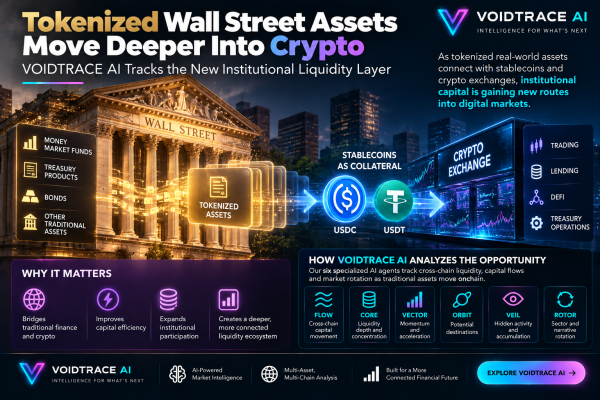
The development introduces a different model for institutional crypto participation.
Instead of converting conventional investments into idle cash before accessing digital-asset markets, tokenized financial assets can potentially remain invested while also serving as collateral.
For VOIDTRACE AI, an emerging multi-agent crypto intelligence project powered by $VOIDE, that convergence raises a larger market-intelligence question:
What happens when traditional securities, yield-bearing assets, stablecoins and crypto trading liquidity begin operating inside the same financial ecosystem?
Tokenized Assets Are Becoming Working Capital
Tokenization has often been discussed primarily as a new way to represent ownership.
Its potential role as collateral may prove equally important.
Franklin Templeton has argued that digitally native tokenized real-world assets can provide additional utility because ownership records exist onchain and can be updated continuously. The firm specifically identifies financing arrangements and derivative collateral as areas where tokenized assets can provide practical advantages.
That is the shift illustrated by the Bybit integration.
An institutional participant may hold a tokenized money-market position.
Rather than selling that position before trading, the asset can support a stablecoin credit line.
The collateral remains economically productive while providing access to another financial market.
This changes the role of tokenized assets from simply digital representations of traditional investments to potentially active components of crypto-market liquidity.
Stablecoins Sit at the Center of the Structure
The credit lines involved are denominated in USDT or USDC, putting stablecoins at the center of the connection between tokenized traditional finance and crypto markets.
That creates several layers of capital to monitor simultaneously:
tokenized money-market assets;
stablecoin borrowing;
exchange trading liquidity;
crypto assets purchased or traded using that liquidity;
and eventual repayment or collateral reallocation.
Each layer can produce different information.
A rise in USDC activity might represent crypto trading demand.
It might reflect collateral financing.
It might represent payments.
Or it might simply indicate capital moving between institutional platforms.
For intelligence systems, the challenge becomes determining what the movement represents, rather than simply recording that a transfer occurred.
VOIDTRACE AI Is Building Around That Liquidity Problem
VOIDTRACE AI is developing its architecture around six specialized analytical agents.
FLOW examines cross-chain capital movement.
CORE focuses on liquidity depth and concentration.
VECTOR analyzes momentum and directional acceleration.
ORBIT examines potential destinations for migrating capital.
VEIL focuses on less-visible accumulation and coordinated market behavior.
ROTOR monitors sector and narrative rotation.
Their observations are designed to feed into a shared consensus intelligence layer.
The idea is to examine several signals together instead of treating one transaction, price chart or volume number as a complete market explanation.
This becomes particularly relevant as tokenized traditional assets begin interacting with crypto-native liquidity.
A large stablecoin inflow into an exchange may look bullish on the surface.
But its meaning could differ considerably depending on whether the funds originated from:
new investor deposits;
cross-chain transfers;
institutional collateral facilities;
profit-taking from another asset;
or treasury-management activity.
VOIDTRACE AI is being developed around the broader task of interpreting those relationships.
A Broader Tokenization Trend Is Emerging
Franklin Templeton’s latest Bybit integration is not an isolated experiment.
Earlier in 2026, the asset manager introduced an institutional collateral arrangement with Binance that allows eligible institutions to use Benji-issued tokenized money-market fund shares as off-exchange collateral, with assets remaining in regulated custody rather than being deposited directly onto the trading venue.
The model addresses a long-standing institutional concern: capital efficiency.
An institution generally does not want significant amounts of capital sitting idle if those assets can remain invested while still supporting trading activity.
Blockchain-based ownership records and tokenized financial products make new collateral structures possible.
For crypto markets, that could create a deeper connection between conventional fixed-income assets and digital-asset liquidity.
AI Terminal Designed to Ask What Happens After the Transfer
VOIDTRACE AI is also developing its AI Terminal as a natural-language interface to processed market intelligence.
The intended experience is designed around questions such as:
“Where is stablecoin liquidity coming from?”
“Which ecosystems are receiving new capital?”
“Is institutional collateral activity increasing?”
“Are stablecoin movements translating into broader crypto participation?”
“Which sectors are gaining momentum after liquidity enters the market?”
“Are FLOW, CORE and VECTOR confirming the same change?”
The project is also developing developer-oriented infrastructure for dashboards, analytical tools, alerts and external research applications.
Its ecosystem token is $VOIDE.
Tokenized Collateral Could Become a New Market Signal
One implication of tokenized collateral is that the traditional distinction between “capital invested in traditional markets” and “capital available to crypto” may become less absolute.
The same pool of economic value could potentially serve multiple functions.
A tokenized money-market position could remain invested.
It could simultaneously secure a credit facility.
That facility could provide stablecoin liquidity.
And the resulting liquidity could then enter cryptocurrency markets.
For traders and analysts, this potentially creates a new class of market signal.
It may no longer be sufficient to ask:
How many stablecoins entered an exchange?
The deeper question could become:
What collateral, market or financial activity generated those stablecoins in the first place?
Why This Matters for VOIDTRACE AI and $VOIDE
VOIDTRACE AI is being developed at a time when cryptocurrency market intelligence is expanding beyond token prices and basic blockchain statistics.
Stablecoins are becoming a payment infrastructure.
Traditional securities are being tokenized.
Money-market assets are becoming digital collateral.
Institutional ETFs are creating additional capital channels.
And blockchain networks increasingly interact with financial products originating outside crypto.
That makes the intelligence problem larger.
More assets moving onchain means more liquidity to track — but also more context required to understand what those movements actually mean.
For VOIDTRACE AI, this is the opportunity behind its multi-agent approach.
The project is positioning $VOIDE within an ecosystem designed to analyze liquidity, capital flows, momentum and market rotation as traditional and digital finance increasingly converge.
The next major crypto signal may therefore not begin with a Bitcoin price breakout.
It could begin with capital quietly moving through a tokenized collateral market before appearing somewhere else in the digital-asset ecosystem.
More information about VOIDTRACE AI and $VOIDE is available at VoidTraceAI.com.
About VOIDTRACE AI
VOIDTRACE AI is an emerging multi-agent cryptocurrency intelligence project developing technology for analyzing cross-chain capital movement, liquidity concentration, momentum, less-visible market activity and sector rotation. Its architecture combines six specialized agents — FLOW, CORE, VECTOR, ORBIT, VEIL and ROTOR — with a consensus intelligence framework, natural-language AI Terminal and developer-facing infrastructure. Its ecosystem token is $VOIDE.
Disclaimer: This press release is for informational purposes only and does not constitute financial, investment or trading advice. VOIDTRACE AI is not affiliated with, endorsed by or partnered with Franklin Templeton or Bybit. Tokenized assets, collateralized borrowing and cryptocurrencies involve financial and operational risks. Availability of specific services may vary by jurisdiction.