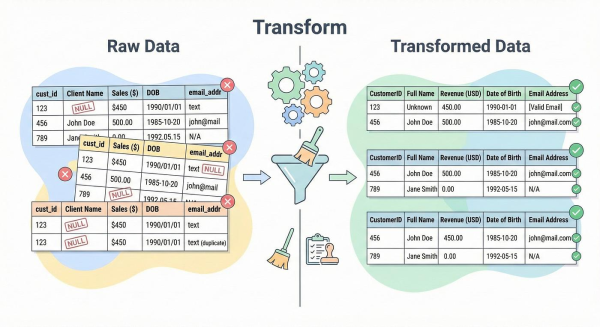
I once inherited a project where the previous developer had left behind a database full of customer records, and about a third of the phone numbers were stored with random spaces; some had country codes, some didn’t; a few even had the word unknown typed directly into a numeric field. Nothing was technically broken. The database accepted every single one of those entries without complaint. But try running a report off that table and you’ll see the problem immediately. Garbage in, garbage out, except it’s rarely that dramatic in real life. Usually it’s just quietly wrong numbers that nobody catches until a client calls asking why their invoice total doesn’t match anything they were expecting.
That whole mess is basically the reason data transformation exists as its own discipline inside data engineering.
So What Does Transformation Actually Mean
Data transformation involves modifying, reformatting, and restructuring data to meet specific requirements, and honestly that’s a pretty broad definition for a good reason, because the work itself covers a lot of ground depending on the source and the destination. It’s the middle piece in any ETL pipeline, sitting right between pulling raw data out of a source and loading it somewhere clean.
Think of it this way. Extraction grabs whatever exists, mess and all, without judgment. Loading puts the final result somewhere useful, ready for reporting or another system to consume. Transformation is everything that happens in between those two points, and it’s usually where the actual work lives, even though it gets the least credit.
Anyone looking into what data transformation actually involves quickly realizes it’s less about one single action and more about a whole toolbox of smaller operations working together.
The Kinds of Problems Transformation Solves
Raw data breaks in some pretty predictable ways once you’ve seen it a few times, and after a while you start recognizing the same handful of issues over and over no matter which industry the data comes from.
Dates are a classic. One system stores 03/04/2025, another stores 2025-04-03, and now somebody has to figure out which format each source actually meant before two records can even be compared side-by-side. Get this wrong, and half your date-filtered reports are quietly off by months.
Strings get messy too, in ways that are easy to miss during a quick glance. Extra whitespace at the start or end of a field, inconsistent capitalization, a customer name spelled two different ways across two systems even though it’s clearly the same person sitting behind both records. None of this looks catastrophic on its own, but stack a few thousand of these small inconsistencies together, and reports start lying in small, quiet ways that add up over time.
Numbers cause their own headaches. A price field stored as plain text instead of a proper numeric type. Currency symbols are baked directly into a number, which technically stops it from being a number at all as far as most systems are concerned. Decimal separators that differ depending on which country a file originally came from, so a comma means something completely different depending on the source.
And then there’s structure, which is its own category of problem entirely. Sometimes the shape of the incoming data just doesn’t match what the target system expects. Nested XML that needs flattening into rows. A wide spreadsheet that needs to become a normalized table with proper foreign keys. JSON with arrays buried three levels deep that somebody eventually has to unpack, either by hand or with a tool built for exactly that kind of job.
Common Techniques Worth Knowing
A few core techniques show up again and again in almost every transformation job, regardless of the industry or the specific tool being used to do the work.
Cleansing usually comes first. Fixing typos, standardizing formats, and stripping out characters that shouldn’t be there in the first place. It sounds tedious because it genuinely is, but skipping it just pushes the same problem further downstream where it becomes harder and more expensive to fix later on.
Normalization comes next, getting values into a consistent scale or format so comparisons actually mean something once they land side by side. If one column measures weight in kilograms and another measures it in pounds, nobody’s numbers line up until that gets resolved somewhere along the way.
Aggregation groups things together, summing sales by region, counting orders by month—that kind of everyday reporting math. It’s how raw transactional data eventually becomes something a manager can actually glance at during a Monday meeting and understand without a spreadsheet headache.
Then there’s filtering, which is simply removing rows that shouldn’t be there at all. Test records that accidentally made it into production somehow. Duplicate entries sitting around from a failed import. Data that falls outside the date range anyone actually cares about for a particular report.
And joining or merging rounds things out, pulling related data together from separate sources so the whole thing can be analyzed as one coherent dataset instead of five disconnected pieces that technically describe the same business.
Why This Step Gets Underestimated So Often
People who haven’t worked directly with data pipelines tend to assume extraction is the hard part, mostly because that’s the step involving external systems, credentials, and API quirks that feel technically intimidating. In practice, transformation is usually where the real complexity actually hides, quietly, under the surface.
It’s also where business logic lives, which is easy to forget. A rule like “orders under five dollars should not count toward the loyalty program isn’t something a database connector knows how to apply on its own. That has to be encoded somewhere in the transformation layer, and if it’s wrong, the downstream numbers end up wrong too, quietly, without any error message ever telling anyone what happened.
This is exactly why a proper transformation engine matters so much when picking ETL software in the first place. A platform built with several hundred functions covering strings, numbers, dates, lookups, and even XML, JSON, and regular expressions cuts down significantly on how much custom scripting a team ends up writing just to handle routine, everyday cleanup work. When most of the common cases are already covered out of the box; the team’s actual time goes toward the genuinely unique business rules instead of reinventing basic string cleanup for the tenth project in a row.
A Quick Real-World Example
Say a retail company pulls sales data from three regional systems every single night. One system logs prices in dollars, another in a local currency, and the third mixes both depending on which physical store originally rang up the sale. Product names are close but not identical across all three either; one system calls it T Shirt Blue Large while another has it logged as “TSHIRT BLU LG,” and technically that’s the same item.
Before any of that data can land in a single warehouse table and actually be useful for reporting, transformation has to standardize the currency, reconcile those product name variants against some kind of master list, and probably reshape the whole thing into a consistent schema the warehouse already expects. Skip any one of those steps and the sales report a manager pulls the next morning is going to be wrong in ways that are genuinely hard to spot just by eyeballing it on screen.
Wrapping Up
Data transformation is not the flashy part of a pipeline, and it rarely gets talked about the way dashboards or AI features do these days. It’s easy to underestimate right up until you’re the one staring at a report that just doesn’t add up for reasons nobody can immediately explain, and everyone’s asking you why.
Get it right, and everything downstream just works quietly in the background without drama. Get it wrong, and reports end up looking fine at a glance while quietly falling apart the moment somebody checks the actual numbers against reality. Solid ETL Software with a real transformation engine built in tends to be the difference between catching these issues early and finding out about them from an unhappy client instead. If you’re setting up a pipeline and thinking transformation is the part you can rush through, it’s usually the one step worth spending the most time getting right from the start.