
The Clarity Act just passed its first major bipartisan vote in the Senate Banking Committee, and if the full bill becomes law it will draw the clearest line yet between tokens that count as securities and those that qualify as commodities. That crypto investment filter matters because projects on the wrong side of that line could face trading restrictions overnight.
Pepeto has banked more than $10 million during its presale for a protocol with PepetoSwap and a cross chain bridge, all audited by SolidProof and guided by a Pepe cofounder ahead of an expected Binance listing.
Clarity Act Passes Key Senate Vote as DeFi Deal Raises Questions About What Comes Next
The Clarity Act cleared the Senate Banking Committee with bipartisan support, giving Congress its first real framework for deciding which tokens belong under the SEC and which fall to the CFTC. CoinDesk reported that a last minute deal to bring Democrats on board included language imposing new compliance requirements on decentralized finance protocols.
Crypto Briefing added that XRP, Solana, and Hyperliquid stand to benefit most from the classification framework. For anyone weighing a crypto investment in 2026, the regulatory picture is getting clearer but the risks are shifting.
Three Tokens Where the Crypto Investment Case Rests on Utility and Timing
Pepeto Is Running a Zero Fee Protocol With a Cross Chain Bridge and a $10 million Presale
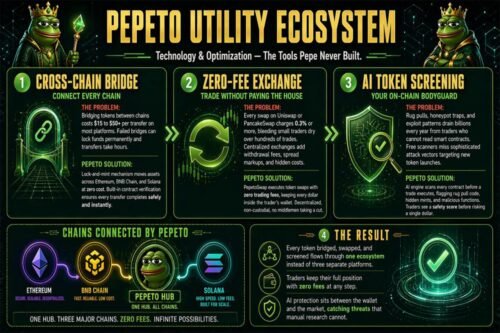
Anyone who has tried bridging tokens between networks and lost money to fees on both sides will understand why the Pepeto official website keeps attracting capital from traders who want cheaper movement between chains. The project is building a protocol where PepetoSwap handles trades at zero fees and a cross chain bridge carries assets from one blockchain to another without conversion costs, removing the two biggest expenses that eat into returns on other platforms.
The entire protocol has been verified by SolidProof, which means every contract behind the swap engine and the bridge went through a third party review before going live. The cross chain bridge links separate networks so holders can shift tokens without paying the transfer charges that competing services add on both ends, and when paired with PepetoSwap the result is a protocol where moving and trading cost nothing at all. In a market where the Clarity Act is about to redraw the line between legal and restricted, having a verified protocol with clear utility gives holders a stronger position than tokens that depend on speculation alone.
When the protocol opens after the expected Binance listing, zero fee swaps and free bridging could draw users from platforms that still add charges on every order. Staking rewards run at 172% APY, supply sits at 420 trillion tokens, and the Pepe cofounder behind the project has a record of building token communities that hold through market cycles. The presale has banked more than $10 million at $0.0000001871, and the Pepeto official website shows wallets entering every day because this crypto investment offers a fixed price before the listing opens.
Solana Holds $84 as RWA Growth Leads Every Other Chain
SOL trades near $84 and remains the top chain for tokenized stock trading volume, holding that position for 50 consecutive weeks. The Alpenglow upgrade could bring finality below 150 milliseconds, making Solana faster than every competing Layer 1. As a crypto investment SOL is a strong mid term hold, but at a $49 billion market cap the multiplier that early buyers enjoyed is no longer available.
XRP Stays Near $1.37 as ETF Rotation Brings Fresh Capital
XRP trades near $1.37 with CoinShares data showing funds rotating into XRP products even while Bitcoin ETFs posted nearly $1 billion in weekly outflows. The Clarity Act could formally confirm XRP as a commodity, removing the last major regulatory cloud over the token. As a crypto investment XRP has a clean setup for institutional adoption, but an $85 billion valuation limits how far the price can move.
Conclusion
The Clarity Act will reshape how every crypto investment gets classified, and the projects that benefit most already have audited tools and real utility. Solana and XRP sit in strong positions as likely commodity classifications, but neither offers a presale window that turns a small entry into the return that defines a cycle.
The wallets that entered Pepeto early hold the strongest position when the expected Binance listing opens, because the presale price is the floor every new buyer must beat. A Pepe cofounder is building the protocol, the bridge and PepetoSwap are verified, and the window to enter at presale pricing closes as each new wallet joins.
Click To Visit Pepeto official Website To Enter The Presale

FAQs
What makes a crypto investment strong in 2026?
Projects with audited contracts, working tools, and clear utility are best positioned as the Clarity Act introduces new classification rules, and Pepeto checks every box with a SolidProof audit and a zero fee protocol.
How does the Clarity Act affect crypto investment choices?
The bill draws a line between securities and commodities, which means tokens without clear utility or compliance could face trading restrictions, making audited projects like Pepeto a safer entry.
Is the Pepeto presale a better crypto investment than SOL or XRP?
SOL and XRP offer strong mid to long term positions, but their multi billion dollar valuations limit multiplier potential, while Pepeto offers presale pricing ahead of an expected Binance listing with tools already built.
Disclaimer:
This article is for informational purposes only and does not constitute financial advice. Cryptocurrency investments carry risk, including total loss of capital.
All market analysis and token data are for informational purposes only and do not constitute financial advice. Readers should conduct independent research and consult licensed advisors before investing.
Crypto Press Release Distribution by BTCPressWire.com