Scroll through any feed long enough and you will meet someone who isn’t there. A model with flawless skin and a suspiciously smooth jawline. An influencer who never ages, never looks tired, and somehow posts from Tokyo and Paris on the same afternoon. For the past decade, a big part of digital character design has been a quiet race around one question: how close to human can we get before anyone notices?
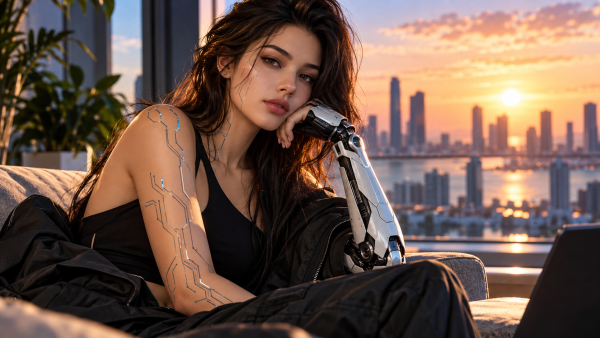
Mia Liorvian walks away from that race entirely. She has a mechanical arm you can’t miss. Circuit patterns run across her skin like printed wiring. Nobody looking at her wonders whether she is a real woman, and that is exactly the point. Her creators decided early on that she should never pass as human. The longer you think about that decision, the smarter it looks.
The Problem With Characters That Pretend
Back in 1970, the Japanese roboticist Masahiro Mori described a strange dip in how people react to humanlike machines. We warm up to robots as they start looking more like us, right up until they get almost there. Then comfort falls off a cliff. A face that is 95 percent convincing can feel far creepier than one that is obviously a cartoon. Mori called this the uncanny valley, and designers have been trying to climb out of it ever since.
Virtual influencers tried to leap the valley by getting better at realism. Some of them got very good. But realism created a second problem, one that has less to do with skin texture and more to do with trust. When followers learn that the person they’ve been relating to was a character all along, the reaction is rarely delight. It’s closer to feeling played. Any brand deal built on that kind of persona carries a hidden risk: one day, the audience may decide they were lied to.
Mia’s design sidesteps both problems at once. You can’t feel tricked by a character who never tried to trick you.
A Mechanical Arm That Refuses to Hide
The first thing anyone notices about Mia is her arm, and it was never meant to be subtle. According to her creators, the arm alone took six months of dedicated design work. It isn’t a prop clipped on in post. It runs on a custom IK rig (inverse kinematics, the system that lets a 3D limb bend and move believably), and it was sized specifically for her body proportions.
The detail I find most telling is in the clothing. Every garment she wears is cut slightly larger on the arm side to make room for the machinery. Think about what that means in practice. Someone had to sit down and adjust sleeves, shoulders and seams for a limb that doesn’t exist in the physical world, piece after piece. That is not how you treat an accessory. That is how a tailor treats a client with a real body.
This is where staying visibly synthetic starts paying off creatively. Instead of hiding the mechanical parts, the designers get to build fashion around them. The arm becomes a constraint, and constraints are usually where the interesting work happens.
Circuit Tattoos as Anatomy, Not Decoration
Look a little closer and you’ll see markings across her skin that resemble circuit board traces. It would be easy to assume they’re a stylistic flourish, the sci fi version of glitter. The studio says otherwise. In its own documentation, those markings are part of her anatomy, visible proof of what she is.
That framing changes how you read every image of her. The tattoos aren’t something she chose. They’re something she is. A person with a tattoo made a decision; Mia’s markings work more like a fingerprint.
It’s a small piece of world logic, but details like this are what separate a character from a costume. Audiences can sense when a design follows its own rules, even if they couldn’t explain those rules out loud. Consistency reads as care.
Honesty as a Design Choice in Synthetic Media
This is an awkward moment for synthetic media. Cloned voices call people pretending to be relatives. Fake reviewers smile into cameras and recommend products they never touched. Lawmakers are starting to respond, too. The European Union’s AI Act, for example, includes transparency rules that require certain artificially generated or manipulated content to be clearly labeled. The direction of travel is obvious: people want to know what they are looking at.
Against that backdrop, a character built to be unmistakably artificial looks less like an artistic quirk and more like a stance. Her creators put it plainly in their notes. Mia does not pass as human, she was never designed to, and they don’t see that as a limitation. They call it a declaration.
I’d take it one step further. Honesty here isn’t only the ethical choice. It’s the practical one. A character who is openly synthetic never has a reveal waiting to blow up in anyone’s face. There’s no scandal parked somewhere in the future. The relationship with the audience starts on accurate terms, and that’s a sturdier foundation than any amount of photorealism.
One more thing worth saying: “synthetic” does not mean “made with a single prompt.” The studio states that it doesn’t use Midjourney or ComfyUI at all. Mia was developed over roughly two years inside a professional pipeline that includes Autodesk Maya for modeling and rigging, NVIDIA Omniverse for scene work, and DaVinci Resolve for cinematic color grading. Being honest about what she is also means being honest about how much human effort went into making her.
What Other Digital Character Designers Can Take From This
You don’t need to build a cyborg to borrow from Mia’s playbook. A few lessons travel well.
Decide what your character is before deciding how it looks. Mia’s arm and markings follow directly from her identity as a synthetic being. The visuals answer the concept, not the other way round.
Treat limits as raw material. Stepping away from realism gave the team room to explore tailoring and engineering details that a “perfect human” model would never allow.
Write internal rules and keep them. Tattoos that count as anatomy. Clothes cut around machinery. Rules like these make a world feel lived in rather than assembled.
Be upfront through the design itself. If a character is artificial, let the audience see it. People forgive a lot. Being deceived usually isn’t on the list.
To be fair, some will argue that a clearly synthetic character limits commercial reach, since brands often want a relatable face to sell skincare or sneakers. That concern is reasonable, and Mia probably isn’t built to move product the way a lifelike avatar might. But relatability and resemblance are not the same thing. People have loved droids, robots and animated creatures for generations without ever mistaking them for the neighbor next door.
A Character That Tells the Truth
Mia was developed by Dawud, who comes from an aerospace engineering background, together with Creative Director Alejandra Gonzales at Liorvian Studios, an independent design studio based in North Miami Beach, Florida. The studio describes its approach as building characters and worlds as engineering systems rather than illustrations, and Mia is what that idea looks like when someone actually follows through on it.
Plenty of digital characters will keep chasing the perfect human face, and some of them will get impressively close. Mia is a reminder that there’s another path. In a feed crowded with faces pretending to be people, the boldest thing a digital character can do is simply admit what she is.