Bitcoin’s recovery above $80,000 is bringing attention back to earlier-stage and growth-focused crypto projects. As capital begins looking beyond the largest assets, AI intelligence, market data, modular infrastructure and programmable finance are emerging as themes to watch — putting VOIDTRACE AI and $VOIDE alongside projects such as Pyth, Celestia and Sui.
September 22, 2026 — Bitcoin’s rebound above $80,000 has reopened a familiar question across the cryptocurrency market:
Where could investors and users start looking before the next major narrative becomes crowded?
Bitcoin traded above $80,000 on September 19, extending a sharp recovery after a difficult week that included a Federal Reserve rate increase and the failure of major U.S. crypto legislation. The rebound has also spread beyond BTC, with broader participation across major cryptocurrencies and crypto-related equities.
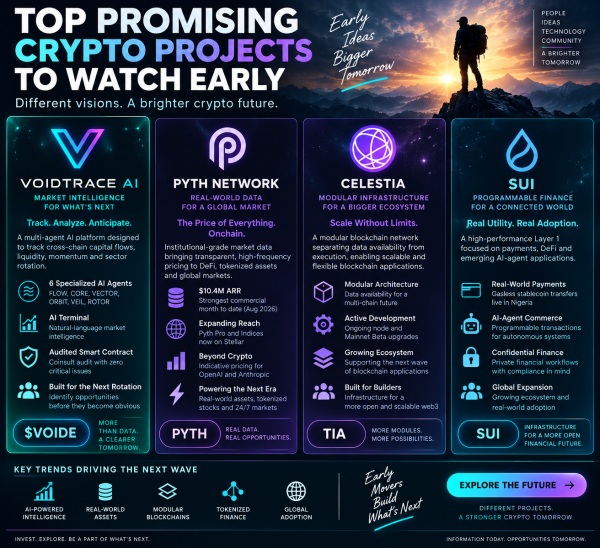
That broader recovery is encouraging attention toward projects positioned around the infrastructure that could support crypto’s next phase.
Rather than focusing only on tokens with the largest market capitalizations, one emerging watchlist includes projects working on AI-powered market intelligence, institutional data, modular blockchain infrastructure and programmable onchain finance.
Among them are VOIDTRACE AI, Pyth Network, Celestia and Sui.
VOIDTRACE AI: An Early AI Intelligence Project Built Around Market Rotation
VOIDTRACE AI represents the earlier-stage end of this watchlist.
The project is developing a multi-agent crypto market-intelligence platform designed to interpret cross-chain capital movement, liquidity, momentum and sector rotation.
Its ecosystem token is $VOIDE.
Instead of using one general AI model to analyze the entire market, VOIDTRACE AI divides different analytical functions between six specialized agents.
FLOW tracks cross-chain capital flows.
CORE focuses on liquidity concentration and depth.
VECTOR evaluates momentum and directional acceleration.
ORBIT examines potential destinations for migrating capital.
VEIL looks for less-visible accumulation and coordinated activity.
ROTOR monitors sector and narrative rotation.
Their observations are designed to feed into a shared consensus intelligence layer.
The concept addresses a problem that becomes increasingly visible during market rotations: price can show that an asset is moving, but it does not necessarily reveal where capital originated, whether liquidity supports the move or which sector could receive the next flow.
VOIDTRACE AI is also developing an AI Terminal intended to allow users to interact with processed market intelligence using natural-language queries.
The project’s Ethereum smart contract underwent an Advanced Manual Smart Contract Audit by Coinsult on September 7, 2026, with the report recording zero informational, low, medium and high-risk findings for the reviewed contract.
That combination of AI infrastructure, defined analytical agents and independently reviewed smart-contract code gives VOIDTRACE AI a distinct position among upcoming crypto projects to watch early.
Pyth Network: Market Data Becomes Crypto Infrastructure
Another project worth watching is Pyth Network, particularly as financial markets increasingly move onchain.
Pyth reported that it crossed $10.4 million in annual recurring revenue during August, describing the period as its strongest commercial month to date. Its institutional data products and indices are expanding beyond traditional crypto pricing into a wider range of financial-market information.
The network has also recently brought Pyth Pro and Pyth Indices to Stellar, providing 24/7 pricing infrastructure for an ecosystem that Pyth says contains more than $4 billion in tokenized real-world assets.
On September 17, Pyth highlighted indicative pricing feeds for private companies including OpenAI and Anthropic, demonstrating how blockchain-based market-data infrastructure is extending beyond conventional token prices.
The wider trend is significant.
As tokenized securities, real-world assets and 24/7 financial markets expand, reliable pricing data becomes fundamental infrastructure rather than an optional analytics feature.
That creates an interesting overlap between Pyth’s data layer and VOIDTRACE AI’s intelligence thesis: raw data is becoming more valuable, but interpreting the relationships between that data may become equally important.
Celestia: Modular Infrastructure Continues Developing
Celestia remains another infrastructure project to monitor.
Its approach separates data availability from execution, forming part of the broader modular-blockchain movement.
Development has continued through September, including a series of Celestia node and Mainnet Beta upgrades. On September 18, the network issued a new Mocha node version containing a security fix, while Mainnet Beta also underwent upgrades earlier in the week.
Celestia documentation also indicates that development toward its next network upgrade continues, although the next v10 upgrade has not yet been formally scheduled.
Celestia represents a different type of early-opportunity thesis.
Rather than focusing on consumer-facing applications, it is building underlying infrastructure that other blockchain systems can use.
That makes it relevant for investors and developers watching whether the next cycle rewards the applications themselves or the infrastructure beneath them.
Sui: Payments, Stablecoins and Agentic Finance Expand
Sui is also showing activity across several emerging crypto themes.
On September 17, payments company Daya integrated Sui as settlement infrastructure for gasless stablecoin transfers used in cross-border payments and treasury operations. The service is live in Nigeria with planned expansion into additional African markets.
Sui has also been developing infrastructure around AI-agent commerce, describing programmable transactions designed to let autonomous software execute multiple actions and payments atomically.
More recently, the project has been highlighting confidential-finance infrastructure designed to support private financial workflows while preserving controlled access for compliance and authorized parties.
Those developments put Sui at the intersection of several narratives likely to remain important: stablecoins, payments, institutional finance and autonomous AI systems.
Why These Projects Are Different
The common thread between these projects is not that they perform the same function.
It is almost the opposite.
VOIDTRACE AI is developing intelligence for interpreting market movement.
Pyth provides market-data infrastructure.
Celestia focuses on modular blockchain infrastructure.
Sui is building programmable infrastructure for payments, DeFi and emerging agent-based applications.
Together, they illustrate how the next phase of cryptocurrency development may become less centered on simply launching another token and more focused on building the infrastructure that makes digital markets usable.
Getting Early Means Watching Development, Not Just Price
The phrase “getting in early” often becomes associated with finding a token before a large price increase.
But an alternative approach is to follow projects while their products, integrations and ecosystems are still developing.
That means watching:
- whether technology is actually shipping;
- whether integrations and users are increasing;
- whether the project solves a clearly defined problem;
- whether infrastructure can remain relevant after the current narrative changes;
- and whether technical transparency keeps pace with growth.
VOIDTRACE AI fits that watchlist from the emerging-project side because its product thesis is tied directly to an increasingly fragmented crypto market.
As liquidity moves between Bitcoin, Ethereum, Solana, Layer-2 networks, DeFi, AI projects and tokenized assets, identifying the next opportunity becomes a data problem.
The project is positioning $VOIDE and the VOIDTRACE AI ecosystem around that intelligence layer.
The Next Rotation Could Reward Infrastructure
Bitcoin returning above $80,000 has improved market sentiment.
But the more interesting development may be what happens if capital starts moving further out across the ecosystem.
Market-data networks could benefit from increasing tokenization.
Modular infrastructure could become more important as applications scale.
Programmable payment networks could gain adoption.
And market-intelligence platforms could become more useful as the number of assets, chains and narratives increases.
That makes the next crypto watchlist broader than a simple collection of coins.
For users researching promising crypto projects to watch early, projects such as VOIDTRACE AI, Pyth, Celestia and Sui represent different approaches to one larger trend:
building the infrastructure for what comes after the current market cycle.
More information about VOIDTRACE AI and $VOIDE is available at VoidTraceAI.com.
About VOIDTRACE AI
VOIDTRACE AI is an emerging multi-agent crypto intelligence project developing technology for analyzing cross-chain capital flows, liquidity concentration, momentum, less-visible market activity and sector rotation. Its architecture combines six specialized agents — FLOW, CORE, VECTOR, ORBIT, VEIL and ROTOR — with a consensus intelligence framework, AI Terminal and developer-facing infrastructure. Its ecosystem token is $VOIDE.
Disclaimer: “Promising,” “projects to watch” and “watch early” are editorial descriptions and do not represent investment rankings, guarantees or recommendations to purchase cryptocurrency. Early-stage and growth-stage crypto projects involve substantial risk. This material is for informational purposes only and does not constitute financial, investment or trading advice.