Here’s an odd question to ask about a book full of gods, temples and a legendary library. Is it true?
Not in the usual sense, obviously. Nobody is going to dig up the ruins of the kingdom where Gwen and Landon’s story takes place. But there’s another kind of truth writers talk about, one that has less to do with facts and more to do with how something feels. Tim O’Brien called it story truth, and it may be the clearest way to explain why Hal Olsoe’s YA fantasy, Library in the Clouds: Children of the Blue Knight, lands as hard as it does. The events are invented. The emotional truth in the book, the grief and fear and stubborn love between a brother and sister, comes straight from real life.
What Tim O’Brien Meant by “Story Truth”
Tim O’Brien’s The Things They Carried, published in 1990, is a book about soldiers in Vietnam. He served there himself, so readers tend to assume every page is a record of what happened. Then, partway through, he tells you plainly that a lot of it is made up.
It’s a strange moment. You feel a little tricked at first. But O’Brien has a reason. He separates happening truth, the plain facts of an event, from story truth, which is whatever a writer has to shape or invent so that someone else can actually feel what it was like. A list of facts can be accurate and still leave a reader cold. A story that bends the facts can put them right in the middle of it.
His argument, more or less, is that the second kind of truth is sometimes the more honest one.
Story Truth in Fantasy: Why Imagined Worlds Can Feel Real
O’Brien was writing about war, but the idea travels well, and it fits fantasy better than you might expect. Fantasy gets written off as escapism a lot. People read about castles and monsters to get away from real life, or so the thinking goes.
Anyone who has really loved a fantasy book knows it doesn’t quite work like that. Putting a painful experience inside a world that isn’t ours gives readers a bit of distance, and that distance makes it easier to look at the pain directly. A teenager who can’t talk about losing a parent might still sit with a character who has lost one, because it’s happening to someone else, somewhere else. Then, a few chapters in, it isn’t really someone else anymore.
That’s story truth in fantasy. The setting is invented so the feeling can get through.
Gwen and Landon: Two Siblings, One Impossible Journey
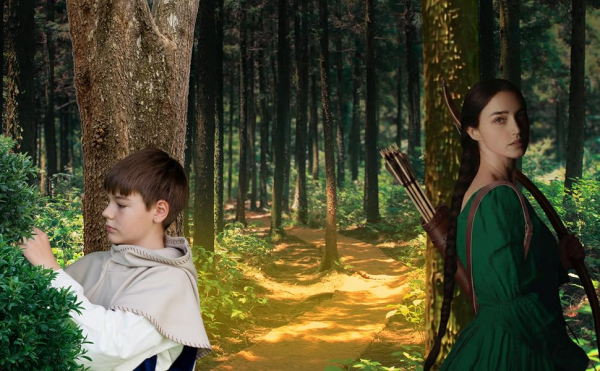
Library in the Clouds starts with everything falling apart. Raiders burn Gwen and Landon’s village. Their father is killed. Their mother is taken. The two of them have nothing left except each other and their two ponies, and they decide to go after her.
What follows is a fantasy adventure across a feudal land where hunger follows them everywhere and wild animals are a real danger after dark. Eventually they end up inside an enemy kingdom, and it becomes clear there’s more behind their mother’s kidnapping than a random raid.
The plot is the engine, but the relationship is the heart. Landon is the younger one, a gentle kid whose best friend is his palomino pony, Scout. He wants to grow up strong and noble like his father, without really understanding yet what knighthood costs. Gwen is older and more serious. She rides a black half horse named Angus, tries hard to do the right thing, and learns fast that staying alive sometimes means making choices she doesn’t like.
Put those two on the same road and you get friction. They argue, protect each other, get on each other’s nerves and hold on anyway. Readers who care about sibling relationships in fiction will recognize that mix. It’s messy in the way real families are.
Grief Without the Magic Wand
A lot of fantasy fixes things with a spell or a prophecy. This book mostly doesn’t. When Literary Titan reviewed it in June 2026 and gave it four stars, the reviewer pointed out how grounded it feels even with all its gods and kingdoms. The story takes its time on the ordinary hard stuff: being hungry, horses worn down by the road, inns that aren’t worth the money, fear, and the small practical choices that keep people alive another day.
That slower pace is doing real work. Grief isn’t one big dramatic moment. It’s getting up, finding food and doing the next thing while something inside you is broken. By keeping Gwen and Landon’s journey tied to these everyday struggles, Olsoe makes their loss feel less like a plot device and more like something that is actually happening to them. It’s a good example of how fantasy and grief can sit together without the magic taking over.
The Real Loss Behind the Fantasy
This is where story truth stops being a theory. Olsoe didn’t invent Gwen and Landon’s grief out of nothing. After her own mother died, she and her sister went through nursing school together. They were studying, working shifts and trying to hold themselves together in a world that suddenly looked unfamiliar.
There were no raiders in that story, and nobody crossed an enemy kingdom. But two sisters did have to find their way through a place that didn’t make sense anymore, relying on each other when there was nobody else to rely on. Olsoe took that experience and gave it a different shape. The facts changed. The feeling didn’t.
She once put it simply in an interview: “Good writing comes from life experience, so don’t forget to live.” You can see that idea all over this book.
Why Emotional Truth in Fiction Matters for Young Readers
The book is written for readers aged 12 to 17, and that matters. Plenty of teenagers run into loss long before they’re ready for it. A parent dies, a family splits up, someone they love gets sick. Adults sometimes assume YA fantasy should shield young readers from that kind of thing. Often the best of it does the opposite, and does it well.
A story like this doesn’t hand a grieving teenager a lecture. It gives them company. It shows two kids who are scared and angry and still keep going, and it lets readers work through their own feelings from a safe distance. That kind of emotional truth in fiction can mean more to a young person than any amount of advice.
So, Can Fantasy Tell the Truth?
Back to the question from the start. Is Library in the Clouds true?
Not literally. The kingdom, the raiders and the library are all invented. But the part that counts, two siblings holding on to each other after their family is torn apart, is as true as anything in a memoir. That’s what Tim O’Brien was getting at in The Things They Carried, and it’s what Hal Olsoe has pulled off here.
Library in the Clouds: Children of the Blue Knight came out on May 22, 2026 from Little Cloudhouse Publishing. It’s the first book in the series and is available on Amazon in Kindle and paperback. For readers looking for a YA fantasy with real heart, it’s well worth picking up, and it leaves plenty of room for wherever Gwen and Landon go next.