Advanced air mobility policy in the United States is being shaped state by state, and the states moving fastest are not following the same playbook. Ohio, North Carolina, and Florida each have a distinct approach. The differences say a great deal about how electric aviation is likely to reach communities.
Lisa Wright, founder and CEO of Landings, has spent the past year meeting state officials, touring sites, and attending industry events. She names these three as the states to watch.
Ohio: An Early Start and a Defense Focus
Ohio started early. Wright recalls the Ohio Department of Transportation publishing work on advanced air mobility around 2016 to 2018, roughly when Uber’s air taxi ambitions first drew attention. The state also has deep aviation heritage. The Wright brothers were from Ohio, though their first powered flight took place in North Carolina, which claims “First in Flight” on its license plates.
Wright sees Ohio leaning toward defense. “They’ve won a lot of contracts, not necessarily advanced air mobility, but the Anduril contract was a big one for Ohio to get,” she said. “I think that kind of leans into they might be looking more at dual-use military use cases.”
Ohio was not among the projects selected for the FAA’s eVTOL Integration Pilot Program. Wright believes geography shaped where industry attention went. Once the leading U.S. manufacturers set their sights on dense coastal cities, inland states that started early found themselves outside the spotlight. “Ohio lost out by not being coastal and highly populated,” she said. “It’s too bad because they were definitely one of the first.”
The state is still moving forward. In Springfield, an electric aircraft race is planned for mid-October as part of local efforts to keep interest in the sector building.
North Carolina: Start With What Works Now
North Carolina has focused on what could be put into service quickly. “They’re using Pivotal for emergency responder services already,” Wright said. “I think that was really smart.”
Pivotal’s single-seat aircraft operate under lighter rules than passenger eVTOLs, so they can be used today without waiting on passenger certification. Instead of leading with air taxis or defense, the state chose a use case with immediate demand: getting responders where they are needed.
Florida: Open the Test Field
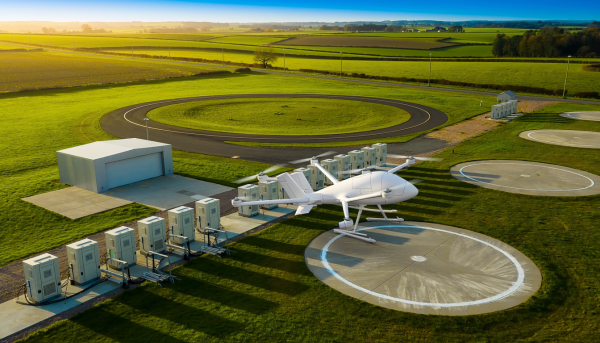
Florida’s approach centers on access. The state is adapting SunTrax, a state test facility that Wright understands was originally built for ground vehicle and charging tests, for electric aviation. Florida’s message, in her words, is: “Our state is friendly, and we’re going to give you this testing platform.”
The Florida Department of Transportation is also one of the eight EIPP projects. State legislation effective July 1, 2026 allows Florida to fund up to 100% of vertiport development costs where federal funds are unavailable, and up to 80% of the nonfederal share where federal funds are used. Wright plans to visit the state’s program to see its vertiport capabilities firsthand.
New York’s Different Route
New York is part of the EIPP, but through the Port Authority of New York and New Jersey rather than the state transportation department. Wright sees that as a gap. “If the state wants to win over manufacturing of these aircraft, or win over a density of business in advanced air mobility, that has to come from the state level as well,” she said.
What States Can Do Next
For states that were not selected, Wright is wary of adding rules. “I don’t want more regulation,” she said. Instead, she points to visible support: opening airspace for testing, allowing test flights, and making it simple to launch aircraft safely. Florida’s test field and New York’s drone testing corridor are two examples.
The goal is to get aircraft in the air where people can see them. “Once people see these aircraft in the air and understand the use cases, it changes their attitude about them,” Wright said.
Her company’s feasibility work has assessed more than 2,000 potential sites, most of them in eight states, which gives her a ground-level view of how policy differences show up in practice.
Taken together, the three states offer distinct models: a defense-led industrial strategy, early operational use, and open testing infrastructure. Which proves most effective may not be clear for several years, but each is already shaping where aircraft fly first.
About Landings
Landings is building North America’s first comprehensive network of vertiport landing and charging infrastructure for electric aircraft, with a planned network of 2,000+ rural locations. Founded by architect and energy management expert Lisa Wright, the company takes an infrastructure-first, asset-light approach through revenue-sharing partnerships with commercial property owners.
This article is based on information provided by the expert source cited above. It is intended for general informational purposes only and does not constitute legal, financial, or real estate advice. Readers should conduct their own research and consult qualified professionals before making any real estate or financial decisions.