If you own property in London, whether it’s a Victorian terrace in Hackney, a flat above a shop in Lewisham, or a commercial unit near Canary Wharf, your roof is quietly doing one of the most important jobs in the building. Most people don’t think about it until something goes wrong. And by then, it’s often more of a headache (and a bigger bill) than it needed to be. Searching for a reliable Roofing Near Me is usually the first thing people do when they spot a damp patch on the ceiling or notice a tile’s gone missing after a storm. But knowing whether you actually need a repair or a full roof replacement, that’s a different question entirely.
Let’s break it down properly.
The Difference Between a Repair and a Replacement
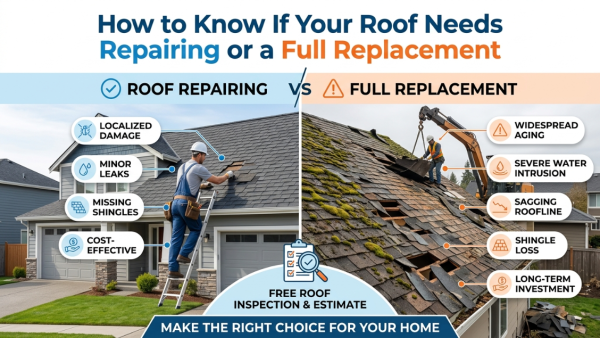
It may seem straightforward, but not necessarily so at first sight. Repair refers literally to solving a particular issue. This means replacing some broken, slipped, or cracked tiles, dealing with a damaged flashing near the chimney, fixing a portion of the felt that might have risen, and a couple more such issues that can be resolved without tearing down the entire roof.
Replacement implies a much more extensive process that involves getting down to the deck level and building anew. This is definitely an investment that demands time and effort. However, there will be situations where this would be the smarter choice. Repairing a structure that has been worn out by time can be compared to decorating a rotting wooden window with a new layer of paint.
The point is recognizing the real problem you have.
Signs That a Repair Might Be Enough
Not every roofing problem is a disaster. Sometimes it’s just wear and tear, and a straightforward fix is all that’s needed.
If you’ve got one or two tiles that have slipped or cracked after a rough bit of weather, that’s typically a repair job. Same goes for flashing that’s come loose around a chimney stack or skylight, this is one of the most common causes of leaks in London properties, and it’s usually very managable with the right roofer.
Moss and algae build-up is another one. It’s incredibly common on roofs across Islington and Southwark, especially on north-facing slopes that don’t get much sun. Left untreated, it can cause moisture to sit on the tiles and eventually work its way underneath. But catch it early and it’s a cleaning and treatment job, not a full replacement.
If your roof is relatively young, say, less than 15 years old, and the issues are localised rather than widespread, a good repair from experienced roofing contractors London will almost always be the right call.
When Replacement Is the Better Option
Here’s where it gets a bit more serious. There are some situations where a patch-up just won’t cut it, and any decent roofer will tell you that straight.
Age is a big one. With regard to typical pitched roofs in the UK constructed from either concrete or clay tiles, these structures usually have an average lifespan of about 50 to 60 years. However, the underlay that lies underneath them may become damaged much earlier than that. Should you be facing a problem where your roof has exceeded 30 or 40 years in age, and you find yourself having several issues arise simultaneously, there may be a message behind it. Once your underlay begins to go bad, you will start experiencing water infiltration in unexpected areas, costing you more money than a full replacement.
Movement or sagging is also a serious symptom. Should there be any signs of a dipping roof or an irregularity in the roofline, there may be some problems with your timbers and deck. It’s definitely better to act now than later on. Dan Lea Roofing will tell you from experience that they have encountered numerous similar cases in London.
Damaged tiles on a large part of the roof and not just here and there usually indicate replacement of the entire roof surface. After a certain point, when one is faced with repairing many tiles and sections, it becomes more economically advantageous.
Persistent leaks that keep coming back, even after being repaired more than once, are also a red flag. If water keeps finding its way in despite work being done, the issue may be deeper than what’s visible on the surface.
Why Getting This Decision Right Matters for Property Owners
For landlords, business owners, and anyone managing a property as an investment, your roof isn’t just a functional necessity, it’s part of your asset. An unmaintained roof can affect your building insurance, your property valuation, and your ability to recieve rent or sell.
We’ve seen it happen in areas like Greenwich and Lewisham, where older stock housing gets neglected for years, and what could’ve been a £500 repair job turns into a £10,000 replacement, plus the cost of dealing with water damage to ceilings, walls, and electrics inside.
Getting ahead of the problem is nearly always cheaper. That’s not just a sales line, it’s basic property management logic.
What a Good Roofer Should Do Before Giving You a Quote
A trustworthy roofing company won’t just take a look from the ground and hand you a number. Any reputable outfit, and this is something Dan Lea Roofing take seriously, will do a proper inspection. That means actually getting up there and checking the condition of the tiles or slates, the flashing, the ridge, the valleys, the guttering, and where possible, the underlay and any internal indicators like loft insulation or rafters.
You should also expect them to be honest with you. If a repair is all that’s needed, that’s what they should tell you. If a replacement is genuinely the better long-term option, they should explain why, clearly and without the pressure.
Ask for photos if you can’t get up there yourself. Any decent roofing contractors London will be happy to show you what they’ve found.
A Few Practical Things Worth Checking Yourself
It is not necessary that one has to climb up to his roof to detect some of these symptoms. Walking around in your property and glancing upward now and then can do wonders when it comes to avoiding major problems in the long run.
Look out for: Cracking in your roof tiling and missing roof tiles. This can happen due to deterioration of mineral-felt flat roof as its granules appear in your gutters. Wet patches may be visible on top floor ceiling and inside the loft area. There may be cracking and staining in the mortar near chimney stacks and other roof extensions.
This by no means indicate the need for new roof, but multiple occurrence warrants an inspection.
Getting the Right Advice
At the end of the day, no online article, including this one, can tell you definitively what your roof needs. Every building is different. What matters is getting an honest assessment from someone who actually knows what they’re looking at.
If you’re in or around London and you’re not sure whether your roof needs a repair or a full replacement, Dan Lea Roofing are worth speaking to. They’ve been working across the city for years and know the kind of roofing challenges that come with London’s property stock, older buildings, flat roofs, party walls, awkward access and all. You can find out more at danlea.co.uk.
No hard sell. Just an honest look and a straight answer.