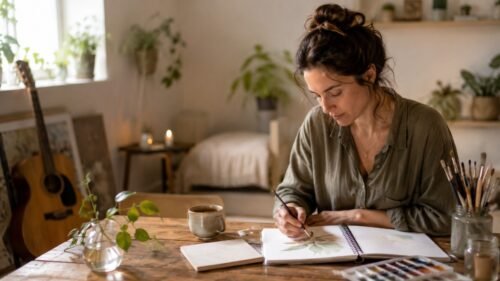
Creativity Doesn’t Need to Be Productive
Pick up a pencil and draw badly. Sing in the car. Write half a page in a notebook and never read it again.
That’s still creativity.
For years, hobbies have had a strange habit of turning into projects. Someone starts baking for fun, then suddenly they’re wondering whether they should sell cupcakes online. A person enjoys photography and, before long, there’s pressure to build a portfolio. Even downtime can start feeling suspiciously like work.
Creative expression offers something valuable precisely because it doesn’t have to achieve anything. Painting, singing, writing, dancing, gardening, playing an instrument, or making something by hand can pull attention away from deadlines and back toward what’s happening right now.
No performance review required.
That makes creativity a surprisingly natural fit with holistic wellbeing. It gives people a way to engage their minds and emotions without turning every quiet moment into another task to complete.
Music Can Say What Conversation Can’t
Ever heard a song and immediately thought of a person, place, or moment from ten years ago?
Music is good at that.
It slips past the careful explanations people often build around difficult feelings. A melody can bring back a memory in seconds. Lyrics can put language around an experience that someone has struggled to describe. Sometimes that recognition matters more than advice.
Australian country artist Norma O’Hara Murphy reflects the kind of storytelling that has long given country music its emotional pull. The genre doesn’t need every story to arrive neatly packaged. Songs can hold heartbreak, humor, family, change, loneliness, resilience, and ordinary life all at once.
That’s part of why music belongs in conversations about wellbeing. It doesn’t necessarily solve anything, and it shouldn’t have to. Sometimes a song simply gives a feeling somewhere to land.
That counts.
Making Something Forces the Pace to Change
Modern life has developed a fairly ridiculous relationship with attention.
A person can answer a message while watching television, checking email, listening to a podcast, and wondering why they can’t relax. The brain barely gets a chance to finish one thought before something else barges in.
Creative work pushes back against that.
Try sketching something while scrolling through three apps. It’s possible, probably, but the drawing won’t appreciate it. Playing guitar, kneading dough, sewing, painting, or shaping clay asks for enough attention that everything else has to move slightly further into the background.
That change of pace can feel refreshing.
Traditional meditation works brilliantly for some people. For others, sitting still and being told not to think somehow produces 47 new thoughts, including several about groceries. Creative activities can offer another route into focused attention without demanding complete mental silence.
Hands busy. Mind quieter.
Expression Can Be Messy and Still Matter
People often stop themselves from being creative because they think they’re not good enough.
Good enough for what?
Nobody has to exhibit the painting. The journal doesn’t need a publishing deal. A song played badly in the living room still counts as playing a song. There is freedom in making something that exists simply because someone wanted to make it.
That freedom can become particularly important when people are working through change. Some might use journaling to notice recurring thoughts. Others may turn to music, movement, visual art, meditation, or conversations with a transformational healer as part of exploring personal patterns and experiences.
There’s no reason all of those approaches need to look alike.
Holistic wellbeing works best when it leaves room for the actual person involved. One person feels better after a five-mile run. Another would consider that a deeply unreasonable suggestion and would rather spend an hour painting. Fair enough.
Wellbeing shouldn’t require everyone to enjoy the same things.
Creativity Can Turn Connection Into Something Easier
Not every meaningful conversation needs to begin with, “So, how are you really feeling?”
Sometimes that’s a lot.
Creative spaces can make connection less forced. Community art classes, choirs, dance groups, workshops, festivals, craft sessions, and live performances give people something to do together. Conversation happens around the activity rather than carrying the full weight of the occasion.
Anyone who has ever sat beside a stranger at a concert knows how quickly shared enthusiasm can remove the awkwardness. One minute nobody knows each other. Ten minutes later, they’re discussing the set list like old friends.
Creative communities can also cross the usual social boundaries. Age, profession, and background don’t disappear, but they become less important when everyone is learning the same song or trying to stop a lump of clay from collapsing.
And yes, sometimes it collapses anyway.
That’s half the fun.
Wellbeing Is Getting More Personal
The old version of wellness advice often came with a formula.
Wake up early. Exercise. Eat perfectly. Meditate. Sleep eight hours. Repeat.
Real life rarely cooperates that neatly.
People have different bodies, schedules, personalities, responsibilities, cultures, and preferences. What feels restorative to one person may feel painfully boring to another. That’s why a more personal approach to wellbeing makes sense.
Location can influence those choices too. On Queensland’s Gold Coast, beach culture, outdoor lifestyles, fitness communities, and complementary wellness services often exist side by side. Someone researching natural treatment Gold Coast options may come across approaches that look beyond a single symptom or routine and consider broader lifestyle habits, stress, movement, rest, and personal wellbeing.
Creative expression can sit comfortably within that wider picture.
Writing may help someone notice thoughts they’ve been brushing aside. Dancing can bring movement back into a week spent behind a desk. Playing music can shift the atmosphere after a rotten day faster than another hour of staring at a phone.
Simple? Yes.
Pointless? Hardly.
Not Every Hobby Needs a Goal
Here’s a mildly rebellious idea: a hobby doesn’t have to improve a résumé, earn money, generate content, or lead anywhere.
It can just be enjoyable.
That might be one of the most useful things creative expression brings to holistic wellbeing. It creates space where curiosity matters more than efficiency. Someone can spend an hour making something imperfect and finish without a measurable achievement to report.
Nothing optimized. Nothing monetized.
Just an hour well spent.
In a world where nearly everything can become a metric, that kind of unproductive pleasure deserves more credit. Creativity doesn’t need to cure, fix, or transform every difficult feeling. Sometimes its job is much smaller.
Give the mind somewhere else to go for a while.