VOIDTRACE AI is outlining how its cross-chain intelligence API could give developers a ready-made signal layer for building trading automation, institutional dashboards and portfolio-aware capital-rotation tools.
August 2026 — As blockchain markets become increasingly fragmented across networks, bridges, decentralized exchanges and liquidity venues, crypto software developers face a growing infrastructure problem.
Building the application is often only part of the job.
Before a trading bot, market dashboard or portfolio-risk tool can become useful, developers may first need to collect blockchain data, normalize activity across different networks, interpret liquidity changes and determine which movements are actually significant.
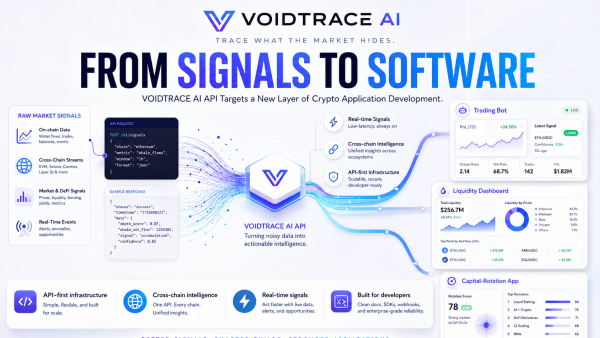
VOIDTRACE AI is developing its API around the idea that much of this intelligence work can happen before the data reaches the application.
The VOIDTRACE AI API is intended to provide developers with structured cross-chain signals that can be used as inputs for other software products.
Instead of every developer constructing a complete blockchain-intelligence stack, applications could potentially consume outputs such as direction, confidence, liquidity conditions and capital-rotation information directly from VOIDTRACE AI.
That creates an architecture where VOIDTRACE provides the intelligence and developers decide what happens next.
Separating Market Intelligence From Execution
This distinction is particularly important for automated trading software.
Executing a trade through an exchange API is a relatively defined engineering task.
The more difficult question is deciding when an opportunity is strong enough to justify execution.
A trading bot powered by the VOIDTRACE AI API could potentially receive:
- confidence-weighted market scores;
- directional signals;
- liquidity strength;
- cross-chain capital-flow information;
- stablecoin concentration;
- sector rotation;
- momentum changes;
- anomalous wallet or accumulation activity.
The bot would then apply its own rules.
For example, a developer might instruct the system to ignore any signal below a particular confidence threshold.
Another strategy might require both positive liquidity momentum and confirmation from cross-chain inflows before an order can be placed.
A third implementation could combine VOIDTRACE signals with conventional price indicators.
The architecture becomes:
Intelligence → Validation → Execution.
VOIDTRACE provides the first layer.
The application controls the second and third.
A Trading Bot Becomes an Execution Engine
This changes how developers can think about automated trading systems.
Instead of requiring the bot itself to discover every market pattern, the bot can become primarily responsible for converting intelligence into actions.
The application may handle:
- exchange connectivity;
- order placement;
- position sizing;
- stop-loss rules;
- take-profit conditions;
- maximum portfolio exposure;
- supported trading pairs;
- user-defined risk controls.
VOIDTRACE AI remains responsible for identifying broader liquidity and capital-flow conditions.
This means developers can focus on building trading logic rather than recreating an entire cross-chain intelligence network.
Cross-Chain Intelligence Requires More Than One Signal
VOIDTRACE AI’s platform is being developed around six specialized analytical agents: FLOW, CORE, VECTOR, ORBIT, VEIL and ROTOR.
Each examines a different part of the market.
FLOW focuses on cross-chain capital movement and tracks inflows and outflows.
CORE examines stablecoin concentration, liquidity depth and capital density.
VECTOR measures liquidity momentum, strength and directional acceleration.
ORBIT evaluates where migrating liquidity may be moving next.
VEIL looks for stealth accumulation and coordinated wallet activity.
ROTOR monitors capital rotation across sectors and market narratives.
The broader objective is to combine these perspectives instead of depending on a single indicator.
For an external developer, the important output is not necessarily the internal complexity behind every signal.
The goal is to make that complexity usable through an API.
Turning Cross-Chain Intelligence Into a Trading-Desk Dashboard
The same API structure could be used for an entirely different product: a professional market dashboard.
Crypto trading desks need visibility across increasingly fragmented markets.
Liquidity can migrate between Ethereum, BNB Smart Chain, Avalanche, Polygon and other ecosystems.
Capital can move through bridges.
Stablecoins can concentrate in particular networks.
DEX liquidity can expand or contract.
Entire sectors can begin gaining or losing market attention.
Displaying all of this normally requires multiple data integrations.
A dashboard powered by VOIDTRACE AI could instead consume an already unified signal stream.
Developers could build an interface displaying:
- bridge inflows and outflows;
- stablecoin concentrations;
- DEX liquidity changes;
- chain-level capital movement;
- sector rotation;
- directional acceleration;
- confidence-weighted alerts.
The value of the application then comes from how that intelligence is presented.
The Dashboard Becomes the User Layer
Different organizations need different views of the same market.
A trading desk might want a live heat map of liquidity movements.
A fund could prioritize alerts when several independent signals agree.
A research analyst might want historical comparisons between stablecoin concentration and sector performance.
Another team might focus exclusively on bridge activity.
The VOIDTRACE AI API could provide a common intelligence layer while each organization builds its own workflow above it.
Filters, layouts, watchlists, notifications and internal risk rules can remain specific to each application.
This makes the concept relevant to both public crypto applications and private institutional tools.
Capital Radar: Connecting Rotation Signals to Real Holdings
Another potential application is a portfolio-aware Capital Radar tool.
A traditional portfolio tracker tells users what they own and how prices are changing.
A Capital Radar application could attempt to answer another question:
Where is capital moving relative to what the user owns?
The user could connect a wallet or import portfolio holdings.
VOIDTRACE AI could identify when liquidity begins rotating from one sector, narrative or ecosystem toward another.
The application could then compare that signal with the user’s exposure.
For example, if a portfolio is heavily weighted toward one sector and VOIDTRACE detects sustained capital movement away from that category, the application could surface a warning.
The app might state that a particular percentage of the portfolio is exposed to an area currently experiencing weakening liquidity conditions.
Turning Intelligence Into Portfolio Risk Context
This is where application developers add another layer of value.
VOIDTRACE identifies the market-level event.
The application explains why that event matters to a specific user.
A Capital Radar tool could potentially evaluate:
- portfolio exposure to the affected sector;
- the assets most exposed;
- changes in liquidity strength;
- stablecoin movements;
- cross-chain confirmation;
- signal confidence;
- severity of the portfolio impact.
Instead of simply presenting a market signal, the software converts that signal into personalized context.
That distinction could support a new category of portfolio-risk copilots.
One API Can Support Several Product Categories
Trading bots, liquidity dashboards and Capital Radar applications are different products, but they share the same infrastructure problem.
All require useful market intelligence before they can perform their core function.
The VOIDTRACE AI API is being developed to sit underneath those applications as a reusable intelligence layer.
That could potentially support additional tools such as:
- automated research terminals;
- cross-chain scanners;
- stablecoin monitoring applications;
- DeFi liquidity trackers;
- whale-activity alerts;
- institutional intelligence feeds;
- sector-rotation monitors;
- portfolio-risk systems;
- market notification platforms.
Each developer can decide how much of the underlying intelligence to expose to the end user.
Developers Build the Product, VOIDTRACE Builds the Intelligence Layer
The wider idea behind the VOIDTRACE AI API is modular development.
A software team building a trading product should not necessarily need to become a blockchain indexing company.
A portfolio application should not necessarily need to create its own capital-rotation detection infrastructure.
A dashboard developer should not need to normalize every bridge and liquidity source independently.
If cross-chain intelligence can be delivered as an API, builders can spend more time on the applications users actually interact with.
That is the role VOIDTRACE AI is attempting to establish within its wider ecosystem.
VOIDTRACE AI Moves Toward the $VOIDE Presale
Development of the VOIDTRACE AI platform and its developer-oriented infrastructure is continuing as the project approaches the $VOIDE presale scheduled for September 4, 2026.
The presale is expected to support payments across Ethereum, BNB Smart Chain, Avalanche and Polygon, with a $10 minimum purchase.
The project is also planning referral and ambassador programs, while presale staking is scheduled to become available in Stage 3.
Developers and users interested in following the VOIDTRACE AI platform, API development and the continuing $VOIDE rollout can visit VoidtraceAI.com.
Frequently Asked Questions
1. What problem is the VOIDTRACE AI API designed to solve?
The VOIDTRACE AI API is designed to reduce the amount of raw cross-chain data processing developers need to perform themselves. It aims to provide interpreted liquidity, capital-flow and market signals that external applications can use directly.
2. What information could a trading bot receive from VOIDTRACE AI?
A trading bot could potentially use confidence-weighted scores, market direction, liquidity context, cross-chain flows, stablecoin concentration, momentum and capital-rotation signals as inputs to its own trading logic.
3. Does VOIDTRACE AI control how a developer’s trading bot executes trades?
No. The concept separates intelligence from execution. VOIDTRACE provides market intelligence, while the developer controls exchange connections, order rules, position sizing, risk limits and execution logic.
4. How could trading desks use the VOIDTRACE AI API?
Trading desks could build custom dashboards that display unified information on bridge flows, stablecoin activity, DEX liquidity, cross-chain capital movement, sector rotation and confidence-weighted signals.
5. What is a Capital Radar application?
A Capital Radar application would connect a user’s wallet or portfolio with VOIDTRACE AI’s capital-rotation intelligence. It could warn users when liquidity begins shifting away from sectors or ecosystems where they hold significant exposure.
6. What are FLOW, CORE, VECTOR, ORBIT, VEIL and ROTOR?
They are the six specialized AI agents within VOIDTRACE AI’s planned intelligence architecture. Each focuses on a different dimension of market activity, including cross-chain flows, stablecoin liquidity, momentum, liquidity destinations, stealth activity and sector rotation.
7. When is the $VOIDE presale scheduled to start?
The $VOIDE presale is scheduled to open on September 4, 2026. Planned payment networks include Ethereum, BNB Smart Chain, Avalanche and Polygon, with a minimum purchase of $10.
Disclaimer: This press release is provided for informational purposes only and does not constitute financial, investment or trading advice. Cryptocurrency markets, automated trading and token presales involve significant risk. Readers should conduct their own research before participating.