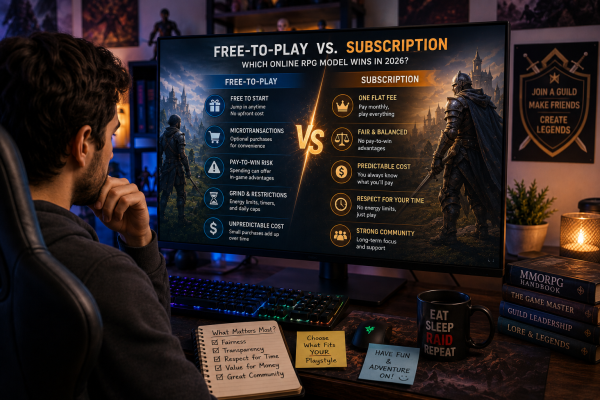
Spent forty bucks on a single mount skin once. Didn’t even need it; the character already had a decent ride and just wanted the shiny one. Took me a solid week to admit that was a weird thing to do. That’s kind of the free-to-play trap in a nutshell, small purchases that feel harmless one at a time until you add them up and realize you’ve spent more than a year of subscription fees on a game that was technically free.
The free-to-play versus subscription debate in online RPGs isn’t new; people have been arguing about it for close to two decades now, but 2026 is shaping up to be an interesting moment for it. Subscriptions are quietly clawing back some respect after years of getting written off as outdated, and free-to-play is facing real pushback from players who are tired of monetization that feels designed to exploit rather than entertain.
The Free-to-Play Trap
Free-to-play sounds great on paper. No barrier to entry, jump in whenever, spend money only if you actually want to. In practice, a lot of online RPGs built around this model design their systems specifically to nudge players toward spending, sometimes in ways that are genuinely uncomfortable once you notice them.
Energy systems that limit how much you can play per day unless you pay to refill them. Loot boxes dressed up as “mystery crates” that dodge gambling regulations in most countries through legal technicalities rather than any real ethical distinction. Battle passes with timers designed to create artificial urgency, buy now or lose access forever, even though the content usually just gets recycled into a future pass anyway.
The really insidious part is how gradual it all feels. Nobody sits down planning to spend three hundred dollars on a mobile RPG. It happens five dollars at a time, a convenience purchase here, a cosmetic there, until months later the total looks absurd next to what a straightforward subscription would’ve cost for the same stretch of time. Research from Statista’s gaming market data has repeatedly shown that a small percentage of players, often called whales in the industry, account for a hugely disproportionate share of free-to-play revenue, which tells you a lot about how these systems are actually built to function.
There’s also the pay-to-win problem, which honestly never fully went away no matter how many developers claim their game avoids it. Even when direct power purchases aren’t allowed, time-saving purchases that let spenders progress faster create a version of the same imbalance. A player who spends money finishes content weeks before someone grinding it out for free, and that gap changes how the whole game feels for anyone not willing or able to open their wallet.
Subscription Models Making a Comeback
For a while it looked like subscriptions were basically dead outside a handful of legacy titles refusing to change. That’s shifting. A growing number of players, especially ones burned by free-to-play spending spirals, are actively seeking out subscription-based online RPGs specifically because the pricing is predictable.
Fifteen dollars a month, full access, no energy timers, no loot boxes, no wondering whether that new mount is going to cost five dollars or fifty. There’s something genuinely relaxing about knowing exactly what a game costs before you even log in, and a lot of players who grew up with free-to-play are discovering that predictability for the first time as adults with actual disposable income to protect.
Subscriptions also tend to align developer incentives with player experience in a healthier way. When revenue comes from ongoing subscriptions rather than one-off purchases, studios have a real reason to keep players happy and engaged long-term rather than just extracting maximum spend before they churn out. Coverage from PC Gamer on subscription-based MMORPGs has pointed out that some of the longest-running, most consistently updated online RPGs on the market still rely primarily on subscription revenue, which suggests the model isn’t as outdated as free-to-play advocates sometimes claim.
That said, subscriptions aren’t perfect either. The upfront commitment can feel steep for players just wanting to try a game casually, and some subscription titles still layer in cosmetic microtransactions on top of the monthly fee anyway, which understandably annoys players who feel like they’re being charged twice for the same experience.
What Players Actually Value
Strip away the marketing from both sides, and what players actually seem to want is fairly consistent regardless of which model they end up choosing. Fairness tops the list almost every time. Whether that means a subscription’s flat access or free-to-play with genuinely cosmetic-only purchases, players overwhelmingly prefer systems where spending money doesn’t create a meaningful gameplay advantage over people who don’t.
Transparency matters just as much. Players want to know upfront what a game is going to cost them over time, whether that’s a clear monthly fee or honest odds disclosed on loot box mechanics. Games that hide the real cost behind confusing currency conversions or vague probability disclosures tend to build resentment even among players who’d otherwise be fine spending money.
Respect for time shows up constantly in player feedback too. Energy systems and artificial grind designed purely to pressure spending get called out fast in online communities, and games that avoid these tactics tend to earn a level of player loyalty that pure monetization strategies struggle to buy. A player who feels respected rather than squeezed is a lot more likely to stick around and recommend the game to friends, which ends up mattering more for long-term revenue than most short-term monetization tricks ever do.
Value for money, unsurprisingly, still matters a ton, but it’s judged less on the sticker price alone and more on what players actually get for it. A fifteen-dollar subscription that includes constant content updates can feel like better value than a “free” game that quietly costs eighty dollars a month once every convenience purchase adds up.
Hybrid Models Are Muddying the Whole Debate
What actually makes 2026 a weird year for this argument is how many games refuse to pick a lane anymore. Pure free-to-play and pure subscription used to be the two obvious camps, but a growing number of online RPGs are landing somewhere in between, and it’s honestly making the whole comparison messier than it used to be.
Buy-to-play with optional cosmetic shops has become one of the more popular middle grounds. Pay once upfront, own the game outright, then spend extra only if you want purely cosmetic items that don’t touch gameplay at all. Players seem to tolerate this model better than either pure extreme, probably because the upfront cost feels honest and anything after that is genuinely optional rather than subtly pressured.
Then there’s the tiered subscription approach, where a base tier gives full access to core content while a premium tier layers in convenience features or cosmetic bonuses on top. This gives budget-conscious players a real way in without locking them out of the actual game, while still giving bigger spenders somewhere to put their money if they want extra perks. It’s not a perfect system either; tiered models can still feel like a subtle way of making the base experience feel intentionally incomplete, but a lot of players seem to prefer it over a flat wall of microtransactions.
Some studios have even started experimenting with seasonal subscriptions instead of monthly ones, essentially a three- or six-month commitment at a discounted rate compared to paying month to month. It’s a small shift, but it signals developers are paying closer attention to how players actually want to budget for these games rather than just defaulting to whatever monetization model was trendy five years ago.
Reader Resource
Figuring out which monetization model actually fits your play style and budget takes a bit of research before committing, especially with so many hybrid models blurring the line between free-to-play and subscription these days. Keeping up with which online RPGs are shifting their pricing structures and which ones are quietly adding new monetization layers make a real difference before you sink hours into a new game.
Sites tracking these industry shifts closely, like pelithub.fi, are worth checking regularly if you want to stay ahead of pricing changes rather than getting surprised by them after you’re already invested in a game’s world and its people.
Conclusion
Neither model is objectively winning in 2026, and honestly, framing it as a battle probably misses the point entirely. What’s actually happening is a slow correction. Free-to-play games are facing real pressure to cut back on exploitative mechanics, and subscription models are proving they can still compete by offering something free-to-play structurally can’t: genuine predictability and fairness. The online RPGs succeeding right now, regardless of which pricing model they use, tend to be the ones that respect players enough to be upfront about what they’re actually paying for.