Category: BigNewsNetwork

  • What Makes a Two-Way Radio Truly Reliable? thumbnail

    What Makes a Two-Way Radio Truly Reliable?

    Range matters—but real reliability also depends on design, audio clarity, durability, the operating environment and support after purchase.

    When people compare two-way radios, one specification often receives more attention than anything else: range.

    But does longer advertised range automatically make a radio more reliable?

    Not necessarily.

    A radio can transmit over distance and still perform poorly if workers cannot hear the message around machinery. A powerful radio is of little value if it cannot withstand the environment in which it is used. And even rugged equipment may fail to solve the problem if a building or large site creates communication dead zones.

    After 16 years working across different communication environments, RETEVIS has developed a broader way to think about reliability.

    1. A Reliable Radio Should Look Ready for the Job

    Reliability starts before the push-to-talk button is pressed.

    Controls should be understandable. Information should be clear. Product design should fit the environment and communicate professionalism rather than complexity.

    For RETEVIS, this represents Visual Reliability.

    The goal is not simply to make a radio attractive. It is to make the product and communication experience clear, recognizable and appropriate for its intended user.

    2. Reliable Communication Has to Be Heard

    A radio can have excellent theoretical coverage while delivering a poor practical experience if the message is difficult to understand.

    This becomes especially important around construction equipment, manufacturing machinery, outdoor wind or crowded commercial environments.

    Audio Reliability therefore means focusing on the complete transmission and listening experience.

    The practical test is simple:

    Can the person on the other side understand the message when it matters?

    3. Reliability Has to Survive Real Life

    Durability means different things in different environments.

    A hotel radio may experience frequent daily handling. A construction radio can face dust, water, drops, vibration and temperature changes.

    That makes testing important.

    For example, RETEVIS RB48 industrial radio series has passed 19 environmental reliability tests under the MIL-STD-810H testing framework.

    Testing provides evidence that reliability has been considered beyond a product’s appearance.

    4. Reliable in One Environment Doesn’t Mean Reliable Everywhere

    This is where many radio comparisons become oversimplified.

    A family hiking outdoors, a warehouse manager, a construction supervisor and an amateur radio operator do not have the same communication problem.

    The right question is therefore not only:

    “Which radio has the best specifications?”

    It is:

    “Which communication approach fits this environment?”

    RETEVIS calls this Scene Reliability.

    It can involve different radios, accessories or even repeaters depending on distance, physical barriers, team size and operating conditions.

    5. Reliability Continues After Purchase

    Professional communication equipment is not always a one-time purchase.

    Organizations may need technical assistance, replacement accessories, configuration support or help expanding a communication system.

    That makes after-sales support part of the overall reliability experience.

    RETEVIS defines this as Service Reliability.

    Reliability Is the Entire Experience

    Together, these five dimensions create a more useful definition:

    Design Reliability + Audio Reliability + Quality Reliability + Scene Reliability + Service Reliability.

    Or more simply:

    Reliable isn’t one feature. It’s the entire experience.

    In 2026, RETEVIS is using its 16th anniversary not simply to look backward, but to make that definition clearer.

    Different people operate in different environments.

    What connects them is the expectation that when communication matters, it works.

    Different World. Same Connection. Always Reliable.

  • Why Performance Accountability Is Reshaping Creator Brand Partnerships


    Validated delivery clearer measurement and better campaign fit are changing how smaller creators and brands work together

    A small-business marketing manager and an independent video creator reviewing a campaign plan and performance results in a studio.

    Clear briefs and measurable delivery help brands and creators evaluate the same campaign on shared evidence.

    Creator marketing is moving into a more accountable phase. Brands still value the trust and personality that independent creators bring to a campaign, but they increasingly want clearer evidence that an activation reached the intended audience and produced meaningful engagement. Creators, meanwhile, want briefs that respect their voice, define expectations in advance and explain how results will be assessed. The result is a gradual shift away from arrangements based mainly on headline audience size and toward partnerships built around fit, delivery and verifiable outcomes.

    This change matters for smaller businesses as well as established advertisers. A company does not always need a famous personality or a vast campaign to introduce a product effectively. It may benefit more from a focused creator whose audience follows a particular subject and pays close attention to recommendations. When both sides agree on the message, the format and the measurement rules before publication, a modest activation can become easier to manage and easier to evaluate.

    The Shift From Reach to Verifiable Outcomes

    For years, follower counts and estimated reach were convenient ways to compare creators. Those figures remain useful, but they cannot show whether viewers actually watched a sponsored segment, clicked for more information or matched the audience a brand hoped to reach. Raw scale can also obscure differences between passive followers and an active community.

    Performance accountability adds another layer. Instead of treating publication as the only completed task, a campaign can define validated actions such as eligible views or clicks. The brand can then examine delivery against an agreed standard, while the creator can see which content choices attracted genuine attention. This does not remove creativity from the process. It gives both parties a clearer basis for discussing what worked.

    Platforms such as Wayo Ads illustrate this shift by offering YouTube-focused campaigns that compensate creators for validated views or clicks without a minimum follower requirement. Campaign availability, acceptance and results still depend on audience fit, content quality and actual performance, so the model is better understood as an accountable buying structure than as a guarantee.

    Why Smaller Creators Are Entering the Market

    Smaller creators have often faced a practical barrier: many conventional sponsorship programmes screen applicants primarily by audience size. That approach is simple for campaign managers, but it can exclude channels with strong subject knowledge, loyal viewers or a useful regional audience. A performance-led model can widen consideration because it gives delivery a more visible role in the decision.

    The opportunity is particularly relevant for creators who publish consistently in a defined category. A technology reviewer, home-improvement channel or specialist educator may be valuable because viewers arrive with a specific interest. The creator’s familiarity with that subject can make a product explanation more natural and more useful than a generic endorsement.

    For brands, this broadens the available mix. Several well-matched creators may provide different perspectives, formats or audience segments. The objective is not to replace larger partnerships, but to select creators according to the work a campaign needs them to do.

    What Performance Based Campaigns Change

    The clearest change is in the brief. A useful brief must describe the product, the intended audience, the required message, the permitted claims, the publication format and the measurement window. It should also state what counts as a valid action and what would make delivery ineligible. Ambiguous rules create friction, especially when compensation depends on reported outcomes.

    Measurement also affects creative planning. A creator may need to make the sponsored portion easy to understand without interrupting the tone of the wider video. The call to action should be relevant and proportionate, while any tracking method should be tested before publication. Brands should allow enough creative freedom for the content to feel authentic, but they should identify legal, safety or accuracy requirements that cannot be changed.

    Finally, performance data makes iteration possible. If viewers respond to a clear demonstration but ignore a vague mention, the next brief can place greater emphasis on practical use. If a campaign attracts clicks but the audience does not continue, the problem may be the landing experience or the offer rather than the creator alone.

    How Brands Can Protect Quality and Trust

    Accountability should begin before a campaign goes live. Brands can review a creator’s recent content, audience relevance, production consistency and approach to sponsored material. A large audience should not compensate for a poor match, and a small audience should not automatically disqualify a creator whose content closely fits the product.

    Clear disclosure is equally important. Sponsored content should be identified in a way that viewers can understand, following the rules that apply in the relevant market and on the publishing platform. Brands should avoid claims that cannot be supported, and creators should be encouraged to describe real product characteristics rather than repeat exaggerated language.

    Campaign teams also need sensible validation controls. Unusual traffic patterns may require review, but creators should know how that review works and have a way to raise questions. Transparent rules help distinguish legitimate quality checks from unexplained rejection. That clarity protects both the advertiser’s budget and the creator’s confidence in the process.

    What Creators Should Check Before Accepting Work

    Creators should begin with audience fit. A campaign that conflicts with a channel’s usual subject, values or viewer expectations can weaken trust even if the immediate payment looks attractive. The best collaboration gives the audience relevant information and lets the creator speak in a familiar voice.

    They should also review the full brief, disclosure requirements, approval process, deadlines, usage rights and validation method. Any unclear claim or measurement rule should be resolved before filming. Keeping an agreed copy of the brief and publication details can prevent later confusion.

    Most importantly, creators should treat performance as one part of a longer relationship with their audience. A forceful call to action may produce short-term activity but damage credibility if it does not match the content. Sustainable creator marketing depends on viewers believing that the recommendation was selected with care.

    The Operational Challenges

    Performance-based partnerships are not effortless. Attribution can be affected by privacy controls, device changes, tracking limits and the time between initial interest and a later decision. Brands may disagree over which action deserves credit, while creators may have limited visibility into data collected after a viewer leaves the publishing platform.

    There is also a risk of focusing too narrowly on the easiest metric. Clicks are measurable, but a useful campaign may also improve understanding, introduce a new brand or answer common questions. Campaign managers should select a primary outcome while retaining enough context to judge content quality and audience response.

    These challenges make transparent reporting and realistic expectations essential. Measurement should support better decisions, not create a false impression that every influence can be reduced to one number.

    A More Measured Market

    Creator marketing is likely to keep combining human judgment with more disciplined measurement. Brands will still need to assess voice, trust and relevance, while creators will still need room to produce content their audiences want to watch. Verifiable delivery adds structure around those creative decisions.

    For smaller businesses, the practical lesson is to start with a defined objective and a well-matched audience rather than chasing the largest visible profile. For creators, the lesson is to evaluate the brief, understand the rules and protect audience trust. When both sides share the same expectations and the same evidence, creator partnerships can become more accessible, more transparent and more useful.

    Final Thoughts

    The strongest creator campaigns are neither purely transactional nor impossible to measure. They combine a credible voice, a relevant product, a clear brief and an agreed view of performance. As the market matures, that balance can help more creators compete on the quality of their work while giving brands a firmer basis for investment decisions.

  • Why Analog Note-Taking Still Matters in a Digital World


    The digital age excelled in capturing ideas, reminders, information, etc. was brought about by the use of digital devices. A single tap saves an idea, records a meeting, or stores the entire document in seconds. However, while this might be convenient, there are advantages to handwritten document preparation not fully appreciated by a keyboard or screen.

    Custom notebooks can be a straightforward way for many individuals to unwind. With handwriting, it becomes more intentional when taking notes because they can’t be recorded with just one action. This slower pace can create a tendency to record key points rather than using recording content. Here are reasons why analog note-talking still counts in a digital world:

    1. Handwriting Helps You Think

    Handwritten notes are not just a clear and physical representation of information. Studies in handwriting and learning demonstrate that the physical act can aid understanding, particularly when handwriting extends to summarizing instead of transcribing ideas. When the task of deciding what to put on the page becomes one of making it a thinking task, then passive listening can become active thinking.

    A notebook additionally gives people freedom of action that some electronic apps don’t give. Add an arrow, highlight a word or phrase, circle an idea, write notes in the margins, or draw connections between two ideas on the same page. When an idea is just beginning to take shape, but isn’t fully formulated to make it onto a digital list, you can use this flexible format to help.

    2. A Break from Digital Noise

    Information is readily available on screens, but there are also distractions. Simple task of idea writing: Notifications, messages, email, and social media can interrupt. Many of these interruptions are eliminated by using a paper notebook, and in its absence you are forced to think on a different page, in a different voice.

    In addition, analog note-taking provides some alleviation in planning for the overwhelmed. You can prioritize your priorities, rather than opening multiple apps or toggling between multiple digital tabs. Overseeing tasks and ideas together may assist you with choosing which to attend to initially.

    3. Paper Can Make Ideas Feel More Personal

    Digital notes may be efficient, but handwritten pages can have a little more personality. Variations in handwriting, errant words, small illustrations, and scribbles in the margins can give indications of the way a person was thinking at a certain time in the process. It’s that personal touch that makes older notes easier to understand and more meaningful than a neat, tidy, digital storehouse.

    Paper can keep memories alive too, beyond information. Keeping it in writing makes it feel more personal. Years later, these writings will be a helpful record of growth and decision-making.

    To sum up, analog notes continue to play a role in note-taking. Handwriting provides opportunity for concentration, personal reflection, and deeper engagement with information. As the digital world abounds, it may be simple to have a notebook nearby as a means to think more intently.

  • Promising Crypto Projects to Watch Early in the Next Rotation: VOIDTRACE AI, Pyth, Celestia and Sui Put Infrastructure in Focus

    Bitcoin’s recovery above $80,000 is bringing attention back to earlier-stage and growth-focused crypto projects. As capital begins looking beyond the largest assets, AI intelligence, market data, modular infrastructure and programmable finance are emerging as themes to watch — putting VOIDTRACE AI and $VOIDE alongside projects such as Pyth, Celestia and Sui.

    September 22, 2026 — Bitcoin’s rebound above $80,000 has reopened a familiar question across the cryptocurrency market:

    Where could investors and users start looking before the next major narrative becomes crowded?

    Bitcoin traded above $80,000 on September 19, extending a sharp recovery after a difficult week that included a Federal Reserve rate increase and the failure of major U.S. crypto legislation. The rebound has also spread beyond BTC, with broader participation across major cryptocurrencies and crypto-related equities.
    That broader recovery is encouraging attention toward projects positioned around the infrastructure that could support crypto’s next phase.

    Rather than focusing only on tokens with the largest market capitalizations, one emerging watchlist includes projects working on AI-powered market intelligence, institutional data, modular blockchain infrastructure and programmable onchain finance.

    Among them are VOIDTRACE AI, Pyth Network, Celestia and Sui.

    VOIDTRACE AI: An Early AI Intelligence Project Built Around Market Rotation

    VOIDTRACE AI represents the earlier-stage end of this watchlist.

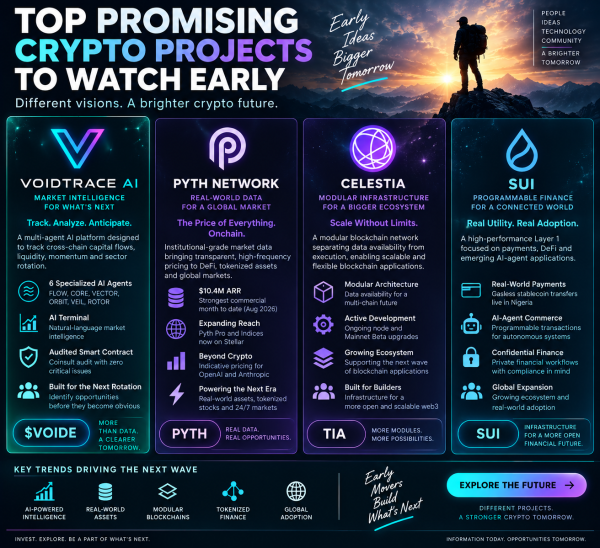
    The project is developing a multi-agent crypto market-intelligence platform designed to interpret cross-chain capital movement, liquidity, momentum and sector rotation.

    Its ecosystem token is $VOIDE.

    Instead of using one general AI model to analyze the entire market, VOIDTRACE AI divides different analytical functions between six specialized agents.

    FLOW tracks cross-chain capital flows.

    CORE focuses on liquidity concentration and depth.

    VECTOR evaluates momentum and directional acceleration.

    ORBIT examines potential destinations for migrating capital.

    VEIL looks for less-visible accumulation and coordinated activity.

    ROTOR monitors sector and narrative rotation.

    Their observations are designed to feed into a shared consensus intelligence layer.

    The concept addresses a problem that becomes increasingly visible during market rotations: price can show that an asset is moving, but it does not necessarily reveal where capital originated, whether liquidity supports the move or which sector could receive the next flow.

    VOIDTRACE AI is also developing an AI Terminal intended to allow users to interact with processed market intelligence using natural-language queries.

    The project’s Ethereum smart contract underwent an Advanced Manual Smart Contract Audit by Coinsult on September 7, 2026, with the report recording zero informational, low, medium and high-risk findings for the reviewed contract.

    That combination of AI infrastructure, defined analytical agents and independently reviewed smart-contract code gives VOIDTRACE AI a distinct position among upcoming crypto projects to watch early.

    Pyth Network: Market Data Becomes Crypto Infrastructure

    Another project worth watching is Pyth Network, particularly as financial markets increasingly move onchain.

    Pyth reported that it crossed $10.4 million in annual recurring revenue during August, describing the period as its strongest commercial month to date. Its institutional data products and indices are expanding beyond traditional crypto pricing into a wider range of financial-market information.

    The network has also recently brought Pyth Pro and Pyth Indices to Stellar, providing 24/7 pricing infrastructure for an ecosystem that Pyth says contains more than $4 billion in tokenized real-world assets.

    On September 17, Pyth highlighted indicative pricing feeds for private companies including OpenAI and Anthropic, demonstrating how blockchain-based market-data infrastructure is extending beyond conventional token prices.

    The wider trend is significant.

    As tokenized securities, real-world assets and 24/7 financial markets expand, reliable pricing data becomes fundamental infrastructure rather than an optional analytics feature.

    That creates an interesting overlap between Pyth’s data layer and VOIDTRACE AI’s intelligence thesis: raw data is becoming more valuable, but interpreting the relationships between that data may become equally important.

    Celestia: Modular Infrastructure Continues Developing

    Celestia remains another infrastructure project to monitor.

    Its approach separates data availability from execution, forming part of the broader modular-blockchain movement.

    Development has continued through September, including a series of Celestia node and Mainnet Beta upgrades. On September 18, the network issued a new Mocha node version containing a security fix, while Mainnet Beta also underwent upgrades earlier in the week.

    Celestia documentation also indicates that development toward its next network upgrade continues, although the next v10 upgrade has not yet been formally scheduled.

    Celestia represents a different type of early-opportunity thesis.

    Rather than focusing on consumer-facing applications, it is building underlying infrastructure that other blockchain systems can use.

    That makes it relevant for investors and developers watching whether the next cycle rewards the applications themselves or the infrastructure beneath them.

    Sui: Payments, Stablecoins and Agentic Finance Expand

    Sui is also showing activity across several emerging crypto themes.

    On September 17, payments company Daya integrated Sui as settlement infrastructure for gasless stablecoin transfers used in cross-border payments and treasury operations. The service is live in Nigeria with planned expansion into additional African markets.

    Sui has also been developing infrastructure around AI-agent commerce, describing programmable transactions designed to let autonomous software execute multiple actions and payments atomically.

    More recently, the project has been highlighting confidential-finance infrastructure designed to support private financial workflows while preserving controlled access for compliance and authorized parties.

    Those developments put Sui at the intersection of several narratives likely to remain important: stablecoins, payments, institutional finance and autonomous AI systems.

    Why These Projects Are Different

    The common thread between these projects is not that they perform the same function.

    It is almost the opposite.

    VOIDTRACE AI is developing intelligence for interpreting market movement.

    Pyth provides market-data infrastructure.

    Celestia focuses on modular blockchain infrastructure.

    Sui is building programmable infrastructure for payments, DeFi and emerging agent-based applications.

    Together, they illustrate how the next phase of cryptocurrency development may become less centered on simply launching another token and more focused on building the infrastructure that makes digital markets usable.

    Getting Early Means Watching Development, Not Just Price

    The phrase “getting in early” often becomes associated with finding a token before a large price increase.

    But an alternative approach is to follow projects while their products, integrations and ecosystems are still developing.

    That means watching:

    • whether technology is actually shipping;
    • whether integrations and users are increasing;
    • whether the project solves a clearly defined problem;
    • whether infrastructure can remain relevant after the current narrative changes;
    • and whether technical transparency keeps pace with growth.

    VOIDTRACE AI fits that watchlist from the emerging-project side because its product thesis is tied directly to an increasingly fragmented crypto market.

    As liquidity moves between Bitcoin, Ethereum, Solana, Layer-2 networks, DeFi, AI projects and tokenized assets, identifying the next opportunity becomes a data problem.

    The project is positioning $VOIDE and the VOIDTRACE AI ecosystem around that intelligence layer.

    The Next Rotation Could Reward Infrastructure

    Bitcoin returning above $80,000 has improved market sentiment.

    But the more interesting development may be what happens if capital starts moving further out across the ecosystem.

    Market-data networks could benefit from increasing tokenization.

    Modular infrastructure could become more important as applications scale.

    Programmable payment networks could gain adoption.

    And market-intelligence platforms could become more useful as the number of assets, chains and narratives increases.

    That makes the next crypto watchlist broader than a simple collection of coins.

    For users researching promising crypto projects to watch early, projects such as VOIDTRACE AI, Pyth, Celestia and Sui represent different approaches to one larger trend:

    building the infrastructure for what comes after the current market cycle.

    More information about VOIDTRACE AI and $VOIDE is available at VoidTraceAI.com.


    About VOIDTRACE AI

    VOIDTRACE AI is an emerging multi-agent crypto intelligence project developing technology for analyzing cross-chain capital flows, liquidity concentration, momentum, less-visible market activity and sector rotation. Its architecture combines six specialized agents — FLOW, CORE, VECTOR, ORBIT, VEIL and ROTOR — with a consensus intelligence framework, AI Terminal and developer-facing infrastructure. Its ecosystem token is $VOIDE.

    Disclaimer: “Promising,” “projects to watch” and “watch early” are editorial descriptions and do not represent investment rankings, guarantees or recommendations to purchase cryptocurrency. Early-stage and growth-stage crypto projects involve substantial risk. This material is for informational purposes only and does not constitute financial, investment or trading advice.


     

  • Best Crypto Presale: BNB Buyers Once Paid a Dime as DigiTap Gives Retail Another Low-Cost Shot at Finding the Next Utility Winner

    BNB is trading near $793 after gaining about 5.4% over 24 hours and more than 10% across the week, bringing one of crypto’s strongest utility-token stories back into focus. BNB started from a completely different place, Binance Academy says its 2017 token sale priced BNB at roughly $0.10 to $0.15.

    DigiTap now gives retail another early utility setup, $TAP costs $0.0589 while the crypto payments app and card are already working before exchange trading begins. For buyers searching for the best crypto presale, the BNB comparison is about timing and utility. BNB was cheap before its ecosystem became huge. DigiTap is still cheap while its own payment ecosystem is already reaching users.

    BNB Started Cheap and Built Utility Around the Token

    BNB launched in 2017 as a utility token. Its original use included trading fee discounts, and the role later expanded into gas payments, DeFi, staking and broader BNB Chain activity. Binance still offers up to a 25% discount on eligible spot and margin trading fees when users pay those fees with BNB.

    That utility helped turn BNB into something users had repeated reasons to hold and use. Today, CoinGecko puts BNB near $793 with a market value above $100 billion, a radically different stage from the early token sale. Nobody buying BNB today can recreate its 2017 entry. DigiTap gives retail a new chance to enter a utility token before the public market has built years of price history around it.

    DigiTap Gives Retail a Sub-$0.06 Utility Entry

    DigiTap is selling $TAP at $0.0589 while the token remains in presale. The key difference from a typical cheap token is that DigiTap already has the product behind it. Its live beta app is downloadable through the App Store and Google Play, and more than 10,000 cards have already been issued.

    The wallet, card and token sit inside the same payments ecosystem. Users can hold crypto, access card functionality and interact with DigiTap before $TAP reaches exchanges. That puts retail in front of the public chart. BNB’s earliest buyers entered before its utility network became globally established. DigiTap buyers are entering while its own utility story is still at the presale stage.

    More Than 10,000 Cards Put the Utility in Users’ Hands

    DigiTap has already issued more than 10,000 cards while $TAP remains before public trading. That gives the token a direct connection to a consumer product instead of leaving utility on a roadmap. DigiTap is building around a familiar behavior, spending money through a card, while connecting $TAP to rewards and the wider app ecosystem.

    The $TAP contract has also been reviewed by Coinsult and SolidProof, adding independent security checks before exchange trading begins. For retail, the setup is straightforward. The app is live, the card works, and the token is still available at presale pricing.

    BNB Shows Why Utility Can Become a Powerful Token Story

    BNB did not remain a token used only for one discount. Its role expanded as the surrounding ecosystem expanded. Today it is used for transaction fees across BNB Chain, decentralized applications, DeFi and other ecosystem functions. DigiTap is building its own utility loop around crypto payments. $TAP is designed around rewards, staking, fee benefits and app activity, giving the token multiple reasons to remain connected to users after the presale.

    That is what makes the BNB comparison compelling. BNB showed how powerful repeated utility can become when a token grows alongside a product ecosystem. DigiTap is attacking the same early utility opportunity through crypto payments while $TAP is still before its first exchange market.

    DigiTap Makes a Strong Best Crypto Presale Case

    BNB’s history shows what early utility can look like before an ecosystem becomes mature. Buyers once had access near the dime level. Today, BNB trades hundreds of dollars above that early sale price and sits among crypto’s largest assets.

    DigiTap gives retail a fresh utility entry at $0.0589, with the product already further along than many presales ever reach before listing. The live beta app is downloadable, more than 10,000 cards have been issued, and Round 4 is already more than 85% sold.

    The public exchange chart has not started yet. For buyers searching for the best crypto presale, DigiTap combines the part of the BNB story retail remembers most, an early low-cost entry, with something buyers can verify today, a working crypto payments product already reaching users.

    VISIT DIGITAP OFFICIAL WEBSITE

    FAQs

    Why is BNB relevant to the DigiTap utility story?
    BNB began as a low-priced utility token and expanded as its ecosystem grew. DigiTap is also building token utility around an operating product, with $TAP still in presale.

    What is the current DigiTap presale price?
    $TAP is currently priced at $0.0589, while Round 4 is already more than 85% sold.

    Does DigiTap already have a working product?
    Yes, DigiTap’s live beta app is downloadable through the App Store and Google Play, and more than 10,000 cards have already been issued.

    Disclaimer:
    This article is for informational purposes only and does not constitute financial advice. Cryptocurrency investments carry risk, including total loss of capital.

    All market analysis and token data are for informational purposes only and do not constitute financial advice. Readers should conduct independent research and consult licensed advisors before investing.

    Crypto Press Release Distribution by BTCPressWire.com

  • Cardano Price Prediction, ADA Pushes Back Above $0.22 as DigiTap Gives Retail a Wallet, Crypto Card and $TAP in One Entry

    Cardano is back above $0.22 as altcoins strengthen, with ADA trading around $0.24 after a sharp weekly rebound. CoinGecko shows Cardano up about 17% over seven days, while daily trading volume is above $700 million.

    DigiTap gives retail a different payments trade, a live wallet and crypto card ecosystem with $TAP still available at $0.0589 before exchange trading begins. The Cardano price prediction is improving as ADA regains momentum, but DigiTap offers something mature altcoins cannot repeat, an entry before the public market creates the first $TAP chart.

    ADA Reclaims $0.22 as Altcoin Momentum Returns

    Cardano has recovered sharply from the sub $0.20 area seen earlier this month. CoinGecko data shows ADA moving from around $0.196 on September 16 to roughly $0.24 today, putting the token firmly back above $0.22. The rebound is arriving alongside wider altcoin strength. CoinMarketCap reported ADA outperforming Bitcoin as its Altcoin Season Index moved higher, with $0.224 becoming an important breakout level.

    Cardano also has a fresh payments narrative. The network is part of the x402 payment standard, which allows applications and AI agents to make automated onchain payments. Cardano’s own material describes x402 as infrastructure for pay per request services and machine payments.

    DigiTap Puts Wallet, Card and Token in One App

    DigiTap gives retail a direct consumer payments setup. The live beta app is already downloadable through the App Store and Google Play, bringing wallet functionality and crypto card access into the same ecosystem while $TAP remains in presale. DigiTap has already issued more than 10,000 cards, so buyers are not waiting for a payments product to appear after the token lists.

    The wallet is live, the card is working, and $TAP sits inside the same ecosystem. Buyers get one entry into the product and the token before public trading begins. DigiTap’s $TAP contract has also been reviewed by Coinsult and SolidProof, adding independent security checks while the token remains at the presale stage.

    The Product Is Ahead of the Public Chart

    Cardano has spent years trading across major exchanges. ADA has deep liquidity, a global community and an established market price. DigiTap is still before that phase. $TAP is currently priced at $0.0589, and Round 4 is already more than 85% sold. The app and card ecosystem are operating now, but the token has not reached its first public exchange chart.

    That gives buyers a much earlier position. DigiTap has put the product in front of retail before the wider market gets the chance to price $TAP. Instead of buying a token first and waiting for utility, buyers can see the utility first and enter while the presale is still open.

    Cardano Builds Payment Rails, DigiTap Builds the Retail Experience

    Cardano’s x402 integration strengthens its payment infrastructure by opening the network to automated transactions between apps, services and AI agents. The Cardano Foundation has also highlighted x402 as part of the emerging machine payment economy. DigiTap approaches payments from the user side. Its wallet and card are built around crypto holders who want to hold digital assets and spend through one interface.

    That creates a simple retail proposition for buyers who want utility they can understand before exchange trading starts. Open the app, access the wallet, use the card, and enter $TAP while the token is still before exchanges. Cardano shows why payments remain one of crypto’s strongest utility narratives. DigiTap takes that narrative directly to consumers while keeping the token entry early.

    DigiTap Gives Retail the Earlier Payments Bet

    The Cardano price prediction has strengthened as ADA moves back above $0.22 and altcoin demand returns. Cardano remains one of the market’s largest established networks, and its payment infrastructure adds another use case to the ecosystem. DigiTap gives buyers a fresh starting point.

    More than 10,000 cards have already been issued, the live beta app is available now, and $TAP remains at $0.0589 before public exchange trading. Retail gets the wallet, the crypto card and the token inside one ecosystem while the public market story is still ahead. For buyers following ADA and searching for the next utility driven crypto opportunity, DigiTap puts the payments product in their hands first and keeps the token entry at the presale stage.

    VISIT DIGITAP OFFICIAL WEBSITE

    FAQs

    What is the latest Cardano price prediction?
    ADA has moved back above $0.22 and is trading around the mid $0.20 range after a strong weekly rebound.

    What is the current DigiTap presale price?
    $TAP is currently priced at $0.0589, with Round 4 already more than 85% sold.

    What can users access through DigiTap?
    DigiTap combines a live wallet and crypto card ecosystem with $TAP, while the beta app is already downloadable through the App Store and Google Play.

    Disclaimer:
    This article is for informational purposes only and does not constitute financial advice. Cryptocurrency investments carry risk, including total loss of capital.

    All market analysis and token data are for informational purposes only and do not constitute financial advice. Readers should conduct independent research and consult licensed advisors before investing.

    Crypto Press Release Distribution by BTCPressWire.com

  • Best Crypto To Buy Now, DigiTap Has 120K+ Wallets Connected as $TAP Turns Crypto Spending Into a Retail Bet

    Bitcoin’s return above $85,000 has brought confidence back into crypto, with ETH, XRP and SOL also posting strong gains as traders move back into risk assets. Bitcoin gained more than 5% over 24 hours on September 21, while more than $648 million in short positions were liquidated. For buyers searching for the best crypto to buy now, DigiTap offers a different entry, 120,000+ wallets are already connected while $TAP remains in presale and the crypto payments app is already live.

    DigiTap is turning crypto spending into a retail token story before exchange trading begins. Users can already access the payments ecosystem, while buyers can still enter $TAP before its first public market chart.

    120K+ Wallets Are Already Connected to DigiTap

    More than 120,000 wallets are already connected to DigiTap while $TAP remains in presale. DigiTap has also sold more than 366 million TAP and raised over $12.2 million. The live presale dashboard currently shows Round 4 active, with $TAP priced at $0.0589 and the next price set at $0.0594.

    Those are connected wallets, not a claim of 120,000 token holders. The number shows how much attention DigiTap has already pulled into its ecosystem before public exchange trading starts. The $TAP contract has also been reviewed by Coinsult and SolidProof, adding independent security checks while buyers are still entering through the presale.

    Bitcoin Strength Has Put Altcoins Back on Retail Screens

    Bitcoin briefly crossed $85,000 for the first time since January after trading around $75,000 less than a week earlier. The move came alongside rising Asian and European equity markets and a major short squeeze, with more than $750 million in crypto positions liquidated over 24 hours.

    Ethereum, XRP and Solana also moved sharply higher during the rebound, showing that capital is no longer moving through Bitcoin alone. That is exactly when retail starts searching beyond BTC for the next utility token with an earlier entry. DigiTap sits in that part of the market. Bitcoin already has a mature public price, while $TAP has not reached exchanges yet.

    DigiTap Turns Crypto Spending Into Token Utility

    DigiTap is not building $TAP around attention alone. Its broader ecosystem combines crypto wallets, cards and everyday spending inside one app. The beta app is already available before the token listing, giving users a working product while buyers are still entering at presale pricing. DigiTap has also issued more than 10,000 cards, putting its payments product into users’ hands before $TAP begins public trading.

    This makes the DigiTap story easy for retail to understand. Crypto moves into the app, users spend through the card, and $TAP sits inside the same ecosystem through rewards and other platform benefits. Instead of buying a token and waiting to discover what it will eventually be used for, DigiTap buyers can see the payments infrastructure before the exchange chart exists.

    The Product Is Live While the Token Is Still Early

    Many presales begin with the token and leave the working product for later. DigiTap has reversed that order. The app is already downloadable, cards have already been issued and 120,000+ wallets have already connected. Public exchange trading still has not started.

    That gives buyers a rare combination, the product has reached users before the token has reached the wider market. DigiTap’s current $0.0589 presale price is also approaching its next step at $0.0594. Round 4 is already well advanced, so buyers waiting for more market attention will not be entering at the same stage as buyers moving before the next round price.

    DigiTap Builds a Strong Case for the Best Crypto To Buy Now

    Bitcoin’s move above $85,000 has reopened the hunt for opportunities beyond the largest coins. Mature altcoins can still rally, but their earliest market stage is long gone. The app is operating, more than 10,000 cards have been issued, 120,000+ wallets are connected and $TAP is still before its first exchange chart. DigiTap has already built the crypto spending product while keeping the token entry at presale level.

    For readers searching for the best crypto to buy now, that puts DigiTap into a very different category from coins that have already traded through multiple bull markets. Retail is getting the payments story before public price discovery, not after the first major exchange run has already brought the crowd.

    VISIT DIGITAP OFFICIAL WEBSITE

    FAQs

    Why is DigiTap being discussed as one of the best crypto to buy now options?
    DigiTap combines a live crypto payments app, more than 10,000 issued cards and 120,000+ connected wallets while $TAP is still before public exchange trading.

    Does DigiTap really have 120K+ wallets connected?
    Yes, DigiTap’s official presale dashboard displays more than 120,000 wallets connected. This figure refers to connected wallets, not token holders.

    What is the current DigiTap presale price?
    $TAP is currently priced at $0.0589, with the next presale price set at $0.0594.

    Disclaimer:
    This article is for informational purposes only and does not constitute financial advice. Cryptocurrency investments carry risk, including total loss of capital.

    All market analysis and token data are for informational purposes only and do not constitute financial advice. Readers should conduct independent research and consult licensed advisors before investing.

    Crypto Press Release Distribution by BTCPressWire.com

  • Sui Price Prediction, SUI Jumps 17% on a Mystery Finance Launch as DigiTap Gives Retail a Crypto Card Bet at $0.0589

    Sui has become one of the strongest large cap movers of the day, with SUI jumping about 17% to roughly $0.96 as traders react to a mystery finance product teased ahead of Sui Basecamp 2026.

    DigiTap gives retail a different payments trade, its live beta app is already downloadable, more than 10,000 cards have been issued, and $TAP is still available at $0.0589 before exchange trading begins.

    SUI Jumps as a New Finance Reveal Builds Momentum

    The latest Sui price prediction has turned bullish after Mysten Labs Chief Product Officer Adeniyi Abiodun teased a major finance product that will be unveiled around Sui Basecamp. SUI traded near $0.96 after gaining about 17% in 24 hours, while volume climbed to around $1.47 billion as traders rushed back into the token.

    The exact product has not been unveiled yet, but Sui has already made the direction clear. Sui Basecamp runs on October 7 and 8 in Singapore, with the official program centered on payments, financial infrastructure, private transactions, stable digital dollars and autonomous finance. That gives SUI a strong new catalyst after a weekly rebound. The token has moved from around $0.69 on September 15 to the upper $0.90 range, showing how quickly a fresh finance narrative can reprice an established altcoin.

    DigiTap Gives Retail the Payments Bet Before the Exchange Chart

    DigiTap is attacking the payments market from a much earlier token stage. DigiTap has already issued more than 10,000 cards while $TAP is still in presale. The live beta app is downloadable through the App Store and Google Play, putting a working crypto payments product in users’ hands before the token reaches exchanges. That creates the early window retail traders spend market cycles trying to find. DigiTap buyers can see the app, use the card ecosystem and enter $TAP before a public trading chart exists. The $TAP contract has also been reviewed by Coinsult and SolidProof, adding independent security checks while the token remains in presale.

    $0.0589 Keeps DigiTap in the Early Entry Zone

    $TAP is currently priced at $0.0589, putting DigiTap below $0.06 while its payments product is already operating. Round 4 is more than 85% sold, so this is not an unlimited entry window. DigiTap has only 10 presale rounds, and every completed stage moves the token closer to public trading.

    The appeal is easy to understand. SUI is rallying now because the market is reacting to what comes next for its finance ecosystem. DigiTap gives buyers the chance to enter before that same public market reaction begins around $TAP. The app is live first, the token chart comes later.

    Sui Proves Finance Narratives Can Move Fast

    Sui has spent 2026 building deeper financial infrastructure. Its network already supports gasless stablecoin transfers, while recent development has focused on instant settlement, confidential finance and tools designed for payments and financial applications. The official Basecamp program says the event will feature product reveals around the next generation of finance, including autonomous payments and private transactions. That explains why a single teaser from Mysten Labs has pulled traders back toward SUI.

    DigiTap is positioned around a simpler retail version of the same broad theme. Crypto holders need ways to move from owning digital assets to actually spending them. DigiTap puts the wallet and card experience into one live app while keeping $TAP at presale pricing. For buyers, there is no need to wait for a roadmap milestone to understand the product. The card already works and the app can already be downloaded.

    DigiTap Gives Buyers the Earlier Crypto Payments Entry

    SUI’s 17% jump is another reminder that the market can move before most retail buyers have time to react. Once a catalyst hits and volume arrives, the cheaper entry can disappear quickly. DigiTap gives retail a chance to move earlier.

    $TAP is still at $0.0589, more than 10,000 cards have already been issued, and the live beta app is already available. Public exchange trading has not started, leaving DigiTap in the stage before the wider market begins pricing the token.

    Sui is showing what happens when a finance narrative catches fire. DigiTap gives buyers a working crypto card and an early token entry before its own public market story starts. For readers following the latest Sui price prediction and hunting for the next payments runner, DigiTap puts the product in place first and gives retail access while $TAP is still below $0.06.

    VISIT DIGITAP OFFICIAL WEBSITE

    FAQs

    Why did SUI jump 17%?
    SUI rallied after Mysten Labs teased a major finance product ahead of Sui Basecamp 2026, bringing fresh attention to the network’s payments and financial infrastructure push.

    What is the current DigiTap presale price?
    $TAP is currently priced at $0.0589, with Round 4 already more than 85% sold.

    Does DigiTap already have a working crypto card?
    Yes, DigiTap has already issued more than 10,000 cards and its live beta app is downloadable through the App Store and Google Play.

    Disclaimer:
    This article is for informational purposes only and does not constitute financial advice. Cryptocurrency investments carry risk, including total loss of capital.

    All market analysis and token data are for informational purposes only and do not constitute financial advice. Readers should conduct independent research and consult licensed advisors before investing.

    Crypto Press Release Distribution by BTCPressWire.com

  • Top Crypto Presales for Upcoming Bull Run: Why MemeToro’s $140K Stage 7 and Open Code Stand Out Along With AlphaPepe

    The top crypto presales for upcoming bull run searches are increasingly focused on projects with products rather than tokens alone. MemeToro and AlphaPepe both connect meme culture with AI-based tools, but their platforms take different approaches.

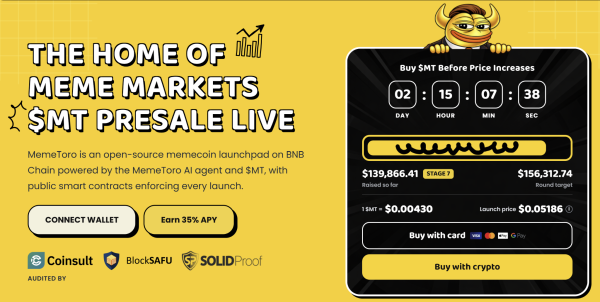
    MemeToro has crossed $140,000 raised in Stage 7 at a current price of $0.00430. Its latest development includes open-source AI launchpad code and automated fair-launch rules.

    AlphaPepe has reported more than 11,500 holders and about $2.58 million raised. Its AlphaSwap product provides pre-trade risk checks and trend signals.

    Why MemeToro’s Open Code Matters

    MemeToro’s open-source approach gives users more information about how its launchpad is designed. The system uses smart contracts and automated rules to structure token proposals and launches.

    The project says its framework checks important details before a token can proceed. This includes allocation totals, funding consistency, and insider-allocation rules.

    That matters because token launches can become risky when users cannot see how funds, supply, or allocations are structured.

    MemeToro’s AI agent also connects trend analysis with token creation. The goal is to help identify internet trends and turn suitable ideas into structured launch proposals.

    AlphaPepe’s Presale and AlphaSwap

    AlphaPepe has built a different utility layer. Its AlphaSwap platform is designed to help users examine tokens before making swaps.

    The project has reported more than 11,500 holders and $2.58 million raised. Its current supplied presale price is approximately $0.02873.

    AlphaSwap adds a pre-trade layer that can provide risk checks and trend signals. This approach is focused on helping users make decisions before trading.

    MemeToro and AlphaPepe therefore target different parts of the crypto process. MemeToro focuses on discovering and launching tokens, while AlphaPepe focuses more on information around token swaps.

    $MT Utility and the Stage 7 Numbers

    The $MT token supports access to MemeToro features, staking, rewards, memecoin trading functions, and prediction markets.

    The current Stage 7 price is $0.00430. MemeToro has stated a listing target of $0.05186.

    If the token reached that target, the mathematical price multiple would be about 12.06x, producing a hypothetical return of around 1,106% before fees.

    This does not mean the target will be achieved. Presale tokens can face price drops, limited liquidity, delayed listings, and lower-than-expected demand.

    How Buyers Can Compare the Projects

    The top crypto presales for upcoming bull run research should begin with basic due diligence.

    Compare:

    • current price and presale stage
    • amount raised
    • holder numbers
    • audit information
    • smart-contract transparency
    • actual product development
    • token utility
    • listing plans

    MemeToro’s open-source launchpad code provides a technical reference point for review. AlphaPepe’s AlphaSwap gives users another product to examine.

    The two projects should be evaluated according to their actual products and risks rather than only promotional price targets.

    More Information on MemeToro ($MT) Presale Here:

    Website: https://memetoro.com/

    X: https://x.com/memetoro_mt

    Telegram: https://t.me/memetoro_mt

    YouTube: https://www.youtube.com/watch?v=gY0jgWy_DtA

    Disclaimer:
    This article is for informational purposes only and does not constitute financial advice. Cryptocurrency investments carry risk, including total loss of capital.

    All market analysis and token data are for informational purposes only and do not constitute financial advice. Readers should conduct independent research and consult licensed advisors before investing.


  • DopaMint Builds an Intent-Based Agent Layer on Base for the Emerging Agentic Economy

    As AI agents evolve from assistants into economic actors, DopaMint is building a House of Intent-Based Agents on Base to help turn user intent into coordinated action across applications, services and onchain infrastructure.

    [SF, 21Sep] — The way people deal with digital platforms has to be changed. Instead of figuring out which app to open and what buttons to click, users can simply describe what they want in plain English through a familiar messaging platform like iMessage and let AI agents work out the steps needed to get it done.

    The next step is for those agents to transact.

    Base is emerging as one of the key ecosystems building toward this shift. With AiFi, agentic wallets, x402 payments, Base MCP and onchain agent identity, Base is creating infrastructure that allows agents to access applications, pay for services and interact with the onchain economy.

    DopaMint is building on top of this emerging infrastructure with a different starting point: intent.

    Its House of Intent-Based Agents brings together 250+ specialized agents through Dope, an orchestration layer designed to understand what a user wants and coordinate the agents, tools and execution required to accomplish it.

    In simple terms, users can just ask for something and let the agents figure out the steps. A request could be as simple as finding and booking a restaurant, planning a trip, swapping, handling a payment, researching a market, managing capital or completing a business task. The user can interact through a familiar messaging experience through iMessage-style conversation while agents work in the background to research options, coordinate with other agents and execute the task within defined permissions and guardrails.

    This extends beyond crypto into everyday digital and lifestyle tasks, bringing the same intent-based experience to the applications and services people already use.

    This creates a model where humans express intent and agents coordinate the execution.

    As more infrastructure becomes accessible to agents, the volume of machine-to-machine activity could eventually surpass what humans can initiate themselves. Base is building the rails for that economy; DopaMint is building an intent-driven layer for interacting with it.

    “The next phase of crypto will be about more than people using applications. It will be about agents using those applications, paying for services and coordinating with other agents,” said Jawwy, Co-Founder of DopaMint. “DopaMint is being built around a simple idea: users should be able to state what they want, while agents handle the complexity underneath.”

    For DopaMint, the long-term opportunity is not another interface for crypto. It is a shift toward an economy where agents can reason, act and transact, with intent as the starting point.

    About DopaMint

    DopaMint is a House of Intent-Based Agents built on Base. Through Dope, its orchestration layer, DopaMint connects users with 250+ specialized agents across markets and money, business operations, professional services, personal life, and creative and technical work.

    Announcement Link: https://x.com/DopaMintLabs/status/2102030708420272605

    Website: dopamint.xyz

    Socials:

    https://x.com/DopaMintLabs

    https://t.me/dopamint_labs

    https://discord.gg/GEygHaKUKt