
Category: BigNewsNetwork

  • Best Crypto to Buy Now:  Math Behind Pepeto as ETH Holds $2,312 and XRP Sits at $1.42 thumbnail

    Best Crypto to Buy Now: Math Behind Pepeto as ETH Holds $2,312 and XRP Sits at $1.42

    Fannie Mae just started accepting crypto as collateral for mortgages after FHFA ordered it to count digital assets like stocks and bonds. That single policy change tells every holder the institutions are building rails to stay. The question is no longer whether crypto grows but which entry captures the most of it. ETH trades at $2,312 and XRP holds at $1.42, but the best crypto to buy now may already sit inside a presale that raised more than $9.8 million during fear.

    Best Crypto to Buy Now as Fannie Mae Accepts Crypto for Mortgage Collateral

    FHFA Director William Pulte ordered Fannie Mae and Freddie Mac to count crypto holdings as qualifying assets for mortgage applications, according to Yahoo Finance. Stablecoin card spending is also growing 100% year over year, as CoinDesk reported this week. Both signals confirm that infrastructure around crypto is expanding, which means the smartest crypto entry right now is the one positioned to benefit most from the capital wave that follows.

    ETH, XRP, Pepeto, and Where the Biggest Returns Actually Form

    Pepeto

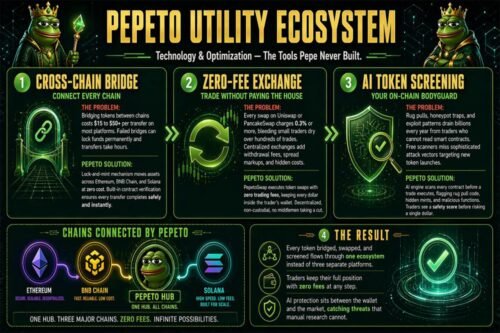
    The market has hundreds of tokens but few ways to trade them without losing money on the way in. Fees pile up on swaps, moving tokens between chains costs more than expected, and contracts that passed no review sit next to verified ones with nothing to tell them apart.

    Pepeto runs a complete exchange built to solve those gaps. PepetoSwap lets buyers trade without paying a fee on any pair, and the risk scorer grades every contract before the trade completes so capital never touches an unverified token.

    The swap strips out costs that shrink positions on each trade, keeping more of every dollar working. The risk scorer assigns a safety grade before the buyer commits, turning guesswork into a clear signal.

    Pepeto closes a gap that costs holders real money: trading without protection and swapping between chains without a safety check. Pepe coin’s original creator built this project, a Binance veteran directs the exchange, and SolidProof signed off on every contract.

    The entry sits at $0.0000001864 per token, and more than $9.8 million arrived during a period when the Fear and Greed Index sat deep in fear territory. Staking at 174% APY grows those positions while the Binance listing gets closer.

    For anyone asking what is the best crypto to buy now, Pepeto answers with math that ETH and XRP cannot touch from their current bases. The same cofounder built Pepe to $11 billion with zero products and 420 trillion tokens, and the distance from presale to that same market cap is over 150x while a fully operational exchange already processes trades.
    Ethereum (ETH)

    ETH trades at $2,312 as of May 8, down 52% from its $4,891 all time high, according to CoinMarketCap. The network still leads in DeFi and tokenization, and the Fannie Mae news adds another layer of credibility. But even a strong recovery to $4,000 from here delivers roughly 75% over what could take a year, and that ceiling sits well below the multiples a presale entry targets.

    XRP

    XRP sits at $1.42, down 53% from its $3.84 peak, according to CoinMarketCap. The cross border payments story remains intact, but the token has traded sideways for months and a return to $3.00 would deliver roughly 110% at most, which is strong for a large cap but far below the 150x that presale math projects from a fraction of a cent.

    Conclusion

    ETH stays the backbone of DeFi and XRP keeps its payments story, but the best crypto to buy now is the entry where math separates by orders of magnitude. Large caps target 2x over months while the presale targets 100x from one listing, and the pace of capital flowing in during fear is the clearest confirmation. More than $9.8 million entered Pepeto while the market bled, and that conviction tells the same story as every winning presale before listing. The Pepeto official website shows the entry still at presale price, and joining what capital already confirmed captures these returns before the listing removes the window permanently.

    Click To Visit Pepeto Website To Enter The Presale

    FAQ

    What makes Pepeto the best crypto to buy now over ETH and XRP?

    ETH targets 75% and XRP targets 110% over months, while the Pepeto presale targets over 150x from one Binance listing event.

    How does the Fannie Mae news affect the top crypto entry right now?

    Accepting crypto as mortgage collateral signals long term institutional commitment, which benefits entries positioned before the capital wave arrives.

    Is it too late to enter the Pepeto presale?

    The Pepeto official website shows the presale still open at the lowest entry before the Binance listing, and over $9.8 million already entered from wallets that see listing day as the trigger.

    Disclaimer:
    This article is for informational purposes only and does not constitute financial advice. Cryptocurrency investments carry risk, including total loss of capital. Readers should conduct independent research and consult licensed advisors before making any financial decisions.

    This publication is strictly informational and does not promote or solicit investment in any digital asset

    All market analysis and token data are for informational purposes only and do not constitute financial advice. Readers should conduct independent research and consult licensed advisors before investing.

    Crypto Press Release Distribution by BTCPressWire.com

  • The Best Crypto Presale to Buy as Tom Lee Calls the Bear Market Over and Pepeto Passes $9.8 million thumbnail

    The Best Crypto Presale to Buy as Tom Lee Calls the Bear Market Over and Pepeto Passes $9.8 million

    Tom Lee told Consensus 2026 that the crypto winter is finished, and BTC closing May above $76,000 confirms a new bull cycle. Every cycle rewarded one group most: the wallets that found the best crypto presale to buy before the crowd arrived. Bitcoin sits at $80,200 and the market is shifting from fear to positioning, which means presale windows close faster than most realize. Pepeto has pulled in more than $9.8 million during that fear, built by the cofounder who turned the original Pepe coin into $11 billion with zero products.

    Best Crypto Presale to Buy as Fundstrat Declares a New Cycle Starting

    Tom Lee, Fundstrat cofounder, said at Consensus 2026 on May 7 that the bear market is likely over and a fresh cycle driven by tokenization is forming, according to CoinDesk. BTC has posted two straight monthly gains near $80,200, and trader John Bollinger confirmed his trend models turned positive, as CNBC reported. When the cycle turns, the biggest gains go to entries already locked before retail floods back in.

    Presale Entries, Pepeto, Bitcoin Hyper, and Remittix Compared

    Pepeto

    The market is full of tokens but short on ways to trade them safely. Prices move across chains at different speeds, fees stack up on every swap, and contracts that look clean on the surface drain wallets the moment money goes in.

    Pepeto operates a trading hub designed to fix all three of those problems at once. PepetoSwap runs every trade at zero fees, and the bridge sends tokens across Ethereum, BNB Chain, and Solana with no transfer cost attached.

    The swap removes trading costs so smaller positions survive every move. The bridge connects three major chains in seconds so capital reaches the best price without losing value. Both tools sit inside one trading hub.

    Pepeto targets a problem that drains real capital from real wallets: paying fees and trusting chains that do not talk to each other. The creator of the original Pepe coin runs this project, SolidProof audited every line of code, and a Binance expert shapes the exchange from the inside.

    The presale sits at $0.0000001864, and more than $9.8 million entered while fear drove most of the market sideways. Staking at 174% APY rewards holders while the Binance listing approaches.

    For anyone searching for the best crypto presale to buy right now, Pepeto answers with a track record no other entry can match. The cofounder already proved the math works once by building Pepe to $11 billion with zero products and the same 420 trillion supply, and reaching that level again from today’s presale delivers a 150x return backed by a complete exchange Pepe never had.

    Bitcoin Hyper

    Bitcoin Hyper builds a Layer 2 on top of Bitcoin for DeFi and staking, but the presale has no confirmed listing date and no live product, according to CoinMarketCap. BTC Layer 2 projects struggled to gain traction in past cycles, and the presale carries that risk with none of the proof.

    Remittix

    Remittix targets cross border payments by converting crypto to fiat without banks in the middle, which sounds strong on paper, according to CoinMarketCap. But the project competes with SWIFT alternatives that already have billions in volume, and no public beta or transaction data exists to prove demand. Presale buyers take on the full risk of an unproven product in a market that already has cheaper options.

    The Verdict

    BTC remains the anchor for the market, but Tom Lee declaring a new cycle means capital will rotate into entries that formed during fear. Bitcoin Hyper adds Layer 2 to BTC and Remittix targets cheaper payments, but the best crypto presale to buy this cycle stands apart in proven math. The cofounder took Pepe from presale to $11 billion with zero products and the same 420 trillion supply, and doing it again with a working exchange is a pattern repeating in the holder’s favor. The Pepeto official website shows the entry still open, and betting on a track record that already delivered is not a guess but the same move original Pepe holders wish they made bigger before listing turned entries into wealth.

    Click To Visit Pepeto Website To Enter The Presale

    FAQ

    Why does Tom Lee’s call matter for the best crypto presale to buy?

    A confirmed bull cycle means presale entries locked during fear get repriced first, and Pepeto collected over $9.8 million in that exact window.

    Why is Pepeto the best crypto presale to buy over Bitcoin Hyper and Remittix?

    Pepeto has a working exchange, a Binance listing approaching, $9.8 million raised, and a cofounder who already built Pepe to $11 billion.

    How do presale buyers benefit when the cycle turns?

    Presales price tokens before listings, and the Pepeto official website shows the entry still sits at the lowest level before the Binance listing permanently removes it.

    Disclaimer:
    This article is for informational purposes only and does not constitute financial advice. Cryptocurrency investments carry risk, including total loss of capital. Readers should conduct independent research and consult licensed advisors before making any financial decisions.

    This publication is strictly informational and does not promote or solicit investment in any digital asset

    All market analysis and token data are for informational purposes only and do not constitute financial advice. Readers should conduct independent research and consult licensed advisors before investing.

    Crypto Press Release Distribution by BTCPressWire.com
  • Open Source SEO Tools That Actually Work in 2025

    I want to be upfront about something before we get into the details here. I spent nearly three years paying for premium SEO platforms, and for a long time, I told myself it was worth it. Then I started actually tracking which features I used each month. Turns out it was maybe four or five things: crawling, rank checks, and a bit of keyword research, and all of them had free or open source equivalents that performed just as well. That realization was uncomfortable. It also saved my business a significant amount of money. If you have been curious about open source seo tools but kept putting it off, this is the article I wish someone had handed me back then.

    We are not talking about hobbyist projects here. The open source SEO ecosystem in 2025 has grown considerably. There are tools in this space that agencies with serious client rosters rely on daily, not because they cannot afford the paid alternatives, but because the open source versions fit their workflows better and do not come with the baggage of vendor lock-in, seat-based pricing, or features that disappear after an acquisition.

    Let’s Talk About the Money Side First

    The pricing conversation is unavoidable. A mid-tier plan at one of the major SEO platforms will run you somewhere between $150 and $300 per month right now. That sounds manageable until you multiply it out: $2,400 to $3,600 per year, every year, for software you may be using at maybe 40% capacity. If you are running an agency and paying for multiple seats, the number gets worse fast.

    The open source path is not entirely free, either, to be fair. You will spend time on setup. You might pay for a small server to host certain tools. And there is a learning curve, especially if you are not comfortable with command-line interfaces or basic scripting. But the economics still tilt heavily in favor of open source for most practitioners once you account for what you are actually getting versus what you are paying for with the subscription platforms.

    Crawling: This Is Where I Started and Where Most People Should Too

    If you are going to dip your toes into open source SEO, start with crawling. It is the most concrete, immediately useful place to begin, and the open source tools available here are genuinely impressive. Python libraries like Scrapy and custom-built crawlers using the requests and BeautifulSoup stack can handle full technical audits, including broken links, redirect chains, canonical issues, missing meta tags, and thin content flags, and output clean data into whatever format your reporting workflow requires.

    What surprises most people when they first set one of these up is how much more control they have over the output compared to what a SaaS crawler gives them. You define the fields. You define the structure. You can add custom checks that are specific to your clients’ sites. A paid platform is built for the average user; an open-source crawler can be built for exactly your use case, which matters when the sites you work on are not average.

    Keyword Research Without Paying Monthly for Data You Already Have Access To

    Here is something worth sitting with: Google Search Console gives you real search data. Not estimates. Not modeled projections. Actual queries, actual impressions, actual clicks, directly from Google itself. Most SEO practitioners have GSC connected to their properties and are using about 10% of what it can tell them. Before paying for a keyword research subscription, it is worth asking whether you have fully mined what you already have access to for free.

    Beyond GSC, there are open source keyword tools that pull from public data sources and give you clustering, volume estimates, and SERP feature analysis without a monthly fee. They are not as polished as the premium tools. Some of them require a bit of configuration to get running the way you want. But they work, and for most day-to-day keyword research tasks, finding gaps, building topic clusters, and identifying question-based queries, they are more than sufficient.

    Rank Tracking: More Flexible Than You Might Expect

    Automated rank tracking is one of the features people are most reluctant to give up when considering a switch away from paid platforms. The concern makes sense; you need reliable data, and you need it consistently. What a lot of people do not realize is that open source rank tracking setups, when built properly, can actually be more reliable than SaaS alternatives because you control the infrastructure and the schedule entirely.

    You can pipe rank data directly into a Google Sheet, a database, or a self-hosted dashboard. You can track exactly the keywords you care about, at exactly the frequency you need, without hitting plan limits or paying per keyword. And when you pair that data pipeline with solid open source seo reporting software, the client-facing output can be genuinely better than what most agencies produce with off-the-shelf tools: cleaner, more relevant, and formatted around what clients actually want to see rather than what the platform decided to show by default.

    Server Log Analysis: The Thing Almost Nobody Does but Should

    If I had to pick one area where open source tools have the biggest practical advantage over their paid counterparts, it would be log file analysis. Not because the tools are dramatically better; it is because most paid SEO platforms either do not offer log analysis at all or charge a significant premium for it as an add-on.

    Server logs tell you how Googlebot actually behaves on your site: which pages it crawls, how often, and whether it is wasting time on URLs that do not matter. For large sites, especially, this data can explain ranking issues that no standard audit would ever surface. Open source log parsers built on Python’s data processing libraries make this analysis accessible at zero software cost. The setup takes a few hours the first time; after that, it becomes a standard part of the audit workflow.

    What the Community Side Actually Looks Like Day to Day

    The support question is the one that always comes up. No live chat, no dedicated account manager, no SLA. Those things are real trade-offs and worth acknowledging honestly. But the community support around well-maintained open source SEO projects is better than most people expect before they try it.

    GitHub issue threads for active projects get resolved quickly, often within a day or two. The answers are usually technically precise because the people responding are practitioners who use the tools themselves. There is no incentive to give you a vague answer to avoid churn; the community just wants the tool to work well. That changes the tone of support interactions in ways that are hard to fully appreciate until you experience it firsthand.

    Making the Transition Without Breaking Your Current Workflow

    Going cold turkey on paid SEO tools is almost never the right call. The smarter approach is to run open source alternatives in parallel with whatever you are currently using, on a real project, for a defined period, say four to six weeks. Compare the outputs. Note where they differ and try to understand why. After a few cycles of that, you will have a much clearer picture of where open source tools genuinely match or exceed what you have been paying for and where a paid tool still earns its keep.

    Most practitioners who go through this process end up keeping one or two paid subscriptions for specific functions that genuinely require them while replacing everything else with open source alternatives. The cost reduction is usually substantial, 50 to 70 percent lower in many cases, without any meaningful reduction in capability for the work they actually do day to day.

    Choosing Tools Without Getting Lost in the Options

    GitHub has hundreds of SEO-related repositories. Many of them are abandoned side projects that were last touched in 2021. Finding the tools worth investing time requires a bit of upfront filtering. Look for projects with commit activity within the last three to six months, issues that are being responded to by maintainers, and documentation that clearly explains what the tool does and does not do.

    Community-curated lists and specialist SEO forums are also genuinely useful here. Practitioners who have already gone through the process of evaluating open source tools tend to be generous with their recommendations and candid about limitations. That kind of real-world feedback is worth more than any feature comparison chart.

    Where This Leaves You

    The argument for exploring open source SEO tools in 2025 is not ideological. It is practical. The tools have matured. The communities supporting them are active. The cost savings are real and significant. And the control you get over your data and your workflow is something that no subscription platform can offer, regardless of what they charge.

    None of this means you have to abandon every paid tool tomorrow. But it does mean that the default assumption that premium platforms are always the professional choice and open source is always the compromise is worth questioning. For a lot of the work that SEO practitioners do every day, that assumption simply does not hold up anymore.

  • How Playing Chess Online Against Bots Helps Beginners Build Real Confidence

    Starting out in chess can feel overwhelming. The rules alone take time to absorb; then come the openings, the tactics, the endgame principles, and the pressure of sitting across from someone who seems to know exactly what they are doing while you are still figuring out how a knight moves. For many beginners, that early experience is enough to put them off the game entirely. The good news is that there is a far gentler and more effective way to find your footing. When you play against chess bots online, you enter a learning environment that is entirely on your terms: patient, adjustable, and completely free of the social pressure that makes early human games feel so daunting.

    Confidence in chess does not come from reading books or watching videos alone. It comes from playing, from making decisions, seeing their consequences, and gradually developing an instinct for the game. Bots make it possible to do exactly that, in a setting where mistakes are just part of the process rather than something to be embarrassed about.

    The Problem with Starting Out Against Human Opponents

    There is nothing wrong with playing against people; in fact, it is essential once you have a basic grasp of the game. But for complete beginners, jumping straight into human games creates a specific kind of problem: the gap between your level and even a moderately experienced opponent is so large that the games rarely feel instructive. You get crushed quickly, you are not sure why, and the whole experience leaves you feeling like chess is simply not for you.

    Even in casual settings, human games carry a social weight that bot games do not. Nobody wants to look incompetent in front of another person. That anxiety about being judged, even in a friendly game, takes mental energy away from the actual thinking you need to do. Beginners end up making rushed decisions just to get the game over with, which does nothing for their development and everything for their frustration.

    Bots remove that dynamic entirely. There is no one on the other side of the screen forming an opinion of you. There is just the board, the position, and the opportunity to think.

    Learning at Your Own Pace Without Judgement

    One of the most underrated benefits of bot practice for beginners is the ability to slow everything down. In human games, particularly online ones, there is always time pressure, either from the clock or from the unspoken social expectation that you should not take too long to move. That pressure is a genuine obstacle for someone who is still learning how to evaluate a position.

    Against a bot, you can take as long as you need. Sit in a position for five minutes, think through your options, change your mind three times, and then make your move. The bot will respond the same way it always does: without impatience, without sighing, without any indication that you are taking too long. That freedom to think slowly and carefully is exactly what beginners need to start building good habits.

    Good habits formed early in chess tend to stick. When beginners learn to check for threats before moving, to think about their opponent’s plan, and to evaluate the consequences of their decisions, all without the distraction of social pressure, those habits become part of how they naturally approach every position. That foundation is what genuine improvement is built on.

    Adjustable Difficulty: Always the Right Challenge

    Perhaps the single most important feature of bot-based chess for beginners is adjustable difficulty. One of the fundamental principles of effective learning is the idea of the challenge zone, the level of difficulty that is just above your current ability, pushing you to grow without overwhelming you completely. Too easy and you learn nothing; too hard and you disengage.

    Human opponents rarely land in that zone for a beginner. Finding someone who is reliably just a little better than you, consistently, across multiple games, is genuinely difficult. Bots solve that problem cleanly. You set the difficulty to a level that gives you real competition without making the game feel hopeless, and you raise it gradually as your play improves.

    That gradual progression is enormously motivating. There is real satisfaction in beating a bot that used to defeat you consistently; it is concrete, measurable evidence that you are getting better. For beginners who often struggle to see their own improvement, that kind of clear feedback is important. It keeps them engaged and gives them a reason to keep playing.

    Repetition Without Awkwardness

    Learning chess well requires repetition. You need to play the same types of positions many times before the right ideas start to feel natural. In human games, asking your opponent to replay a position or try the same opening again is awkward at best. With a bot, there is no awkwardness; you simply start a new game and go again.

    This means beginners can drill specific situations as many times as they need to. Struggling with a particular opening? Play it ten times in a row until the ideas become familiar. Keep losing in the endgame when you have a material advantage? Set up those positions and practice converting them until the technique feels automatic. That kind of focused, repetitive practice is how skills move from conscious effort to genuine instinct, and bots make it completely frictionless.

    A well-designed chess bot also responds logically and consistently to whatever you play, which means you start to see patterns in how positions develop. Over time, those patterns build into a genuine understanding of the game rather than a collection of disconnected facts.

    Building the Courage to Try New Things

    One of the quieter benefits of bot practice is the confidence it builds to experiment. In rated human games, there is a real cost to trying something unfamiliar; you might lose rating points, and the fear of that outcome pushes most players back toward what they already know. Conservatism is one of the main reasons players plateau; they stop exploring and start just repeating what feels safe.

    Against a bot, the cost of trying something new is zero. You can attempt an opening you have never played before, try a speculative sacrifice in the middlegame, or deliberately steer the game toward an endgame you want to practice, all without any consequence beyond the outcome of that single game. That freedom to experiment is how players discover what they enjoy, what suits their style, and what they want to develop further.

    Over time, that willingness to try new things in bot games translates into a more confident and creative approach in human games. Players who have experimented widely against bots tend to be less rigid in their thinking and more comfortable handling unfamiliar positions when they arise in real competition.

    Tracking Progress and Staying Motivated

    Motivation is one of the biggest challenges for any beginner, in chess or anywhere else. The early stages of learning are often frustrating; progress feels slow, the game feels impossibly complex, and it can be difficult to see how far you have actually come. Good bot-based platforms help address this by giving players clear ways to track their improvement over time.

    Moving up through difficulty levels is itself a form of progress tracking; when you can consistently beat the bot at level five and need to move to level six for a real challenge, that is concrete evidence of growth. Some platforms also offer post-game analysis, showing you which moves were strong, which were mistakes, and what better options were available. That kind of feedback loop, play, review, improve, repeat, is exactly what keeps motivated learners engaged over the long term.

    For beginners, especially, having visible evidence of progress matters. It is easy to feel like you are not improving when you are still losing games, but if the difficulty of the opponent you are beating is steadily rising, the improvement is real, even if it does not always feel that way.

    When to Make the Move to Human Games

    Bot practice is a beginning, not an endpoint. The goal for any chess player is ultimately to compete and connect with other people; that is where the game becomes truly alive. But the transition from bot practice to human games goes much more smoothly when you have built a genuine foundation first.

    A beginner who has spent time with bots, learning to think before moving, developing opening familiarity, and practicing basic endgame technique, will find human games far less intimidating than someone who jumps in cold. The fundamentals are already there; what human games add is the unpredictability, the psychological element, and the social experience that make chess such a rich and enduring game.

    The confidence that bot practice builds is real and transferable. It does not disappear the moment you sit down against a person; it shows up in the way you approach the board, the way you handle setbacks, and the way you keep thinking clearly even when the position gets complicated.

    Conclusion: Confidence Comes from Playing

    There is no shortcut to becoming a confident chess player; you have to play, and you have to play a lot. But where and how you practice in the early stages makes an enormous difference to how quickly that confidence develops and how enjoyable the journey feels.

    Bot-based chess gives beginners exactly what they need: a patient, adjustable, judgment-free environment where they can make mistakes, learn from them, and keep coming back for more. The confidence that grows from that kind of consistent, low-pressure practice is exactly what every new player needs to fall in love with the game and keep improving for years to come.

  • Cissey Clothing Expands Afro-Inspired Fashion Brand With Shopify Launch, Glam Knot™ Focus, and International Growth Strategy for 2026 thumbnail

    Cissey Clothing Expands Afro-Inspired Fashion Brand With Shopify Launch, Glam Knot™ Focus, and International Growth Strategy for 2026

    Paris-founded fashion brand expands across the US, UK, and European Afro-diaspora markets through modern headwear and premium hair-protection accessories.

    Cissey Clothing, a fast-growing Afro-inspired fashion and hair-accessories brand founded by two brothers born in Paris with Senegalese roots, has announced its 2026 expansion strategy centered on the launch of its e-shop, the continued growth of its signature Glam Knot™ Turban collection, and the development of a broader international community built around confidence, culture, and modern elegance.


    Founded with the vision of combining African cultural identity with contemporary fashion and practical hair care, Cissey Clothing specializes in premium pre-tied turbans, satin bonnets, and protective accessories designed to merge style, elegance, and everyday functionality. The company’s products are primarily designed for women, while the brand also continues expanding into more inclusive and unisex collections.

    The brand operates with the philosophy “Adorn your crown. Assert your power,” positioning its collections as both fashion statements and tools for self-confidence and self-expression.

    Cissey Clothing stated that its mission is to create practical yet empowering products that allow individuals to express beauty effortlessly during daily life, self-care routines, weddings, cultural celebrations, and special occasions.

    The company’s creative direction is strongly influenced by African culture, diaspora fashion trends, and modern visual storytelling. Through professional photography, user-generated content, and social media-driven branding, Cissey Clothing is building a digital-first fashion community focused on identity, elegance, and empowerment.

    The project also aims to strengthen collaboration between Senegalese and French partners for handmade conception and creative development, reflecting the founders’ bicultural background and commitment to authentic craftsmanship.

    At the center of the company’s expansion strategy is the Glam Knot™ Turban, a pre-tied turban designed for quick wearability while helping protect natural hair against frizz and breakage. The product is positioned as a combination of elegance, convenience, and hair care.

    The Glam Knot™ collection currently includes multiple color options, including gold, grey, brown, and black, with the gold variation identified internally as one of the brand’s strongest-performing premium products.

    In addition to its flagship Glam Knot™ Turban, the brand’s catalog includes satin protective bonnets, reversible wax-print beanies, and satin headwear products intended to complement natural hair-care routines while maintaining a premium aesthetic.

    Cissey Clothing’s ambassador program is expected to involve creators and influencers within the natural hair, Afro beauty, and lifestyle communities. The company intends to collaborate with micro and mid-tier creators to expand visibility and social proof across key markets.

    Cissey Clothing stated that its long-term objective extends beyond fashion retail alone. The brand aims to establish itself as a recognizable Afro-inspired lifestyle label representing confidence, cultural pride, modern femininity, and accessible elegance for consumers across global diaspora communities.

    The company continues preparing its e-shop launch while expanding inventory, activating ambassador campaigns, and strengthening its digital marketing infrastructure ahead of the upcoming growth phase.

    To learn more and get started visit, https://cisseyclothing.com/

    For the latest updates, follow Cissey Clothing on Social Media @cisseyclothing

    Media Contact

    Company Name: CISSEY CLOTHING

    Contact Person: Moussa D.

    Email: Cissey.officiel@gmail.com

    Website: cisseyclothing.com

    City: Paris

    Country: France

  • The Energy Bottleneck That Could Decide Which Vertiports Launch First thumbnail

    The Energy Bottleneck That Could Decide Which Vertiports Launch First

    The race to build vertiport infrastructure across North America is hitting an unexpected wall that has nothing to do with aircraft certification or FAA regulations. Energy infrastructure coordination with utilities is creating 18-month delays that threaten to push operational timelines well past aircraft availability, fundamentally reshaping which sites can actually launch when eVTOL certification arrives.

    Lisa Wright, founder of Landings, has spent recent weeks navigating utility coordination challenges that reveal a stark reality: even sites with apparent grid access face multi-year timelines when utilities must coordinate upgrades, conduct engineering studies, and schedule construction around existing service obligations.

    “We’re looking at 18 months minimum for utility coordination on sites we thought had straightforward grid access,” Wright explained. The timeline compression that defined early 2026, when aircraft certification and infrastructure development both appeared to require nine months, has evaporated. Infrastructure development now represents the longer critical path, with energy systems emerging as the primary constraint.

    Why Utility Timelines Stretch Beyond Expectations

    The 18-month utility coordination timeline breaks down into phases that standard commercial real estate development rarely encounters. Initial engineering studies require 2-3 months to assess existing capacity, identify upgrade requirements, and specify equipment needs. Utility approval processes add another 3-4 months as internal review boards evaluate project economics and grid impact.

    Equipment procurement extends timelines further, particularly for specialized transformers and switching gear that utilities don’t stock for immediate deployment. Lead times for this equipment currently run 6-9 months from major manufacturers, with some components reaching 12 months in high-demand scenarios.

    Construction scheduling represents the final delay. Utilities coordinate vertiport infrastructure work around maintenance schedules, emergency repairs, and higher-priority projects serving existing customers. A site ready for construction might wait 3-6 months for crew availability, particularly in rural markets where utility crews serve vast territories with limited personnel.

    Wright’s experience with a county boundary property illustrates these cascading delays. The site sits adjacent to utility territory that received infrastructure modernization, but falls just outside that service area. Connecting to the upgraded grid requires coordination between two utility providers, engineering studies from both entities, and construction scheduling that accommodates both utilities’ operational calendars.

    “What looked like a six-month timeline turned into 18 months once we understood the full coordination requirements,” Wright noted. The discovery forced a strategic pivot toward distributed energy solutions that bypass utility dependencies entirely.

    Distributed Energy Emerges as Timeline Solution

    The utility coordination challenge is accelerating adoption of distributed energy systems combining solar generation and battery storage. These systems deploy in 6-9 months, operate independently of utility upgrade timelines, and provide operational advantages that grid-dependent sites can’t match.

    Wright’s team is now structuring solar co-location partnerships and battery system agreements for the premier site that originally assumed grid dependency. The distributed energy approach costs more upfront, roughly $300,000-500,000 compared to $200,000-400,000 for utility grid connections, but reaches operational status in half the time while creating multimodal charging infrastructure serving aircraft, school buses, municipal fleets, and community vehicles.

    The timeline advantage proves economically decisive. A site operational in 9 months generates revenue while grid-dependent competitors spend 18 months in utility coordination. The early revenue stream more than compensates for higher infrastructure costs, particularly when accounting for renewable energy incentives that offset capital expenditure.

    Distributed energy systems also eliminate ongoing utility demand charges that penalize peak usage patterns. Aircraft charging creates concentrated demand spikes that trigger expensive demand charges on grid-connected sites. Solar-plus-battery systems avoid these charges entirely while monetizing excess generation capacity through grid sales during off-peak periods.

    What This Means for Site Selection Strategy

    The utility coordination timeline discovery fundamentally reshapes vertiport site selection criteria. Properties adjacent to recently upgraded utility infrastructure move to the top of feasibility rankings. Sites requiring utility coordination across multiple providers or significant grid upgrades drop in priority regardless of other advantages.

    Wright’s feasibility software, which analyzes properties for vertiport suitability, is being updated to weight utility coordination complexity more heavily in site scoring. A property with excellent aviation characteristics (appropriate size, terrain, zoning, FAA clearances) but complex utility requirements now scores lower than properties with adequate aviation characteristics and straightforward energy solutions.

    The strategic implication extends beyond individual site selection to network planning. Operators building multi-site networks must stagger development timelines to accommodate utility coordination delays or pursue distributed energy strategies that enable parallel development across multiple locations.

    For commercial real estate owners evaluating vertiport partnerships, the energy infrastructure timeline represents the critical due diligence question. Developers promising 9-12 month timelines to operational status must demonstrate either existing utility agreements with confirmed timelines or credible distributed energy partnerships that bypass utility dependencies.

    The First-Mover Window Narrows Further

    The utility coordination challenge compounds the urgency that’s characterized vertiport development throughout 2026. Aircraft manufacturers including Joby continue accelerating certification timelines, with commercial operations potentially arriving sooner than second-quarter projections suggested just months ago.

    Sites that began utility coordination in late 2025 or early 2026 are positioned to reach operational status coinciding with aircraft availability. Sites beginning utility coordination now face 18-month timelines that push operational readiness into late 2027, well after competitors establish first-mover positions in radius-based markets.

    Wright maintains that distributed energy solutions offer the only path to timeline parity for sites beginning development now. “If you’re starting utility coordination today, you’re already 18 months behind,” she explained. “Distributed energy gets you operational in 9 months, which is the only way to be ready when aircraft certification arrives.”

    The radius-based economics of vertiport networks create permanent disadvantages for late movers. The first vertiport serving a 12-25 mile area captures most traffic in that radius. Sites reaching operational status 18 months after competitors face marginal economics that make investment difficult to justify.

    For the advanced air mobility infrastructure industry, the utility coordination challenge represents a maturation moment. Early optimistic timelines assumed energy infrastructure would fall into place as aircraft certification approached. Reality proves that energy infrastructure requires more planning, coordination, and time than aircraft development itself. The developers who recognized this complexity early and structured distributed energy solutions maintain timeline advantages that late movers can’t overcome through conventional grid-dependent approaches.

    About Landings

    Landings is building North America’s first comprehensive network of vertiport landing and charging infrastructure for electric aircraft, with a planned network of 2,000+ rural locations. Founded by architect and energy management expert Lisa Wright, the company takes an infrastructure-first, asset-light approach through revenue-sharing partnerships with commercial property owners. Learn more at landings.co/solutions.

    This article is based on information provided by the expert source cited above. It is intended for general informational purposes only and does not constitute legal, financial, or real estate advice. Readers should conduct their own research and consult qualified professionals before making any real estate or financial decisions.

  • Florida’s Real Estate Market Is Losing Its Middle Class. This Developer Saw It Coming. thumbnail

    Florida’s Real Estate Market Is Losing Its Middle Class. This Developer Saw It Coming.

    While most of the real estate industry spent the last few years celebrating Florida’s pandemic-era population boom, at least one development firm was quietly reading the numbers and heading for the exit.

    Daniel Kaufman, founder of Kaufman & Company – a fully vertically integrated real estate firm operating across multifamily development, advisory, and joint ventures – made the call to exit Florida based on data signals that were visible well before they became consensus. The firm builds workforce and middle-class housing. And by that specific measure, Florida’s story had already changed.

    What the Data Was Saying

    The pandemic migration surge into Florida was real. But the segment driving it was not the same segment Kaufman & Company builds for. High-net-worth individuals and retirees moved in. The middle class – the teachers, healthcare workers, and service employees who make cities function – were moving out.

    Current census data confirms net outmigration from Florida. Job creation is concentrated in low-wage service work. Construction costs in the state have climbed above California in some segments. Insurance premiums are among the highest in the country. Wages, ranked near the bottom nationally, have not kept pace.

    For a firm building workforce housing, those fundamentals don’t work. The cost structure to build is too high. The tenant base that can sustain market rents in that cost environment is shrinking.

    Why Developers Stay When They Should Leave

    The harder question isn’t why the data pointed toward an exit. It’s why so many developers ignored it.

    Kaufman is direct on this: most decisions in real estate are emotional. Florida has a strong brand. People have personal connections to the market. The press was uniformly positive for years. And when you’ve already deployed capital in a region, there’s a natural reluctance to acknowledge that the thesis has changed.

    The firms that will be most exposed in Florida over the next two to three years are the ones who looked at the market’s peak-era metrics and treated them as a steady state. They’re building into a concession-heavy, oversupplied environment, with rising costs and a tenant base that can’t support the rents needed to make the numbers work.

    Where the Capital Is Going Instead

    Kaufman & Company isn’t bearish on real estate broadly. They’ve identified clear alternatives to markets that have become overcrowded.

    Northwest Indiana, sitting roughly 30 minutes outside Chicago, is one current focus. Small cities like Chesterton and Valparaiso have near-zero vacancy and no concessions on new units. The population isn’t growing dramatically, but there’s not enough existing inventory to serve the people already there. For a firm that builds at a measured, sub-institutional scale, that’s exactly the kind of structural gap they look for.

    Burlington, Vermont is another. Seventy-five thousand residents, some of the highest rental rates relative to size in the country, and a vacancy rate approaching zero. Too small for the major institutional platforms. Exactly the right size for a firm that moves fast and doesn’t need a committee decision to commit to a market.

    Kaufman & Company’s broader approach to market selection and development is documented at their case study page.

    The Broader Signal

    The Florida story is not unique to Florida. It’s a pattern that plays out in every market that experiences a rapid surge of attention and capital: oversupply follows enthusiasm, concessions follow oversupply, and operators who built their future demand projections on peak-era numbers are left with assets that don’t perform.

    The firms that come out ahead in those cycles aren’t necessarily smarter. They’re just watching a different set of inputs, and they’re willing to move against the consensus when those inputs start telling a different story.


    Kaufman & Company is a vertically integrated real estate development platform specializing in workforce and middle-class multifamily housing across emerging secondary and tertiary markets. The firm operates without outside investor capital, maintaining the speed and flexibility to enter and exit markets ahead of institutional capital flows.

    This article is intended for informational purposes only and does not constitute legal, financial, or investment advice. The views and opinions expressed herein reflect those of the individuals quoted and do not represent an endorsement of any company, product, or service mentioned. Readers should conduct their own due diligence and consult qualified professionals before making any investment decisions.

  • The Clock Is Already Running: Why Waiting to Plan Senior Care Costs More Than You Think thumbnail

    The Clock Is Already Running: Why Waiting to Plan Senior Care Costs More Than You Think

    Most families begin researching assisted living facilities in the middle of a crisis. A parent falls. A surgery doesn’t go as planned. A doctor recommends a level of care that can no longer be provided at home. By that point, the decisions that matter most – financial planning, understanding care needs, evaluating facilities – are being made under pressure and without the benefit of time.

    The consequences of that rushed approach can be costly, and not just financially.

    Douglas Halperin, Principal at Elevated Estates, has spent years helping families navigate these decisions across assisted living and memory care communities in Florida. His perspective on what families consistently get wrong – and how they can do better – offers a practical framework for anyone who wants to approach senior care proactively rather than reactively.

    The Price on the Brochure Is Not the Price You’ll Pay

    The first mistake Halperin sees repeatedly is an incomplete understanding of what senior care actually costs. Families often overestimate the price going in, but underestimate how it can grow once a loved one is already placed.

    “A lot of assisted living facilities have very opaque pricing,” Halperin explains. “There’s a lot of questions as to what their level of care is and how much each of those different levels will cost. Someone might come in at level two, where it’s $1,000 above the base rent, but very quickly they’re moved to level three – and that’s $1,800 more. Suddenly they’re in a situation where mom really likes it there, but they just can’t afford it.”

    The alternative – all-in pricing, where the rates stay more consistent regardless of care progression – provides families with genuine predictability. But not every facility operates that way, and families who don’t ask the right questions upfront often discover the distinction too late.

    Halperin’s practical advice: before signing anything, ask specifically how pricing changes as care needs increase, what triggers a move to the next care level, and what the realistic total cost looks like six to twelve months in. The number on the brochure is rarely the number you’ll actually pay.

    The Benefits Nobody Told You About – And Why the Clock Has Already Started

    There is another layer to the financial picture that goes largely unaddressed until a placement becomes urgent: the programs that can help offset the cost require lead time to access.

    “When you’re waiting too long, nothing happens overnight,” Halperin says. “If your loved one is a veteran, there are lots of different veteran resources. If they’re below certain income thresholds, they can qualify for subsidies through Medicaid. There could be programs through a union, a pension, or a religious organization. When everything is happening at the last minute, it’s very hard to figure all those things out.”

    The practical implication is that families who start exploring options a year or two before a placement becomes necessary – even informally – are in a fundamentally different position than those who wait for a crisis. Medicaid applications take time. Veteran benefit documentation takes time. Selling a home, if that’s part of the plan, takes time. Each of those steps is easier when there is no emergency creating pressure to rush.

    Halperin also raises a dynamic that rarely gets discussed openly: seniors themselves sometimes resist assisted living not because they don’t want to go, but because they don’t want to spend down assets they hope to leave to their children. “If you were to ask the children how they felt, most of the time they would say they want mom or dad to live out their best life – not to leave a larger inheritance. The parent’s guilt is often misappropriated.” Understanding that dynamic early, and having a candid family conversation about it, can prevent a parent from delaying necessary care for the wrong reasons.

    What Smart Planning Actually Looks Like Before a Crisis Forces Your Hand

    Planning proactively for senior care doesn’t require certainty about when care will be needed. It requires getting clarity on a handful of key variables while there is still time to act on them.

    The starting point, according to Halperin, is understanding the financial picture: Social Security income, pension amounts, asset values, and whether any form of long-term care insurance is in place. Not all long-term care policies are structured the same way – some pay a fixed monthly amount for a set number of years, others cover a lifetime total – and the details matter when projecting how long a placement can be sustained at a given facility.

    From there, families should think honestly about what level of support a parent is likely to need, and whether the facilities they’re considering can accommodate that progression over time. Moving someone with cognitive decline from one facility to another because the first couldn’t support increased care needs is disruptive in ways that go beyond logistics. For people with memory impairment in particular, transitions carry real emotional and cognitive costs.

    “You want to find a place you can grow with,” Halperin says. “A place where you feel confident your loved one can stay for a substantial amount of time. If you’re bringing someone in at the upper limit of what’s financially possible, and there’s a decent chance costs will increase in six months, that might not be the right place – even if it seems like the best option today.”

    The Quiet Warning Signs That a Change Is Coming

    Not every placement follows an acute event. Many begin with a slow accumulation of warning signs that families miss or explain away until they become impossible to ignore.

    Halperin points to a few of the more overlooked ones: a growing sense of anxiety when a parent doesn’t check in for a few hours; the quiet observation that home maintenance and daily tasks have become more of a burden than the parent lets on; or the recognition that a loved one’s world has steadily contracted – fewer outings, fewer social connections, more hours in front of the television.

    “If you’re feeling a constant need to check in, and if you don’t hear from them every several hours and you’re nervous – that’s probably a good sign to trust your gut,” he says. “It’s often a signal that what’s in place isn’t really working, even if nothing catastrophic has happened yet.”

    When families wait for the crisis before acting, they lose the ability to choose thoughtfully. When they pay attention to the quieter signals, they gain something valuable: the chance to make a decision on their own timeline rather than someone else’s emergency.

    For families in Florida seeking affordable assisted living or memory care, Elevated Estates offers communities built around resident needs with transparent, all-in pricing. Visit elevatedestatesassistedliving.com or connect with Douglas Halperin on LinkedIn to learn more.


    Douglas Halperin is Principal at Elevated Estates, a Florida-based operator of assisted living and memory care communities focused on delivering high-quality, affordable senior care across the Tampa Bay area.

    This article is based on information provided by the expert source cited above. It is intended for general informational purposes only and does not constitute legal, financial, or real estate advice. Readers should conduct their own research and consult qualified professionals before making any financial decisions.

  • How I Finally Found a Personal Trainer Cheap Enough to Actually Stick With

    Let me tell you something nobody in the fitness industry wants to say out loud. Most people do not quit their training because they lose motivation. They quit because it costs too much to keep going. I learned this the hard way after signing up with a gym trainer three years ago, doing six sessions, then quietly letting the whole thing die when I saw what the monthly bill looked like. Finding a personal trainer cheap enough to actually fit into a normal person’s budget felt impossible for a long time. Until it was not.

    The thing nobody tells you upfront is that the expensive version of personal training is not actually better training. You are paying for the gym’s rent, the mirrors, the smoothie bar, the front desk staff, and about twelve other things that have zero effect on whether your squat form is correct. The knowledge and the coaching itself, that part is the same. It is just buried under a pile of costs that have nothing to do with fitness.

    I figured this out slowly and then all at once, the way most useful realizations tend to happen.

    The Moment I Stopped Assuming Expensive Meant Better

    I had a conversation with my cousin last year that genuinely shifted how I thought about this. She had been working with an online coach for about seven months. I saw her at a family lunch and she looked strong in a way that was hard not to notice. Not skinny and not exhausted-looking the way some people get when they overtrain, just genuinely fit and healthy-looking. I asked her what she had been doing.

    She told me the monthly cost. I actually asked her to repeat it because I assumed I had misheard. It was less than what I spend on the gym membership I barely use. She had a personalized program, weekly check-ins, and access to her coach whenever she had a question. For that price. I went home and started looking into it properly that same evening.

    What I found was that the online training market had changed a lot in the past few years. Quality coaches who had previously only been accessible to people living near them, or people who could afford premium gym rates, were now available to anyone with a decent internet connection. Geography had stopped being a barrier, and price had dropped with it.

    What Remote Training Actually Gives You

    Once I started working with a personal trainer remotely, the first thing I noticed was how much more thought had gone into my program than anything I had received in a gym setting. In person, sessions tend to be reactive. You show up, the trainer picks something, you do it, and you go home. There is not always a lot of long-term thinking behind it.

    Remote training works differently because the coach has to plan ahead. Your program is written out in full before you ever start. The reasoning behind each exercise, each progression, and each rest day is already worked out. It is not improvised on the spot while the trainer is half distracted by someone on the squat rack behind you. That planning shows in the results.

    My coach sent me a twelve-week plan on day one. It mapped out exactly what I would be doing, why the loads were set where they were, and how the difficulty would shift over time. I had never received anything like that from an in-person trainer. Honestly it was a little overwhelming at first. But I followed it, and by week six I was lifting weights I had never come close to before.

    The Budget Math That Actually Make Sense

    Here is how I think about the cost now, because I think a lot of people calculate it wrong. The relevant comparison is not “online training vs. no training.” It is “online training vs. what I was spending before and getting nothing real from.”

    Before I started this, I had a gym membership, some protein powder I bought on and off, a fitness app I subscribed to and used for about three weeks, and the occasional session with a trainer at the gym when I felt guilty enough to book one. Add all of that up across a year, and the number is genuinely embarrassing. What did I get from it? Not much. Some inconsistent progress. A lot of started-and-stopped routines.

    Replace all of that with one properly structured online program with a real coach, and the cost comes down significantly while the results go up. That is not a pitch. That is just arithmetic.

    The other part of the math people forget is time. Getting to and from a gym takes time. Waiting for equipment takes time. Fitting sessions around a gym’s schedule takes time. Training at home with a remote coach takes none of that extra time. You do the session and you are done. For a lot of people the time saving alone would justify switching even if the cost were identical.

    Why a Barcelona Coach Made Sense for Me Specifically

    I will be upfront about the fact that I was not specifically looking for someone based in Barcelona. I was looking for someone with the right combination of skills, and the coach I ended up with happened to be there. What I needed was someone who understood physiotherapy as well as training, because I have a lower back issue that had made previous training attempts uncomfortable and short-lived.

    Most gym trainers I had worked with before either ignored the back problem entirely or were so cautious about it that sessions became pointless. Neither extreme was helpful. What I needed was someone who actually understood the mechanics of what was happening and could design around it intelligently.

    The coach I found had that background. From the very first week, exercises were chosen that worked around the problem while also building strength in the areas that were contributing to it. The back did not just stop being a problem. It actually got better over the course of the program. That was not something I expected. It was a real surprise and a genuinely good one.

    The Consistency Question Nobody Talks About Enough

    There is one thing about online training that I think gets undersold, and it is the consistency piece. People talk about motivation a lot. They talk about program design and form and nutrition. What they do not talk about as much is how much of fitness success comes down to just not stopping.

    The main reason I stopped previous training attempts was not laziness. It was that something disrupted the routine, and I never found my way back into it. A work trip. A busy week. An injury that sat me out for two weeks and then I just never went back. The gym slot disappears, the rhythm breaks, and the whole thing collapses.

    With an online coach, the structure bends rather than breaking. A work trip does not mean missing sessions because the session comes with you. A disrupted week means a modified program, not an abandoned one. My coach adjusted my plan twice in three months around things that came up in my life. Both times I kept training rather than stopping. That continuation is the whole game. It is genuinely what makes the difference between people who make progress and people who start over every January.

    What I Would Tell Someone Sitting on the Fence Right Now

    If you have been thinking about getting proper coaching but the cost of traditional options has been putting you off, the online route is worth a serious look. Not as a compromise or a budget version of the real thing. As its own thing that, for most people’s actual lives, works better.

    The quality is there. The personalization is there. The accountability is there. The price is lower. And you can do it from wherever you happen to be, on a schedule that fits around your life rather than the other way around.

    I spent two years telling myself I would sort my fitness out properly when things settled down. Things do not settle down. You just have to start with what you have got and where you are and figure it out from there.


  • From “Participants” to “Changemakers”: American Teens Are Redefining Social Innovation thumbnail

    From “Participants” to “Changemakers”: American Teens Are Redefining Social Innovation

    On April 18th New York time, the 2026 US Teen Leadership Summit, hosted by InGenius Prep USA, successfully concluded in Queens, New York. The event brought together more than 150 participants from across the United States — including outstanding high school club leaders, teen entrepreneurs, and representatives from the education sector and non-profit organizations — with teen leadership development and social innovation practice at its core, offering a powerful showcase of the energy and ambition the new generation is bringing to public issues and social change.

    As a comprehensive youth development platform built by InGenius Prep USA, this year’s summit integrated competition pitches, achievement exhibitions, and resource networking into a single dynamic event. Following a rigorous national selection process, ten outstanding teen projects advanced to the finals and were showcased and professionally evaluated on site. The competing projects spanned social services, technological innovation, and cultural communication, demonstrating not only the solid practical abilities of today’s high school students, but also the growing participation and influence of teens in public affairs. According to the organizer, the summit not only offered teens a stage to present their achievements, but also helped students turn creative ideas into actionable projects through special funding support and mentorship feedback.

    Katherine Otilia Zapata, Director of Education at the Office of the Queens Borough President, attended the summit and delivered remarks offering strong recognition of teen-led social innovation. She noted that young people’s deep engagement with community issues is not only a vital path for personal development, but also a key source of community vitality and resilience. Official recognition and endorsement from the education sector provides broader room for teen-driven social innovation to grow, backed by meaningful policy-level support.

    Xueping Geng, Senior Director of InGenius Prep’s New York Office, emphasized in an on-site interview that the summit’s core value lies in building a complete growth ecosystem — from the spark of an idea to the realization of a project, from individual development to broader social impact. “This is more than a competition; it is a platform for students to showcase their work, gain recognition, and learn to turn ideas into action,” she said. Through dedicated funding support and a structured mentorship feedback system, the summit is committed to ensuring that every promising teen social innovation project receives the resources it needs to grow.

    In the technology innovation track, teen social innovation demonstrated a strong practical orientation and meaningful social purpose. Davis Meng, Top 10 finalist and founder of Shotdoc, presented a sports data analysis system that provides real-time feedback and critical data support at the precise moment an athlete releases the ball, helping them adjust their movements instantly — a project rooted in genuine care for athlete health and performance improvement. Its selection as a finalist reflects the summit’s deliberate emphasis on the social value of technology as a key evaluation dimension: truly meaningful innovation lies not only in the sophistication of the technology itself, but in its ability to solve real problems for real people.

    In the social responsibility and public welfare session, multiple non-profit organizations participated extensively, bringing deep firsthand insights to the conversation. Stephanie Zabriskie, Founder and Executive Director of HUMANCULTURE, described a meaningful qualitative shift in teen-led social projects — one that goes well beyond traditional volunteerism or charity work. These initiatives are now delivering tangible basic services to community members while also systematically documenting local knowledge and cultural memory to promote the preservation and inheritance of heritage. These practices, she argued, confirm a profound transformation already underway: teens are evolving from “participants” in social services into genuine “actors” driving change.

    This transformation was vividly embodied across the summit’s Top 10 projects. Isabella Liu, Founder of Dance to Empower, uses dance as a medium to build bridges of self-expression and mutual understanding among teens from different backgrounds — helping marginalized youth rebuild confidence and find belonging within their communities. Through conversations with student leaders from diverse fields at the summit, Isabella not only uncovered potential cross-sector collaboration opportunities but also gained greater clarity on her project’s future direction. “The summit made me realize how many peers are driving change in their own ways. We can learn from each other and go further together,” she said.

    Overall, this summit was both a showcase and a powerful signal: today’s American teens are engaging with social challenges and exploring innovative solutions with a vision and sense of responsibility that belies their age. As more resources and platforms open up to this generation, the impact of teen-led social innovation is poised to deepen — leaving an increasingly visible mark on the future of community governance and public service.