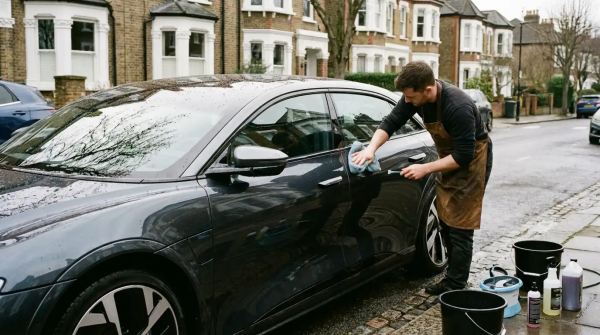
Tesla detailing for electric vehicles needs a slightly different kind of care. That includes Teslas, Polestars, BMW iX models, Audi e-tron cars, and other modern EVs with cameras, sensors, glossy trim, charging ports, and large glass panels. A lot of owners assume an EV is easier to wash because there’s no traditional engine bay to think about, and that part is, to be fair, simpler. In some ways, that is true. But it often means being more careful in other areas.
As a mobile detailing specialist working across West London, from Brentford TW8 and Ladbroke Grove W10 to Chiswick, Kew, Richmond, Notting Hill, and Chelsea, I keep seeing the same issues. Soft Tesla paint picking up swirl marks. Water getting pushed into sensitive spots. Flush door handles left dirty. Smears across cameras. And harsh brushes being used on premium cars that really should never go near them, which still happens surprisingly often. Good EV detailing usually comes down to the right method, not just using more products.
In this guide, I’ll walk you through safe Tesla detailing and EV detailing methods, explain why ceramic coating makes real sense for electric cars, and show how an eco friendly car wash approach fits naturally with EV ownership. It’s a practical match, especially for anyone who wants to protect paint, keep sensors and cameras cleaner, and avoid unnecessary wear. I’ll also cover why mobile car detailing is often the easiest option for busy owners, families, and enthusiasts.
Why EVs need a gentler wash process
Electric cars are not niche anymore. The International Energy Agency reported that more than 20 million EVs were sold worldwide in 2025, and 25% of all new cars sold were electric. That is a big shift. Because of that, more owners need care advice that really fits modern vehicles, instead of relying on older wash habits that probably were not designed with EVs in mind.
Key EV market figures showing why specialized EV care now matters
| EV Market Metric | Figure | Year |
| Global EV sales | 20 million+ | 2025 |
| Share of new car sales | 25% | 2025 |
| Oil demand displaced | 1.2 million barrels/day | 2025 |
With numbers like that, EV care is now a common topic rather than something only specialists think about, and that feels pretty normal at this point. In most cases, EV owners run into the same cleaning questions fairly quickly.
Electric car sales grew by 20% globally to exceed 20 million in 2025, meaning one-quarter of all new cars sold were electric.
— International Energy Agency, IEA, Global EV Outlook 2026
Tesla owner guidance supports the same careful method. Tesla recommends hand washing with a clean soft cloth, cold or lukewarm water, and a mild, high-quality car shampoo. That fits with what professional detailers often see in practice. Gentler contact usually lowers the chance of damage, especially on sensitive trim and delicate finishes.
The main risk points on an EV are easy to miss. Charging port doors should never be sprayed at close range with a strong pressure jet. Camera lenses and parking sensors can also get marked, and rough washing may even loosen them. On a Tesla Model 3 or Model Y, flush door handles can trap grime around the edges. On cars like the Model S or Model X, the large gloss and glass surfaces show marks very easily if they are dried badly. That is why a softer wash process matters so much for EVs.
Safe washing methods for Tesla detailing in real life
The safest way to wash a Tesla, or really any EV, usually starts before any water hits the paint. First, make sure the charge port is fully closed. If the car has Tesla Car Wash Mode, switch that on too. Tesla says this setting closes the windows, locks the charge port, disables the wipers, and changes other systems that might otherwise get in the way during a wash, which makes the whole process easier. It’s a small step, but it often prevents the kind of simple problems that can interrupt the rest of the wash.
For the wash itself, use a mild, pH-neutral shampoo with soft microfiber wash tools. Harsh brush washes are best avoided, and hot water is not a good idea either. Cold or lukewarm water is usually the safer choice for paint, trim, seals, and glass. A top-down approach works well here. Start with the roof glass and upper panels, then move to the doors and rear quarter panels. Leave the lower panels and wheel arches until later, since that’s where the heaviest grit usually collects and where scratching often starts.
Around cameras and sensors, a lighter touch matters. Keep your passes gentle and avoid scrubbing. You also do not want to hold a pressure lance too close to camera housings, badge areas, or the edges of the charging port. The same care should usually apply to glossy black trim and piano black pillars, which tend to scratch much more easily than many people expect.
Wheel care deserves attention too. EVs may create less traditional brake dust because of regenerative braking, but they still pick up plenty of road film, tar, and grime. Use wheel-safe products and separate tools for the wheels and the body. On premium EV detailing jobs, extra time around wheel arch liners and lower sensor zones often helps, because these areas trap grit and can splash dirt back onto freshly cleaned paint afterward.
Where Tesla detailing owners accidentally damage EV paint and trim
Most damage does not happen during a full deep detail. It usually happens during quick maintenance washes, which is probably the most frustrating part. That is especially true with Tesla detailing, since many owners and pros already know Tesla paint is often on the softer side. Because of that, bad wash habits tend to show up fast, and marks can appear earlier than people expect.
One common mistake is using too much pressure around the charging flap. Another is dragging dirt across the paint by using the same mitt or sponge on the whole car. Marks also often build up around flush handles, because people try to work dirt out with nails, stiff brushes, or a dirty cloth. That usually causes more damage than people think. A safer option is to pre-clean the handle edges with soft detailing brushes, then use a gentle all-purpose cleaner that is safe for painted surfaces, with nothing too harsh.
Families often need extra interior care too. White or light vegan leather seats in a Tesla Model Y can pick up denim dye, food marks, and pressure lines from child seats. Even so, soaking these surfaces is rarely a good idea. In most cases, a controlled low-moisture interior clean is the safer choice. The same goes for touchscreens. Spray the cloth instead of the screen, and use a product that does not leave an oily residue. That small habit can prevent a lot of unnecessary hassle.
For lease-return and presale customers, the goal is usually not just clean paint. It is also presentation, and helping the car look properly cared for. Light decontamination, careful machine polishing where needed, and trim revival can make a car look newer without overworking the finish. Owners in Richmond and Chelsea have often saved themselves a lot of stress at inspection time by dealing with swirl marks, stained interiors, neglected wheels, and other obvious issues early instead of leaving everything until the week before handover.
Why ceramic coating suits EVs so well
If there’s one upgrade that makes real sense for EV owners, it’s ceramic coating. The shine is part of the appeal, of course, but that’s not the only reason. It also helps with everyday wear on cars that often have delicate finishes and large panels where every mark tends to show.
A good ceramic coating adds a sacrificial layer over the paint. That helps cut down light wash marring, makes the car easier to clean, and improves how water moves on the surface. For anyone driving a Tesla Model 3 or Model Y every day through West London traffic, that often means less grime sticking to the doors, bonnet, and rear panels, along with fewer harsher washes over time. That matters here because even a careful wash still brings some risk of contact marks.
Ceramic coating also fits EV ownership for another reason: many drivers are already thinking about efficiency and sustainability. When the surface is protected, dirt usually comes off faster, so lower-water and lower-chemical maintenance becomes much more realistic if the wash method is done properly, which is the part that really counts. So the benefit is practical as well as visual. That’s probably why an eco friendly car wash approach feels like such a natural fit for EV ownership.
For owners looking for a stronger trust signal, certification matters. Ecoverde Valeting is an IGL Ceramic Coating Certified Installer, so the coating work is not treated like a quick add-on. That tends to matter most when someone is trusting a company with paint correction and long-term protection. Still, proper prep matters more than the bottle in this situation. If the paint is swirled, contaminated, or rough, coating over it locks those flaws in instead of improving the finish.
For drivers comparing options, professional car ceramic coating services and careful paint correction in London can work together to improve both protection and finish quality.
Eco-friendly methods make sense for EV owners
A lot of EV owners go electric because they want a cleaner, smarter way to drive, and that mindset often carries over to how they look after the car too. An eco-friendly car wash does not mean doing less. It is really about cutting down waste while still keeping the vehicle protected, which is usually what most owners want anyway.
For lightly to moderately dirty EVs, low-water and rinseless methods can work very well when they are handled by someone who really knows the process. In places such as Notting Hill, Ladbroke Grove, Brentford, and similar parts of West London, they are especially useful because space, drainage, and time are often limited, which is common there. What usually matters most here is proper lubrication, clean towels, careful technique, and knowing when a stronger rinse is still the better option. That is especially true when the car has picked up more grime than usual.
This approach can also make things easier for home visits and workplaces. Busy professionals do not always want to drive to a fixed valeting bay and wait around, so mobile car detailing lets the vehicle be cleaned where it is already parked, whether that is outside a home in Kew or at an office in Chiswick. It is simple and more practical for everyday life. EV owners also tend to benefit because public charging areas are shared spaces, so they usually are not the best place to leave a car for longer cosmetic work.
For West London owners who want specialist low-water vehicle care, Ecoverde Valeting fits that eco-conscious, mobile-first model in a way that works for premium cars as well as everyday family EVs, so it is not just for high-end vehicles. That is probably a big reason why this approach often appeals to EV drivers.
Drivers who prefer fully mobile maintenance can also look at the company’s mobile car wash service for routine exterior care between larger details.
How often Tesla detailing and EVs should be valeted or detailed
For most EVs that are used regularly, a full valet or detail every 4 to 6 weeks is usually a sensible routine. It helps stop contamination from building up and gives the trim, wheels, glass, and interior a proper reset before wear starts to show. If the car is parked outside under trees, used for school runs, or driven every day on busy roads, it often helps to do it a bit more often, especially with all that grime. In most cases, that kind of schedule keeps the car looking cleaner for longer.
The clearest signs that the paint needs more than a basic wash are usually easy to spot. In sunlight, swirl marks tend to show up quickly. You can also check whether water still beads or sheets off cleanly. One useful test is to lightly run a hand over the paint after washing. If it feels rough, it probably needs decontamination. On Teslas, it is also worth checking around the handles, cameras, and lower doors, because those areas often wear faster when they are ignored, and they collect more dirt than expected. These small checks can often save hassle later.
When choosing a service, trust usually makes a real difference. Ecoverde Valeting has 560+ 5-star reviews and Checkatrade verification, which gives owners some peace of mind that specialist care is backed by real customer experience. That is useful whether the vehicle is a family Model Y, a polished Model S, or another high-end EV needing careful cosmetic work before sale or return, when flaws often show most.
For anyone comparing options, a West London mobile car valeting and detailing service can save time and still give EVs the gentler process they need. Owners needing deeper cleaning can also consider a dedicated car detailing service for paintwork, trim, and interior care.
Frequently Asked Questions
Is Tesla detailing different from normal car detailing?
Yes. Tesla detailing needs more care around flush door handles, cameras, sensors, charging ports, large glass areas, and soft paint. The basic goal is still to clean and protect the car, but the wash method has to be gentler and more controlled.
Can you use a pressure washer on an EV?
You can, but with caution. Keep pressure away from the charging port, camera lenses, sensors, and trim edges, and never use a close, aggressive jet on those areas. A safe hand-wash method is usually better for long-term cosmetic care.
How often should a Tesla or EV be professionally detailed?
A full valet or detail every 4 to 6 weeks works well for most daily-driven EVs. Cars used for commuting, school runs, or street parking may need more frequent maintenance, especially if the paint is unprotected.
Is ceramic coating worth it for a Tesla Model 3 or Model Y?
For many owners, yes. Tesla paint can mark easily, and ceramic coating helps with gloss, easier cleaning, and lower wash friction over time. Ecoverde Valeting also offers this with IGL-certified installation, which is useful if you want coating work done with proper prep rather than as a rushed add-on.
What makes an eco friendly car wash better for EV owners?
It uses less water, careful product choice, and low-waste techniques without sacrificing finish quality. That suits many EV owners who already value sustainability and want a cleaner maintenance routine at home or work.
Can mobile car detailing work for luxury EVs and lease-return cars?
Yes, if the service is set up for specialist work rather than a quick wash. Mobile car detailing is often ideal for busy owners because the car can be inspected, cleaned, and protected without wasting time at a fixed location. Ecoverde Valeting is one local example in West London for owners who want premium vehicle care brought to them.
Keep your EV cleaner, safer, and easier to maintain
The best EV detailing is usually careful, not aggressive. Hand washing with a mild shampoo, soft microfiber tools, and sensible pressure control will often do a better job than a rushed wash with harsh contact, because that is where many marks begin. Teslas and other EVs need extra care around charging ports, cameras, sensors, flush handles, wheels, and those large glossy panels. These small details often make the difference when the aim is to keep the car looking sharp without causing the same kind of damage the wash was supposed to avoid.
For the easiest ownership path, routine maintenance works best when paired with proper protection. A regular valet every 4 to 6 weeks helps keep road grime, brake dust, and everyday dirt under control. A ceramic coating makes cleaning easier and helps protect delicate paintwork, which will likely save effort later. An eco friendly car wash method also cuts water and product waste, which matches what many EV owners already care about.
For busy West London drivers, the biggest advantage of mobile car detailing is time. Care can be arranged at home or at work, so there is no need to lose part of the day at a wash bay or driving across town. That makes it easier to keep a Tesla or EV in better condition through winter, summer, and everything in between. If the paint has lost its gloss, water no longer beads, or the interior needs a proper reset, booking online is likely the easiest next step.