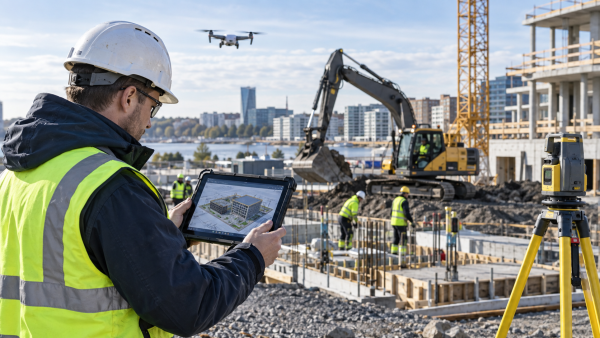
Finland’s construction industry has changed more in the last decade than in any previous period of its history. Ten years ago the most important tool on a job site was a tape measure and a set of paper drawings. Today the same site might have drones flying overhead, sensors buried in the ground and even partially autonomous machinery doing the digging. The year 2027 looks like a turning point, where digital tools are no longer experiments but everyday reality on Finnish construction sites from Helsinki to Rovaniemi. This article looks at which technologies are actually shaping Finnish construction right now and what they mean in practice, both for large contractors and for people building their own homes.
Why the construction sector is digitizing so quickly in Finland
Finland’s construction sector has long struggled with a productivity problem. Compared with many other industries, productivity growth in construction has been slow, and at the same time labor shortages have hit the industry hard, especially in the Helsinki region and other growth centers. Digitalization has been seen as one of the main answers to this challenge. When project information flows in real time from designer to worker on site, mistakes drop and schedules hold up far better than they used to.
Another reason digitalization is accelerating is that companies such as Marulla and other industry voices have made it clear that construction technology is no longer reserved for large publicly listed firms. More and more small and mid sized construction businesses are adopting affordable cloud based tools that used to be available only to the biggest players. This is spreading better practices across the whole sector and raising the general quality bar.
Autonomous machinery and sensor data on site
One of the most visible changes is the growing use of autonomous and semi autonomous machinery. Excavators that can carry out precise digging work guided by a GPS model are no longer rare on large infrastructure projects. The main benefit of these machines is accuracy. When a machine repeats the same motion hundreds of times a day, following the plan exactly, the amount of rework and error drops significantly.
VTT Technical Research Centre has studied this topic extensively and pointed out that progress in sensor technology has been just as important as automating the machines themselves. Sensors installed on site continuously collect data on soil moisture, the curing rate of concrete and small movements in structures. This data means problems can be caught before they turn into expensive repairs. In Finland’s cold and damp climate this matters a great deal, since damage caused by frost and meltwater has traditionally been one of the costliest risks in any building project.
Artificial intelligence in project management
The role of artificial intelligence in construction is no longer limited to guiding machines. More and more project management software now uses machine learning to optimize schedules, forecast material orders and flag risks as early as the design stage. Such software can compare a current project against hundreds of past projects and highlight the exact point where delays typically occur.
Rakennusteollisuus RT, the Confederation of Finnish Construction Industries, has highlighted that improving communication between subcontractors and main contractors through AI assisted tools has produced measurable savings on several Finnish projects. When every party sees the same up to date information in the same system, misunderstandings and duplicated work fall sharply. This matters especially in Finland, where the building season is short and every lost working day costs more than it would in many other countries.
Sustainability requirements are getting stricter
Alongside technology, the second major driver of change is tightening sustainability requirements. The EU’s building energy efficiency directive and national emissions targets are forcing the industry to rethink both material choices and construction processes. Sitra, the Finnish Innovation Fund, has noted in several reports that construction is one of the largest sources of carbon emissions in Finland, which means changes made in this single sector have an outsized effect on the country’s overall climate goals.
In practice this shows up as a renewed interest in wood construction, greater use of recycled materials and much more precise life cycle emissions calculations done already at the design stage. Digital tools make this calculation far easier than before, since the data no longer sits scattered across separate spreadsheets but lives in a single connected system.
What this means for people building their own home
Although most of the headlines concern large infrastructure projects and urban development, the ordinary homeowner building or renovating a house benefits from these changes too. Many of the new design programs are now available to individual clients, allowing them to simulate, before a single shovel touches the ground, how a house will perform for energy use and indoor air quality across different seasons.
A practical tip is to ask any construction company you are considering which digital tools they actually use to track a project. A firm that can offer a real time view of progress on site is usually also keeping up with the wider trends in the industry. This can lower stress considerably over the course of a long building project, since you know exactly what stage things are at instead of relying purely on phone updates.
The pace of change in construction technology shows no sign of slowing down. If anything, 2027 is likely to be just the beginning of how data, automation and sustainability requirements reshape Finnish construction over the coming decade. Both industry professionals and ordinary homeowners have good reason to keep an eye on these developments, since they will eventually touch almost everyone’s home and daily life in one way or another.
Frequently asked questions
Are fully autonomous construction machines already common in Finland?
Fully autonomous machines are still rare, but semi autonomous solutions, where a machine handles part of the work under GPS guidance while an operator supervises, are already fairly common on larger infrastructure sites.
Should someone building a house worry about AI being involved in the process?
There is no need for concern. Artificial intelligence in this context acts as a support tool that helps with planning and scheduling, it does not replace human work or decision making on the actual building site.
How can you tell if a construction company keeps up with the latest technology?
A good way to find out is to simply ask what digital tools the company uses for project management and whether it offers clients a real time view of how the work is progressing.