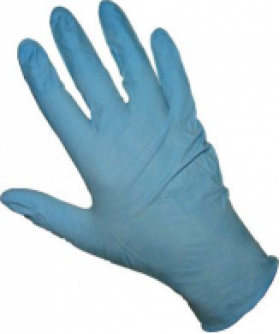
Stand at a butcher’s counter and the disposable gloves are nearly always blue. Walk into a garage and they are nearly always black. Often the same material, the same box of 100, the same price per glove. The colour is doing a job in both places and it has nothing to do with branding.
I went looking into this because a small food producer asked me something I could not answer properly. She wanted to know whether the blue nitrile gloves her husband bought by the case for the workshop were the same gloves she was buying at four times the price for the prep room. Search for an answer and you get supplier pages that say “food safe” without saying what that means, and forum threads where several people disagree with total confidence. This is the version I wish had come up.
Blue is used because nothing in food is blue
The reason for blue in food handling is foreign body detection. Blue barely occurs in food naturally, so a torn fingertip in a tray of mince or a fragment in a mixing bowl stands out instead of disappearing into the product. It is the same logic behind blue catering plasters and blue cleaning cloths.
Larger plants go further with metal detectable gloves, which carry a metal loaded additive so an inline detector picks up a fragment nobody spotted by eye. For a shop cutting to order that is overkill, and the colour on its own does most of the work.
Black in a garage runs the opposite way. Black hides oil and grease, so the glove still looks usable after ten minutes on a gearbox and the mechanic keeps it on instead of stripping it off because it looks filthy. Hiding contamination is a feature in one room and a serious problem in the other.
Powder free is the spec that actually matters
Older disposable gloves came dusted with cornstarch to make them easier to pull on. That powder goes airborne when you snap a glove onto your wrist, and in a latex glove it carries latex proteins with it. The US FDA banned powdered patient examination gloves in 2016 on that basis. Food operations moved the same way without being pushed, because loose starch drifting near open product is a question you do not want an inspector asking you about.
Any box worth buying says powder free on the outside. If it does not say it, assume it is not.
Latex, and why butchers gave up on it
Natural rubber latex is comfortable and cheap and it is a genuine allergen. In a food setting the allergen is the whole problem, because the protein can transfer to what you are handling. Nitrile also resists punctures better, which counts when your hands are working near bone and a boning knife. Most butchery and catering operations switched years ago and have not gone back.
What the standards on the box do and do not tell you
This is where the confusion actually lives. A box of blue nitrile gloves will typically carry EN 455, the medical examination glove standard covering things like freedom from holes and the AQL figure. It may carry EN ISO 374 for chemical and micro-organism protection, and EN ISO 21420 for general protective glove requirements. It will carry a CE mark.
Not one of those is a food contact declaration.
In the UK and the EU, materials intended to touch food fall under Regulation (EC) No 1935/2004. Compliance is evidenced by a Declaration of Conformity from the manufacturer, and food contact packaging usually carries the glass and fork symbol. A well made powder free blue nitrile glove might be entirely suitable for the job, but “medical grade” and “CE marked” are different claims to “declared for food contact”, and a supplier who cannot produce the declaration has not made that claim.
That distinction is worth real money to a small operator. It is the difference between buying one expensive box for everything and buying two cheaper boxes and using each for what it is for.
How that works out in practice
Most independent food businesses I have spoken to end up with more than one glove on the shelf. Direct handling of open product gets the blue, powder free, food contact declared box, changed often and binned. Everything else, the cleaning down, the yard, the delivery run, the packing of outer cases, gets an ordinary workshop box. A trade priced case such as https://greasemonkeydirect.co.uk/products/box-of-100-nitrile-gloves-large-powder-free covers that side of it perfectly well at a fraction of the cost, without anyone pretending it is certified for something it is not.
The same glove range is also where cut resistant gloves and sleeves sit, and for a butchery that is the more interesting purchase. Glove fragments in product are rare. Knife injuries are not.
The handling question gets bigger once a shop starts posting orders out. HERD Butchery in Butlersbridge, County Cavan is a reasonable example of the shift: a craft butcher working a full animal approach that now ships chilled parcels around Ireland. Mail order adds steps. Cutting, weighing, wrapping, boxing with gel packs, labelling. Each one is another pair of hands, and a glove policy has to survive all of them rather than just the counter.
Where this advice stops
Colour coding is a convention rather than a legal requirement in most places, and your environmental health officer has the final say on what your operation needs. I am not one. What I would do before the next order goes in is turn the box over. If the glass and fork symbol is not on it and your supplier cannot send you a Declaration of Conformity, that box belongs in the van rather than on the prep bench.