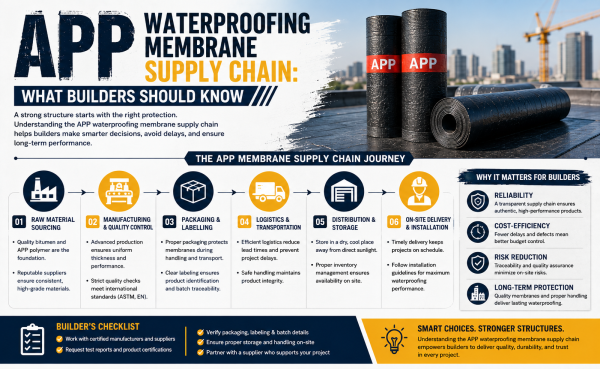
Every builder who’s run a large project long enough has a supply chain horror story, and materials like waterproofing membrane tend to feature in more of them than you’d expect. It’s not glamorous material — nobody’s tracking APP membrane delivery the way they track structural steel or major equipment — but a waterproofing shortfall at the wrong moment can stall a roofing crew for weeks, push back the entire building envelope schedule, and create a domino effect through every trade waiting to close in behind them.
Unlike smaller residential jobs where a supply hiccup might mean a short delay, large-scale commercial and infrastructure projects operate on tight sequencing where waterproofing often sits on the critical path. A membrane shortage doesn’t just delay the roofing crew — it delays weatherproofing, which delays interior trades, which delays the whole handover schedule. Understanding how the APP membrane supply chain actually works, and where the real risk points sit, is worth the attention of any builder managing a project at scale.
Why APP Membrane Supply Chains Behave Differently Than Other Materials
APP modified bitumen membrane isn’t a simple commodity product sitting on a shelf ready to ship in any quantity at any time. Production involves blending APP polymer into a bitumen base at controlled temperatures, applying reinforcement, and finishing with the appropriate surfacing — a process that runs in batches, on production schedules that manufacturers plan around their broader order book, not around any single buyer’s project timeline.
This matters because it means lead times aren’t just a function of shipping distance. A manufacturer with a full production schedule might quote a longer lead time even for a buyer close by, while a manufacturer with open capacity might turn around an order faster despite being farther away geographically. Builders who assume lead time scales predictably with distance sometimes get caught out by this — the actual driver is production capacity and scheduling, with shipping time added on top.
Raw material availability adds another layer. Bitumen pricing and availability track petroleum markets, and APP polymer supply has its own separate market dynamics. Significant swings in either can affect a manufacturer’s production costs and, in tighter markets, their willingness to commit to fixed pricing on larger forward orders. Builders sourcing for projects with long planning horizons — where the material order gets placed months before it’s actually needed on site — benefit from understanding this volatility rather than assuming quoted pricing will hold indefinitely without confirmation closer to the actual order date.
Lead Times: What Actually Drives Them
For builders planning procurement schedules, it helps to break lead time down into its real components rather than treating it as a single number a supplier quotes upfront.
Production scheduling is usually the largest variable. A manufacturer already running APP membrane production for other orders may be able to add a buyer’s order into a nearby batch run with minimal delay, while a request for a less common thickness or surfacing combination might need to wait for the next scheduled production run of that specific specification. Asking directly about current production scheduling, rather than accepting a generic quoted lead time, often reveals more accurate timing.
Order size relative to standard batch runs also affects timing. An order that fits neatly within a manufacturer’s typical batch size tends to move faster than one that’s unusually small (and not worth a dedicated production run) or unusually large (requiring multiple batch runs or additional scheduling coordination).
Shipping method and distance add the more familiar layer of lead time — ocean freight for large international orders typically runs several weeks depending on origin and destination ports, on top of production time, while regional or domestic sourcing can compress this significantly for builders working within reach of a manufacturer’s shipping network.
Customs clearance and inland transport at the destination end round out the full timeline, and these steps are often where unexpected delays creep in even when production and shipping went smoothly. Builders working with an experienced freight forwarder, and a supplier who prepares documentation correctly the first time, generally see fewer surprises at this stage.
For large projects, the practical takeaway is to build procurement timelines around realistic total lead time — production plus shipping plus customs and inland transport — rather than the headline production time alone, which is often the number quoted first but rarely the full story.
Bulk Ordering: Getting the Timing and Terms Right
Large infrastructure and commercial projects typically order membrane in volumes well beyond what a smaller job would need, and this changes the sourcing conversation in a few important ways.
Placing a bulk order early enough to align with a manufacturer’s production scheduling, rather than requesting a rush order once the roofing crew is already mobilized and waiting, gives builders meaningfully more leverage on both pricing and delivery reliability. Manufacturers generally prioritize orders that fit well into their existing production planning, and a builder who can commit to a delivery window that works for the factory’s schedule often gets better terms than one demanding compressed timelines against an already-tight production calendar.
It’s also worth discussing whether a large order can be split into staged deliveries rather than a single shipment, particularly for projects where the full membrane quantity isn’t needed on-site simultaneously. Staged delivery reduces on-site storage requirements and the risk of weather damage to stockpiled rolls waiting for installation, while still locking in pricing and production commitment for the full order upfront.
For projects large enough to represent a meaningful share of a manufacturer’s capacity, it’s reasonable to discuss forward contracts or price locks that protect against raw material volatility over the life of a multi-phase project, since bitumen and polymer input costs can shift meaningfully over a project timeline that spans many months.
Case Study: Sourcing for a Large-Scale Infrastructure Project
Consider a scenario common to large commercial and infrastructure builds: a project requiring APP membrane across multiple flat-roof structures, phased over an 18-month construction schedule, with roofing work on different buildings scheduled to begin at different points throughout the project.
A builder approaching this without a clear supply chain strategy often defaults to ordering membrane project-phase by project-phase, requesting delivery shortly before each roofing crew mobilizes. This approach feels lower-risk on paper — smaller individual orders, less capital tied up in early inventory — but it actually increases exposure to the production scheduling and lead-time variability described above, since each order effectively restarts the lead-time clock and competes against whatever else is in the manufacturer’s production queue at that moment.
A more resilient approach locks in the full project’s membrane requirement with the manufacturer early, even if delivery is staged to match each phase’s construction schedule. This gives the manufacturer visibility into total demand across the project timeline, allowing them to plan production accordingly rather than treating each phase as a separate, unpredictable order. It also protects the builder against mid-project price increases or capacity constraints that might affect a manufacturer’s ability to accommodate a late-stage rush order for the final project phases.
For this kind of project, working directly with an established APP waterproofing membrane supplier — one with sufficient production capacity to handle the full project volume and a track record of reliable staged delivery — reduces the coordination burden considerably compared to managing multiple smaller suppliers across different project phases, each with their own lead times, quality standards, and communication practices.
Managing Risk When a Single Source Isn’t Enough
For very large projects, or ones where schedule risk is particularly costly, some builders choose to qualify a second manufacturer alongside their primary APP waterproofing membrane supplier, specifically as a contingency rather than a routine dual-sourcing strategy. This isn’t about splitting every order between two suppliers, which tends to complicate quality consistency and dilute the volume-based pricing leverage of committing to one manufacturer. Instead, it means having a vetted, ready-to-activate backup that’s already passed sample testing and certification review, so that if the primary supplier hits a genuine capacity constraint or unexpected disruption, the builder isn’t starting the vetting process from zero under time pressure.
This kind of contingency planning is worth the modest upfront effort primarily on the largest or most schedule-sensitive projects, where the cost of a multi-week membrane delay meaningfully exceeds the administrative cost of qualifying a backup source in advance. For smaller or less time-critical projects, the added complexity of managing two supplier relationships usually isn’t justified, and a single well-vetted manufacturer with realistic lead-time visibility is the more practical approach.
Weather and seasonal demand also deserve a place in supply chain planning, particularly for builders in regions with a defined construction season. Membrane demand tends to spike ahead of favorable installation weather, and manufacturers see predictable seasonal surges in order volume. Placing orders ahead of that seasonal rush, rather than competing for production capacity during the industry’s busiest months, is a simple but often overlooked way to improve delivery reliability without any change in supplier relationship at all.
Building Supply Chain Resilience Into Project Planning
The broader lesson for builders managing material-intensive projects is that waterproofing membrane, despite not being the most visible material on a project, deserves procurement planning proportional to its actual position on the critical path. A shortage in structural steel gets noticed and escalated immediately; a membrane delay sometimes doesn’t get flagged until the roofing crew shows up with nothing to install, by which point the schedule impact is already locked in.
Building supply chain resilience means engaging with suppliers early, understanding real production lead times rather than headline quotes, considering staged delivery for large or phased projects, and maintaining enough visibility into the manufacturer’s capacity and scheduling to catch potential delays before they become site-level problems. For large infrastructure and commercial projects in particular, treating membrane sourcing with the same procurement discipline applied to more visible materials is one of the more reliable ways to keep a tight construction schedule from unraveling over something as preventable as a supply chain gap.