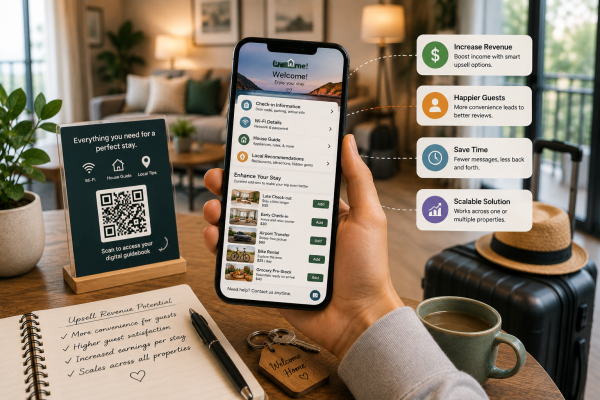
Most hosts think about their guidebook purely as a support tool. Something that answers questions, cuts down on messages, makes the stay smoother. All true, and all worth doing on their own merits. But there’s a second function that hosts running multiple properties have started paying closer attention to, and it’s the revenue side of the same document.
A digital guidebook, unlike a printed folder, is something a guest opens repeatedly throughout a stay. That repeated attention is valuable real estate, and hosts who’ve started treating it that way are seeing meaningful extra income per booking without adding operational overhead.
The Numbers Behind This
Industry data on short-term rental upsells has gotten more specific over the past couple of years, and the ranges are worth knowing if you haven’t looked at this closely. Properties offering a handful of well-priced add-ons, things like early check-in, late checkout, and equipment rentals tend to see somewhere between a couple hundred and several hundred dollars in additional revenue per stay. Late checkout alone often gets taken up by close to half of guests when it’s priced reasonably and offered at the right moment, usually the day before departure rather than buried in a pre-arrival message nobody reads carefully.
None of this is huge on a per booking basis. A single late checkout fee isn’t going to change anyone’s year. But multiply it across every stay, every month, across however many units a host manages, and the number stops looking small fairly quickly.
What Actually Sells
Not every upsell performs the same, and it’s worth being specific about what tends to convert.
Late checkout. Consistently one of the highest converting options, particularly for guests with afternoon or evening flights who’d otherwise be dragging luggage around a city for hours.
Early check in. Similar logic in reverse is valuable for guests arriving on morning flights who don’t want to wander until a standard 3pm check-in.
Airport transfers. Especially useful in cities where public transit from the airport is confusing or where guests are traveling with a group and luggage.
Equipment rentals. Kayaks, bikes, beach gear, this performs particularly well at coastal or mountain properties where the activity is the whole point of the trip and renting locally at full price is genuinely inconvenient.
Prestocked groceries. A small convenience fee to have basics waiting on arrival tends to appeal to families and older travelers who’d rather not shop the first night after a long trip.
Why the Guidebook Is the Right Place to Offer This
Timing and framing matter more than the offer itself. Airbnb’s own booking flow doesn’t really support upsell pricing, which is part of why hosts route this through a separate channel, usually a digital guidebook or guest portal that guests are already opening for other reasons.
A digital guidebook for Airbnb hosts that includes an upsell section solves this cleanly. Guests see the offer at the exact moment it’s relevant, browsing checkout details a day before departure and noticing a late checkout option right there in the same section, rather than receiving a separate promotional message that reads like a sales pitch. Framed this way, as a convenience sitting next to information they already needed, conversion tends to be noticeably higher than a cold offer sent through a generic message.
Why This Matters More as You Scale
A single property owner might treat this as a nice bonus. A host or property manager running ten, twenty, or thirty units treats it very differently, because the math compounds in a way that’s easy to underestimate until it’s actually tracked.
A modest portfolio pulling in a few thousand dollars a month in upsell revenue, purely from options guests were already inclined to want, represents a meaningful chunk of annual income that required close to zero incremental labor once the system was set up. Compare that to the cost of manually managing these requests over text message, checking availability, confirming payment, and updating cleaning schedules by hand, and the labor savings alone justify moving to a structured digital format before even counting the extra revenue.
The Trust Factor Behind Higher Conversion
There’s a psychological piece worth naming directly. A guest who’s already been using the guidebook for two days, checking Wi-Fi, reading local recommendations, and following the appliance instructions, has built a small amount of trust in that resource by the time checkout approaches. An offer that shows up inside a tool they’ve already found useful lands differently than an unsolicited message from a stranger asking for more money.
This is part of why cold upsell messages sent through Airbnb’s messaging system tend to underperform compared to the same offer placed inside a guidebook a guest has already been relying on. Context changes how an offer reads, even when the price and the service are identical.
Where Hosts Tend to Get This Wrong
The most common mistake is offering too many add-ons at once, turning the guidebook into something that feels like a checkout page at an airport car rental counter, upsell after upsell stacked on top of each other until the guest just closes the tab. Guests respond better to a short, curated set of options that feel genuinely useful rather than a long menu that feels like the host is trying to extract every possible dollar.
The second mistake is pricing without checking what similar properties nearby actually charge. A late checkout fee that’s noticeably higher than what guests would expect for the area tends to depress conversion even if the convenience itself is genuine. A quick look at what comparable listings in the same market charge for the same add-ons keeps pricing in a range guests are actually willing to pay.
Tracking What Actually Works
Once a handful of upsells are live, the next step is watching which ones actually convert and adjusting from there. A host managing several properties might find early check-in performs well at one location near a business district, where guests tend to arrive on morning flights, while late checkout performs better at a beach property where guests are squeezing every possible hour out of a vacation before an evening flight home.
This kind of pattern only becomes visible once there’s actual data to look at, which is another argument for starting with a small, trackable set of offers rather than a long list that makes it hard to tell what’s actually driving revenue. A simple monthly check, revenue per upsell type divided by total bookings that month, is usually enough to spot which options are worth keeping and which aren’t earning their place in the guidebook.
Setting This Up Without Overcomplicating It
Start narrow. Two or three upsells, priced conservatively at first, placed in the guidebook section a guest naturally visits around the relevant moment; checkout details for late checkout; and arrival information for early check-in or airport transfer. Expand once you see what guests actually take up, rather than guessing at a long list of add-ons from day one.
Pricing matters too. Fees that feel proportional to genuine convenience tend to convert well. Fees that feel like a host squeezing extra margin out of a guest tend to generate resentment instead of revenue, and that trade-off isn’t worth it for a few extra dollars per stay.
The Bigger Picture
None of this replaces good hospitality or turns a guidebook into a storefront guests resent opening. Done well, upsells inside a digital guidebook feel like genuine convenience, options a guest would have wanted anyway, made easy to access at the right moment. For hosts thinking seriously about scaling a short-term rental business, this is one of the lower-effort, higher-return changes available, and it starts with a tool most hosts already have in some form, just not yet built to actually capture the revenue sitting inside it.