
TLDR: Google AI Overviews have changed SEO from a rankings-only game into a visibility and citation challenge. Even pages that rank at the top can see a sharp drop in CTR once AI summaries appear, which makes this change hard to ignore.
The article walks through nine practical tactics: publish original content backed by real experience, answer queries fast with easy-to-pull formatting, build topic clusters, improve technical SEO, use schema to make meaning clearer, show trust signals, add citation-friendly assets like tables and FAQs, track AI Overview visibility and CTR, and use AI to scale research and improvement rather than replace strategy.
The main point stays simple: brands need content that not only ranks, but also gets cited. Teams should review existing pages, make clarity and trust stronger, and use the best ai seo tool to support flexible, brand-safe workflows, so growth does not come at the cost of control.
Google search is changing quickly, and every ai seo tool is adapting to the shift. Ranking in the top 10 still matters, but it’s no longer the whole story. Users now often see an AI Overview before the classic blue links, which is a pretty big shift. That means content has to do two things at once: rank in regular search results and also be easy for Google to understand, trust, and cite in those AI Overview summaries.
For digital marketers, SEO teams, and content managers, this shift is hard to ignore. At a SaaS company, an e-commerce brand, or another growing online business, it’s probably already showing up in Search Console. Some pages still sit on page one or in the top 10, yet clicks feel weaker. That usually isn’t just a hunch. Current research shows AI Overviews are common, and they often cut clicks when they appear above standard organic results, especially for informational searches. At the same time, being included in those summaries can help protect visibility and keep a brand in front of people.
So when someone asks how to rank in Google now, the answer is simple, even if it isn’t easy: create content that deserves to be cited. This guide covers 9 tactics that actually work. It looks at people-first content, stronger formatting, technical SEO, topical authority, schema, E-E-A-T, and smarter measurement. It also looks at how an ai seo tool and solid ai content optimization workflows can help teams grow without turning a site into a pile of generic content, which is usually exactly what needs to be avoided.
Why AI Overviews Changed SEO Goals
For years, SEO teams were chasing one main outcome: better rankings and more clicks. That still matters, of course. But AI Overviews changed the search results page, and that shift changes what success often looks like. In many cases, users now see a quick summary at the very top before they even decide whether to click, which can change behavior quite a bit.
Ahrefs reported that AI Overviews appeared on 48% of queries in its March 2026 update, and top-ranking pages saw 58% lower CTR when those summaries appeared (Ahrefs). Pew Research Center also found that people were less likely to click a traditional result when an AI Overview was there.
How AI Overviews are changing search behavior
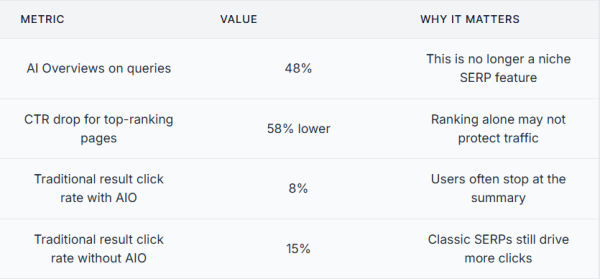
Source: Ahrefs and Pew Research Center
That doesn’t mean SEO is dead. Not even close. It means the goal is broader now. Ranking still matters, but teams also want to become trusted sources that Google can use in its summary. Because of that, many are moving beyond rank-only tracking and paying closer attention to citation visibility, answer extraction, and brand presence, which are all pretty practical signals here.
Google’s guidance, meanwhile, has stayed pretty consistent. It still emphasizes useful, original, satisfying content along with a strong page experience (Google Developers). So the tactics below build on that base. In most cases, teams are not starting over, they’re just adjusting how they define success.
1. Publish Content That Adds Something New With an AI SEO Tool
This first tactic is still usually the most important one. When a page says pretty much the same thing as everyone else, it probably won’t stand out in organic search. It’s also less likely to be cited in AI Overviews, which matters here in a very real way.
Google has been pretty clear about this.
Focus on your visitors and provide them with unique, satisfying content.
— Google Search Central / Google Developers editorial guidance, Google Developers
It sounds simple, but a lot of teams still miss it. They end up publishing safe, generic pages that mostly repeat common advice. AI tools can make that problem worse when they’re used just to speed up drafting, and you can usually spot when that happens. Better ai content optimization isn’t about adding more words. It’s about making pages clearer, more specific, and more useful. In most cases, that’s what “new” should really look like:
Add first-hand insight
Use real examples from campaigns, product data, support tickets, customer objections, or even sales calls, the messy parts too. That usually helps. SaaS brands can show what changed before and after a content update, while e-commerce teams can explain buying criteria, return patterns, and the reasoning behind product comparisons, which honestly makes things clearer.
Add original structure
A vague topic usually works better when you turn it into a clear framework. For example, instead of writing a broad page on ‘SEO automation’ (it’s often too loose), build a practical model that shows what to automate, what people should review, and what should be measured each week.
Add opinion backed by evidence
Useful content does not need to sound neutral or bland. It can take a clear position when that view is truly earned. If one workflow is better than another, explain why and keep it concrete. Specific details usually make it easier to show what works better and why that difference matters in real use.
This is also where a strong ai seo tool can help in many cases. The best ai seo tool should support gap analysis, SERP research, and your team’s process. Even then, your team still needs to add judgment, examples, and brand voice. That part is often what matters most.
2. Answer the Query Fast and Make It Easy to Extract
AI Overviews pull together short, direct answers. When a page hides the main point under a long intro or vague, fluffy copy, it usually makes Google’s job harder, and probably yours too.
The fix is pretty simple: make the page easy to scan and easy to quote, so the answer appears fast.
Use a simple AI SEO tool page pattern
A clear format usually works best when the direct answer is near the top. After that, add a short definition or summary paragraph, then use clear H2s and H3s. Bullets, lists, and steps also help, especially when there’s a bit of supporting detail after the main answer.
It can also help to treat each section like a small answer block. If someone asked one sub-question out loud, could Google likely pull that section and use it with little extra work? That’s often a really good test.
Write for follow-up questions
In AI search, users often ask more detailed follow-up questions. They search in chains, so one query can easily lead to the next, and that’s pretty normal. That’s why it helps not to stop at the obvious keyword. Go a bit broader and cover related intent such as:
- what it is
- why it matters
- how to do it
- mistakes to avoid
- best tools
- examples
- costs
- alternatives
This is where modern content workflows become a lot more useful. The best platforms usually do more than draft posts. They can analyze competing pages, find missing subtopics, suggest relevant internal links, and help keep formatting consistent across many URLs, which honestly saves time. That matters because AI systems often prefer pages they can understand quickly.
Google AI Overviews Explained | What They Mean for Your SEO
When thinking about how to rank in Google today, keep this in mind: if a person can’t find the answer quickly, an AI system probably won’t trust the page as much either.
3. Build AI SEO Tool Topic Clusters, Not Isolated Articles
One great article can help, sure. But a stronger content setup usually does more, at least in this view. AI Overviews seem to reward wider topical depth, not just one page that gets lucky. When a site includes a guide, a comparison page, a glossary entry, an FAQ, a case study, and a product page around the same theme, it sends a much stronger authority signal.
That tends to matter a lot for SaaS and e-commerce brands, probably more than many people expect. Buyers rarely convert from one short blog post. They compare options, check pricing, review use cases, and look for proof as they go. That is usually the real journey. Content should support that full path and help people move from early research to a final decision.
A simple cluster example
If the core topic is ‘ai content optimization,’ one useful cluster could include:
- a pillar guide on ai content optimization
- a page on content briefs for AI-assisted SEO
- a comparison of manual editing vs AI-assisted updates
- a checklist for technical SEO before publishing
- a case study showing traffic growth after refreshes
- FAQs about AI content detection and quality
This kind of cluster usually helps in two ways at the same time. It lets users explore the topic in more depth, which is often the main goal, while also giving search engines the internal context they need to understand expertise.
Many modern SEO platforms now support more than just the writing part of the process. They can help teams plan clusters, find content gaps, manage internal links across larger sites, and keep a clearer view of what has already been published. That is especially helpful for mid-sized businesses with large or growing sites. Missed internal linking opportunities and outdated pages can slowly hurt visibility over time, and most teams do not notice it right away.
For teams comparing platforms, guides on SaaS SEO tools can also help clarify which workflows fit larger publishing operations best.
In the past, a brand might publish one article and simply hope it ranks. Now, a brand can build a fuller set of content around the topic instead. It gives the topic stronger support through related pages, clearer internal links, and fresher updates, which usually means a better chance of supporting rankings and AI Overview citations when people are actively searching.
4. Strengthen Technical SEO So Google Can Actually Use Your Content
A lot of teams brush this off because it feels less exciting than content strategy, which makes sense. But AI Overviews still rely on the same basic search systems: crawling, indexing, rendering, and properly understanding pages.
If content is hard to reach, stuck behind scripts, orphaned, duplicated, or just slow, Google usually has less to work with. That means less to use and, in most cases, less reason to show it.
Focus on the basics first
Your key content should be:
- indexable in HTML
- linked from relevant pages
- not blocked by robots rules by mistake
- using clean canonicals
- fast enough on mobile
- easy to read above the fold
Google also points to page experience in its AI search guidance, which usually isn’t much of a surprise.
Ensure that you’re providing a good page experience for those who arrive either from classic or AI search results, such as whether your page displays well across devices, latency of your experience, and whether visitors can easily distinguish main content from other content.
— Google Search Central / Google Developers editorial guidance, Google Developers
This often matters even more for teams publishing at scale across WordPress, Ghost, or Webflow. On busy teams, these basics are easy to miss. In many cases, production speed gets most of the attention, while crawl hygiene quietly slips, especially when content moves through different people and systems.
Strong technical SEO helps other work do better.
A good ai seo tool should help with writing, but it should also support internal linking, publishing workflows, content refreshes, and structured outputs that work with your CMS cleanly. That’s a big reason teams use platforms like SEOZilla.ai: to generate content while keeping it matched with brand voice, internal structure, and publishing systems.
Teams researching browser-based optimization workflows may also find value in these SEO toolbar extensions for browsers, especially for technical reviews and SERP analysis.
5. Use Structured Data to Clarify Meaning, Not to Cheat the System
Schema is not some magic trick for AI Overviews, and it probably never was. Google has not said that adding markup by itself will get a page cited. Even so, it still matters. In most cases, it helps search engines understand the page more easily by removing confusion and making the meaning clearer.
For example, schema can help search engines understand:
- what type of page this is
- who wrote it
- what product is being discussed
- what questions the page answers
It can also make it clear which organization is behind the content, and that context is often useful.
On SaaS sites, Article, FAQPage, Organization, and Person markup can support trust and make the content easier to understand. For e-commerce, Product, Review, and merchant-related details usually matter more, especially on product and category pages.
Search behavior is also moving beyond informational queries. Search Engine Land reported that AI Overviews appeared on 14% of shopping queries, which suggests that commercial and buying-intent searches are shifting too (Search Engine Land). Because of that, structured product information and trust-focused content may matter more now than they did before, or at least that seems to be where things are heading.
The main point is simple: use schema to clarify facts that already exist on the page, not as a shortcut. It should not be treated like a fix for weak content. Schema will not save thin pages. But when a page is already strong, clear markup can help search systems understand it with more confidence, which usually means fewer mixed signals about what the page is saying.
6. Show Real Experience and Trust Signals With an AI SEO Tool Workflow
AI Overviews are made to sum up useful sources, that’s the whole point. So trust matters even more here. If a page has no author, no proof, no examples, or really no sign of real first-hand experience, it’s often much easier to ignore, which honestly makes sense here.
Add visible credibility cues
Strong trust signals often include:
- named authors or reviewers
- short author bios with relevant expertise
- screenshots, product examples, original visuals, or other proof
- clear methodology sections for comparisons or tests
- references to first-hand use and maybe even internal data
- accurate update dates
That’s a big part of why human review still matters in AI-assisted content work, often more than some teams think. AI can help with research, drafting, and optimization at scale. But a person still needs to check accuracy, sharpen the thinking, and add real experience. Without that step, teams often publish pages that look polished on the surface but don’t leave much impression on readers.
It also connects to AI content detection concerns. Search engines and SEO tools are getting better at spotting formulaic, low-value pages, and in practice, trying to hide AI use usually isn’t the best choice. A better approach is to improve the final page so it feels natural, fits your brand voice, and truly helps the reader with useful details, clear examples, and trustworthy information.
If your content could just as easily have come from almost any site in your niche, it’s probably too generic. Content that clearly comes from people with real knowledge of the topic often has a better chance of ranking and earning citations. In my view, that still matters.
7. Create Citation-Friendly Assets Inside the Page
A lot of teams still think mainly in paragraphs. But AI systems often handle information better when it’s neatly organized. If better visibility in AI Overviews is the goal, it usually helps to build parts of the page that are easy to cite, which is pretty practical.
That includes:
- quick definitions
- comparison tables
- checklists
- short step-by-step workflows
- concise summaries after long sections
- FAQ blocks
For example, a comparison article about SEO automation tools can include a simple decision table. A guide can add a checklist readers can actually use. They’re small additions, but they help people and also usually make things easier for search systems to process.
The same approach also works across content design on a larger site. Strong internal links, consistent formatting, and reusable templates make content easier to scan and easier to maintain, especially as a site grows. A lot of AI-first SEO workflows now focus on the whole system, not just article generation. AI is used for briefs, clustering, and refreshes, while human editors handle polish and precision.
AI SEO tool workflows for extractable content
Good ai content optimization often comes down to extractability in practice. The main question is whether someone can understand the strongest parts of the page in seconds. Can a user get value quickly? Can Google cite a specific section without having to guess what it means?
If the answer is yes, the content is probably better prepared for the current search landscape.
8. Track AI Overview Presence, Citation Visibility, and CTR Changes
You usually can’t improve what you’re not measuring. Traditional rank reports still matter, but by themselves they’re not enough anymore. A page can still rank well and lose clicks when an AI Overview shows up above it in search results, and that’s happening a lot now.
Pew Research Center showed that shift with a pretty striking finding.
Users click a traditional result only 8% of the time when an AI Overview is present, versus 15% without one, a 47% relative decline.
— Pew Research Center researchers/study authors, Pew Research Center
So reporting should usually go past average position.
Track these items:
- which target keywords trigger AI Overviews
- whether your site is cited in those summaries
- CTR on AIO queries compared with non-AIO queries
- changes in branded search volume
- assisted conversions from informational content
There is some good news too. Search Engine Land pointed to a CTR rebound in one Seer Interactive study. AI Overview queries rose from 1.3% to 2.4% between December 2025 and February 2026 (Search Engine Land). Still, the picture is changing, and user behavior is shifting too, so it’s better not to assume that trend will last.
Measure rankings, but also pay attention to how visible you are inside AI-heavy SERPs. That will often give you a clearer picture of what’s really going on.
9. Use AI to Scale the Right Work, Not Replace Strategic Thinking
AI can be really useful in SEO, but usually only when it’s used for the right tasks. The best teams aren’t trying to flood the web with average articles, and honestly, that often backfires. Instead, they use AI to speed up the heavier work, especially research, structure, optimization, refreshes, and similar jobs.
A helpful ai seo tool should support work like:
- content briefs based on what already ranks
- semantic clustering across large sites
- internal linking suggestions
- updating old pages before traffic drops
- publishing across multiple CMS platforms
- keeping tone matched to brand voice
That’s why the best ai seo tool usually isn’t the one that writes the fastest. A better question is whether it helps create content at scale that is useful, technically sound, and safe for the brand. In most cases, that’s a better way to judge it than simply measuring how fast it produces copy.
For larger teams, this matters even more. When lots of pages are spread across several sites, consistency often starts to drive growth. AI can support that system in the background without taking over the process. But the team still needs editorial rules, review steps, and a clear definition of quality, because otherwise things can drift pretty fast.
Teams evaluating enterprise workflows sometimes compare platforms directly, including analyses like Surfer SEO vs Ahrefs when deciding which setup supports their process best.
Use AI to expand coverage and improve execution. But don’t treat it as a reason to stop thinking, especially when quality depends on steady judgment.
Frequently Asked Questions
Can you directly optimize for Google AI Overviews?
Not with one special trick. Google has said the best approach is still people-first, technically accessible, useful content. The difference now is that your pages also need to be easy to extract, summarize, and trust.
Does ranking number one guarantee inclusion in an AI Overview?
No. Ranking helps, but it does not guarantee citation. AI Overviews may pull from several sources, so your page needs both strong rankings and strong answer quality.
What type of content is most likely to appear in AI Overviews?
Content that answers a question clearly, covers the topic well, and includes trustworthy signals tends to be more useful. Guides, explainers, comparison pages, FAQs, and buying support content are all strong candidates when they are well structured.
How important is technical SEO for AI Overview visibility?
It is very important. If Google cannot crawl, index, render, or understand your content well, it is less likely to use it in any search feature. Clean internal linking, mobile performance, and indexable HTML still matter.
What should I look for in the best ai seo tool for this workflow?
Look for a platform that helps with more than drafting. The best ai seo tool should support briefs, clustering, internal links, refresh workflows, brand voice controls, and publishing operations. For teams that want scalable, brand-aligned content production, tools like SEOZilla.ai fit this kind of workflow well.
Can AI-generated content rank in Google AI Overviews?
Yes, but only if the final content is genuinely useful and well edited. AI should support research and production, not replace quality control. Platforms like SEOZilla.ai are useful when teams want AI-assisted output that still sounds natural and stays aligned with brand and SEO standards.
Put These 9 Tactics Into Practice
If there’s one takeaway to remember, it’s this: AI Overviews usually reward the same basic strengths that good SEO has always rewarded, but now there’s more pressure on clarity, trust, and how easily content can be pulled into a summary. Strong rankings still matter. But pages also need to be easy for Google to summarize confidently and cite clearly.
Here are the 9 tactics again:
- publish content that adds something new
- answer the query early and clearly
- build topic clusters instead of isolated posts
- improve technical crawlability and page experience
- use structured data to clarify meaning
- show real expertise and trust signals
- create citation-friendly assets like tables, checklists, and similar resources
- measure AI Overview visibility and CTR shifts
- use AI to scale smart workflows rather than low-value output
For anyone working on how to rank in Google today, this is the playbook. Some pages already do well but still seem too vague. Others rank, but don’t get clicks. And some need stronger internal links, clearer answers near the top, better proof, or a few of those fixes together. One useful approach is to audit existing pages first and find where those issues show up most clearly.
Then improve those pages before anything else. You can use ai content optimization to sharpen structure and completeness, which is often a practical place to start. An ai seo tool may also help find gaps and scale updates across pages without lowering quality. In many cases, that means tightening headings, filling in missing subtopics, and improving internal links. Brands that do well in AI search will probably be the ones people trust most, especially when their pages are clear, useful, and easy to trust.