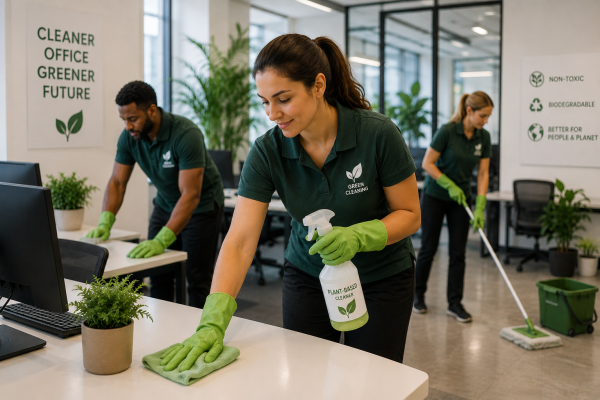
There’s a conversation I keep having with business owners in the GTA, and it usually starts the same way. Someone mentions eco-friendly cleaning products, and the person across from them gets a slightly skeptical look. Not hostile. Just that particular expression that says, “I’ve heard this pitch before, and I’m not sure I believe it.” They’re thinking about green cleaning as a marketing label, something companies put on bottles to charge more and make buyers feel responsible. Something that probably works fine on light dust but couldn’t handle the real cleaning demands of a busy commercial space.
I understand that skepticism. It’s earned. The word eco-friendly has been applied to enough products that don’t deserve it that a reasonable person should be cautious. But the actual science behind modern green cleaning formulations, what they contain, how they work, and what they eliminate, tells a genuinely different story than the one most skeptics are picturing.
And beyond the product question, there’s a larger shift happening in how Canadian businesses think about their physical environments, their obligations to the people who work in them, and the impression they make on clients who increasingly care about these things. That shift is real, it’s measurable, and ignoring it is starting to carry actual business costs.
What Eco-Friendly Commercial Cleaning Actually Means
The term means different things in different contexts, which is part of why the skepticism exists. But in the context of professional commercial cleaning, eco-friendly refers to something fairly specific: cleaning solutions that are biodegradable, non-toxic, and free of the chemical compounds that conventional cleaning products typically rely on, compounds like ammonia, chlorine bleach, synthetic fragrances, and phosphates.
Those conventional chemicals work. Nobody is arguing otherwise. They disinfect surfaces, they cut through grease, and they produce the visual results that cleaning is supposed to produce. The problem is what happens after they do their job. Chemical residue left on surfaces gets absorbed through skin contact. Volatile compounds released during cleaning become part of the indoor air that employees breathe for the rest of the workday. Wastewater carrying these compounds enters municipal systems and, ultimately, natural water bodies.
Modern biodegradable cleaning solutions accomplish the same disinfection outcomes, verified through independent testing against the same bacterial and viral targets, using plant-derived surfactants, enzymatic formulations, and naturally occurring antimicrobial compounds. They break down in the environment rather than persisting. They don’t leave chemical residue on surfaces. They don’t release volatile organic compounds into the air during or after application.
For a commercial space where people spend eight or more hours a day breathing the same air and touching the same surfaces, that distinction is not trivial. It’s a direct health consideration that shows up in how people feel over the course of a working week.
The Health Benefits That Don’t Get Talked About Enough
Most conversations about eco-friendly cleaning focus on the environmental angle, which is legitimate and important. But the more immediate case for green cleaning in commercial spaces is actually the health case, and it’s surprisingly direct.
Conventional cleaning products are a documented source of indoor air quality problems. Ammonia-based cleaners release fumes that irritate respiratory passages. Bleach products interact with other common indoor compounds to produce chloramines, compounds associated with respiratory inflammation, eye irritation, and in cases of repeated exposure, more serious lung effects. Synthetic fragrances, present in a huge proportion of conventional cleaning products, are among the more common triggers for migraine and allergy responses in sensitive individuals.
In a commercial office, these products are being applied to dozens of surfaces throughout the building on a regular cleaning schedule. The people working in that building are inhaling the resulting compounds and making skin contact with surface residue from the moment they arrive. Over time, the cumulative effect on employees who spend most of their working lives in that environment is not negligible.
Switching to genuinely non-toxic, biodegradable cleaning formulations removes that chemical burden from the indoor environment. The air quality improves. The skin and respiratory irritation that employees may have normalized as just part of office life diminishes. People who didn’t realize they were experiencing low-grade chemical exposure often notice the difference within weeks of the switch, not dramatically, but in the way that a background noise you’ve stopped hearing becomes audible again the moment it stops.
What Canadian Businesses Are Actually Responding To
The shift toward eco-friendly commercial cleaning in Canada isn’t happening in a vacuum. It’s being driven by a combination of factors that have converged over the past several years into something that feels less like a trend and more like a permanent recalibration.
Environmental regulation is part of it. Canadian federal and provincial frameworks around chemical use, waste management, and corporate sustainability reporting have tightened meaningfully, and businesses operating in heavily regulated sectors are increasingly aware that their cleaning protocols sit within the scope of their environmental compliance obligations. Using cleaning products that produce hazardous wastewater in a facility that’s subject to environmental reporting requirements is a liability question, not just an ethical one.
Employee expectations have shifted as well. The workforce that entered the market over the last decade has a measurably different relationship with questions of corporate environmental responsibility than previous generations. Businesses that can demonstrate genuine environmental commitments, not greenwashing, but actual operational choices that reflect stated values, attract and retain talent more effectively. Cleaning protocols might seem like a minor signal, but they’re part of a larger pattern of choices that employees notice and interpret.
Client expectations have moved in the same direction. Procurement processes at larger companies increasingly include sustainability criteria that their vendors and service providers are expected to meet. A business that can speak specifically to its use of non-toxic, biodegradable cleaning solutions across its facilities is better positioned in those conversations than one that can’t.
Addressing the “Does It Actually Work?” Question Directly
This is the question that lingers longest for skeptics, and it deserves a direct answer rather than a reassuring deflection.
Modern eco-friendly cleaning formulations, the professional-grade ones used by reputable commercial cleaning companies, not the consumer-market products with natural on the label, are tested against the same efficacy standards as conventional products. Independent laboratory testing measures their performance against specific bacterial and viral targets: Staphylococcus aureus, E. coli, influenza virus, and norovirus. The products that meet those standards receive certifications from bodies like EcoLogo and Green Seal, which apply rigorous criteria to both environmental impact and cleaning performance.
The short answer is that properly formulated, professionally applied green cleaning products clean as effectively as conventional ones for the surface types and contamination levels found in typical commercial environments. They do not, in general, perform as well in extreme industrial scenarios, heavily contaminated manufacturing environments, or certain food processing contexts, where more aggressive chemical intervention is necessary. But for the cleaning demands of an office, a professional services firm, a retail space, or a light industrial facility, the performance difference is negligible, and the health and environmental advantages are real.
The skepticism is understandable. The performance reality, at the professional level, doesn’t support it.
What to Expect from Green Commercial Cleaning Done Properly
The shift to eco-friendly cleaning in a commercial space isn’t just a product swap. Done properly, it involves a review of the entire cleaning protocol, the products, the equipment, the application methods, and the schedule, to ensure that the environmental and health benefits of green formulations are actually being realized rather than just labeled.
Equipment matters as much as products. HEPA-filtered vacuum systems capture particulate rather than redistributing it. Microfiber cleaning tools pick up and remove contaminants rather than spreading them across surfaces. Steam cleaning equipment disinfects through heat rather than chemistry, eliminating the need for chemical disinfectants on surfaces where steam application is practical.
Professional commercial cleaning services that have genuinely integrated eco-friendly practices, rather than simply relabeling existing products, can speak specifically to what they use, why, and what the testing behind those products demonstrates. That specificity is worth asking for. A vague commitment to “green cleaning” without the ability to name products, certifications, and protocols is not the same thing as an actual eco-friendly cleaning program.
The businesses across Toronto and the GTA that have made this shift with the right partner are discovering something consistent: the environmental commitment and the health outcomes and the cleaning quality are not in tension with each other. They’re the same thing, delivered by the same approach. That’s what elite cleaning services built around genuine eco-friendly practices actually look like in operation, and it’s a meaningfully different experience than what most commercial spaces are currently managing with.
The skepticism about green cleaning made sense in an earlier era. The products have caught up to the promise. The question now is less whether eco-friendly cleaning works and more whether the businesses choosing cleaning partners are asking the right questions to find the ones doing it properly.