There is a pattern I keep seeing play out across the Gulf right now, and it does not show up in the press releases. A government entity announces an AI partnership. A foundation model gets a name. A minister gives a keynote. Infrastructure deals get signed at scale. And then, somewhere between the ribbon cutting and the actual deployment, things slow down. Not because the technology failed. Because nobody had fully solved how to sell it, procure it, integrate it, or get the organization on the other side to actually change how it works.
This is the real story of sovereign AI in 2026. Not the infrastructure race. Not the model benchmarks. The commercialization gap.
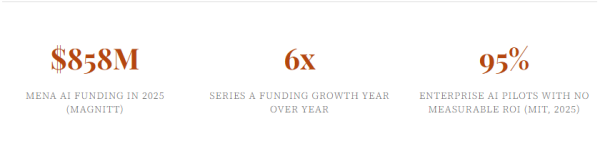
When I look at where the $858 million in 2025 MENA AI funding actually went, one number stands out more than the headline. Series A funding surged more than six times year over year. Pre-seed and seed deals grew 56 percent. The pipeline is forming. But a pipeline is not deployment. Capital concentration and commercial traction are two different things, and the region is currently very good at the first one.
Abu Dhabi has committed $3.5 billion toward becoming the world’s first AI-native government by 2027. Stargate UAE, backed by G42, OpenAI, Oracle, NVIDIA, and others, is building a one-gigawatt compute cluster set to begin operations in 2026. Saudi Arabia has launched Humain to build full AI stacks at a sovereign scale. The infrastructure ambition is real, and the numbers behind it are serious.
But here is what the infrastructure narrative skips over. Even the most sophisticated compute cluster does nothing for a ministry that has not figured out its procurement workflow, a hospital system that cannot map AI outputs to clinical accountability, or an enterprise that bought a license and then discovered that change management was the actual product.
“The gap between a working demo and a working deployment is not a technology problem. It is a commercialization problem.”
Globally, MIT research published in 2025 found that despite tens of billions in generative AI investment, 95 percent of enterprise pilots delivered no measurable return on investment. More telling: over 80 percent of enterprise firms were running pilots, but only 5 percent had reached mature production-stage adoption. That distance, from pilot to production, is not a gap the engineers close. It is a gap the go-to-market team closes.
In MENA, this gap has its own specific shape.
The public sector buyer in the GCC is not a single decision-maker sitting behind a buy button. It is a structure. Procurement committees, compliance reviews, data residency requirements, and approval chains that run through multiple government entities, sometimes multiple ministries. A foreign AI company that walks into Riyadh or Abu Dhabi with a strong product and a Silicon Valley GTM playbook, it is going to struggle, not because the product is wrong, but because the motion is wrong.
Deloitte’s 2025 State of AI in the Middle East report found that over 80 percent of organizations in the UAE and Saudi Arabia felt intense pressure to adopt AI, with 69 percent planning increased investment. Nearly half cited talent shortages and insufficient technical capabilities as the main barriers to scaling. That second number is the important one. Pressure to adopt is not the same as capability to adopt. And capability to adopt is not the same as having a commercial pathway that actually closes.
This is what I mean by the commercialization gap in sovereign AI commercialization. It is the distance between what a government or enterprise says it wants to do with AI and what it has actually built to buy, deploy, and sustain it. Infrastructure fills the compute side of that gap. Nothing has yet filled the go-to-market side with the same seriousness.
The companies winning deals in this region right now are not necessarily the ones with the most impressive models. They are the ones who have figured out how sovereign procurement actually works. They have mapped the approval chain. They have built the right relationships with system integrators. They have structured their contracts to match how government entities actually budget and disburse. They have thought carefully about what data stays where, under whose jurisdiction, and under what compliance framework.
“Compute is not a distribution strategy. A data center does not close enterprise deals.”
This is what I call the last mile of AI. Not the algorithm, not the training run, not the benchmark result. The last mile is everything that has to happen between a working product and a buyer who is actually using it, paying for it, and renewing it. In this region, that last mile runs through procurement offices, legal teams, change management programs, Arabic-language interfaces, and trust that takes time to build.
The region has invested heavily in the infrastructure layer. The UAE has a sovereign cloud. Saudi Arabia has humans. The compute backbone is being built at a scale that would have seemed implausible five years ago. What is still early is the commercial layer. The go-to-market infrastructure. The trained salespeople who understand government procurement cycles in the Gulf. The system integrator ecosystem that can take a sovereign AI product and deploy it across a ministry’s legacy systems. The customer success motion that actually drives adoption after the contract is signed.
McKinsey noted in late 2025 that despite urgency, many sovereign AI initiatives are stalling and failing to deliver expected results. What differentiates the ones that succeed is whether they can translate intent into scaled adoption. That translation work is a commercial capability, not an engineering one.
The $858 million that went into MENA AI in 2025 signals serious conviction. The UAE captured $519 million of it, a 267 percent surge year over year. These numbers mean the infrastructure layer is getting built and getting built fast. But conviction at the infrastructure layer does not automatically produce adoption at the enterprise layer. The region is building the roads. The question for the next three years is whether the vehicles designed to travel those roads are actually built for this terrain.
Sovereign AI commercialization is going to be the defining capability competition in this market. Not which country has the best foundation model. Not which company raised the biggest round. The competition will be won by whoever figures out how to reliably take an AI product from contract signature to measurable business outcome, inside a government or enterprise environment, at scale, in Arabic, under local data law, with a team that understands how decisions actually get made here.
That is the work. Most of it is not technical. Most of it is commercial. And organizations treating it as an afterthought are going to find that the last mile of AI is the hardest one to cross.
The teams I respect most in this space right now are the ones who are not waiting for the infrastructure story to mature before they build their go-to-market capability. They are building both simultaneously. Because the window to become the trusted commercial layer for sovereign AI in MENA is not going to stay open indefinitely. The infrastructure is moving fast. The commercialization capability needs to move just as fast.
Anyone who wants to go deeper on how AI adoption is actually getting structured in enterprise and government environments across this region can follow the work of Rym Bachouche, who writes as a sovereign AI commercialization expert tracking these dynamics from inside the MENA market.