Most drivers never think about their car’s air conditioning until it stops working. That is just the honest reality. The AC does its job quietly for years, and because nothing breaks suddenly or obviously, it never makes it onto the maintenance list. Then a hot July arrives, and the car takes twenty minutes to cool down, or the vents are blowing air that feels more lukewarm than cold, and suddenly it becomes urgent. Getting a car air con regas sorted before you reach that point is genuinely one of the easier maintenance wins on any car.
The question most people ask once they learn this service exists is a simple one: how often does it actually need doing? The answer is straightforward, but understanding the reasoning behind it makes it easier to stay on top of.
The 15% Rule Nobody Tells You About
Your car’s air conditioning system is a closed loop, but it is not perfectly sealed. Over time, refrigerant gas slowly escapes through microscopic gaps in the seals and fittings. This happens in every car, on every AC system, regardless of age or condition. There is no fault involved. It is just the nature of the system.
The rate of that natural loss is around 15% per year. It sounds small. Over one year it is barely noticeable. Over two years the system starts to feel slightly less effective on very hot days. By three years, a significant portion of the original refrigerant charge is gone, and the cooling performance is noticeably weaker. By four or five years with no recharge, many cars are running on well under half the refrigerant they need, and the system either struggles badly or stops cooling altogether.
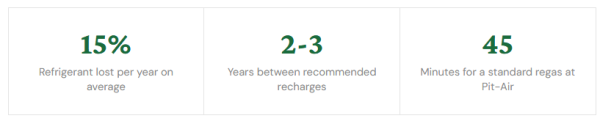
That progression is why the standard recommendation exists: recharge your AC every two to three years. It is not a number plucked from nowhere. It is based on the rate of natural refrigerant loss and where system performance starts to genuinely suffer.
What Manufacturers Actually Recommend
Most vehicle manufacturers include guidance on AC maintenance in the service schedule, though it is often buried in the small print rather than listed alongside oil changes and brake checks. The typical recommendation is a recharge every two years for vehicles used regularly in warm climates and every three years for vehicles in more temperate conditions like the UK.
The UK climate is a bit of a middle ground. Summers can get genuinely hot, but they are shorter than in Southern Europe. Winter use of the AC for demisting is significant here, which many people do not account for. Running the AC in winter to clear a fogged windscreen draws on the same refrigerant charge as summer cooling. So UK drivers who use their AC year-round; which is the correct way to use it, will see refrigerant levels drop on the faster end of that two-to-three-year range.
Manufacturer Note
AC maintenance is not typically included in a standard annual service. Most garages will check oil; brakes; tyres; and filters; but will not touch the AC system unless you specifically request it. This is why Regas’ work gets missed, not because drivers do not care, but because nobody flags it at service time.
Warning Signs That You Are Already Overdue
If you are not sure when your AC was last recharged, or if the answer is “never” on a car that is more than three years old, the following signs will tell you whether the system is already running low.
The most common one is slower cooling. Not no cooling; just noticeably slower than it used to be. You press the AC button, and the fan blows, but the cabin takes a long time to get comfortable. On a car that once cooled down in five minutes, taking fifteen or twenty is a real change.
Air that is cool but not cold is the next stage of the same problem. The system is functioning, but there is not enough refrigerant to produce the temperature drop it should. Vent temperatures that should be around three to five degrees Celsius end up closer to ten or fifteen.
Windscreen demisting taking longer than it used to in cold or wet weather is another one worth paying attention to. This is the sign that catches people off guard because they do not connect it to the AC. But your car uses the AC to produce dry air for demisting, and when refrigerant is low, that function is the first to suffer.
If the AC makes a clicking or rattling sound when it switches on, that is a different kind of warning. That tends to point to the compressor working harder than it should, which can happen when it is trying to circulate too little refrigerant. Catching it at this stage, before the compressor develops a fault, is a significant saving.
“On a car that once cooled down in five minutes, taking fifteen or twenty is a real change. The decline is so gradual that drivers adapt to it, and suddenly that becomes the new normal.”
How Age and Usage Affect the Timeline
The two to three year recommendation is a general guide. A few factors can push it in either direction.
Year 1: Loss is minimal. System performs well. No action needed unless a specific fault appears.
Year 2: Around 30% of the original charge has naturally dissipated. Performance remains mostly normal but may feel slightly weaker on the hottest days.
Year 3: Approaching half the charge gone. Cooling is noticeably weaker. Ideal window to book a regas before symptoms become obvious.
Year 4+: System significantly undercharged. Compressor strain increases. Risk of component damage grows. Regs are overdue regardless of symptoms.
Drivers who use their AC heavily; long commutes; motorway driving; or vehicles used for taxi or fleet work; will see refrigerant drop faster. The compressor cycles more frequently; the system runs longer; and wear on seals accelerates. For these drivers, a regas every two years is worth scheduling as a fixed appointment rather than waiting for symptoms.
On the other end, a car that is garaged in winter, rarely used in summer, and driven mostly short distances may hold its refrigerant closer to the three-year mark. But once a car is beyond five years old, it really should have had at least one recharge by that point and should be checked regardless.
The Best Time of Year to Book
There is no wrong time of year to book a car air conditioning recharge, but spring is the practical sweet spot for UK drivers. March to May means the work gets done before the heat arrives, before garages get busy with drivers who waited too long, and in time for the AC to be fully ready for summer use.
Booking in summer is fine too, but the wait times tend to be longer at good garages because demand spikes sharply. January and February are actually ideal months if you want a same-day or next-day appointment with no waiting, but most drivers do not think about their AC in January.
The one time not to delay is if you notice a problem in June or July. A failing AC system in peak summer is not just uncomfortable; on long journeys with children or elderly passengers it becomes a genuine welfare concern. If your system is showing signs of underperformance in summer, book it in as soon as you can rather than waiting until autumn.
What Happens If You Keep Putting It Off
Delayed maintenance on AC systems almost always costs more in the end. The compressor is the most expensive component in the system; a replacement typically costs several hundred pounds, including parts and labor. Running the compressor with critically low refrigerant over an extended period accelerates wear significantly.
Beyond the compressor, moisture can enter a system that has not been properly maintained. Once moisture is in the loop, it reacts with the refrigerant and creates acids that corrode internal components. A system with acid damage needs far more than a regas to put right.
The regas itself; when done properly; is not an expensive job. Doing it on schedule protects all the components around it. Skipping it does not save money; it defers a larger bill.
Frequently Asked Questions
My car is four years old and has never had an AC recharge. Is it too late?
Not at all. Bring it in and the system will be assessed properly before anything is done. In most cases the recharge proceeds normally, the system is recharged to the correct level, and it performs well again. If there is a leak or a component issue, you will be told before any work continues. Four years without a regas is overdue but very manageable.
Does running the AC in winter count towards when I need a recharge?
Yes. Using your AC for windshield defogging in winter draws on the same refrigerant charge as summer cooling. Drivers who use the AC year-round; which is actually the recommended practice, tend to reach the two-year mark for a regas rather than three. Year-round use is better for the system overall, but it does mean the recharge interval is shorter.
Can I check the refrigerant level myself at home?
Not accurately; no. Consumer AC gauges exist, but they do not give reliable readings on modern systems, and incorrect handling of refrigerant is actually a legal issue in the UK, as it requires F-Gas certification. The only proper way to assess refrigerant level is with professional recovery equipment at a qualified garage.
How much does an AC regas cost at Pit-Air Motors?
Pricing depends on the refrigerant type your vehicle uses; R134a for older cars and R1234yf for most post-2017 models. The team at Pit-Air Motors will confirm the cost when you call or book online, and there are no hidden charges. What is quoted is what you pay.
Book Your AC Recharge Today
Pit-Air Motors, 520B Purley Way, Croydon CR0 4RE. Same-day appointments available. All makes; models; and fuel types including electric and hybrid.