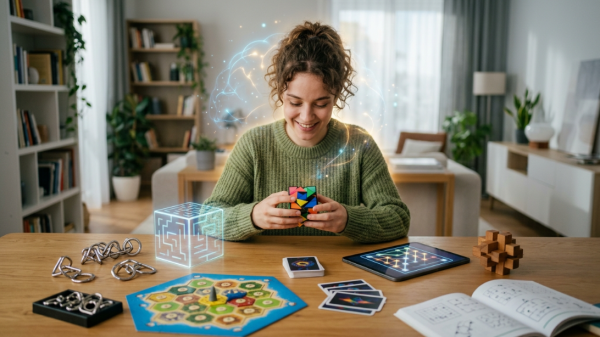
Most people stumble into logic games by accident. A newspaper puzzle here, a phone app there; maybe someone left a Sudoku book on the kitchen table, and you picked it up out of boredom. What surprises people is that once they start, it gets harder to stop. Not because the games are addictive in the usual sense, but because there is a very particular kind of pleasure in solving something through pure reasoning, without any luck or guesswork involved.
That feeling is what separates logic games from most other entertainment. A good film or song gives you something. A logic puzzle asks something of you, and the reward only comes when you have earned it. That is a different relationship with entertainment altogether, and it turns out a lot of people find it more satisfying than passive consumption once they get a taste of it.
The ten games below are worth your time for different reasons. Some have been around for decades and are popular for exactly the right reasons. Others are less well known but genuinely impressive once you sit down with them. None of them require any special equipment, any spending, or any prior experience with puzzles. What they do require is your full attention, at least while you are playing.
What Actually Counts as a Logic Game?
This question matters more than it might seem. The phrase gets applied loosely, and not everything sold as a brain game or logic trainer deserves the label. Some so-called logic games are really just memory tests with a puzzle skin. Others rely on reaction speed rather than reasoning. A genuine logic game is one where every step of the solution follows from rules and information you have been given, with no randomness deciding the outcome.
The other thing worth saying is that difficulty and depth are not the same thing. Some logic tricks are hard to beat but shallow once you understand their mechanics. The best ones keep revealing new layers the more time you spend with them. That is what you should look for, and that is what connects the ten games on this list.
1
Sudoku
You probably already know Sudoku, or at least know of it. Nine rows, nine columns, nine smaller boxes, each needing the numbers one through nine exactly once. No arithmetic. No tricks. The whole thing runs on elimination and logical deduction, which sounds simple until you try an expert-level grid and realize you have been staring at the same four cells for fifteen minutes.
What keeps Sudoku relevant after two decades of mass popularity is the range. Easy grids are genuinely accessible to beginners. Hard grids, particularly competition-style ones published in specialist magazines or puzzle sites, involve techniques most casual players have never encountered, things like X-wings, swordfish patterns, and coloring chains that take serious study to learn. That ceiling is surprisingly high, and it keeps experienced players coming back.
For free daily puzzles, the New York Times Sudoku section offers three difficulty levels and keeps a clean, distraction-free interface.
2
Chess Puzzles
Playing a full chess game takes time, preparation, and another person. Chess puzzles require none of those things. You are given a board position and one clear task: find the best move. Usually this means checkmate in a set number of moves or winning a decisive amount of material. The position is already set up for you. Your job is just to see it.
That last part sounds easier than it is. Chess puzzles train a very specific kind of visual-logical thinking called pattern recognition. Over months of regular practice, your brain starts filing away tactical patterns, and eventually you begin spotting them during actual games without consciously searching. Ten minutes of puzzles a day, done consistently, produces measurable improvement faster than almost any other form of chess study. Lichess offers an outstanding free puzzle trainer, rated and filtered by difficulty and theme.
3
Nonograms (Picross)
Nonograms are grid puzzles in which you color in cells based on number clues given for each row and column. The clues tell you how many consecutive cells should be filled and in what groups. By working through each row and column systematically, you eliminate possibilities until the correct cells reveal themselves, forming a pixel image when complete.
What makes nonograms appealing beyond the puzzle mechanics is the pacing. They are unhurried in a way that Sudoku and chess puzzles are not. You can work methodically through a nonogram over twenty minutes and feel genuinely calm by the end of it. Nintendo has sold millions of Picross games on its handheld consoles for exactly this reason. For browser play, Puzzle Nonograms has a large free library with adjustable difficulty.
4
Minesweeper
Minesweeper has been shipping with Windows since 1990, and most people have clicked through a few games without thinking much of it. That reputation undersells it considerably. On beginner settings the game is trivial, but on expert mode with a large grid, clearing the board cleanly is a genuine accomplishment that requires methodical thinking and careful probability estimation in the endgame.
The competitive Minesweeper community, which does exist and is larger than you might expect, has broken the game down into a sophisticated body of technique. Speed runners use specific flagging strategies, opening sequences, and corner logic to shave milliseconds off their times. Most casual players never see any of this depth, but it is there. For a well-built browser version, Minesweeper Online replicates the classic experience cleanly with leaderboards.
5
Einstein’s Riddle and Grid Deduction Puzzles
The famous riddle attributed to Einstein goes something like this: five houses, five colors, five nationalities, five pets, five drinks, and fifteen clues. Who owns the fish? The puzzle is solved entirely through logical inference, cross-referencing clues until the only remaining arrangement satisfies all of them at once.
These grid deduction puzzles are excellent training for the kind of structured thinking that comes up in real-world situations like planning, analysis, and troubleshooting. They force you to manage multiple constraints simultaneously and to recognize when a deduction is certain versus when it only seems likely. Puzzle Baron’s Logic Puzzles has thousands of these in varying difficulty, well worth bookmarking if this type appeals to you.
6
KenKen
KenKen was invented by a Japanese teacher named Tetsuya Miyamoto, who designed it as a classroom tool for building mathematical reasoning without making students feel like they were doing homework. The structure borrows Sudoku’s grid and uniqueness rules, then adds arithmetic: grouped cells called “cages” each carry a target number and an operation, and your solution has to satisfy both the uniqueness constraint and the arithmetic at the same time.
It sounds more complicated than it feels in practice. The arithmetic operations guide your logic rather than demanding calculation, which makes KenKen feel like a puzzle first and a math exercise second. Smaller grids make for quick, satisfying solves. Larger ones can challenge experienced puzzlers for a long time. The official site at KenKen Puzzle offers daily free puzzles across multiple size and difficulty combinations.
7
Wordle and Its Many Variants
When Wordle launched in late 2021, it spread in a way that very few browser games ever have. The mechanic is six guesses to find a five-letter word, with colored feedback after each attempt showing which letters are correct, which are present but misplaced, and which are absent entirely. Sharing your result as a grid of colored squares without spoiling the answer turned out to be unexpectedly shareable on social media.
The original game is owned by the New York Times now, but the puzzle community responded to its success by building dozens of variants. Quordle runs four simultaneous grids. Dordle runs two. Wordle swaps words for country shapes. Framed uses film stills. Most of these are free and browser-based. What holds all of them together as logic games is the systematic elimination approach that distinguishes strong players from casual ones. Luck plays a smaller role than most people realize.
8
Sokoban
Sokoban is a Japanese warehouse puzzle from 1981 in which you push crates to marked storage locations. The rules are intentionally limited: you can push crates but never pull them, and you can only push one at a time. That constraint turns out to be remarkably fertile ground for puzzle design, because a single misplaced push can make a level permanently unsolvable, forcing a complete restart.
The appeal is in the planning. Good Sokoban players describe the game as a kind of spatial chess, where you mentally simulate several moves ahead before committing to any of them. Beginner levels are solvable through experimentation. Advanced levels, particularly those designed by the puzzle community, rather than the original creators, can take hours of careful analysis to crack. For browser play, Sokoban Online has hundreds of levels organized by difficulty.
9
Mahjong Solitaire
Mahjong Solitaire is a different game from the four-player Mahjong played across East Asia, though it uses the same tiles. The solitaire version asks you to clear a stacked arrangement of tiles by matching and removing them. pairs, but only tiles that are unblocked on at least one side and have no tile sitting on top of them can be selected. The challenge is in the sequencing.
Remove the wrong pair early and you lock yourself out of other tiles, eventually reaching a position where no valid moves remain. Playing well means thinking ahead, identifying which tiles are creating bottlenecks, and choosing a removal order that keeps options open. It is more strategic than it looks from the outside and considerably more relaxing in its pacing than most of the other games on this list, which makes it a good choice for unwinding without turning your brain completely off.
10
Hashi (Bridges)
Hashi does not get mentioned in mainstream puzzle discussions nearly as often as it should. The setup is a grid of numbered circles representing islands. You draw bridges connecting them horizontally or vertically. following three rules: each island must have exactly as many bridges as its number, bridges cannot cross each other, and the completed network must connect every island into one continuous group.
The solving process is built on constraint propagation. An island with a high number in a corner position has limited neighbors, so you can immediately determine how many bridges must go in each direction. That certainty propagates outward, triggering further deductions. When a puzzle comes together cleanly, it feels almost architectural. If you enjoy Sudoku but want something that feels structurally different, Hashi is the most underrated recommendation on this list.
Where to Actually Play These Games Online
The good news is that none of these require paid subscriptions or app downloads to enjoy. Most have solid browser versions you can open right now. For a single destination that pulls together a range of logic and puzzle games without cluttering the experience with advertising or unnecessary account creation, SpillQ is worth bookmarking. The platform runs cleanly across devices and covers a solid variety of the puzzle formats discussed above. It is the kind of site you open when you have fifteen minutes and want to get straight into playing without fuss.
Beyond that, the specialist sites mentioned throughout this article, Lichess for chess puzzles, Puzzle Baron for grid deduction puzzles, and Brilliant.org for those who want structured courses in logic and reasoning rather than just casual play, all hold up well and have been around long enough to be trusted.
Worth knowing: trying to play five different logic games at once tends to dilute the benefit of each. Pick one, stick with it for a few weeks, and let your skill actually develop before adding another. The progress feels more real that way.
Do Age and Experience Level Actually Matter?
They matter less than people tend to assume. The cognitive abilities that logic games develop, pattern recognition, structured reasoning, and forward planning, have no age prerequisites. Children pick up these skills through play naturally. Adults who have never tried logic games often discover they take to them faster than expected, because adult working memory and vocabulary actually help in certain puzzle types like Wordle and grid deduction.
What does change across age groups is the right entry point. Younger children generally do better with puzzles that give quick visual feedback and have short completion times. Nonograms and simple matching games fit this well. Older children and teenagers can handle abstract systems like Sudoku and Hashi without much trouble. Adults looking for something genuinely challenging tend to gravitate toward chess puzzles and grid deduction formats, where the depth is nearly unlimited.
The American Psychological Association has published research indicating that sustained engagement with cognitively demanding activities throughout adulthood correlates with better mental agility in later years. Logic games are not a medical intervention, but they are one of the more enjoyable ways to give your brain consistent, varied challenges across a lifetime. That seems like a reasonable argument for starting now regardless of where you are in that lifetime.
To Wrap Up
Ten games, ten very different experiences. What connects them is that they all reward genuine thinking rather than speed or luck, and they all get more interesting the more time you give them. That is a rarer combination than it sounds.
If none of the ten feel immediately appealing, that is fine. Logic games have a way of finding their audience gradually. Start with whichever one sounds least intimidating, play it a few times over a week, and see whether the satisfaction of getting better at something pulls you in. For most people, it does.
The easiest way to begin is to open a browser tab and try one right now. Everything else follows from there.