
Something peculiar occurs when millions of players worldwide are asked why they continue playing the same game after two, five, or ten years. The answer is almost never about graphics or frame rates. It is about people, places, and progress, three things that MMORPG games deliver with a consistency and depth that no other genre has come close to matching.
The world of online gaming has fundamentally changed how an entire generation spends their free time in the evenings, how social groups are formed, and what success means for an individual. Within this cultural shift of epic proportions, MMORPG games have a place of great influence. They were among the first digital spaces where players did not just compete against one another; they built lives alongside each other, with all the complexity and attachment that phrase implies.
Understanding what drives that attachment is not merely an interesting question for game designers. It illuminates something real about how people seek community, identity, and purpose in an increasingly fragmented world. For those ready to explore the breadth of what this genre offers, kaikkitaieimitaan24.fi provides a well-curated window into the online entertainment landscape, a smart starting point before committing to a world you may end up calling home for years. Because with MMORPG games, that is exactly what tends to happen.
The Unique Gameplay Experience of MMORPG Games
The moment you try to explain MMORPG games to someone who has never played one, you face an immediate vocabulary problem. Words like “game” connote a beginning, a middle, an end, a winner, and a loser. None of these apply here in any conventional sense.
The key difference between MMORPG games and other traditional single-player games is the idea of persistence. The game world does not reset when you log out. It does not pause, replay, or offer a checkpoint. While you sleep, your guild is still operating. Markets are moving. Territories are shifting. Alliances are being tested. You return not to a saved state but to a world that has continued without you, exactly as a real place would.
A World That Outlives Any Single Session
This continuity creates a fundamentally different emotional relationship with the game. Players in traditional titles invest in completing content. Players in MMORPG games invest in inhabiting a world. That distinction, between consumption and belonging, is the single most important factor behind the genre’s extraordinary retention rates.
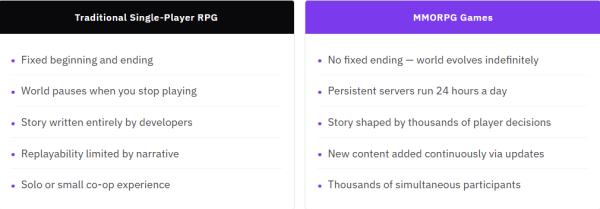
Continuous gameplay loops also play a central role. In the best MMORPG games, there is always something meaningful to do, and crucially, there is always something you are working toward. The design philosophy is built around ensuring that players never reach a full stop. There is always a next tier of gear, a next skill milestone, and a next chapter of the faction storyline waiting just beyond where you currently stand.
Character Development and Player Progression

Ask any psychologist about the motivational mechanics behind MMORPG games, and you will quickly arrive at a concept called variable reward schedules. The unpredictability of when the next big drop will happen, combined with the certainty that consistent effort moves you measurably forward, creates a motivational loop that the human brain finds deeply engaging.
But reducing character progression to psychology does it a disservice. What leveling systems in MMORPG games actually deliver is a narrative of personal growth that players author themselves. You were a level-one nobody in that starting village. Six months later, you are carrying gear that took coordinated effort from twenty people to obtain, and players newer than you ask for your advice. That arc is genuinely satisfying in ways that extend well beyond dopamine.
Gear, Skills, and the Pursuit of Mastery
Equipment systems in modern MMORPG games have become sophisticated economies in their own right. Gear has rarity tiers. Crafting disciplines require genuine skill investment to be mastered. The difference between a player wearing good gear and one wearing great gear is visible and meaningful socially, strategically, and aesthetically. Players invest a lot of time theorycrafting optimal builds, discussing their findings with their respective communities, and experimenting with the potential of certain combinations of classes.
It is a level of progression that is one of the main reasons why MMORPG games retain players for longer than any other genre of game. The journey from novice to master is not a simple one; it is a complex, individual experience for each player who makes it along that road.
Community and Social Interaction

Here is a fact that surprises people who have never spent time in a serious MMORPG game: a significant number of the people playing them are not primarily there for the gameplay. They are there for the people.
The social infrastructure that is part of MMORPG games is unmatched in all forms of digital entertainment. Guild systems create organizational structures that have real-world notions of hierarchy and accountability. Communication tools such as voice chat in raids, text chat for strategy sessions, and in-game mail for trading create a communication model that is similar to real-world organizations.
From Strangers to Squadmates
The transformation from stranger to trusted teammate inside an MMORPG game happens faster than most people expect. Shared adversity, a difficult raid that required fourteen attempts over three weeks before finally succeeding, creates bonds with a quality and durability that is genuinely surprising to those who dismiss these communities from the outside.
The most powerful thing about MMORPG games is not what they give you to do; it is who they put beside you while you do it. Those relationships outlast any individual game and often outlast the games themselves.
Trading systems add another social dimension. Crafters, merchants, and resource gatherers form their own communities within the larger game world, connected to combat players through mutual dependency rather than shared activity. The blacksmith who supplies gear to the raid team never fights alongside them but is no less integral to the guild’s success.
Discovering the right community within an MMORPG game is one of the most important decisions a new player will make. That is where platforms like Kaikkitaieimitaan24 offer real value, helping players orient themselves within the wider gaming ecosystem before they commit their time and social investment to a particular world.
Why MMORPG Games? Keep Players Hooked for Years
The vast majority of games follow a rather predictable pattern of interest that peaks during launch, declines steadily over time as all the content is played through, and then is abandoned. MMORPGs were built from the ground up to break this pattern, and they do it in a number of different ways that reinvent the genre on a regular basis.
The most important of these is the live-service update model. Unlike a title with a fixed release and a sequel cycle, MMORPG games are in a permanent state of development. Patches arrive weekly or monthly. Major content updates land quarterly. Expansion packs, which add entire new continents, class systems, and story lines, relaunch the game every year or two. The result for the player is that the game they logged into six months ago is genuinely, meaningfully different from the game they are logging into today.
The Retention Mechanisms That Set the Genre Apart
Seasonal Events
Time-limited festivals, themed dungeons, and exclusive rewards create genuine urgency that pulls lapsed players back reliably
Expansion Packs
Major content releases that effectively relaunch the game for veterans while simultaneously welcoming newcomers
Social Accountability
Guild commitments and raid schedules create genuine external motivation to stay active that no solo game can replicate
Infinite Progression Ceilings
Each update raises the cap, ensuring there is always a meaningful next goal regardless of current achievement level
Community Events
Server-wide challenges and world events generate shared experiences that become part of the game’s collective memory
The result of layering these mechanisms together is a retention profile that makes MMORPG games unique among entertainment products. Players do not simply enjoy them; they organize their lives around them. Raid nights become calendar fixtures. Expansion launches become anticipated events shared with friends across countries. The game becomes, in a very real sense, a recurring part of how players define their leisure time and social identity.
There is also an economic stickiness that reinforces all of the above. Years of accumulated progress, characters built with thousands of hours, rare gear earned through collective effort, and server reputations developed over time create a genuine barrier to simply walking away. This is not a design flaw. It is a reflection of real investment that players made freely and value sincerely.
Conclusion: Built to Last, Designed to Draw You Back
The global appeal of MMORPG games is not a puzzle to be solved. It is the logical result of a genre that recognized something essential about human motivation long before the rest of the entertainment world caught on: people don’t just want to have experiences. People want to find a sense of belonging to something, to become something, and to do it with the people who matter to them.
Every aspect that makes MMORPG games engaging and appealing, the world itself, the depth of development, the social aspects, and the continuous content updates, is just a different way of answering the same underlying question: how do we create a space that people really want to keep returning to?
The genre has been answering that question for millions of people for over twenty years. With better technology, smarter design, and a global audience that’s never been larger, MMORPG games are only improving on that answer. For millions of people around the world, the invitation is simple: find your world, find your people, and stay as long as you like. Most do.