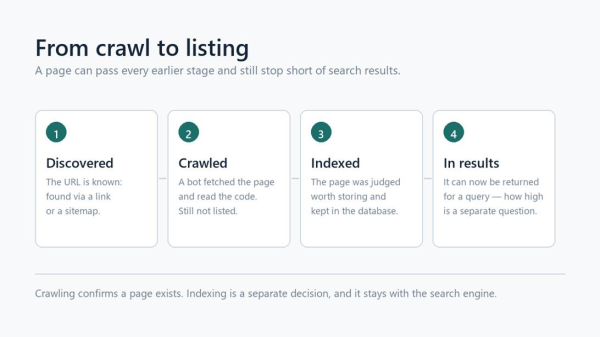
Marketing departments and business operators often spend weeks creating product pages, case studies, and informational articles, only to find that those URLs fail to attract visitors from organic search. When technical teams examine server activity logs, they often observe automated search engine software visiting the website regularly. The confusion is understandable. If a search engine is actively requesting and downloading digital assets, leadership naturally assumes that those pages will soon appear in public search listings. However, the architecture of modern web discovery operates in distinct stages, and automated discovery does not automatically lead to search visibility.
The Distinction Between Crawling and Indexing
To see why content stays hidden, it helps to separate discovery from inclusion. Crawling represents the exploratory phase of search operations. Automated programs, usually called spiders or bots, follow links across the broader internet to find new or revised addresses. When a bot visits a corporate site, it fetches the underlying code and assesses the page structure. This process merely confirms that an address exists and responds to technical requests without server errors.
Indexing represents an entirely separate editorial and technical decision. Once search software fetches a digital document, parsing systems analyze the text, examine media elements, evaluate page layout, and determine whether the material provides sufficient unique utility to justify storage space in a global database. Search operators maintain massive data infrastructure, but storage space and computational resources remain finite. A page can be visited multiple times each month while search systems deliberately decline to store it for query retrieval.
Quality Standards and Thin Informational Value
The most frequent reason a page remains excluded after discovery involves perceived quality. Search algorithms assess whether a URL provides original value or simply repackages existing text found elsewhere across the web. E-commerce platforms, regional service providers, and multi-location directories are especially vulnerable to this evaluation. When dozens of catalog pages reuse manufacturer product descriptions, or when local service landing pages swap only town names while leaving identical paragraphs intact, automated quality filters often categorize the material as thin or duplicate.
Technical configuration choices also trigger deliberate exclusions. Marketing teams occasionally implement contradictory technical instructions by mistake. For instance, an internal publishing platform might inadvertently apply restrictive robots directives, canonical tags pointing toward alternate parent pages, or redirect chains that confuse automated parsers. While such directives often prevent crawling, certain misconfigurations still allow discovery visits while explicitly instructing database systems to discard the gathered data. In other scenarios, excessive page rendering weight, heavy script execution, or unstable visual elements lead automated quality evaluation systems to defer permanent storage.
Verifying Which Company Pages Actually Exist in the Database
Server logs prove a visit, not a listing, so teams have to audit their actual presence in search results. The most fundamental diagnostic method involves standard verification dashboards provided directly by major search platforms. Within these administrative consoles, site operators can review operational reports that classify pages under categories such as discovered but not currently indexed, or crawled but excluded. These status reports provide transparent confirmation that automated crawlers retrieved a document before automated quality filters set it aside.
Spot checks work well for a handful of priority pages. By entering direct search operators using a page address within a search query box, marketing staff can verify whether an individual URL produces a result. If a query yields zero results for an exact address that has been live for weeks, the page has not been preserved in search storage. However, manual checks become impractical across websites containing hundreds or thousands of product categories. Enterprise marketing teams often monitor larger inventories using specialized verification software, such as IndexVero, to track database status changes across extensive URL sets without checking each address individually. It remains essential to remember that no external platform possesses the authority to force inclusion, as the final decision on whether to accept a page always belongs exclusively to the search engine.
Pruning Redundant Assets and Clarifying Page Hierarchy
Fixing persistent exclusions is an architecture problem, not a reason to publish more pages. Businesses frequently discover that consolidating several weak pages into a single comprehensive resource delivers better results than publishing dozens of fragmented articles. When internal links direct visitors and discovery programs toward a concise collection of informative assets, automated systems more readily understand which pages serve as the primary source of commercial expertise.
Clean navigation structures also play a critical role in clear communication with discovery programs. When important pages sit deep inside complex folder structures or lack direct text links from main category menus, automated evaluators often assume the business considers those assets unimportant. Removing outdated promotional pages, repairing broken links, and providing clean XML sitemaps that reflect only live, valuable URLs helps search crawlers allocate their computing power toward high-priority business materials.
Closing the gap between a crawler visit and an actual listing takes steady oversight. By understanding that automated site visits represent merely an initial inspection rather than an acceptance into search results, business leaders can correctly diagnose visibility problems, elevate textual standards, and maintain digital assets that search platforms consider worth presenting to readers.