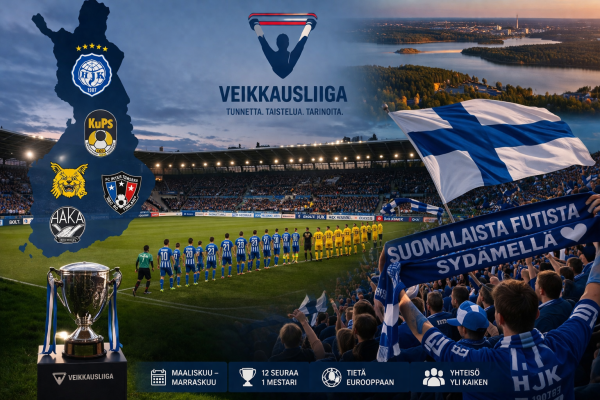
There is a particular feeling you get at a football match in Finland that is difficult to describe to someone who has not experienced it. It is not the roar of eighty thousand people in a Champions League stadium. It is not the carefully choreographed spectacle of a Premier League Sunday afternoon. It is something quieter and, honestly, more genuine than either of those things. You are close to the pitch. You can hear the players calling to each other. The crowd knows what it is watching. And football, particularly in the Veikkausliiga, is better than most people outside Finland have any idea.
I realize that sounds like the kind of thing someone says when they are trying to convince you of something. But follow Finnish football for a full season and see if you come away thinking differently. Most people who give it a genuine chance do not.
The Grounds: Small, Loud in the Right Moments, Completely Real
Finnish football stadiums are not architectural statements. They were not built to impress visiting dignitaries or feature in glossy television broadcasts. They were built to hold football matches for communities that wanted to watch football. That sounds obvious until you have been to enough grounds around Europe that were designed primarily for everything except the actual experience of watching the game.
At a Veikkausliiga ground, whether that is the Tammela in Tampere, the Veritas Stadion in Turku, or the Bolt Arena in Helsinki, you are close to what is happening. The dimensions of Finnish grounds put you near the action in a way that bigger stadiums simply cannot replicate. When a striker cuts inside and strikes the ball, you feel it differently than you do from row forty-seven in a sixty-thousand-seat ground.
The Bolt Arena in Helsinki deserves particular mention because it represents what Finnish football infrastructure looks like at its most developed. It is a proper modern stadium with good sight lines, covered seating, and a proper atmosphere when the home support is in full voice. HJK matches in European qualifying have produced nights there that would not have felt out of place at clubs playing at a considerably higher level.
Finnish Supporters: A Different Kind of Passion
Finnish football supporters are sometimes mischaracterized as reserved. That is not quite right. What they are is selective about when they make noise, which, if you think about it, is not a bad quality in a football crowd. The atmosphere at a Veikkausliiga match does not need to be manufactured through music playing over a stadium PA system or prompted by a scoreboard telling people to make noise. When something happens worth reacting to, a goal, a near miss, or a contentious decision, the reaction is immediate and entirely genuine.
There is also a level of tactical knowledge among regular Veikkausliiga followers that you do not always find in bigger leagues where a significant portion of the crowd is there for the experience rather than the football. Finnish supporters tend to understand what they are watching. They notice the pressing structure. They see when a midfielder is out of position. They appreciate a well-executed defensive transition in a way that crowds shaped by entertainment culture sometimes do not.
There is no pretense at a Finnish football match. No one is there to be seen. They are there because they follow their club, and for ninety minutes, that is the only thing that matters.
The Derby Matches: Where Everything Goes Up a Level
Every football league has its derbies, the matches where the points matter less than the result because the result will be remembered by both sets of supporters for months or years afterward. The Veikkausliiga has several of them. The Helsinki derby, when circumstances produce it. The Tampere derby between Ilves and Tampere United. The matches between Turku’s clubs that carry decades of local rivalry with them.
These fixtures change the atmosphere of the whole weekend. The city feels different on derby day. There is more conversation about football in the cafes and on the streets. People who do not usually attend matches turn up because some games require your presence regardless of your normal habits. The stadiums fill in a way that regular fixtures do not always manage. And the football, almost without exception, rises to the occasion in a way that reminds you why rivalry matches exist.
The Tampere derby specifically has a history that goes back generations. Families in Tampere have been divided along Ilves versus Tampere United lines for as long as both clubs have existed. That kind of embedded rivalry does not produce a manufactured atmosphere; it produces the real thing, with all the tension and emotion and occasional unpredictability that comes with it.
How Finnish Football Culture Has Changed
Finnish football has been on an upward trajectory culturally as well as competitively. The sport’s relationship with Finnish identity has shifted meaningfully since the national team’s Euro 2020 qualification. Football is no longer playing second fiddle to ice hockey in quite the way it used to; or at least, the gap has closed. Young people who might previously have grown up primarily as hockey fans are now following club football with genuine investment. That shift in cultural position is significant for the long-term health of the game in Finland.
Coverage of Finnish football has expanded as a result. BBC Sport and other international football media have featured Finnish club stories and national team analysis with increasing regularity over the past few years, something that would have been almost unimaginable a decade ago when Finland was simply not on the international football radar in any meaningful way.
Social media has played a role too. Clubs that have invested in their digital presence; producing content in multiple languages, engaging with supporters online, and making their matchday experience visible to people who cannot attend in person, have built followings that extend well beyond Finland’s borders. There are Veikkausliiga supporters in countries that have no geographic or cultural connection to Finland who found their way to Finnish football through a highlight clip, a Twitter thread, or a YouTube video and never looked back.
Following the League From Outside Finland
This is worth addressing directly because it is an increasingly common experience. More people are following the Veikkausliiga from abroad than ever before, and the practical barriers to doing so have dropped considerably. Match broadcasts are more accessible. Statistics and results are available in real time. Club social media accounts keep international supporters connected to what is happening between matchdays.
The European dimension helps with international visibility too. When Veikkausliiga clubs appear in UEFA qualifying rounds, those matches are broadcast to audiences across the continent. UEFA.com covers these matches with the same editorial attention it gives to all qualifying competitions, which means Finnish clubs get a level of European exposure during the summer months that feeds directly into awareness of the domestic league.
For anyone wanting to follow the Veikkausliiga from a distance, whether you are in central Europe, the UK, or anywhere else, the infrastructure to do so properly now exists in a way it did not five years ago. The league is reachable. The clubs are findable. The football is worth the effort of finding it.
The Matchday Rhythm: Something Worth Experiencing in Person
If you ever get the chance to attend a Veikkausliiga match in person, and this is worth saying clearly, do it. Not because Finnish football is perfect or because the experience will necessarily change your life. But because it represents something that is genuinely becoming harder to find in European football at the senior level: a professional match where the football is the main event, the crowds are genuine, and the whole experience has not been packaged and commodified into something resembling a theme park attraction.
The pre-match routine at a Finnish ground is straightforward. You arrive. You find your seat or your standing section. You watch the warm-up. The teams come out. Football happens. It sounds unremarkable until you realize how many football experiences in 2026 involve everything except the football being the central point of the exercise.
Why the Outside World Should Pay More Attention
Football culture outside the big five European leagues has an image problem in the sense that it is largely invisible to mainstream football media unless something unusual happens. A small league club makes a big cup run. A player from an unexpected background signs for a famous club. Coverage tends to be episodic rather than sustained. The Veikkausliiga deserves better than episodic coverage.
The Guardian’s football writing has occasionally captured what makes following football outside the elite leagues genuinely rewarding: the closer connection between clubs and communities, the more transparent relationship between what a club earns and what it spends, and the sense that results carry weight precisely because resources are not unlimited. The Veikkausliiga embodies all of those qualities. It is a league where clubs have earned their positions through work rather than inherited them through wealth.
That is not a romantic notion; it is just an accurate description of how Finnish club football operates. And it makes following the league feel like following something real rather than something produced.
An Honest Invitation
If you have read this far and you are not already a Veikkausliiga follower, give it a season. Not three matches. A full season, from the spring opening round to the November finale. Watch the title race develop. Learn the clubs. Understand the rivalries. Notice which players are worth watching carefully. Let the rhythm of the league get under your skin the way football leagues do when you stop dipping in and out and start actually following.
The Veikkausliiga will not disappoint you. It might surprise you. It will almost certainly make you wonder why you did not start paying attention sooner. That is the best recommendation any football league can have.