
Let me say something that most SEO articles will not say upfront: for a lot of people, Semrush is simply too much of a tool. That is not an insult to the platform. It is genuinely one of the most capable SEO suites ever built. But capability and usefulness are two different things, and paying for one when you only need the other is a financial habit worth breaking.
The search for sites like semrush that cost less and still deliver has gotten much more productive in 2026. A few years ago, you either paid the premium or accepted something noticeably weaker. That gap has closed considerably. Today there are tools that handle specific SEO tasks extremely well, charge a fraction of the price, and in some cases work better for smaller operations precisely because they are not trying to do everything.
This article looks at the best of those options. Not every tool here will be the right fit for every reader. But by the end of it, most people should have a clearer sense of where to put their budget and what to expect in return.
A Honest Look at Semrush and Where It Falls Short
Semrush was built for people managing SEO at scale. Multiple clients, large keyword sets, detailed PPC reporting, social monitoring, content audits, and technical crawl data all housed under one login. For an agency billing out SEO retainers across twenty accounts, the math makes sense. The platform earns its price when the entire feature set is being used actively.
The trouble is that most people using Semrush are not running twenty client accounts. They are a founder trying to rank their SaaS product. Or a small business owner who wants to understand why their competitor keeps appearing ahead of them in Google. Or a content manager who needs to plan articles and track whether they are gaining traction. These are not trivial goals, but they do not require the full depth of Semrush to address.
There is also the onboarding reality. Semrush is not a platform you open and immediately understand. The interface is dense. The reporting options number in the dozens. New users often spend their first week watching tutorials instead of actually doing SEO. For teams where one or two people wear all the marketing hats, that time cost is real even when it does not appear on an invoice.
And then the price. $129 per month to start, with costs rising if you need more projects, more users, or certain data features. For a business watching margins carefully, that number demands justification every single renewal cycle.
Why More Marketers Are Searching for Semrush Alternatives in 2026
The transition has been a gradual process, but the difference has become very noticeable. Teams are moving away from all-in-one tools towards more specialized tools, which excel at one or two tasks. This approach, also called the modular SEO stack, has the advantage of being more affordable and easier to update as required.
There is a second player to mention. There is a trend in AI-based content tools. It is not just about keyword tracking and technical audits in 2026. There is a need to publish a certain amount of good, keyword-optimized content. It is a major growth driver for organic traffic. Traditional SEO tools are not designed for that. Today, many teams use a traditional keyword research tool in combination with a content automation tool.
The combination works out cheaper than using Semrush alone, and it’s more productive, as each tool is used for something it does well.

Best Sites Like Semrush Worth Using in 2026
The tools listed below have been chosen on the basis of the price-value ratio, actual utility for small to mid-sized teams, ease of onboarding, and the actual SEO problems they can solve. Some overlap with Semrush functionality. Others address different gaps entirely.
SE Ranking: The Closest Like-for-Like Swap
If you need keyword tracking, competitor research, backlink monitoring, and website audits all in one tool, then SE Ranking is the most obvious answer at a lower cost. It starts at around $31 per month. That alone makes it worth checking out.
What sets SE Ranking apart is how it structures pricing around actual usage. The cost adjusts based on how many keywords you track and how frequently rankings update. Weekly tracking across a focused keyword set costs very little. Daily tracking across thousands of keywords costs more. That flexibility is rare in this category and genuinely useful for smaller operations where keyword volume is modest.
The interface is cleaner than Semrush. Onboarding takes days rather than weeks. For most everyday SEO tasks, SE Ranking gets out of the way and lets you work. It is not as deep as Semrush in every data category, but the depth it lacks is usually the depth that small teams never actually needed.
SEOZilla: A Strong Semrush Alternative for Content-Led Growth
Most SEO tools show you what to do and then leave the execution entirely to you. That gap between insight and action is where a lot of small teams lose time and momentum. A useful semrush alternative for content-driven businesses is SEOZilla, which sits at the execution layer rather than the research layer.
SEOZilla is another content automation tool that uses AI to research your niche, write optimized long-form content, and even publish it to your CMS. The platform supports WordPress, Webflow, Shopify, Ghost, HubSpot, and Wix. You can review articles before publishing, adjust the publishing schedule, and even adjust the brand voice to make it sound like it is written by you. The system adjusts to how your brand currently sounds.
The plans begin at $19.99/month, which allows you to publish four articles. The Pro plan, costing $99.99/month, allows you to publish 30 articles across three projects, which, from the perspective of a growing startup or multi-site operator, represents a very appealing output vs. cost. Articles have a word count of up to 4,000 words, including AI image generation, data tables, and sections, all of which are geared towards featured snippets and AI search results via tools like ChatGPT or Perplexity.
The reason SEOZilla belongs in this list of Semrush alternatives is that for most teams, content creation is probably the largest barrier to organic growth. Knowing what keywords to focus on doesn’t get you ahead.Publishing consistently optimized content does. A tool that handles that output directly solves a more pressing problem than another research dashboard.
Ahrefs: The Backlink Standard
Ahrefs is not a cheap alternative as it is priced similarly to Semrush, starting at around $129 per month. However, it is included in this list because, in some cases, it provides better data quality in the most important tools for teams that value backlink and competitor analysis above all else. If link building drives your strategy, that specificity has real value. Some teams find Ahrefs more focused and less cluttered than Semrush for organic SEO work precisely because it does not try to cover PPC and social media monitoring alongside everything else.
Mangools: Genuinely Enjoyable to Use
Mangools is five focused tools packaged together: KWFinder for keyword research, SERPChecker, SERPWatcher for rank tracking, LinkMiner for backlinks, and SiteProfiler for domain overview. Each interface is visually clean and logically organized. The next step is usually obvious without clicking around to find it.
Plans start around $29 per month. For bloggers, solo operators, and small content teams that want reliable keyword and tracking data without a learning curve, Mangools often becomes a preferred daily tool simply because it is pleasant to open. That sounds minor until you have spent time fighting with a complex dashboard on a tight deadline.
Ubersuggest: Low Cost, Low Friction
Ubersuggest works best as an entry point, not an endpoint. It covers keyword ideas, basic site audits, and a backlink overview at a very low price with a limited free tier. The data is thinner than the tools above and the feature set will feel limiting once an SEO operation matures past the basics. But for a new business trying to understand keyword opportunities for the first time, it gets the job done without requiring a significant financial commitment.
Moz Pro: Metrics That Actually Get Used Outside the Tool
Moz sits at roughly $99 per month. The Domain Authority metric is present in link outreach emails, agency reports, and client presentations with a frequency that no other tool or platform has been able to achieve. In addition to this familiarity, the reports provided by Moz Pro explain the meaning of the numbers and provide suggestions for what to do next, which makes it a truly useful tool for SEO knowledge acquisition.
Pros and Cons: Honest Comparison
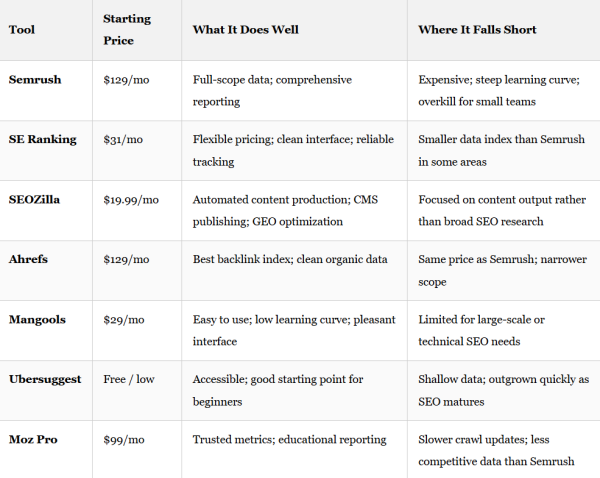
Worth noting: Many teams using two focused tools, one for research and tracking, one for content production, end up spending less than a single Semrush subscription while getting more consistent output. The modular approach tends to outperform the all-in-one approach when neither tool is left underused.
How to Pick the Right Tool for Your Situation
The decision gets a lot easier once you identify where your actual SEO effort is currently stuck. That is the question worth answering before comparing feature lists or pricing tables.
Teams stuck on rankings and unsure of the reason: SE Ranking or Mangools will provide you with insights into the movement of your keywords, the health of your site, as well as the gaps your competitors have, without the complexity of the other tools.
Teams that know their keyword targets but struggle with the ability to publish: a content automation tool solves the real problem more directly than simply providing another research tool. Consistent, well-organized publishing does more for organic rankings over a twelve-month period than any audit report.
For those who want to do both research and content and have a budget of less than $130 per month: A combination of SE Ranking and another content tool of the low tier can cost as little as $60 per month and satisfy both needs.
Teams that link building as a principal growth channel: Ahrefs is worth the investment, even at the same cost as Semrush, as the data quality of the backlink data makes it worth it for that purpose alone.
Final Thoughts
Semrush is not overpriced for what it does. It is overpriced for what most small businesses and solo operators actually use. That distinction matters because it changes how you shop for an alternative.
You are not looking for a cheaper version of Semrush. You are looking for the right tool for the job you actually need to do, at a price that makes sense given where your business is right now. Those are often very different tools, and finding the right one takes about ten minutes of honest self-assessment followed by a free trial or two.
The options mentioned in the article are the best available choices as of 2026, and there are no compromises. In fact, some of these tools are better suited for smaller businesses than Semrush has ever been, simply because they were created with smaller businesses in mind from the outset.
Start where your bottleneck is. Pick a tool that addresses it specifically. Give it 60 to 90 days of consistent use before forming a verdict. That approach will tell you more about what works for your business than any feature comparison ever could.