Even the best cybersecurity programs can sometimes miss blind spots, especially when it comes to human behavior, system misconfigurations and cross-system weaknesses. Traditional tools and vulnerability scans don’t always show how real attackers work in the real world.
That’s why more and more businesses are using a red team assessment. Red teams test how well your defences hold up when they are attacked. They do this by recreating realistic, multi-stage breaches. These tests look beyond technology. They also target people, processes, and strategic decision-making to find the most important weaknesses.
Here are the top red team scenarios that help businesses find risks before hackers do.
What is a Red Team Assessment?
Before exploring the scenarios, it’s important to understand what a red team assessment involves.
A red team assessment is a high-level security test in which ethical hackers act like real-world enemies by using the same tactics that cybercriminals, nation-state actors and insider threats use.
Penetration testing focuses on just one system or application while red teaming looks at your entire ecosystem. It tests your detection capacities, your response processes, user awareness and how well your system can handle a coordinated attack.
Now let’s look at the different red team assessment scenarios: 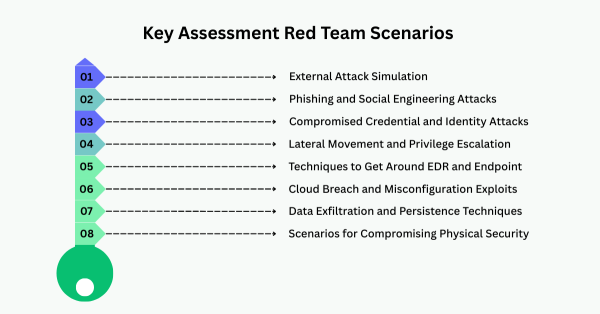
1. External Attack Simulation
It’s important to note that this scenario is similar to how real attackers start - from the outside and with little information.
In this red team scenario, attackers:
- Use OSINT tools to inspect or observe your systems
- Find assets that are exposed, misconfigured servers, or weak authentication points
- Take advantage of defects in public-facing systems
- Try to gain a foothold inside the network
This situation shows where your perimeter defences are weak and how well your external defences work.
2. Phishing and Social Engineering Attacks
Before reviewing the techniques, it’s worth noting that humans are still the most common entry point for attackers.
Red teams simulate:
- Targeted phishing emails
- CEO fraud or business email compromise attempts
- Harmful document attachments
- Phone-based social engineering
This situation reveals how easy it is for employees to be tricked and how well your company’s security awareness program works.
3. Compromised Credential and Identity Attacks
Identity-based attacks have become one of the most common ways that attackers get in.
Red teamers use:
- Leaked or reused passwords
- Weak MFA settings
- Brute-force and password spraying methods
- Abuse of misconfigured SSO or identity providers
This situation tests whether attackers can move from stolen credentials to more access.
4. Lateral Movement and Privilege Escalation
Note that, once attackers get initial access their next move is to expand their privileges and move deeper into important systems.
Red teams simulate:
- Taking advantage of internal settings misconfiguration
- Moving between network segments
- Gaining privileges to access at the administrator or domain level
- Accessing sensitive workloads like cloud consoles or databases
This situation reveals the problems with segmentation, monitoring and access control.
5. Techniques to Get Around EDR and Endpoint
Before we talk about common ways to do this, keep in mind that modern attackers focus heavily on bypassing EDR and endpoint controls.
Red teamers test:
- Memory injection and fileless attacks
- Living-off-the-land (LOTL) techniques
- Custom malware payloads that are designed to prevent detection
- Obfuscation and anti-analysis strategies
This identifies flaws in your system’s detection capabilities.
6. Cloud Breach and Misconfiguration Exploits
Before looking at potential findings, it’s important to remember that cloud misconfigurations are now one of the biggest risks for businesses.
Some examples of red team scenarios are:
- Taking advantage of IAM roles that are too flexible or permissive
- Taking advantage of misconfigured storage buckets
- Using insecure serverless functions
- Breaking into API endpoints
These tests help companies find gaps in their cloud governance, identity controls and workload protection.
7. Data Exfiltration and Persistence Techniques
It’s important to remember that detecting data theft is often harder than stopping initial access.
Red teams attempt to:
- Exfiltrate sensitive data through encrypted channels
- Use scheduled tasks or backdoors to have continued access
- Maintain secrecy for a long time
- Bypass DLP and monitoring tools
This scenario tests how well your SOC and incident response teams can detect long-term intrusions.
8. Scenarios for Compromising Physical Security
Before listing common tactics, keep in mind that this scenario is only used when it is safe and possible.
Red teams simulate:
- Tailgating into restricted areas without permission
- Installing rogue devices, like Wi-Fi Pineapples and USB drops
- Getting into internal systems through workstations that are unattended
This can reveal weaknesses in physical access controls and employee security practices.
Why These Red Team Scenarios Matter
Red team assessments can reveal weaknesses or flaws in systems that regular assessments cannot reach.
Some of the primary benefits are:
- Better threat detection and SOC readiness
- Better coordination of incident response
- Increased employee security awareness
- Validation of security investments
- Identifying unknown attack paths
- Stronger alignment between cybersecurity and business risk
In short, red teaming turns assumptions into proof by revealing how attackers can get into your system and how well your defences work.
Next Steps
A red team assessment is an important step for your organisation if you want to improve its resilience, test its detection skills and find hidden weaknesses.
To begin:
- Find the most important red team scenarios that fit your environment
- Focus on real-life attacker techniques mapped to MITRE ATT&CK
- After the exercise, conduct collaborative purple-team sessions.
- Use the results to make long-term security plans and SOC improvements.
Many organisations work with trusted cybersecurity companies like CyberNX, which offer advanced red team assessments. They help organisations by mimicking the actions of advanced attackers and find critical weaknesses in the business.
Conclusion
Red team assessments can no longer be considered just optional for your organisation. They are now a necessary part of modern cybersecurity. By carrying out the real-life red team scenarios, organisations can see blind spots, operational weaknesses, and their response readiness.
These insights give leaders the tools they need to improve defences, train teams, check controls and get ready for threats long before they can happen.