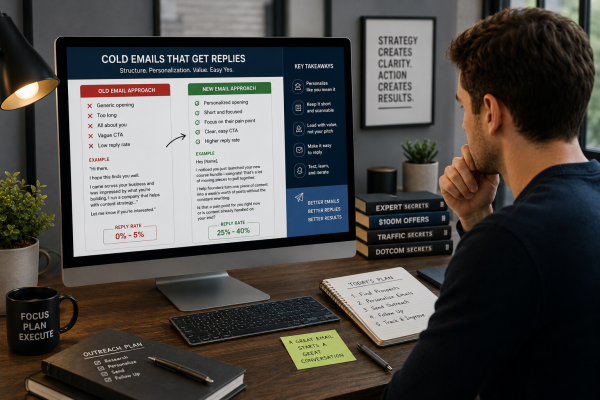
For about four months straight, I sent cold outreach emails into what felt like a void. I’d write something I thought sounded professional, hit send to a list of maybe thirty people, and then wait. Not a single reply most weeks. Occasionally someone would open it, according to my tracking, and then just… nothing. No reply, no interest, and no polite not right now. Just silence.
I started assuming the problem was the offer itself. Maybe nobody wanted what I was selling. Maybe my pricing was off. Maybe the whole idea was bad. I spent way more energy questioning my business model than I probably should have, when the actual problem was much simpler and much more fixable than I realised at the time.
My emails just weren’t written the way emails that get replies are written.
What Changed
I stumbled onto the fix almost by accident. I was reading through a founder’s newsletter where she’d shared, with permission, an outreach email that had gotten her a meeting with someone fairly well known in her space. I read it twice, and something clicked. It wasn’t clever. It wasn’t even particularly polished. But it followed a structure that mine didn’t.
That sent me down a path of studying proven examples instead of just writing whatever came to mind and hoping for the best. I started paying attention to the actual mechanics behind emails that worked, not chasing whatever sounded right to me in the moment, since apparently what sounded right to me was also sounding forgettable to everyone else.
What Actually Makes an Email Get a Reply
A few things kept showing up again and again once I started looking closely.
The opening line mattered way more than I gave it credit for. Most of my old emails opened with some version of I hope this finds you well or a generic compliment about the person’s work. Replies came from openings that referenced something specific and true about the recipient, something that couldn’t have been copy-pasted to fifty other people.
Length mattered too, in the opposite direction from what I expected. I used to write long emails because I thought more context would help my case. Turns out short, specific emails performed way better. People are busy. A long email is a request for their time before you’ve even earned five seconds of it.
Tone was another big one. My early drafts sounded like I was trying too hard, overly formal, and a little stiff, like I’d copied the tone from a business school textbook. The emails that actually got replies sounded like a person talking to another person, casual but still respectful.
And then there was the call to action, which I was genuinely getting wrong in almost every email I sent. I’d end with something vague like let me know if you’re interested, which gives the other person nothing to actually do. A specific, low-pressure ask, like a simple yes-or-no question or offering two possible times instead of asking them to figure out scheduling themselves, made replying feel easy instead of like a chore.
Where Swipe Files Came Into the Picture
Once I understood what actually worked, writing every single email from scratch still took forever, because I was essentially reinventing the wheel each time, adjusting structure and tone by feel instead of working from something proven. That’s when I started using a swipe files collection built specifically for outreach and funnel copy, basically a set of tested email skeletons I could adapt instead of starting completely blank every time.
Having a collection of proven swipe files to reference cut my writing time down dramatically, and more importantly, it meant I was always starting from something that had already been shown to work, then adjusting the specifics to fit my situation instead of guessing blind.
It’s a small shift, but it changed how outreach felt entirely. Instead of dreading writing another cold email, I was tweaking a solid starting point, which is a completely different mental task than staring at a blank page trying to sound impressive.
Before and After
Here’s roughly what my old emails looked like. “Hi there, I hope this finds you well. I came across your business and was really impressed by what you’re building. I run a company that helps entrepreneurs with their content strategy, and I think we could potentially work together. Let me know if you’d be interested in hearing more.” Polite. Generic. Forgettable. It could have been sent to literally anyone, and it read that way.
Here’s closer to what I write now. Hey, I noticed you just launched your new course bundle; congrats, that’s a lot of moving pieces to pull together. I help founders turn one piece of content into a week’s worth of posts without the constant rewriting. I’m curious if that’s a pain point for you right now or if content’s already handled on your end? Shorter. Specific. Ends with an easy yes or no instead of a vague open door.
The difference isn’t that the second one is more clever. It’s that it actually sounds like it was written for one specific person, and it gives them something simple to respond to.
A Starting Point, Not a Shortcut Around Personalization
I want to be honest about the limits of this, because swipe files aren’t magic. If you take a proven structure and just copy and paste it word for word to fifty different people without changing anything meaningful, you’ll get the same silence I used to get, just with slightly better grammar. The value isn’t in the exact wording; it’s in the underlying structure, the pacing, the way tension and specificity are built into a short message.
What worked for me was using swipe files as scaffolding, then filling in the actual specifics about the person I was reaching out to. The structure came from something tested. The substance still had to come from me actually paying attention to who I was writing to.
If you’re an entrepreneur stuck in the same cold outreach void I was in for months, I’d genuinely start there. Not with a new offer, not with lower prices, just with the actual structure of what you’re sending. Study a few examples that have worked for other people, notice the pattern, and stop assuming your silence means your business idea is bad. A lot of the time, it just means your email needed a better opening line and an easier way to say yes.