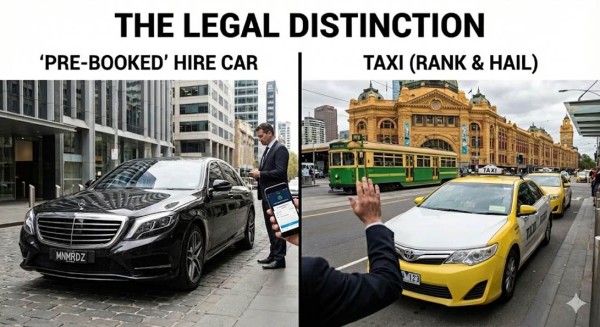
The landscape of commercial passenger transport in Victoria, Australia, has undergone significant transformation over the last decade. With the rise of the gig economy and ride-sharing apps, the line between a traditional taxi and a private hire car often blurs in the eyes of the consumer. However, from a regulatory standpoint, the distinction remains sharp, enforced by strict guidelines set forth by Commercial Passenger Vehicles Victoria (CPVV). At the heart of this distinction lies a single, critical operational mandate: the requirement for pre-booking.
Understanding the legal and operational differences between “rank and hail” services (taxis) and “booked” services (hire cars and chauffeurs) is essential not only for compliance within the industry but also for consumer awareness regarding safety, pricing, and service standards.
The ‘Rank and Hail’ vs. ‘Pre-Booked’ Divide
In Victoria, the commercial passenger vehicle industry is bifurcated into two primary categories based on how the service is engaged. Traditional taxis possess unique privileges; they are the only vehicles legally permitted to be hailed from the street or wait at designated taxi ranks (such as those found outside Flinders Street Station or Melbourne Airport). They operate on a meter system, where the fare is calculated based on time and distance as the journey progresses.
In contrast, hire cars—often recognized by their VHA or VHB license plates—and luxury chauffeur services operate under a strict “pre-booked only” license. Under Victorian transport law, it is illegal for a hire car driver to accept a passenger who hails them from the curb or to solicit business directly from a taxi rank. The booking must be made and recorded through a booking service provider before the trip commences.
The Mechanics of Pre-Booking Compliance
The pre-booking regulation is not merely a bureaucratic formality; it serves as a cornerstone of the hire car industry’s operational model. When a passenger books a service like a luxury chauffeur, the details of the trip—including pick-up location, destination, and passenger details—must be logged in advance.
This regulatory framework necessitates a fixed-price model. Unlike taxis, where the final fare is unknown until the destination is reached, pre-booked hire cars typically provide a set fare agreed upon at the time of booking. This transparency protects consumers from price uncertainty caused by traffic jams or inefficient routes.
Industry observers note that this model has pushed hire car operators to invest heavily in digital infrastructure. Modern booking platforms used by established Melbourne-based services, such as MNMRiDEZ, utilize sophisticated dispatch systems that ensure every trip is logged in compliance with CPVV regulations. These systems provide a digital audit trail, ensuring that the “pre-booked” legal requirement is met for every single journey, thereby distinguishing professional operators from non-compliant entities.
Safety and Consumer Protection
The distinction in booking methods also has implications for passenger safety and traceability. Because every hire car trip is pre-arranged, there is a definitive record of who is driving, who the passenger is, and the intended route.
Commercial Passenger Vehicles Victoria emphasizes that unbooked trips in private vehicles (touting) are illegal and unsafe. The pre-booking requirement ensures that the vehicle is part of a monitored fleet. For corporate travelers and VIPs, this layer of accountability is the primary driver for choosing private chauffeur services over on-demand ride-hailing or taxis.
Furthermore, the vehicle standards differ. Hire cars in Victoria generally adhere to stricter vehicle age and luxury standards compared to the broader taxi fleet. The regulatory intent is to create a tier of service that caters to planned, premium travel needs—such as airport transfers and corporate events—rather than immediate, short-distance utility travel.
The Future of the Two-Tier System
While deregulation in other states has sometimes eroded the differences between service types, Victoria maintains a clear structure. The ongoing demand for reliable, fixed-price transport confirms that the pre-booked model offers value distinct from the immediacy of a taxi.
For the consumer, the takeaway is simple: if you need a car now, you hail a taxi. If you need guaranteed service, a fixed price, and a specific standard of vehicle, you utilize a pre-booked hire car. Services that bridge this gap efficiently, maintaining strict adherence to the pre-booking laws while offering seamless digital access, represent the maturing face of Victoria’s private transport sector.
As Melbourne continues to grow, the enforcement of these distinctions ensures a diverse transport ecosystem where both immediate hail services and premium pre-booked options can coexist, each serving a specific function in the city’s mobility network.