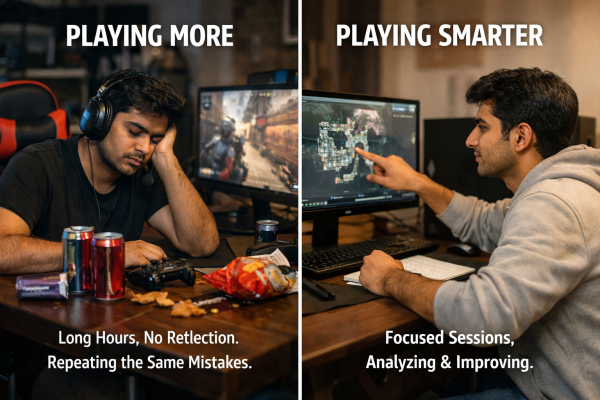
Many competitive players assume that improvement is a matter of time. The more matches they play, the better they expect to become. While repetition does play a role, experience alone does not guarantee progress. In fact, playing more without intention often leads to stagnation. The real difference between steady improvement and endless grinding lies in how players use their time, not how much of it they spend.
Playing smarter focuses on quality over quantity. It prioritises learning, reflection, and deliberate adjustment. Players who adopt this approach improve faster, maintain motivation longer, and avoid the burnout that often follows excessive grinding.
Why Playing More Feels Productive
Playing more feels productive because it generates visible effort. Matches completed, hours logged, and ranks chased create a sense of progress.
This feeling can be misleading. Repetition without feedback reinforces existing habits, both good and bad. If those habits are flawed, playing more simply makes them harder to change.
Grinding feels like work, but work without direction rarely leads to growth.
The Limits of Pure Repetition
Repetition is effective when paired with correction. Without correction, it creates plateaus.
Many players experience this plateau after early improvement. They play frequently but stop climbing. Mechanics feel sharp, yet results stagnate.
This happens because repetition alone does not address decision making, positioning, or strategic awareness. These elements require reflection, not just playtime.
Playing Smarter Begins With Intent
Playing smarter starts before the match begins. Intent defines what the player wants to improve.
Instead of focusing solely on winning, smarter play sets process goals. These may include improving positioning, managing resources better, or adapting faster to opponents.
Intent gives each match purpose. Even losses become valuable when aligned with a learning objective.
Focused Improvement Targets Weaknesses
Grinding spreads attention thin. Focused improvement narrows it.
Smarter players identify specific weaknesses and work on them deliberately. They may ignore other areas temporarily to concentrate effort where it matters most.
This focus accelerates improvement because energy is not wasted on already stable skills.
Reflection Turns Experience Into Learning
Experience becomes learning only when reflected upon. Smarter players review matches mentally or through replays.
They ask why decisions worked or failed. They look for patterns rather than isolated mistakes.
Reflection transforms matches into data. Without it, matches blur together and lessons are lost.
Why Grinding Often Leads to Burnout
Grinding prioritises volume over sustainability. Long sessions, emotional swings, and repeated losses exhaust motivation.
Burnout occurs when effort feels disconnected from progress. Players feel stuck despite investing more time.
Playing smarter reduces burnout by aligning effort with improvement. Progress feels tangible even when sessions are shorter.
The Role of Mental Energy
Mental energy is a limited resource. Playing smarter respects this limit.
Short, focused sessions often produce better results than marathon grinds. Players make clearer decisions and learn more effectively when fresh.
Understanding when to stop is as important as knowing when to push.
Smarter Play Improves Decision Making
Decision making improves through awareness, not repetition. Smarter players slow down critical moments.
They consider positioning, timing, and risk rather than defaulting to instinct. Over time, these considerations become automatic.
Grinding rarely creates this awareness because decisions are made on autopilot.
Practice Versus Performance
Grinding blurs the line between practice and performance. Every match feels like a test.
Smarter players separate the two. Some matches are used to experiment and learn. Others are used to apply refined skills.
This separation reduces pressure and improves long term results.
Learning From Losses Instead of Chasing Wins
Wins feel rewarding but losses teach more. Smarter players extract lessons from defeats.
They identify what went wrong without emotional reaction. Losses become guidance rather than discouragement.
Grinding often avoids this step by immediately queuing again, missing the opportunity to learn.
Playing Smarter Requires Better Information
Smarter play depends on understanding. Players need frameworks to interpret what happens in matches.
Analytical resources like NowLoading help players connect mechanics, strategy, and context, supporting focused improvement rather than blind repetition.
However, information must be applied intentionally to be effective.
Quality Practice Beats Quantity Play
Quality practice isolates variables. Players test specific changes and observe outcomes.
Quantity play mixes too many variables at once. It becomes difficult to identify what actually improved or failed.
Smarter players control their practice environment as much as possible.
The Illusion of Time-Based Progress
Time-based progress assumes that improvement is automatic. In reality, progress depends on adaptation.
Players who play less but reflect more often outperform those who grind endlessly without adjustment.
Time is only valuable when used deliberately.
Smarter Play Builds Long-Term Consistency
Consistency comes from stable decision making. Smarter play builds routines and habits that support reliability.
Grinding produces volatility. Performance fluctuates with mood, fatigue, and luck.
Consistency is more valuable than occasional peaks.
Adapting Faster Through Focus
Focused players adapt faster to patches and meta shifts. They understand principles rather than memorising patterns.
Grinding players struggle because their habits are rigid. Change feels disruptive rather than manageable.
Adaptability is a direct result of smarter play.
Measuring Progress More Accurately
Smarter players measure progress through behaviour rather than rank alone.
Improved positioning, better timing, and clearer decisions signal growth even if rank temporarily stagnates.
Grinding often relies solely on rank as feedback, which can be misleading.
Why Smarter Play Extends Competitive Lifespan
Players who grind heavily often quit early due to burnout. Smarter players sustain interest longer.
Enjoyment shifts from winning to improving. This mindset keeps competition engaging even during plateaus.
Longevity matters more than speed.
Building a Smarter Play Routine
Smarter play benefits from routine. Short sessions, clear goals, and post-match reflection form a sustainable cycle.
This routine reduces frustration and increases learning efficiency.
Over time, smarter play becomes instinctive.
Common Myths About Grinding
One common myth is that more hours equal more skill. Another is that talent only emerges through volume.
In reality, skill emerges through attention and adaptation. Volume without thought delays mastery.
Breaking these myths frees players to improve intelligently.
Final Thought
The difference between playing more and playing smarter lies in intention, focus, and reflection. Grinding creates the illusion of progress through effort alone. Smarter play creates real improvement through deliberate learning.
Players who play smarter improve faster, adapt better, and enjoy competition longer. They use time as a tool rather than a test of endurance.
In competitive gaming, success does not belong to those who play the most. It belongs to those who learn the best from every match they play.