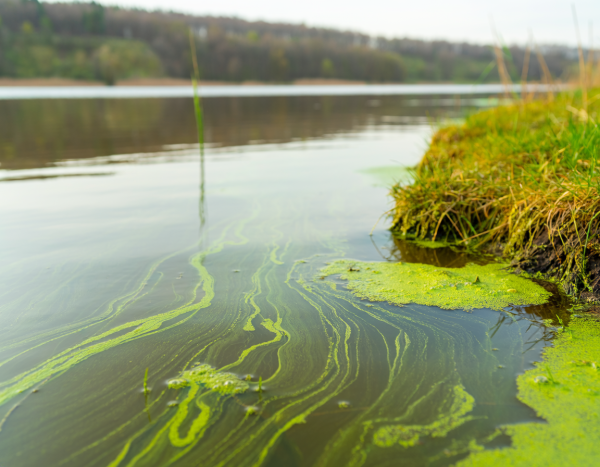
Harmful algal bloom advisories have become a recurring part of the summer and early fall on the western Finger Lakes. They arrive as headlines, circulate quickly, and are often shared without being read – which is a problem, because the advisories are not interchangeable. Some describe a lake-wide bloom. Some describe a single localized patch along one stretch of shoreline. The distinction changes what a resident or visitor should actually do.
On Conesus Lake, in Livingston County, New York, the county Department of Health issues those advisories and updates them as conditions change. The most recent described a lake-wide bloom observed at multiple points around the shoreline and extending into open water.
What a bloom is, and what it looks like
A harmful algal bloom is a rapid proliferation of cyanobacteria – naturally occurring organisms present in most fresh water – under conditions that let them multiply quickly. Some cyanobacteria produce toxins. New York State health guidance notes that exposure can cause symptoms including diarrhea, nausea or vomiting, and skin, eye or throat irritation, with allergic reactions and breathing difficulties also reported.
Matthew Sharman, who was born and raised on Conesus Lake and sells waterfront property there, describes the visual signature as green streaks and floating particulate – scattered green material that can pool into a surface scum. “It looks like someone spilled paint in the water, like a paint swirl,” he says.
Sharman is a real estate professional rather than an environmental or health authority, and is direct about the limits of what he can assess. The practical point he emphasizes is one the state also makes: harmful and harmless blooms are difficult to tell apart by sight. The working assumption should be avoidance of anything that looks suspect, rather than confidence in an identification.
Guidance issued by the Livingston County Department of Health advises keeping people and animals out of water where blooms are present, avoiding suspected areas, and not swimming, wading, boating or fishing near one. It further advises against eating fish taken from affected water, rinsing with clean water after any contact, and seeking medical guidance if symptoms follow.
Pets warrant particular attention, since algae clings to fur and is swallowed during grooming, and veterinary advice is appropriate after a suspected exposure. Questions about drinking water, health effects or current conditions should go to the county Department of Health or to the New York State Departments of Health and Environmental Conservation, which maintain current guidance and a statewide bloom notification system. Readers should rely on those sources rather than on this article for health decisions.
Familiarity is not safety
Sharman says the question he fields most often from buyers and sellers is how seriously the advisories should be taken. His answer is consistently that they should be taken seriously, and he is skeptical of the reassurance that longtime residents sometimes offer newcomers.
“Just because something’s familiar doesn’t mean that it’s harmless,” he says.
He is equally skeptical of the opposite reflex. Blooms shift, appear and disappear with wind and weather, which means a photograph circulating on social media may describe a condition that no longer exists – or understate one that has since spread.
“Yesterday’s photograph or last month’s headline is not today’s situation,” he says.
The practical instruction that follows is unglamorous: check the current advisory before using the water, and read past the headline to what the advisory actually describes. The Livingston County Department of Health is the primary source for Conesus Lake, with the state Departments of Health and Environmental Conservation providing broader guidance on bloom appearance and precautions.
Season, depth and conditions
Blooms are associated with warm, still conditions and are more common on shallower water. Sharman notes that Honeoye Lake and Silver Lake, both shallower than Conesus, tend to present more favorable conditions, though no lake in the region is immune.
Late summer and early fall are the months to watch most closely, but the season does not observe a schedule. Blooms have been reported on Conesus as early as June in recent years, and there is no reliable date after which the water is reliably clear. Conditions can change day to day, which is why Sharman’s advice reduces to staying current with health guidance rather than learning a seasonal rule.
The phenomenon is also not new. Sharman points out that Conesus Lake action planning documents addressing water quality date back more than a decade, well before the current cycle of coverage. He is careful not to let that become a dismissal: a documented history is context, not a reason to stop paying attention.
What is being done, and what owners should know
Sharman says frustration among lake owners often takes the form of a belief that nothing is happening, and he does not think that holds up. Watershed management plans, lake associations, watershed councils and soil and water conservation districts coordinate work across monitoring, stormwater and erosion management, runoff control and nutrient reduction, with phosphorus a particular focus. The county publishes water quality research and annual reporting.
What that work does not offer is a switch. Progress is incremental and distributed across multiple entities, and Sharman’s framing is that responsibility for the lake extends past the households with lakefront addresses to the surrounding watershed.
For owners and prospective buyers, his advice is property-specific rather than lake-wide. Conditions vary considerably across a single lake: coves and shoreline curvature, north-end versus south-end position, drainage patterns and where runoff enters all affect what a given property experiences. Blooms can be present in one section and absent in another.
This is among the property-specific factors Sharman examines in a Sharman Pro Pre-Check, his structured pre-listing review, which is intended to surface conditions and paperwork issues before a property reaches the market rather than during a transaction.
Asked how he handles the subject with a concerned buyer, Sharman says he declines to argue either side of it. Whether it matters depends on how the buyer intends to use the water – daily swimming, young children or a dog that heads straight for the lake each warrant a real conversation; wanting to look at the water may not.
“You don’t build trust by minimizing something that’s important,” he says. His stated position is that a buyer should understand what they are purchasing, how they plan to use it, and what could affect that experience – which, he adds, is the buying process generally, not a special case.
About the Expert: Matthew Sharman leads The Sharman Team at Real Broker NY LLC, serving Greater Rochester, the GLOW region, and the western Finger Lakes, with particular focus on Conesus Lake and Livingston County lakefront property.
This article is based on information provided by the expert source cited above. It is intended for general informational purposes only and does not constitute legal, financial, or real estate advice. Readers should conduct their own research and consult qualified professionals before making any real estate or financial decisions.