
The growth of online art retail has opened the market to thousands of brands, which has been good for accessibility but has also made it harder for buyers to know who to trust. When a company sells handcrafted, premium-priced artwork entirely through digital channels, questions about legitimacy arise naturally and deserve honest answers. One of the most common questions prospective buyers search for is, Is Vinchy Art legit as a source for abstract art? and that question deserves more than a binary yes or no. This article approaches it analytically, examining what legitimacy actually means in the context of an online art brand, what buyer experiences and production practices reveal about Vinchy Art specifically, and what any careful buyer should evaluate before placing an order with any company in this category.
Defining Legitimacy in the Online Art Market
Legitimacy, when applied to an online art brand, encompasses several distinct dimensions that buyers often conflate. The first is operational legitimacy: does the company exist, process orders, and deliver products? The second is product legitimacy: do the pieces arrive as described, with the claimed materials and production methods? The third is representational legitimacy: does the company accurately communicate what buyers are purchasing, including realistic timelines, honest descriptions of what handcrafted products involve, and transparent policies?
A company can pass the first test easily and still fail the second or third. Understanding which dimension of legitimacy a complaint or concern addresses makes it possible to evaluate feedback about any brand more accurately. Much of the confusion buyers encounter when researching Vinchy Art online stems from conflating these three questions rather than examining them separately.
What the Production Process Reveals About Brand Credibility
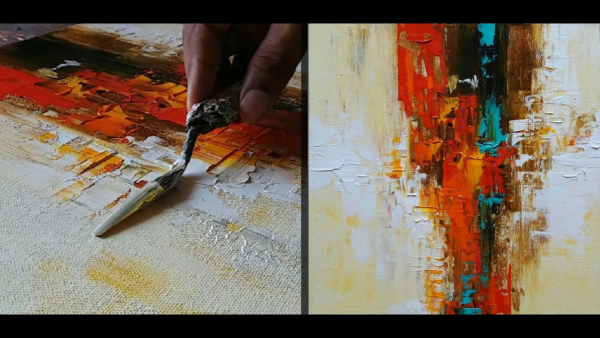
One of the most reliable indicators of a legitimate handcrafted art brand is the coherence between its stated production process and the actual characteristics of the pieces buyers receive. Vinchy Art positions itself as a producer of hand-painted, texturally dimensional abstract canvas work, a category that has specific, verifiable physical properties if the production claim is genuine.
Genuine hand-painted abstract art produced with heavy-body medium involves multiple distinct sessions: an initial compositional layer, followed by successive texture-building applications that must cure between sessions before additional material can be added without disturbing the layers beneath. This process takes days, not hours. A brand that truthfully produces work this way will, by operational necessity, have longer production timelines than a print-on-demand service. When buyers report waiting one to three weeks before their order ships, that timeline is consistent with legitimate studio production rather than evidence of a problem.
Conversely, a brand falsely claiming to produce hand-painted textured work while actually shipping digitally printed products would be identifiable upon receipt: the surface would lack genuine three-dimensional relief, the piece would be uniform in a way that machine production creates and human application does not, and the material weight would reflect ink on substrate rather than built-up paint. Buyer accounts that describe receiving pieces with actual surface depth, visible brushwork variation, and tactile paint structure are consistent with genuine production, and these accounts represent the majority of detailed product-focused reviews in Vinchy Art’s public feedback record.

Reading Customer Feedback Accurately
Customer reviews for any handcrafted, internationally shipped product require careful reading because the feedback pool contains multiple types of experiences that are structurally different from one another. Three categories of reviews deserve separate attention when evaluating whether Vinchy Art is legit as an abstract art source.
Category One: Product Quality Feedback
Reviews that focus specifically on the received artwork, its surface, craftsmanship, color, and physical condition on arrival, are the most informative for legitimacy assessment. The majority of detailed, product-specific reviews describe pieces that arrived with genuine texture, intact framing, and compositional quality consistent with the product images. This category of feedback is the strongest indicator of operational and product legitimacy.
Category Two: Expectation-Based Feedback
A significant portion of negative reviews across the handcrafted art category reflects expectation mismatches rather than product failures. Buyers accustomed to the rapid delivery and pixel-precise consistency of print-on-demand services sometimes apply those expectations to handcrafted work and find the experience frustrating. Longer production windows, slight natural variation between the digital approval preview and the finished painted piece, and the tactile unfamiliarity of genuine thick-paint surfaces are all characteristics of legitimate handcrafted production, not evidence of a problem.
Category Three: Service and Communication Feedback
Reviews that focus on response times, revision handling, or shipping communication represent a third category. These are legitimate quality indicators for any business; responsiveness and proactive communication matter. Some buyers report satisfactory interactions with Vinchy Art’s support process; others describe delays in receiving status updates during production. This feedback suggests room for improvement in communication consistency, which is a service quality observation rather than a legitimacy concern.
Trust Signals That Buyers Should Look For
When evaluating any online art brand, certain observable signals help distinguish credible operations from unreliable ones. These signals are worth applying directly to the question of whether Vinchy Art is legit for abstract art purchases.
Transparent Policies and Clear Product Descriptions
Legitimate brands provide accessible information about what buyers are purchasing: material specifications, production timelines, revision processes, return policies, and shipping methods. Vague or absent policy information is a meaningful caution signal. Vinchy Art’s product pages include descriptions of the handcrafted production process and general shipping timelines, which represent basic transparency; buyers should read these carefully before placing an order rather than applying assumptions from other online shopping experiences.
Verifiable Buyer History Across Multiple Platforms
A brand with legitimate operations accumulates buyer feedback across multiple independent platforms over time. This history is more meaningful than reviews on a company’s own website, which may be curated. Independent reviews on platforms like Trustpilot, Reddit, and dedicated art buyer forums provide a more balanced picture. The volume and longevity of feedback across these channels is a more reliable trust indicator than any single review source.
An extensive assessment of buyer history and brand positioning, including how Vinchy Art sits within the broader premium handcrafted art market, is available through this detailed independent Vinchy Art analysis, which examines the evidence across multiple review sources and draws conclusions about where the brand genuinely delivers and where buyer caution is warranted.
Consistency Between Marketing Claims and Product Reality
Perhaps the most fundamental legitimacy test is whether what a brand says it sells is what buyers actually receive. For Vinchy Art, the specific claim is hand-painted, texturally dimensional abstract canvas artwork. Buyers who receive pieces that exhibit genuine impasto depth, surface variation natural to human paint application, and physical canvas weight consistent with built-up medium are receiving what was advertised. The evidence in the public review record suggests this is the predominant outcome, which places Vinchy Art on the credible side of this particular test.
Common Doubts and Honest Answers
Is the Pricing Justified?
The price differential between Vinchy Art’s textured abstract pieces and cheap canvas prints is real and sometimes significant. As explored in other analyses of this market segment, the inputs that go into genuine hand-painted work—skilled labor, professional-grade mediums, heavier canvas, finishing compounds, and the production time required for multi-session paint application—account for that difference in cost. Buyers who understand they are paying for a handcrafted object rather than a manufactured print typically find the pricing reasonable. Those comparing it to print-on-demand prices are comparing incompatible product categories.
What Happens If the Piece Arrives Damaged?
International shipping of dimensional canvas artwork carries inherent risk, and how a company handles damage claims is one of the clearest indicators of whether it operates with buyer interests in mind. Buyers who document damage on arrival and contact support with photographic evidence generally report resolution in the form of replacement or refund, though timelines for resolution vary. The existence of a resolution process, even an imperfect one, is qualitatively different from no process at all.
Are the Pieces Truly Handmade?
This question is best answered by buyers who receive pieces and examine them directly. The physical evidence of hand-painted production,surface irregularity, visible tool marks, paint ridges that project measurably above the canvas plane, and slight color variation within the composition,is not reproducible by machine at the price points Vichy Art charges. Buyers who receive pieces and examine them report these physical characteristics consistently, which constitutes the Vinchy ArtVinchy ArtVinchy Artmost direct available evidence of genuine handcraft production.
Practical guidance for prospective buyers: Read the product description carefully before ordering; pay particular attention to stated production timelines and add them to the shipping estimate to form a realistic delivery expectation. Review the return and damage policy before purchase. If ordering for a specific occasion or deadline, contact the company in advance to confirm current production capacity. These steps, applied to any online art purchase, reduce friction significantly.
A Balanced Conclusion
The question of whether Vinchy Art is legit for abstract art does not resolve to a simple verdict because legitimacy itself is not a single property. As an operational entity that processes orders, produces handcrafted canvas artwork, and ships internationally, the evidence supports a positive answer. As a brand whose product matches its production claims, the physical evidence from buyer-reported experiences supports credibility. As a service operation with consistent communication: the record is more mixed, and buyers who place a high value on proactive updates throughout their order process should factor that in.
For buyers interested in genuine abstract art quality standards and work that carries physical presence, dimensional texture, and the material characteristics of handcrafted production, Vinchy Art sits within the credible segment of the online art brand market. Approaching the purchase with accurate expectations about what handcrafted artwork involves, reading policies before ordering, and applying the same evaluative standards you would to any significant online purchase: these habits serve any buyer well, regardless of which abstract art brand they ultimately choose.