If you are running 20+ deliveries a day, you already know the pain. Drivers backtracking across town. Fuel costs eating your margins. Customers calling because their order is late. You have tried Google Maps, maybe a spreadsheet, maybe just eyeballing it. None of it scales.
The fix is a multi stop route planner that actually works for delivery. But most tools were not built for what you deal with daily. Here is what to look for — and how to get more out of your routes starting tomorrow.
What Most Route Tools Get Wrong
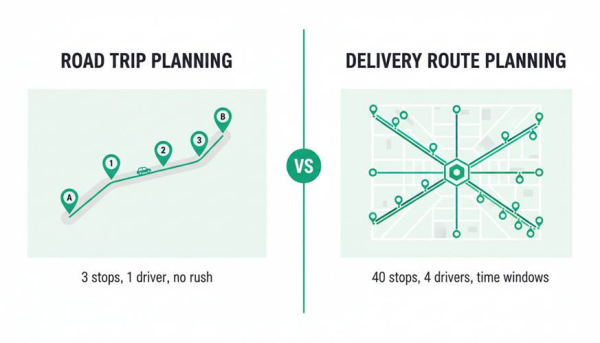
Most route planners are built for road trips. Point A to point B with a few stops in between. That is not delivery.
Delivery route planning means handling 30, 50, or 100 stops at once. It means splitting those stops across multiple drivers. It means your routes start at a kitchen or warehouse and might end somewhere completely different. It means customers have time windows, and a 2 PM drop that shows up at 3:30 PM costs you a review, a refund, or a customer.
If your tool cannot handle all of that, you are still doing half the work manually.
What a Delivery-Ready Route Planner Actually Does
Not all route optimization is equal. Here is the checklist that separates tools built for delivery teams from everything else:
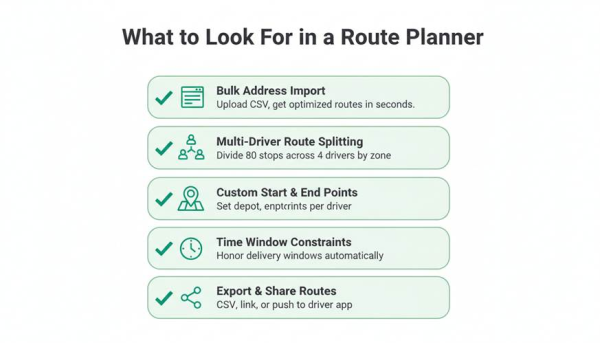
Handles bulk address import. You should be able to upload a CSV or Excel file with all your stops and get optimized routes back in seconds. If you are copy-pasting addresses one at a time, the tool is wasting your time.
Splits stops across drivers. You do not just need one optimized route. You need to divide 80 stops across four drivers, grouped by zone, each with their own optimized sequence. A good route planner does this in one step instead of forcing you to manually sort who gets what.
Lets you set start and end points. Your driver starts at the depot. Maybe they end there too, or maybe they end at a second location. If the tool assumes every route is a round trip, it does not understand delivery.
Respects time windows. Some drops have to happen between noon and one. Others are flexible. Route optimization should reorder stops automatically while honoring those constraints — not force you to choose between an efficient route and keeping your promises.
Exports and shares easily. Once routes are built, you need to get them to your drivers fast. Download as CSV, share a link, or push to a driver app. If the only option is a screenshot of a map, that is a problem.
Five Habits That Make Good Routes Great
Even with the right tool, a few habits separate teams that save 15 percent on fuel from teams that save 30 percent.
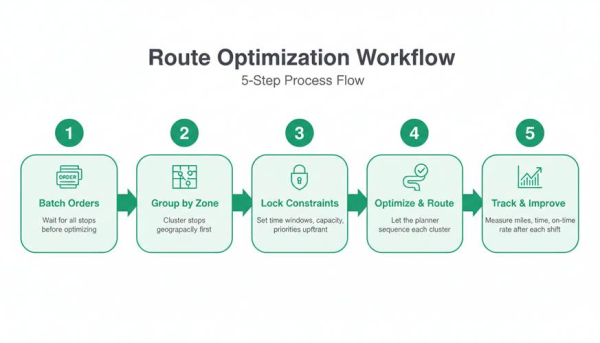
Batch before you optimize. Do not plan routes as orders trickle in. Wait until you have all the stops for a delivery window, then optimize the full batch. Partial information produces partial results.
Group by zone first, then optimize. Before splitting stops across drivers, cluster them geographically. Then let a route planner optimize each cluster. This prevents two drivers from crossing paths on the same street.
Lock in your constraints up front. Time windows, priority deliveries, vehicle capacity — set these before you generate routes. Adjusting after the fact means re-doing the whole thing.
Run the numbers after each shift. Track total miles, total time, and on-time rate. Patterns show up fast. Maybe your Tuesday afternoon routes always run long because of school traffic. Shift those stops earlier and the problem disappears.
Start at one delivery window. You do not need to change everything at once. Pick your busiest window, run it through a multi stop route planner, and compare to what you would have done by hand. The gap is usually obvious.
Why This Matters More Than You Think
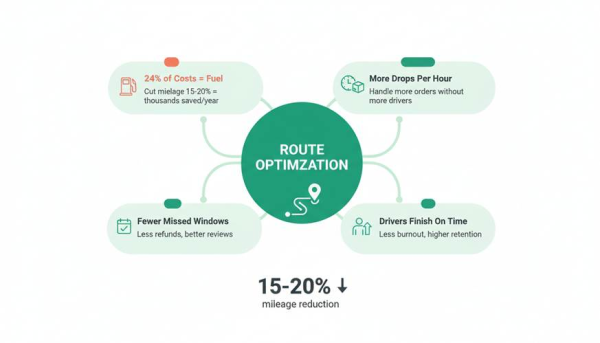
Fuel is roughly 24 percent of operating costs for delivery businesses. Cut your total mileage by 15 to 20 percent and that is thousands of dollars a year for even a small team.
But the real win is not just fuel. It is drivers finishing on time instead of burning out. It is fewer missed windows and fewer angry calls. It is being able to take on more orders without hiring more drivers.
Delivery route planning is not a nice-to-have anymore. If your competitors are optimizing and you are not, they are doing more drops per hour at a lower cost. That gap compounds every single day.